
Italy – France: Mancini’s Substitutes Make The Difference in Drought-Ending Win (3-1)
For the first time in 64 years, Italy would secure a victory on home soil against France. It didn’t look as if that would be the case when France tore to an early lead in a dominant first half. However, Italy were much improved after the break, with Roberto Mancini’s substitutes proving the difference as they routed their visitors.
Tactical analysis and match report by Nick Hartland.
We decided to make this article free to read. If you want to support our work, consider taking a subscription.
The second coming of Roberto Mancini started poorly, but soon showed its promise. Italy were thoroughly defeated in a 2-0 loss at home to Belgium, a scoreline that was fairly flattering to the Azzurri. Following that, Italy beat Turkey both home and away, and provided the wet blanket to Zinédine Zidane’s France homecoming with a 1-1 draw at the Stade de France. There was renewed confidence in this Italy side as they came into the second international break, and even hope that they could overturn a 64-year-long winless run at home to Les Bleus.
Zidane entered his second international break with a squad wracked by injuries. He was without Ousmane Dembélé, Esteban Lepaul, Maghnes Akliouche, Manu Koné, Maxence Lacroix, and William Saliba, while Kylian Mbappé would be unavailable for this first game after picking up a knock. There wouldn’t be much sympathy afforded to him; there’s no other manager in the international game who can boast as deep a selection as he can. New blood looked to be the theme for this international break.
Mancini went with a 4-3-3 formation. Gianluigi Donnarumma was in goal, with a backline consisting of Riccardo Calafiori, Alessandro Bastoni, Giorgio Scalvini, and Michael Kayode. Sandro Tonali anchored the midfield, with Nicolò Barella and Davide Frattesi as number eights. Up front, Pio Esposito was supported by Nicolò Cambiaghi and his older brother Sebastiano Esposito.
Zidane matched Italy’s shape. In goal, Mike Maignan, behind a back four of Adrien Truffert, Dayot Upamecano, Jérémy Jacquet, and Malo Gusto. In midfield, Lucas Da Cunha sat at the base of the trio, while Adrien Rabiot and Rayan Cherki were given more advanced roles. In attack, Bradley Barcola was surprisingly given the central role, while Désiré Doué and Michael Olise occupied the wings.
All to plan for Zidane
From the start of the match, France made their intentions clear. It’s become a recognizable opening in the modern game, with Paris Saint-Germain popularizing a rugby-style kick-off, where they kick the ball into touch, close to the opposition’s corner flag. The aim behind this was explained brilliantly in The Athletic, but to put it simply for the basis of this article, it allows a team like PSG, who want to impose their pressing system on the opposition, a chance to dominate territory from the first whistle and to wear the opposition down.
For Zidane and the other major proponents of it, the aim behind it has this psychological aspect. It put Italy into a position where, from the start, they were trained to look to escape pressure by hitting the ball long. In doing so, France, with a mixture of high pressing and counter-pressing, could win the ball and then keep Italy pinned into their final third. The result was that France now had the game exactly where they wanted it to be played, and could deploy their fluid in-possession structure.
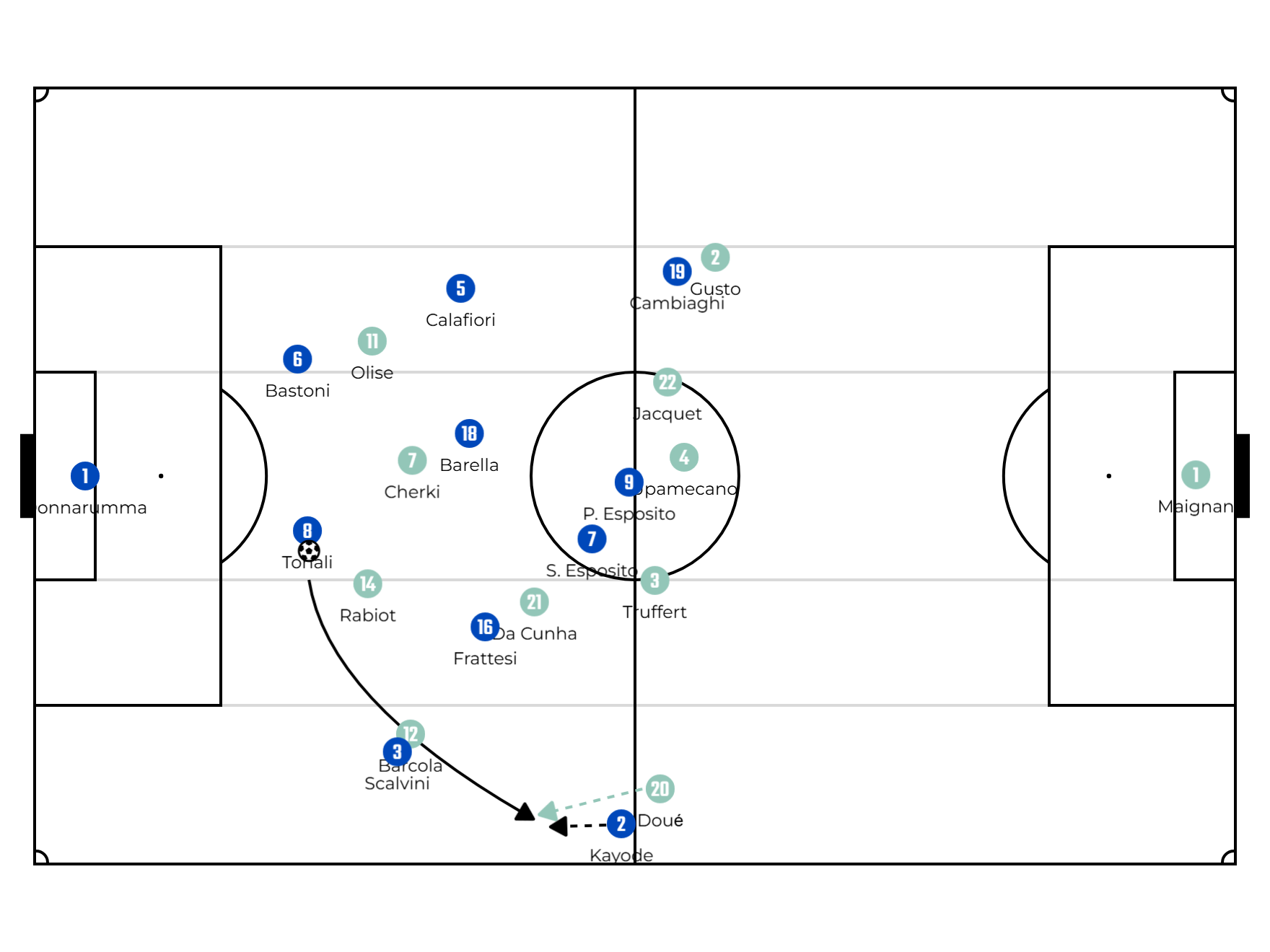
3rd minute: Tonali drops between the center-backs and sprays the ball wide to Kayode. France press high in a man-oriented system. Doué gets to the ball first to win possession back for France high up the pitch.
With the ball, the principles under Zidane had been clear, but not always effective during his previous games. In those, France often created a diamond in midfield with double width on the wings. It was able to maintain possession fairly well, but it felt sterile and rigid. A notable criticism was that it would often lead to too many players outside the opposition’s block. It looked from the opening of this game as if Zidane had worked on that. France looked more fluid and unpredictable from this shape, with their attackers given more freedom to drift and swap.
It lent an element of unpredictability to the team that had largely been missing in the previous matches. And with more players looking to position themselves within the opposition block, there was more tension within Italy’s defensive system in the opening exchanges. The threat was, like the killer in a slasher film, omnipresent, always lurking, providing this residual baseline of fear. And within ten minutes they found the opening goal.
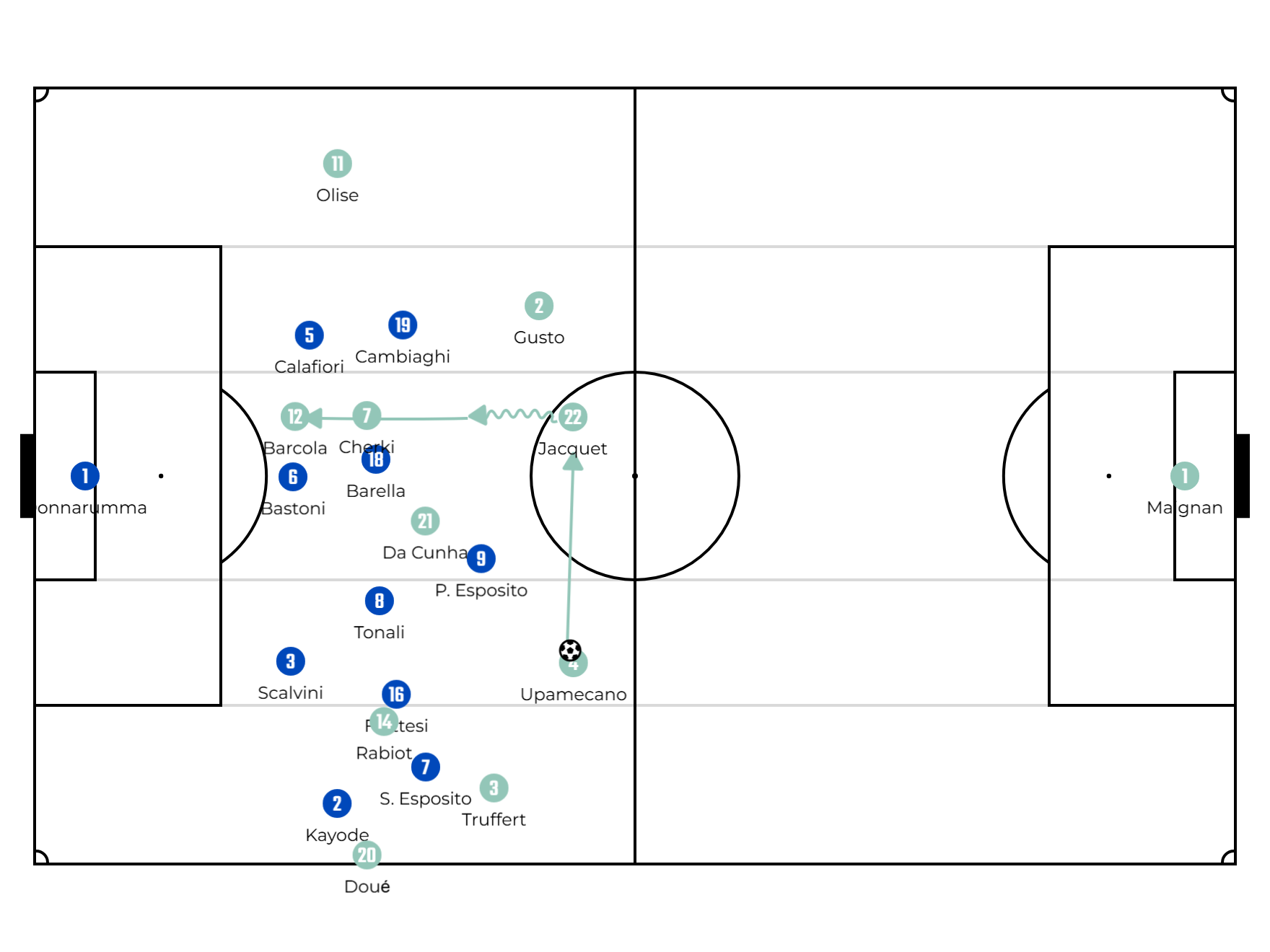
9th minute: France in settled possession. There’s still a fair number of players outside the block, but this is counteracted with a willingness to play the ball through the lines, rather than what could happen where France shiftted the ball outside the defensive shape without penetration.
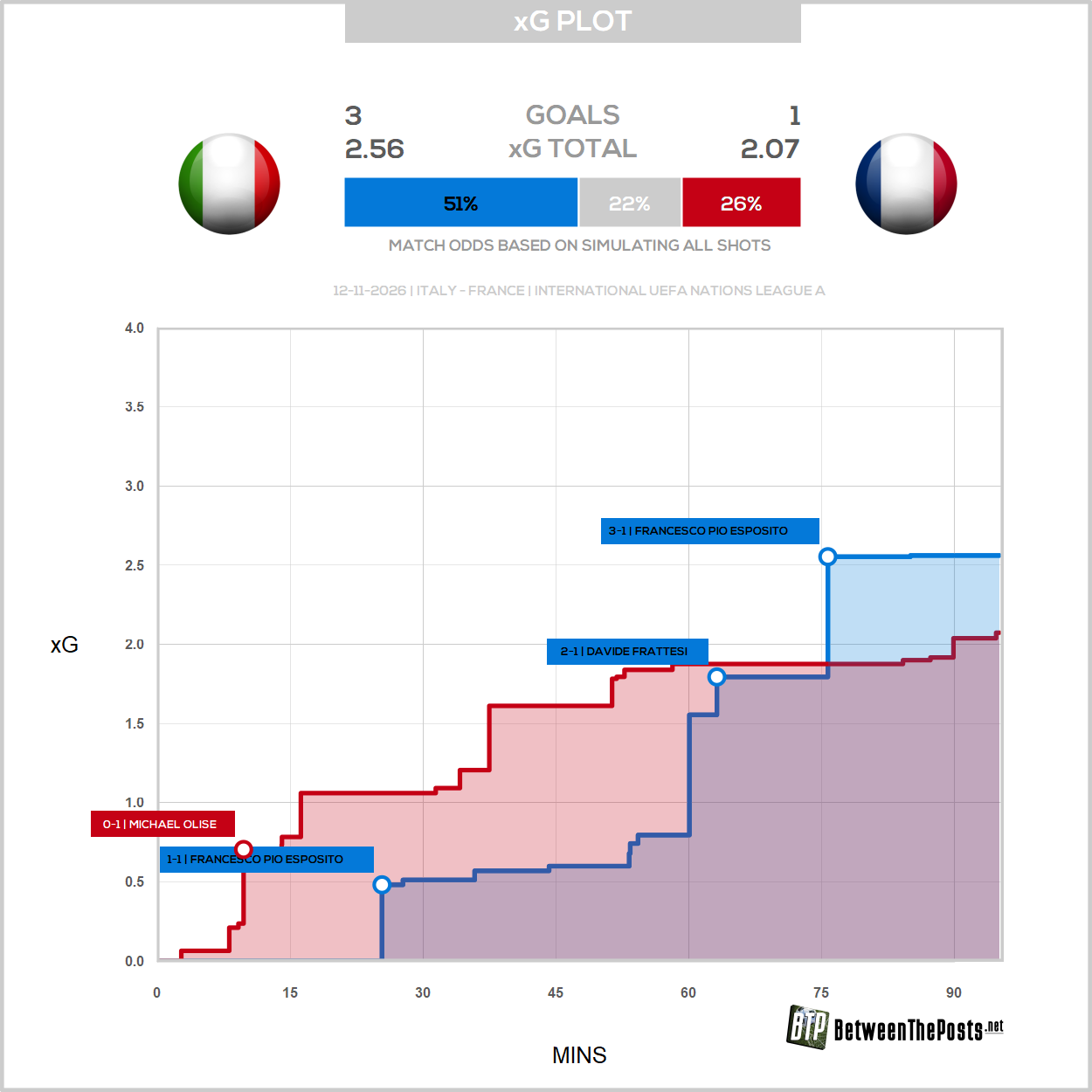
They were given a helping hand when Donnarumma, under pressure, passed the ball to Olise. The Bayern Munich winger dribbled past Bastoni before firing his side ahead. It felt like a just reward for a good start, and suggested perhaps that this was going to be an opening act to a milestone win in Zidane’s fledgling tenure. Dear reader, it was not.
Momentum shifts
Italy would manage to register an equalizer in the 26th minute, with their first shot on target. The goal would come from a quick restart after Olise was penalized for a handball. Frattesi managed to play through France’s pressure; his physicality and strength were enough to hold off Da Cunha and switch the play from France’s left to their right, where they could target Gusto. The Chelsea fullback did not cover himself in glory as he tried to defend Cambiaghi; the winger breezed past him to deliver a cross into P. Esposito, who tapped home.
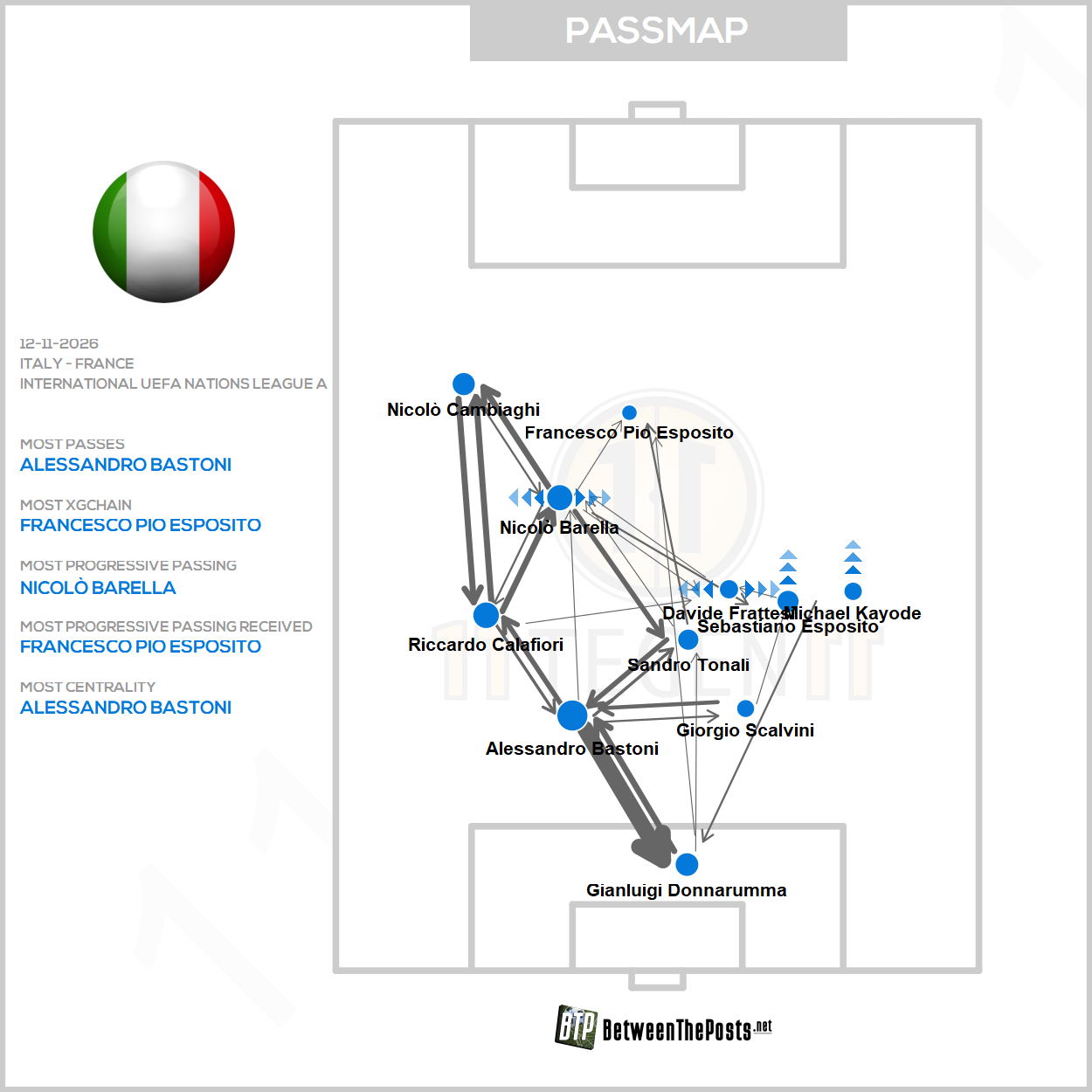
We can see in this pass map a focus on attack down the left, with Cambiaghi often receiving the ball in advanced areas.
Buoyed by the goal, the momentum following it was firmly in Italy’s favor. They again looked to apply pressure down Gusto’s wing with a switch into the final third. Gusto’s positioning often meant that there was space for a blue shirt to receive the ball. S. Esposito came close to matching his brother with a tight shot in the box, forcing a save from Maignan. It would take around five minutes for France to put their foot on the brakes and take some of the sting out of the game.
When building out from the back. France wanted to shift the ball from side to side, inching up the pitch patiently, pushing Italy to defend from a zonal structure rather than their more opportunistic high press. The idea behind France’s game plan in these situations was to restore control of the tempo when they had the ball in vulnerable areas. Albeit in transition, Les Bleus were still willing to attack quickly, using the short spaces between their players to create these rapid exchanges that would move the ball out of counter-pressure and then attack the space behind their opposition with pace.
By half-time, it felt as if France were once again in the ascendancy. They had struck the post twice before the break, and weathered the brief storm from the hosts. What followed was nothing short of a disaster for Zidane.
Italy unsettle their visitors
Neither manager made a change to their personnel at half-time. However, Mancini looked to alter his approach somewhat. He wanted his side to avoid dropping as regularly into their zonal defensive structure as they had done in the first half. Instead, Italy looked to engage higher up the pitch and put more pressure on France to prevent Les Bleus from controlling the tempo. The early signs were positive for Italy, who caused several turnovers high up the pitch.
The result was that while France had more of the ball, it was often in passages of play that would start and end close to their goal, with Italy rushing them into mistakes and stopping them from gaining patient territory. Olise responded by dropping deeper to try and collect the ball from the backline to help with progression – something he had admittedly done on occasion in the first half, but not as often as in the second.
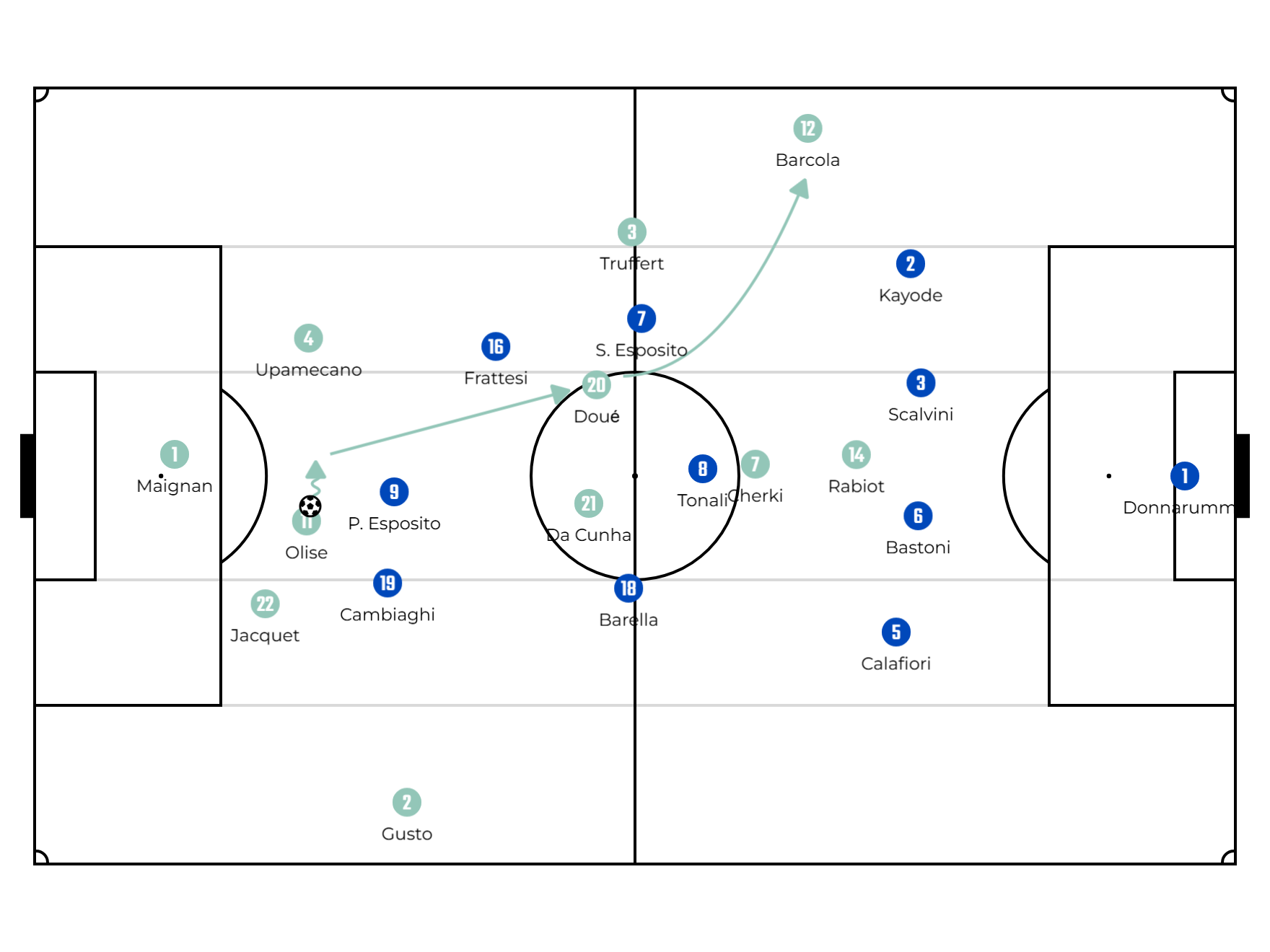
57th minute: Olise drops between the center-backs, causing a bit of confusion in Italy’s pressing system. From this position, Olise can connect the passes and play through the pressure.
This did help somewhat as France began to finally gain ground and show flashes of danger, with Cherki hitting the post in the 52nd minute, while in the 58th, Rabiot forced a good save off Donnarumma. It was this shot from Rabiot that kickstarted a transition from Italy which should have resulted in them taking the lead. Donnarumma collected the ball and then threw it to Calafiori. The left-back had spent much of the game in a fluid role, making unpredictable runs; this time he drove down the center of the pitch before laying the ball out wide to Cambiaghi.
The winger slipped into the box where he was taken out by Gusto, in what has become a trademark act of clattering clumsiness from the Frenchman. A penalty was the only decision the referee could come to. Gusto’s blushes would be saved when S. Esposito fired wide from the spot. It was a monumental let-off for France, and was a warning that went unheeded into the remainder of what would become a humiliating half.
Mancini’s substitutes make the difference
Following the penalty miss, Mancini readied his substitutes. It felt as if the Italian sensed there was frailty in the France side and wanted to capitalize on that. S. Esposito and Cambiaghi were replaced with Antonio Vergara and Federico Dimarco. Dimarco would be on the pitch only for a minute before he made his mark. The left-winger with a pull-back cross found Frattesi for the near-post finish in the 63rd minute.
Mancini made another change ten minutes after the goal, with Issa Doumbia coming on for Frattesi, after the goalscorer had a collision with Doué, which left the Frenchman’s tooth looking misaligned. It was notable that while Mancini had made alterations to take advantage of the changing game state, Zidane remained unmoved by what he had seen, even as his side looked more and more frustrated.
Perhaps there was a sense that he couldn’t fully trust a bench full of greenhorn players who had yet to make their debut. However, something needed to give as the game was beginning to slip out of their control. Vergara, in the 74th minute, would steal the ball in the box and then get taken out by Upamecano, to give Italy another chance from the spot.
The younger Esposito would not make the same mistake as his older brother and fired home to give Italy the two-goal lead. Only then did Zidane finally make a change, bringing on four players with Gusto, Barcola, Doué, and Truffert, making way for Saël Kumbedi, Eli Junior Kroupi, Senny Mayulu, and Andy Diouf. Only Diouf of the four wasn’t making his international debut. Italy didn’t let up on the pressure or their intensity in the remaining minutes as France flailed at a game they would have expected from the first half to have won.
Takeaways
The new Mancini era is truly up and running now. He’s managed to transform this Italy side into one with character and aggression. His ability to read the flow of the game needs to be highlighted, with his early substitutes proving to be influential in hitting France at exactly the right time.
For the first time under Zidane, France have tasted defeat. This was a match that ran away from the visitors. Just as Mancini’s game management should be highlighted, Zidane’s should be criticized. There was a sense that he did not truly trust his bench.