
Newcastle United – Arsenal: Madueke Rescues a point as Arsenal Lose Momentum In The Second Half (2-2)
For 45 minutes, this looked like another routine win for Arsenal. Newcastle couldn’t get near their rotations and ended up defending in numbers. Then Arsenal’s gift changed the game and St James’ Park woke up. The first half was for the away side while the home team took over the second half.
Tactical analysis and match report by Ebuka Ogoegbunam.
Newcastle United hadn’t won in three games in all competitions before this one. They lost back-to-back home league games to Aston Villa and Everton, and a 2-0 win away at Crystal Palace was their only victory in their last five in the league. They did pick up a 1-1 draw at Fulham before the international break, but sitting 12th with three wins from ten, the fans needed something from this game, especially at home.
Arsenal came into it in a very different mood. They were top of the league with nine wins from ten and had won their last five, beating Leeds United, Nottingham Forest, Everton, Liverpool and Hull City. They didn’t concede in the last four of those.
Newcastle United lined up in a 4-2-3-1, with Lukáš Horníček in goal and a back four of Amar Dedić, Malick Thiaw, Dan Burn and Lewis Hall. Lewis Miley and Sean Steur played in the double pivot, with Joe Willock ahead of them. Jacob Murphy and Harvey Barnes started out wide and William Osula led the line. Matthias Jaissle made two changes from the Fulham game, bringing in Miley and Willock for Nico González and Yoane Wissa. Joelinton was unavailable, while Jacob Ramsey was back from suspension and started on the bench.
Arsenal set up in a 4-3-3, with David Raya in goal behind Jurriën Timber, Ezri Konsa, Gabriel Magalhães and Riccardo Calafiori. Declan Rice, Bruno Guimarães and Martin Ødegaard were the midfield three, and Noni Madueke and Eberechi Eze played either side of Kai Havertz. Mikel Arteta made one change from the win over Hull City, with Eze coming in for Christos Tzolis. Guimarães started against his old club. Bukayo Saka missed out through injury and Max Dowman was suspended.
Arsenal’s Roaming Rotations
In possession, Arsenal’s 4-3-3 didn’t stay as a 4-3-3 for long. Rice dropped to the right of Konsa and Magalhães to make a back three, with Ødegaard coming short just ahead of them. That let Timber and Calafiori leave the fullback positions and move up on either side of Guimarães, so the shape became more of a 3-1-3-3.
The front line gave them their width. Madueke was on the right with Timber moving up inside him, and Eze was on the left with Calafiori doing the same. Havertz stayed central between Burn and Thiaw. When both fullbacks got high, Arsenal had five players up against Newcastle’s back four, and that’s the problem Newcastle had to solve without the ball.
Newcastle wanted to press Arsenal’s 4-3-3 high but also wanted to transition into a defensive block when Arsenal beat deep territory. Barnes alongside Osula jumped to the center backs when they were high, and the midfielders picked up Arsenal’s midfielders to stop them playing through the middle.
Murphy had a different job. He was on Calafiori, and wherever Calafiori moved, he tracked his movements. When Calafiori pushed high, Murphy ended up in the back line and Newcastle were defending with something like a back five.
When they sat in a mid or low block, it became a back six. Barnes had to drop into the backline because of Timber’s position to avoid any overload in the defensive line. That left Newcastle in a 6-3-1 defensive shape.
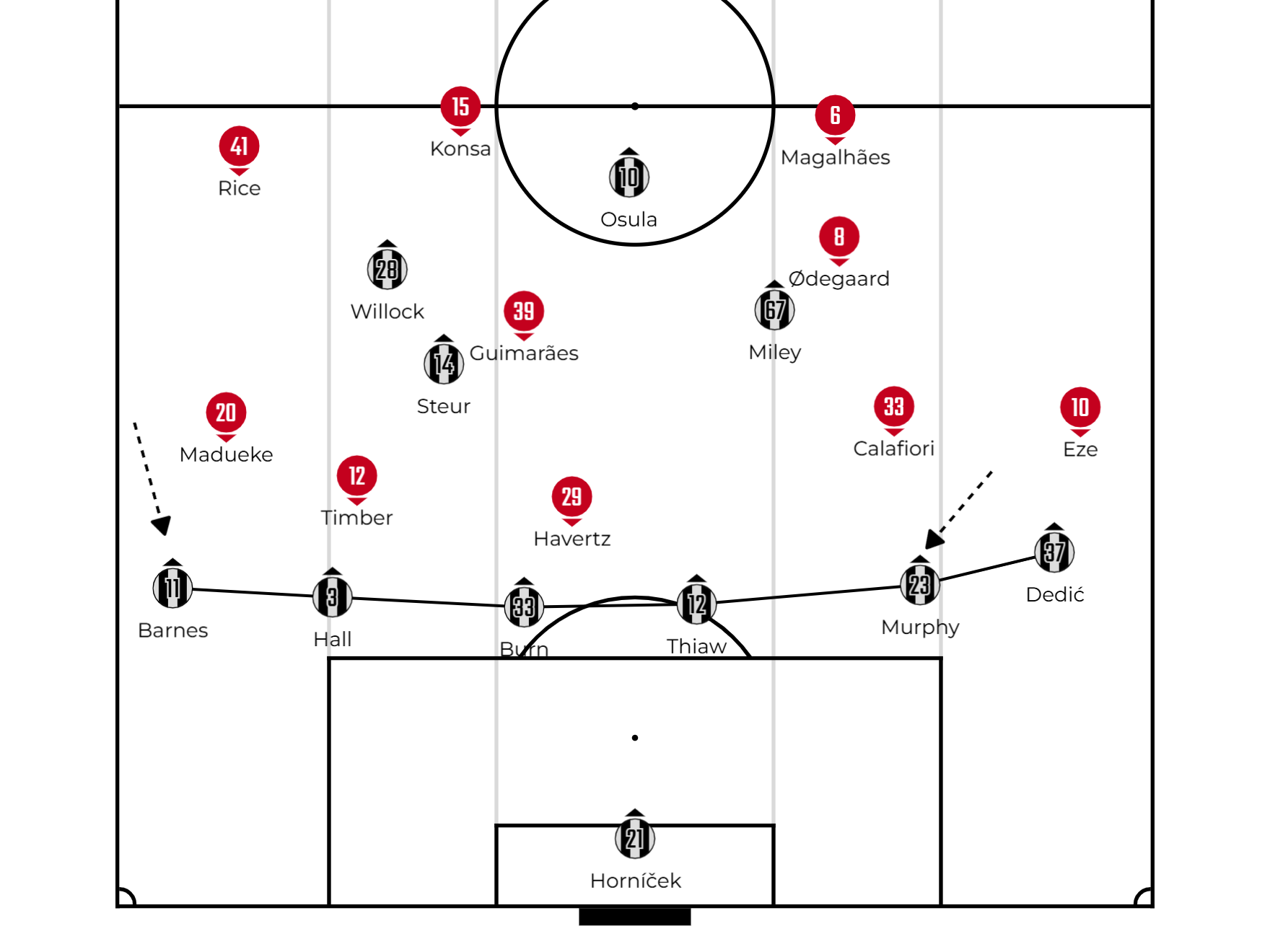
Newcastle’s 6-3-1 block with Barnes and Murphy dropping into the back line.
A lot of this came from how much Arsenal moved. Timber was not tied to one zone at all. He roamed around the pitch and even turned up on the left side, rotating with Calafiori and Ødegaard, which made it hard for Newcastle to know who was marking who.
The players kept moving, but the idea of their 3-1-6 shape was still intact. Rice, Timber and Ødegaard were very mobile with roles being swapped in possession amongst these three players. Sometimes Rice dropped into the first line and Timber pushed up, and other times it was the reverse with Timber inverting into midfield Ødegaard at times acted as the sole six in possession. Newcastle tried to stay man-oriented to deal with the numbers that were dropping deep.
Timber and Calafiori moved up on either side of Guimarães, with Madueke, Havertz and Eze ahead of them. Havertz was also very mobile as the striker. He was always drifting into wide areas interchanging positions with other players.
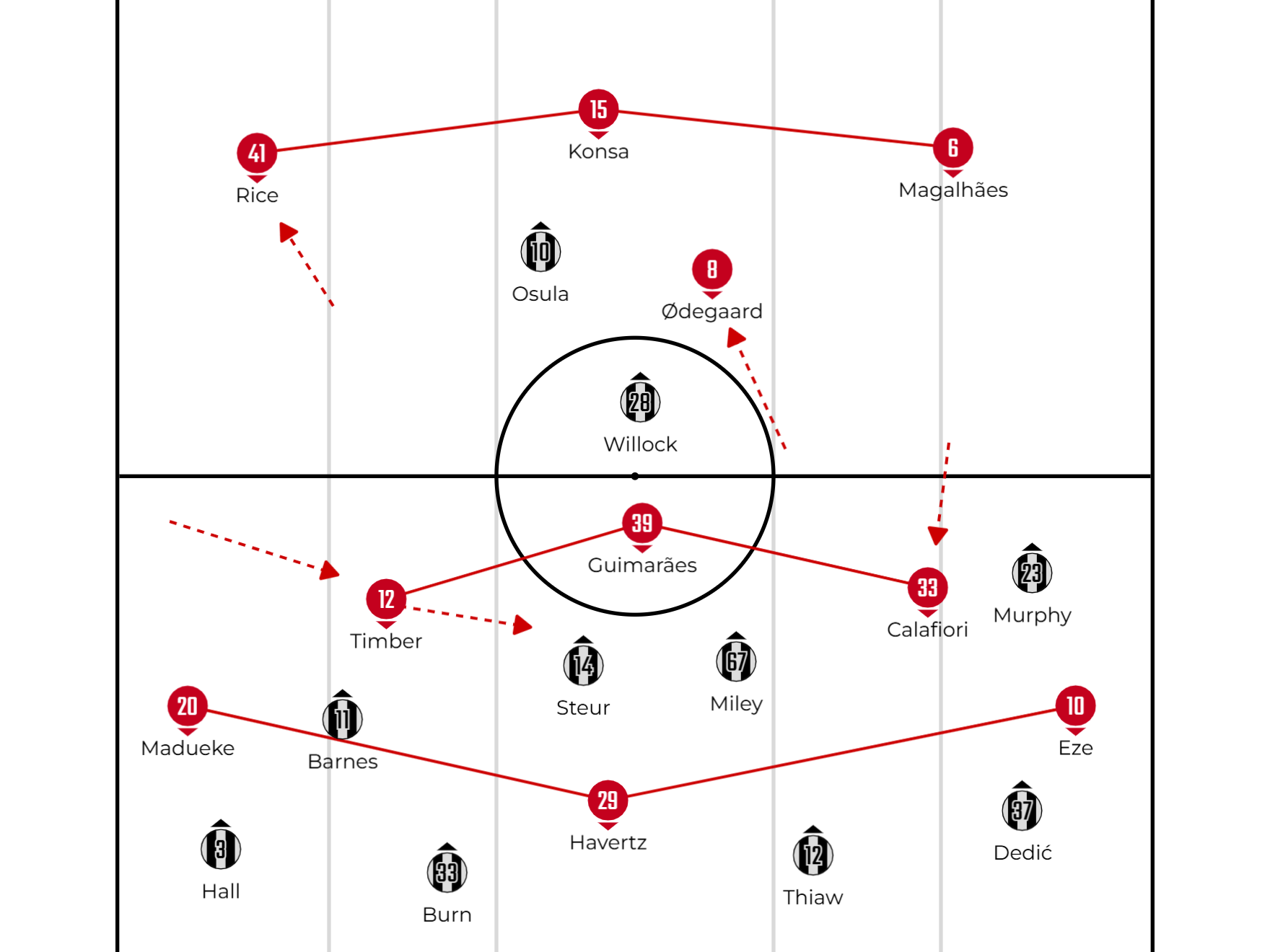
Arsenal’s 3-1-3-3 shape with Rice and Ødegaard dropping and Timber and Calafiori moving up.
Over the Press
Arsenal had full control of the first 30 minutes. They used the numbers in the first and second line to retain the ball as Newcastle reluctant to put pressure in a lot of moments. The away side had more possession , and when they did lose it, they won it back before Newcastle could get going. Newcastle struggled in transition throughout the first half and Arsenal’s momentum was on a high.
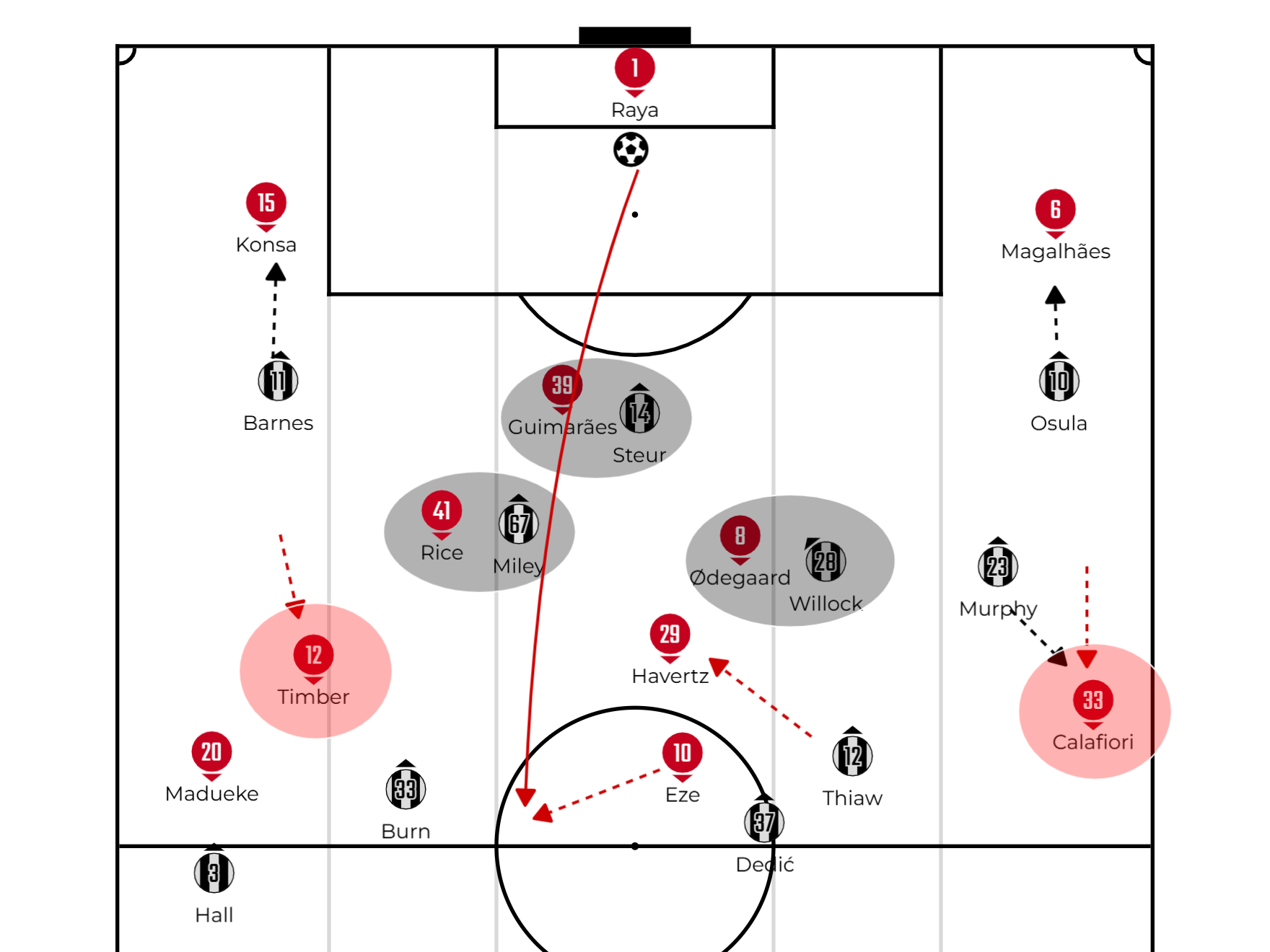
When Newcastle pressed high, Arsenal’s solution was to go long over the top as Raya wasn’t put under pressure. Arsenal used these moments to win first and second balls and access the final third. The gunners were able to generate chances from this sequences.
Newcastle were man to man in midfield, with Steur on Guimarães, Miley on Rice and Willock on Ødegaard, while Barnes and Osula jumped to Konsa and Magalhães. Havertz was key because every time he dropped, he pulled a defender with him (Thiaw) with him. Due to this, the Newcastle defensive line had less numbers, and Arsenal’s wingers and fullbacks could take advantage of that space.
Raya going over Newcastle’s man-to-man press, with Havertz dropping deep, creating space for his teammates.
Arsenal used their press as a medium of control on the other end. When Newcastle tried to play out, Ødegaard always looked to jump out from his midfielder assignment to the goalkeeper while Madueke and Havertz were tasked to the two center backs, Burn and Thiaw. Timber jumped to Hall on the right hand side.
Newcastle used Dedic high up and wide to drag Eze away from the press, while moving Murphy inside the central channels. Arsenal defended Newcastle’s build up plan in the first half.
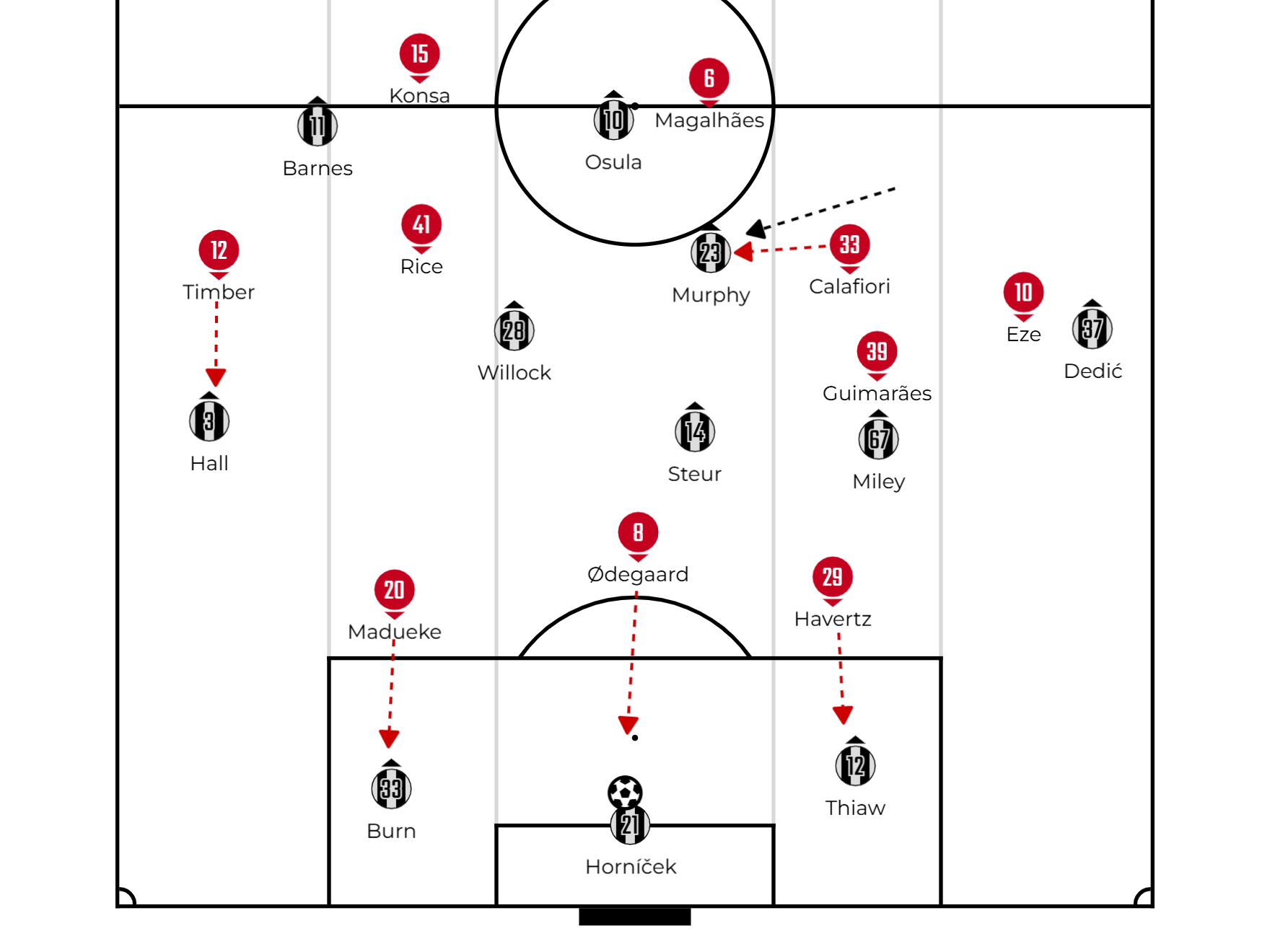
Arsenal’s high press, with Timber jumping onto Hall and Calafiori following Murphy inside.
Arsenal’s first goal came before the break. In the move leading up to the goal, Havertz swaps positions with Madueke. This lead to Thiaw marking Madueke and when Madueke dropped deep, Thiaw was dragged out of the defensive line. This opened up space for Arsenal to attack Newcastle’s backline. Havertz got the better of Hall and slipped the ball in behind Dedić for Eze, who finished past Horníček.
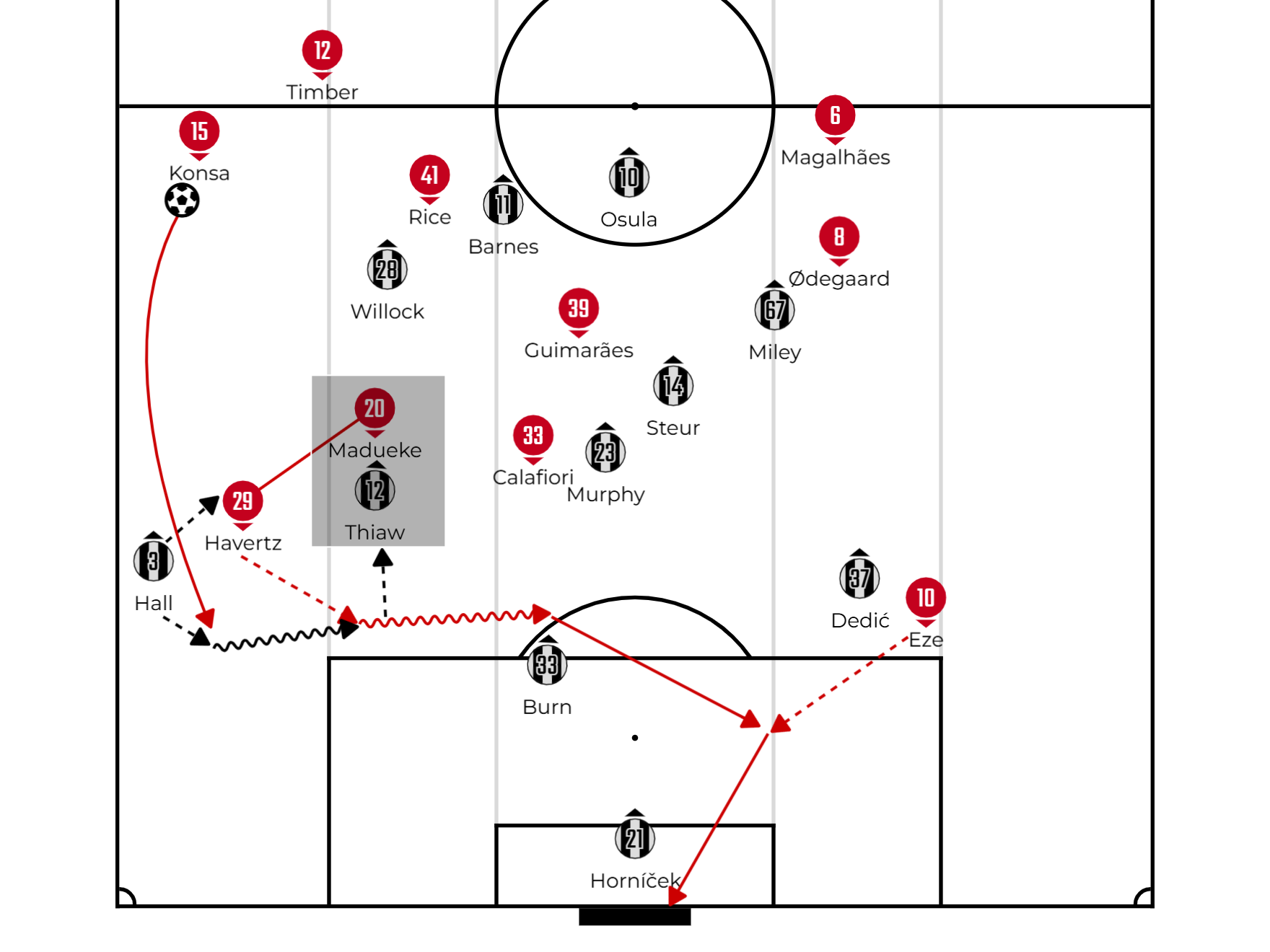
Arsenal’s opening goal against Newcastle.
The Throw-in That Changed the Game
Jaissle made three changes at half-time, with Tino Livramento, Anthony Elanga and Ramsey on for Dedić, Murphy and Steur. Newcastle came out pressing higher and were much more aggressive, going man to man all over the pitch.
The moment that really changed the game, though, was an Arsenal throw-in. Ødegaard couldn’t deal with it with Willock on him, and the ball fell to Osula, who set up Barnes to make it 1-1. Newcastle had struggled for most of the game up to that point. Now they had a goal and all the momentum.
They used it and got a second goal from a corner not too long after. Burn got his head to a Hall corner, there was a scramble in front of Raya and Thiaw poked it in from close range. It got worse for Arsenal when Raya had to come off with a shoulder injury. Kepa Arrizabalaga replaced him, and Myles Lewis-Skelly and Tzolis came on for Guimarães and Eze.
Man to Man at a Cost
Newcastle were 2-1 up in a game they had struggled in, and they still insisted to go man to man. They kept pressing high and leaving a lot of space behind them when they had a lead to protect. Arsenal were able to play through Newcastle’s press although they increased the intensity.
Minutes later, Newcastle conceded from a sequence where Arsenal played through their pressure again. Barnes and Osula pressed again, and Arsenal came out on the left through Magalhães, Calafiori and Tzolis. Timber had already drawn Burn out of the defensive line with the kind of rotation we saw all game. Tzolis found Timber, Timber found Havertz, and when Thiaw stepped out as well, there was nobody covering the middle. Havertz set Ødegaard away into that space and he played in Madueke on the right, who cut inside onto his left foot and scored past the goalie. Timber’s positioning to invert was key in the response of Newcastle going man to man.
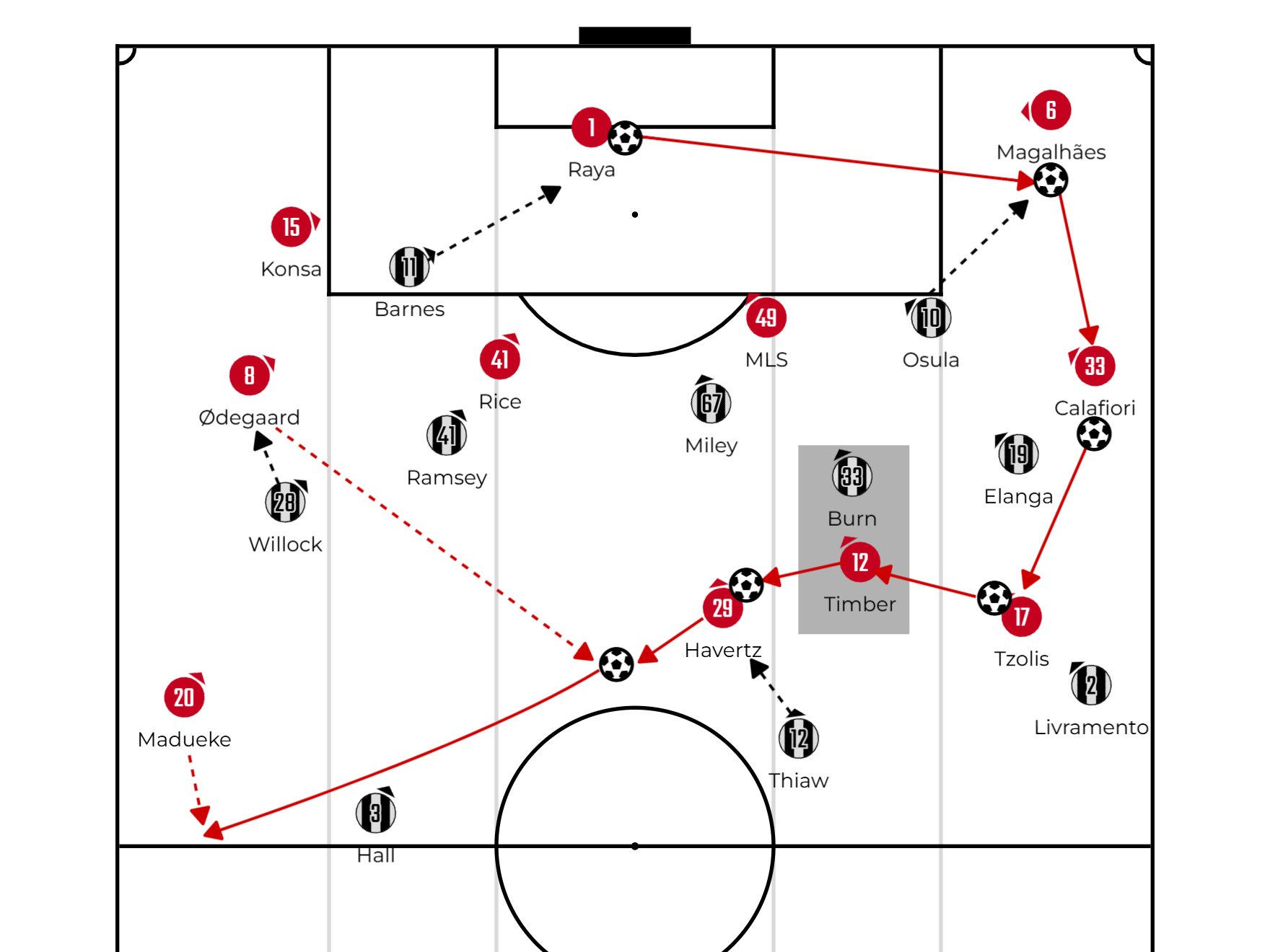
Timber drawing Burn out as Arsenal play through Newcastle’s man-to-man press to find Madueke.
Takeaways
Arsenal were the better side by a distance in the first half. Newcastle couldn’t handle the rotations, Arsenal kept going long over the press and the home side spent spells of the half in a 6-3-1. It was only 1-0, and one poor moment from a throw-in was enough to bring Newcastle back. Credit to Jaissle as well, because the half-time changes gave his side the aggression they were missing.
Newcastle would probably have taken a point against the league leaders before kick-off. After being 2-1 up, though, they’ll look at that second goal and question why they were still going man to man with so much space behind them. The press got them back into the game and then cost them the win. For Arsenal, they showed how good they were exploiting a press by going over and playing through. For Arsenal, the run of five straight league wins is over, but they are still six points clear at the top.
Match plots would be added as soon as possible.