
Manchester City – Napoli: Limited Tensions Equal A Stalemate (2-2)
Both attacks did not function for different reasons. But whilst one club’s hierarchy is (currently) comfortable with their own team’s inefficiencies, will the other be comfortable with theirs?
Tactical analysis and match report by Joel Parker.
A grand return had been cut short. Napoli had started well at the Etihad in September 2025, until Giovanni Di Lorenzo’s red card forced Antonio Conte to make a sacrifice. Kevin de Bruyne was taken off less than half an hour into his return to Manchester; fourteen months later, and it was a chance to make amends, only the legacy and stature of the Belgian had a greater impact on both teams this time round.
Manchester City have shown growing pains in a post-Pep and De Bruyne world. Enzo Maresca had established good form at the start of the season, but underlying problems in pressing roles have remained and a static buildup is failing to provide the dominance we are used to. De Bruyne slowed production down in his last season at City, but glimpses of his peak will hope to provoke a return to form for Maresca and his team.
Whilst City struggle to find that final third actor, De Bruyne has had a difficult time on the bay. In the summer, he criticized a very defensive vision for football in Conte… if only he knew what would come around the corner. Massimiliano Allegri has failed to platform the veteran, whose own vision for football is extremely low-risk, with low rewards. Sitting next to De Bruyne, in the one press conference Aurelio De Laurentiis has allowed, Allegri had already denounced this fixture for the decisive games against Club Brugge, Sabah and Viking. Surely, a winner like De Bruyne would be impressed with this mindset.
Maresca made five changes from the team that drew to Fulham. Phil Foden, Iliman Ndiaye and Jérémy Doku were replaced by Rayan Cherki, Allan and Enzo Fernández in the attack. The other switches came in the defense: captain Rúben Dias and Abdukodir Khusanov were replaced by Joško Gvardiol and Matheus Nunes. Erling Haaland took the armband.
Allegri made three changes, to the team that beat Torino. Antonio Vergara was added to a long injury list, and Noa Lang was selected as the attacker behind the striker. De Bruyne would start in place of Frank Anguissa and Rafa Marín was out for Mathías Olivera as Napoli moved from the 3-5-1-1 formation to a 4-5-1 shape.
An unmovable game state
Preemptive thoughts do not always follow in football, but even the most neutral of neutrals could tell you how this version of Man City would play out against this version of Napoli. However, that doesn’t mean this came without caveats. Firstly, Maresca’s team showed difficulties in building out of the back against the man-to-man that Napoli did deploy, especially on the right side, where some moves were inconsistent. Even though Napoli were not stepping up with much intensity, they still encouraged some long passes to be made from Gianluigi Donnarumma (City were more comfortable when Matheus Nunes pushed forward and Cherki pinned Olivera, whilst a two-versus-one was established on Lang).
Secondly, Napoli did have some phases where they could circulate the ball. Under Allegri, the team has had constant moving parts and they have not been settled in one structure. In this game, they were established in a 4-3-3 formation, which had both Billy Gilmour and De Bruyne deep to help retain possession, and holes remained in some pressing situations where Napoli was capable of playing down the right channel.
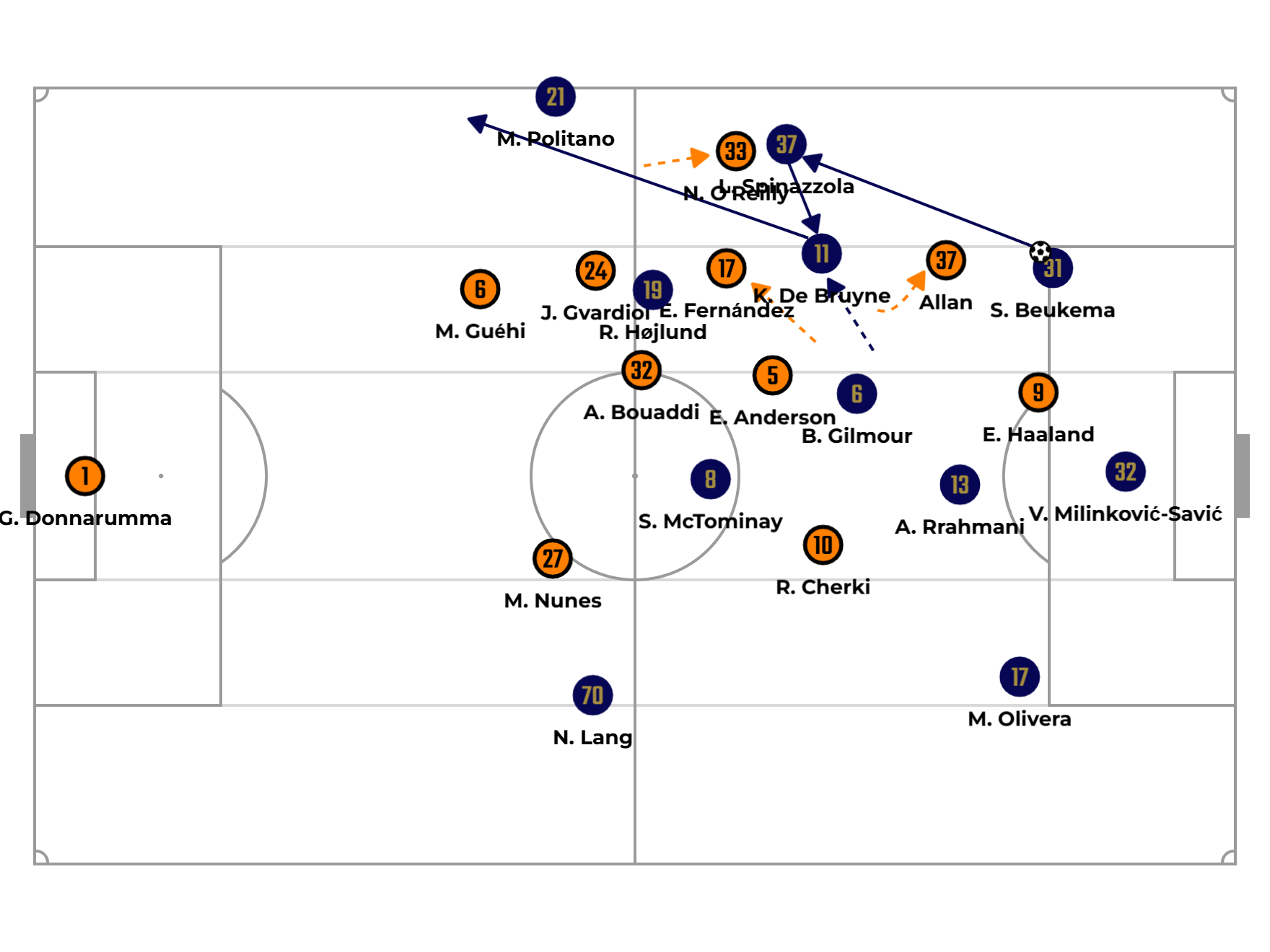
11th minute: Napoli play through City’s attempts to press. As Milinković-Savić passed to Rrahmani, Allan had moved towards De Bruyne and Beukema was free to pass too. This encouraged O’Reilly to jump onto Spinazzola, but space was afforded to De Bruyne as Fernández had moved deeper. In the process, Politano was free to run onto the channel pass produced by the Belgian, and the winger carried the ball from the touchline into the box, but without an end product.
Some advantages may have been taking place, but this is a Napoli team whose priority is its passivity and dropping players deep for safety. The man-to-man did not lead to high turnovers (they have produced the least in Serie A this season) and circulation was only afforded in their own half, without the territory to put City under immense pressure. As a result, the game state we anticipated was locked in: City held the bulk of the possession from the middle third onwards, as Napoli dropped deep, with Politano and Lang even joining the defensive line depending on the situation.
Maresca made sure his usual positional points were in place. Matheus Nunes often tilted to make the back three and Nico O’Reilly acted as one of the interiors or inverted from the left fullback position. Allan held maximum width on the left side, Cherki held minimum width as City were not as strict about stretching their opponent on the other side. Ayyoub Bouaddi had the most central presence of the midfielders; Fernández and Elliot Anderson were often located in the halfspaces, although it was the Englishman who had the exchanges with Bouaddi in the pivot spots.
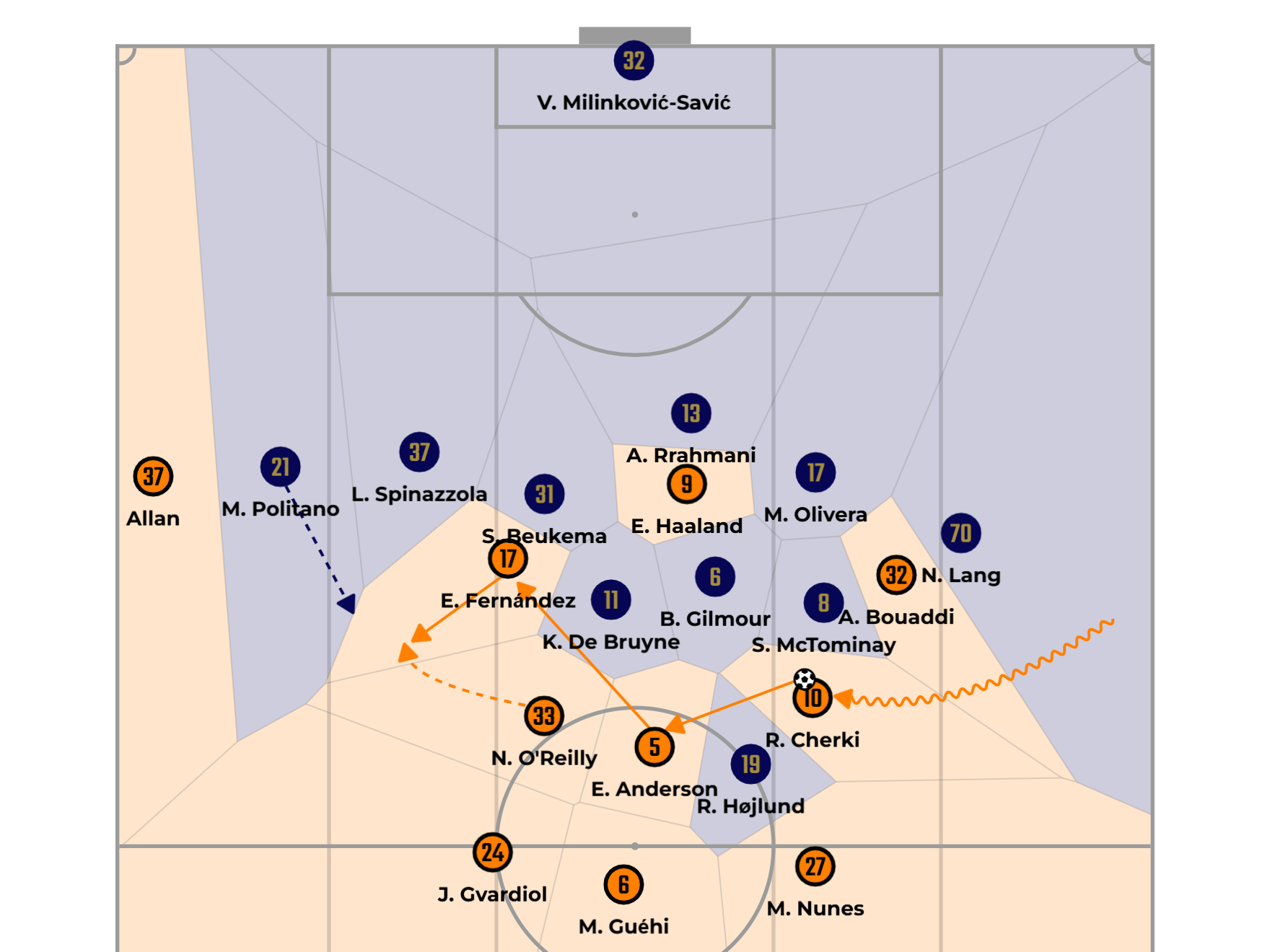
22nd minute: Cherki carried the ball inside, tracked by Olivera until the Uruguayan dropped back into his position, which highlighted how easy it was for City to bunch players around the pivot spot and how many players they had located outside of the block (nine in this situation), without having the players out wide to create tensions on the Napoli block. O’Reilly did not push further wide when Cherki made his dribble, which, in turn, created a slow tempo in which City moved possession.
The result was a buildup that was slow in tempo and unprogressive in nature. It did not take much effort for City to get possession into the final third, often through the inside movements of O’Reilly and Cherki, who were constantly attempting to make carries from the right. However, attacking the final third was where City had some major issues: considering this was once the team that had interiors such as De Bruyne and İlkay Gündoğan killing teams in the halfspaces through their off-the-ball movements and timing into the box. A cycle changes, and City appears to struggle to create any of these moves to break into the penalty area.
Additionally, Erling Haaland still appears to linger at the back post; only that the positioning to attack crosses or sprint into the space, created by the striker, is nowhere near as effective under Maresca. As a result, the first half did see some shots on target: Anderson’s low shot from range forced a low save out of Vanja Milinković-Savić within the first minute, and Beukema had a header saved from a corner late in the half, but this was a game that was very limited in action.
Goals come as a consequence
Both teams picked up where they had left off in the second half. City had two-thirds of the possession, whilst Napoli struggled to retain it when it was with anyone other than Gilmour or De Bruyne. Maresca made his first change ten minutes into this period, which you could still argue was delayed: Doku was deployed, after tearing through Italian bodies in the previous international break. But just as the Belgian entered the field, Napoli caused a surprise as unresolved issues in the deep City buildup were not addressed.
Marc Guéhi passed to Nunes and attempted to move forward, off the ball, to play through Napoli’s man-to-man structure. But as Cherki knocked a pass inside, Gilmour was there to collect, having tracked Bouaddi but maintaining his distance. Gilmour can be hailed as one of Napoli’s best distributors from deep, although his passing techniques in deep are not usually replicated in the final third. Here he showed excellent composure to slide in Rasmus Højlund, who got onto his preferred foot and fired a low shot past Donnarumma for the opening goal.
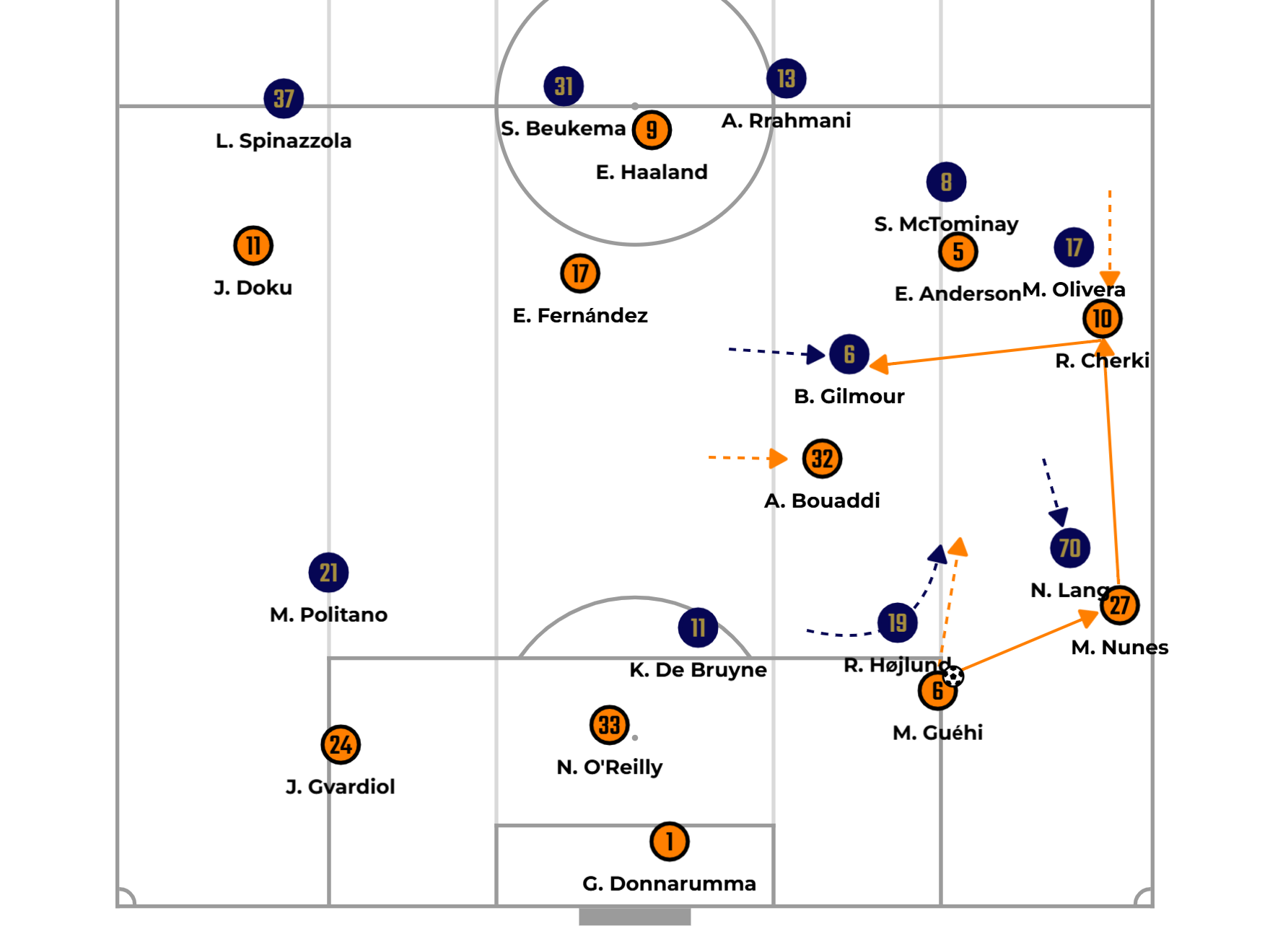
54th minute: Buildup to Napoli’s first goal as City failed to break through the man-to-man press. A loose pass inside found Gilmour and City were not quick enough to respond and stop the Scotsman from playing Højlund through on goal.
Napoli taking the lead only reinforces Allegri’s aims from the get-go. Now the Neapoilitans can stay deep in their defensive arrangement and take as few risks as possible with the lead intact. The problem for Napoli, and especially Allegri within this decade, is that his deep block is not as compact or organized as one would expect, so some passages started to open through Cherki making a one-two to move inside or Nunes making an inside run. After the hour, Iliman Ndiaye was added to the proceedings, which enabled Cherki to act in the center now that City had two wingers who were very comfortable in taking on their opponent one-versus-one.
City were not behind for too long. Anderson made an excellent diagonal run across goal on a fast break forward, which forced a save out of the goalkeeper, shortly before they forced a corner. From that set-piece, the Napoli defense remained inactive as Doku received short, played a simple cutback to Bouaddi, who fired the ball home for an equalizer. City were back in the game, but the changes hardly swung the game into offensive dominance. What was particularly interesting was that Doku (especially) and Ndiaye were only willing to dribble inside, rather than take the fullback/winger around the outside for the cross. Take-ons were completed, but issues remained prevalent.
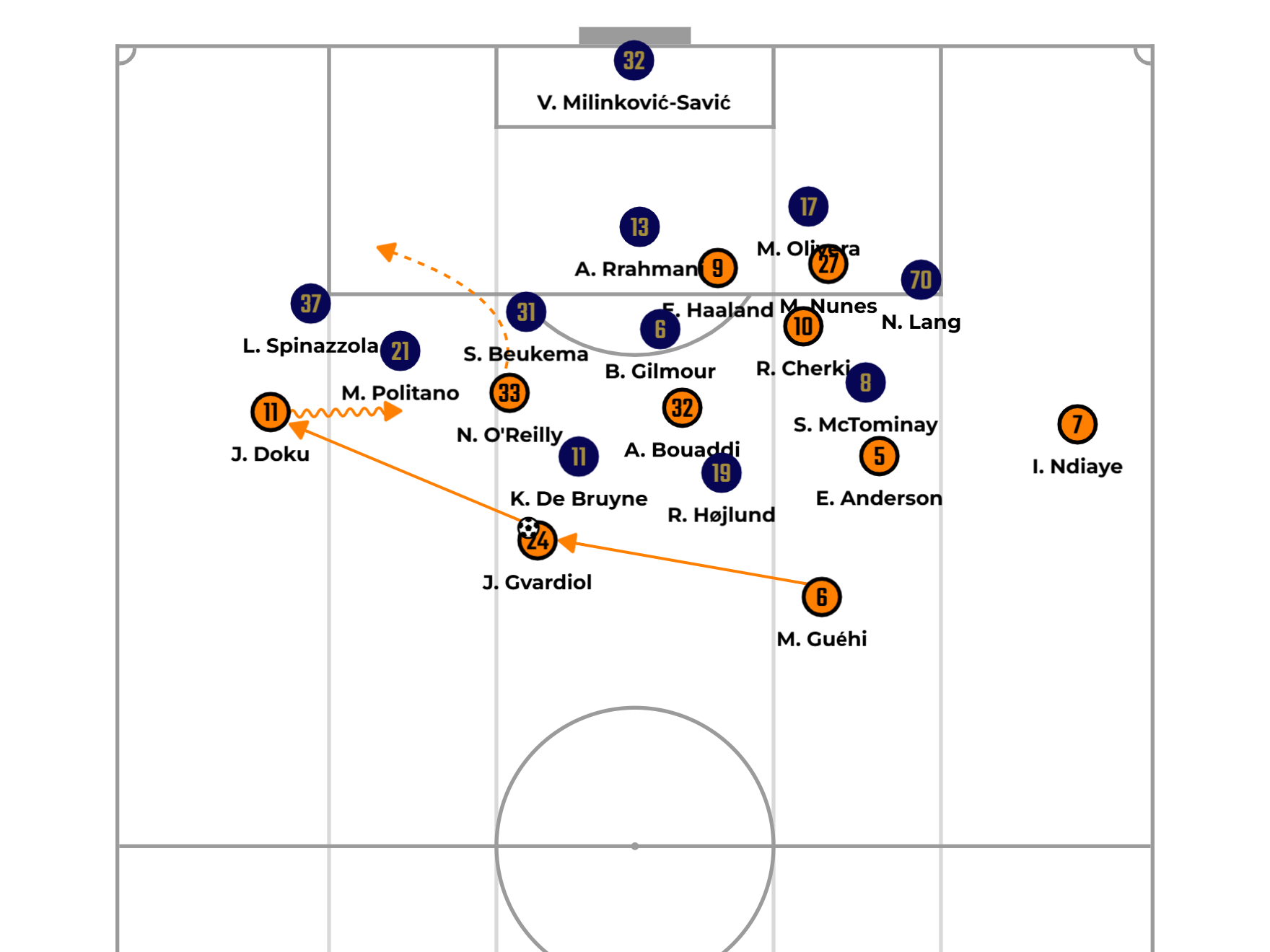
70th minute: Another carry produced by Doku, but the same attacking issues were still prevalent from City. When the Belgian was lined up to cross into the box, only Haaland and Nunes were the occupiers and Politano blocked the ball from being whipped into the area.
Allegri summoned Frank Anguissa (a much longer cameo for De Bruyne this time round) and Giovane with fifteen minutes left, and it was another occasion where substitutes were introduced and the game changed again. Amir Rrahmani and Olivera struggled to build cleanly, but the situation still led to McTominay switching and excellent technique from Politano played the inside run of Spinazzola as O’Reilly committed. Giovane’s run cleared out the back post for Lang to strike on the volley and Napoli were back in the lead.
Conditions were in place for a surprise victory, yet the same events played out. Napoli went ahead, and the big chances started to trickle through: from a corner, the ball reached Gvardiol free at the far end, only for him to take control and fire a powerful shot against the foot of the post. Bombarding the box became even easier for City, and the equalizer came with five minutes left. Ndiaye had the occupation of both Lang and McTominay, whilst nobody tracked Cherki in the halfspace, who took the ball around Olivera and fired in from an acute angle.
Takeaways
It only takes a few results for inquests to start. Cherki pointed to a lack of energy, whilst Haaland highlighted something not quite clicking. These quotes can fall under anybody’s interpretation, but a look at the numbers from this game paints a definitive picture: 262 passes in the final third, 18 shots and 1.37 Expected Goals from open play. The data is not good enough for a team built to steamroll through any opponent.
The result benefits Napoli, especially when Allegri had already denounced this game in the pre-match presser. He is still De Laurentiis’ main choice, even when the rest of the results have remained quite bleak. Nevertheless, the schedule is much kinder to them going into the winter months.
Use the arrows to scroll through all available match plots. Click to enlarge.
Check the match plots page for plots of other matches.