

Argentina – Austria: It’s The Messi Show Again For Argentina, Making Back-to-Back Wins In Group J (2-0)
Argentina’s identity was on full display through direct attacking play between the lines, creating space for each other to attack with runners. Austria’s exposed defensive approach allowed Lionel Messi to dictate play and punish his opponent. Argentina’s power and intensity in midfield and defence helped to neutralize Austria’s attacking intent.
We decided to make this article free to read. If you want to support our work, consider taking a subscription.
Tactical analysis and match report by Ebuka Ogoegbunam.
Lionel Messi’s hat trick in his previous game against Algeria stole the show in the first round and proved a lot of doubters wrong about his quality at his old age in his career. His impact was clear to see, and most especially his quality in the final third. With rumours suggesting this could be Messi’s last World Cup, fans would cherish every moment he enters the pitch to play for his country.
Argentina’s win against Algeria saw a resilient and powerful midfield alongside their defence. They limited Algeria to no shots on target in the whole match. Their opponents, Austria, won their opening match, beating Jordan 3-1. The only sides with wins in the group faced each other to maintain their momentum in the tournament.
Ralf Rangnick selected Alexander Schlager in goal with Stefan Posch, Kevin Danso, David Alaba who captains the side and Konrad Laimer, making up the defensive line. Nicolas Seiwald and Xaver Schlager make up the midfield with Paul Wanner operating higher up in attacking midfield. Marcel Sabitzer and Romano Schmid played on the left and right wing respectively. Michael Gregoritsch led the line in attack for Austria.
Lionel Scaloni’s starting XI included Emiliano Martínez in goal with a back four of Nahuel Molina, Cristian Romero, Lisandro Martínez, and Facundo Medina. Alexis Mac Allister played with Enzo Fernández in midfield. Thiago Almada played on the left wing while Rodrigo De Paul operated on the right. Lionel Messi and Lautaro Martinez played up front in attack.
Playing Through The Pressing Triggers
Argentina’s setup was no different from last game with the same XI. On the ball they set up in a 4-3-3 narrow shape. De Paul played in the midfield when Argentina were on the ball with the fullbacks occupying the wide areas, keeping the width. Messi and Almada operated between the line, with the latter having more freedom to roam and swap positions with Enzo.
Austria set up in a 4-4-2 block off the ball. Wanner and Gregoritsch led the press from the front, covering Mac Allister as the pivot while looking to put pressure. Argentina were very patient in build up. Romero and Lisandro shifted the ball side to side while Enzo and De Paul dropped deep outside the Austria mid-block to progress play.
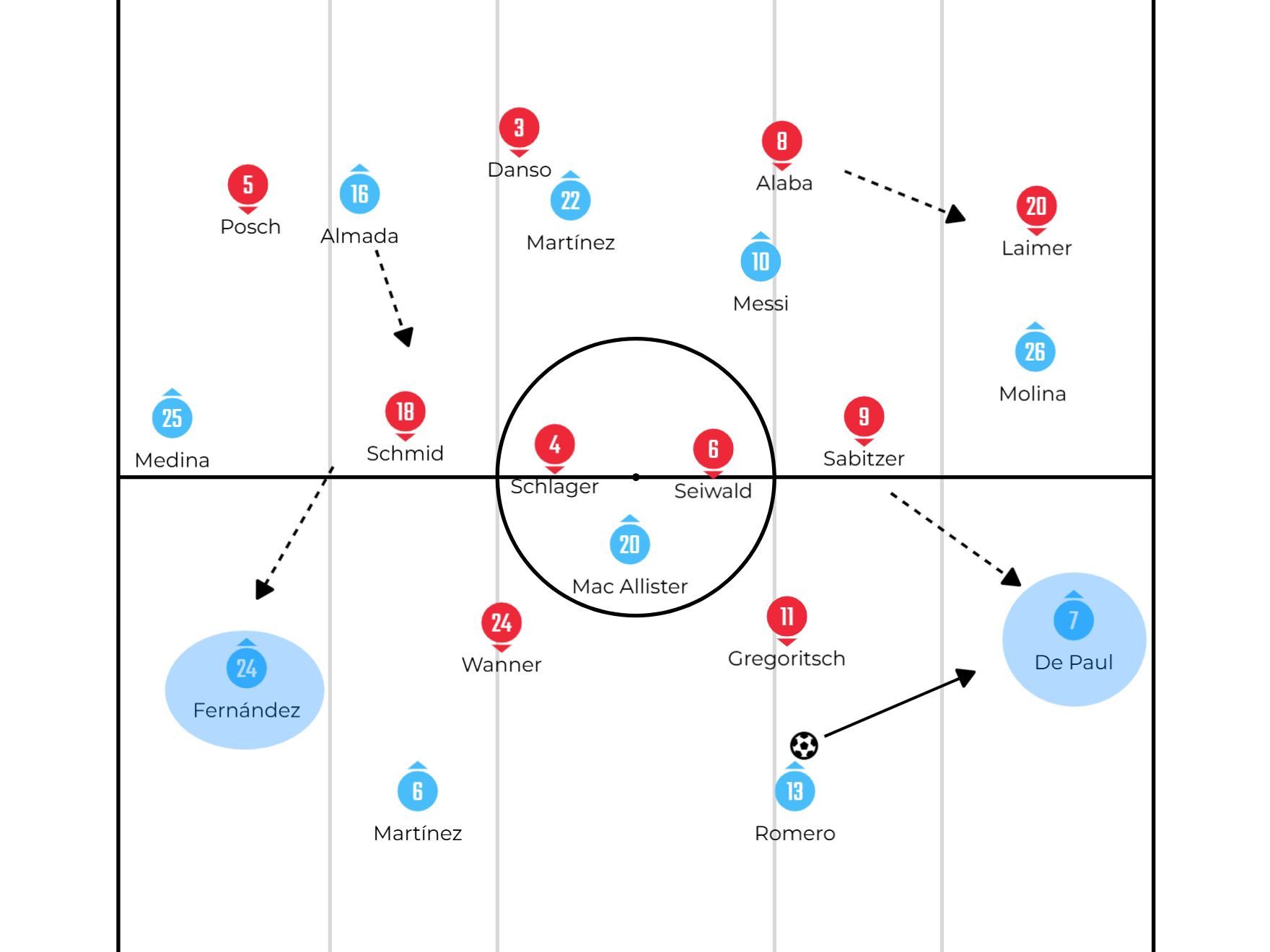
Enzo and De Paul’s movements; Dropping outside the Austria mid-block
Argentina looked to bait Austria’s press in build up by dropping Mac Allister into the first line of build up. Argentina’s midfield made lots of rotations and movements with the aim to attract and play through their opponent. When Argentina’s build up had three players in the first line of build up, Austria put pressure high up.
Argentina were able to play through the press because of the movements made by the midfielders and players high up. They played quick combination passes to escape the press. Messi dropping deep for support, enhancing proximity with teammates while his teammates constantly made runs to initiate second and third man combinations gave Argentina solutions to beat the pressure they faced.
This sequence occurred multiple times and Austria were forced to retreat every time Scaloni’s men beat the press. Argentina attacked quick whenever they beat the press, using the free man in the half spaces, often Enzo or Almada to progress into the final third. This was also the build up to the penalty that was awarded to Argentina early on. Messi was integral in these sequences with his movements.
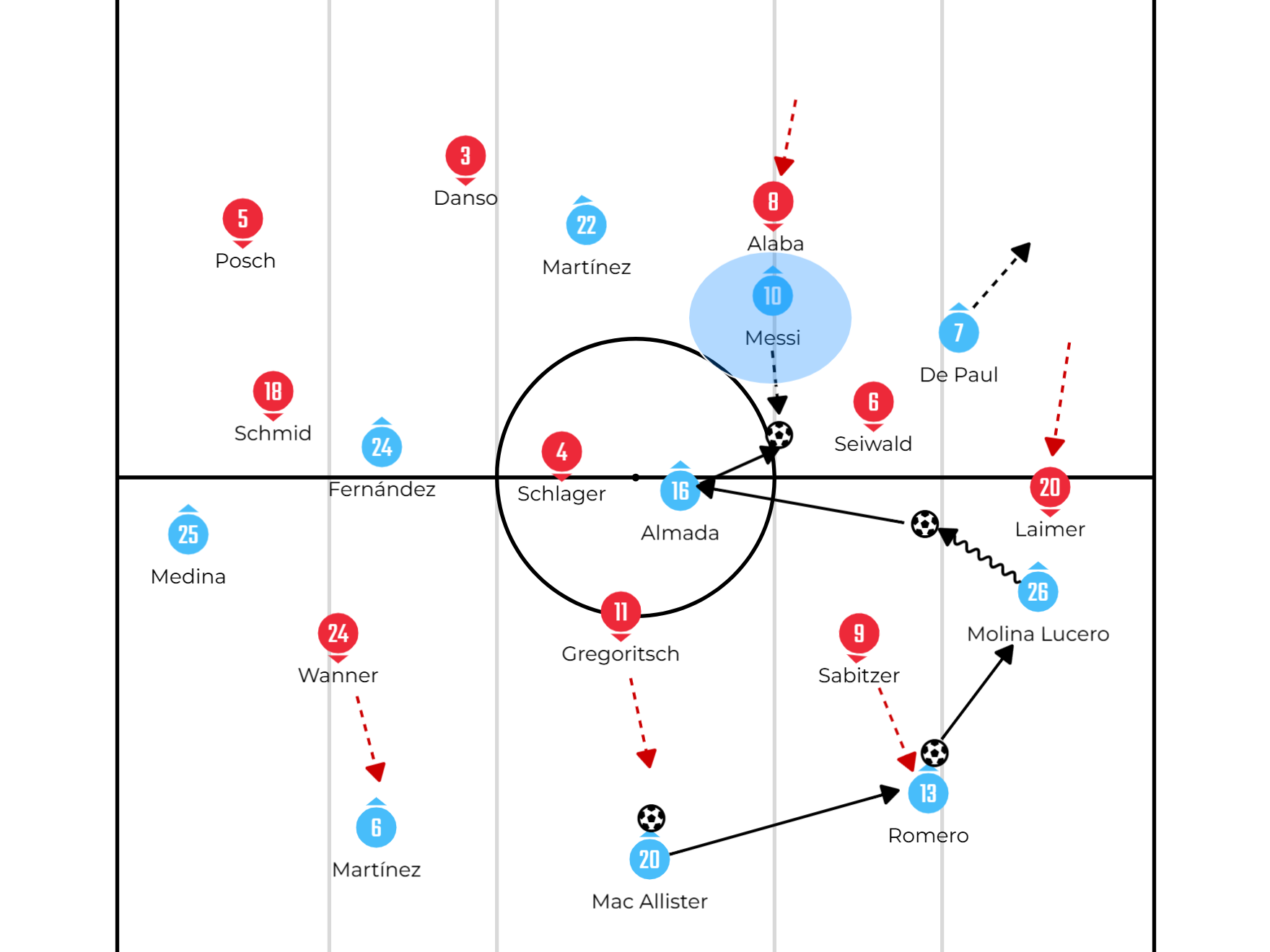
Mac Allister drops into the first line, attracting pressure; Argentina uses combinations under pressure to progress.
After a VAR check, the penalty was given. Messi stepped up and missed the penalty. Argentina missed a chance to have an early lead. Although, they maintained their pressure and intensity with the ball, they were aggressive without the ball. Their overall intensity sustained them as the first half progressed.
Messi Makes It Count This Time
Argentina didn’t look to press when Austria were in possession. They decided to sit back in a mid-block as they wouldn’t be an effective pressing team with Messi not effective in that aspect anymore. Austria’s center backs had time on the ball during build up. Alaba and Danso had space to drive forward and time to pick a pass without pressure.
Seiwald dropped into the first line, forming a back three in build up. This allowed the fullbacks to push up while the wingers tucked inside between the lines. Wanner made dropping movements to manipulate the Argentine block and create spaces for his teammates in the middle. However, Argentina made this difficult because of how compact they were and aggressive in high zones.
Argentina were aggressive in wide and central areas. Romero and Lisandro were very quick to leave their defensive lines and force turnovers in their favour. Messi’s Argentina were rewarded this time and it was no surprise who started and finished the move. Similar to previous sequences earlier in the game, Argentina’s move for their opening goal was the same concept.
Messi drops deep and attracts his marker, who was Alaba, out of the defensive line. Messi’s pass is received by Almada, who had two players to his left making runs, Enzo and Medina. The overload on the left side allowed Medina to receive the ball and put in a cross towards the edge of the box. The ball seemed to arrive towards Almada, but his dummy run deceives the Austrian defence and allows Messi to shoot the ball past the goalie into the back of the net.
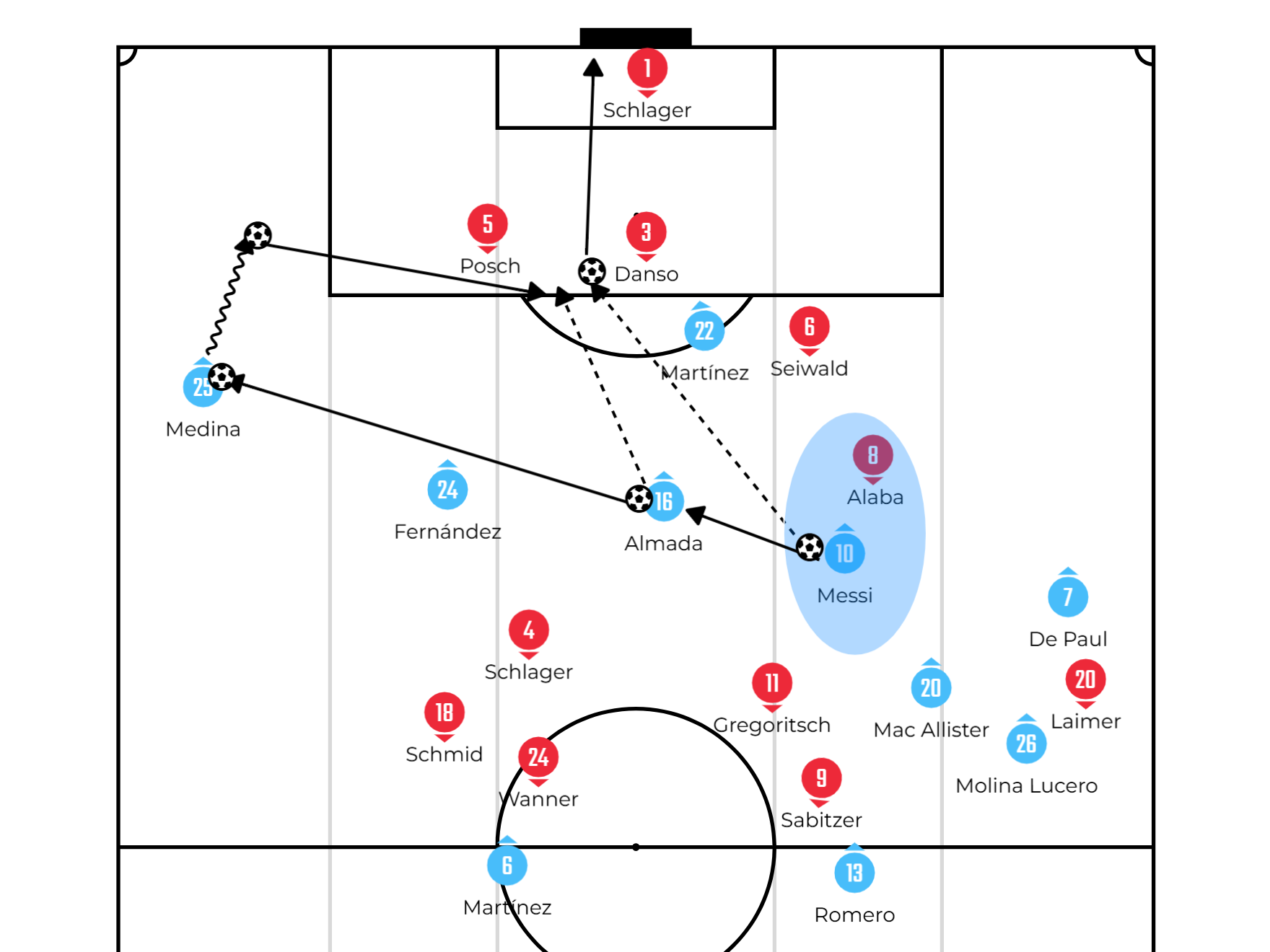
Messi started the move, dropping deep and progressing the play between the lines. Medina’s cross found Messi at the edge of the box for the finish.
The goal coming in the later stages of the first half gave a sigh of relief for the Argentine fans and Messi after the penalty miss earlier on.
Austria Had No Answers.
Argentina had a lead to hold on to and sat in their midblock, where they suffocated Austria in the final third. The opening goal allowed Argentina to be more cautious defensively. Lautaro and Enzo were tasked to cover the midfielders.
Mac Allister was tasked with following Wanner so no man would be free. If they were free, they had to be behind the ball. Argentina forced a lot of turnovers in their own half, hence creating attacking transitions for themselves. They didn’t look as quick, but they had spaces to attack the Austrian backline when they won back the ball.
Austria had more possession in the second half but it rarely led to any meaningful progression. They were often forced back into their own half when they tried progressing into the final third. Argentina did well to cover spaces and restrict gaps throughout the game.
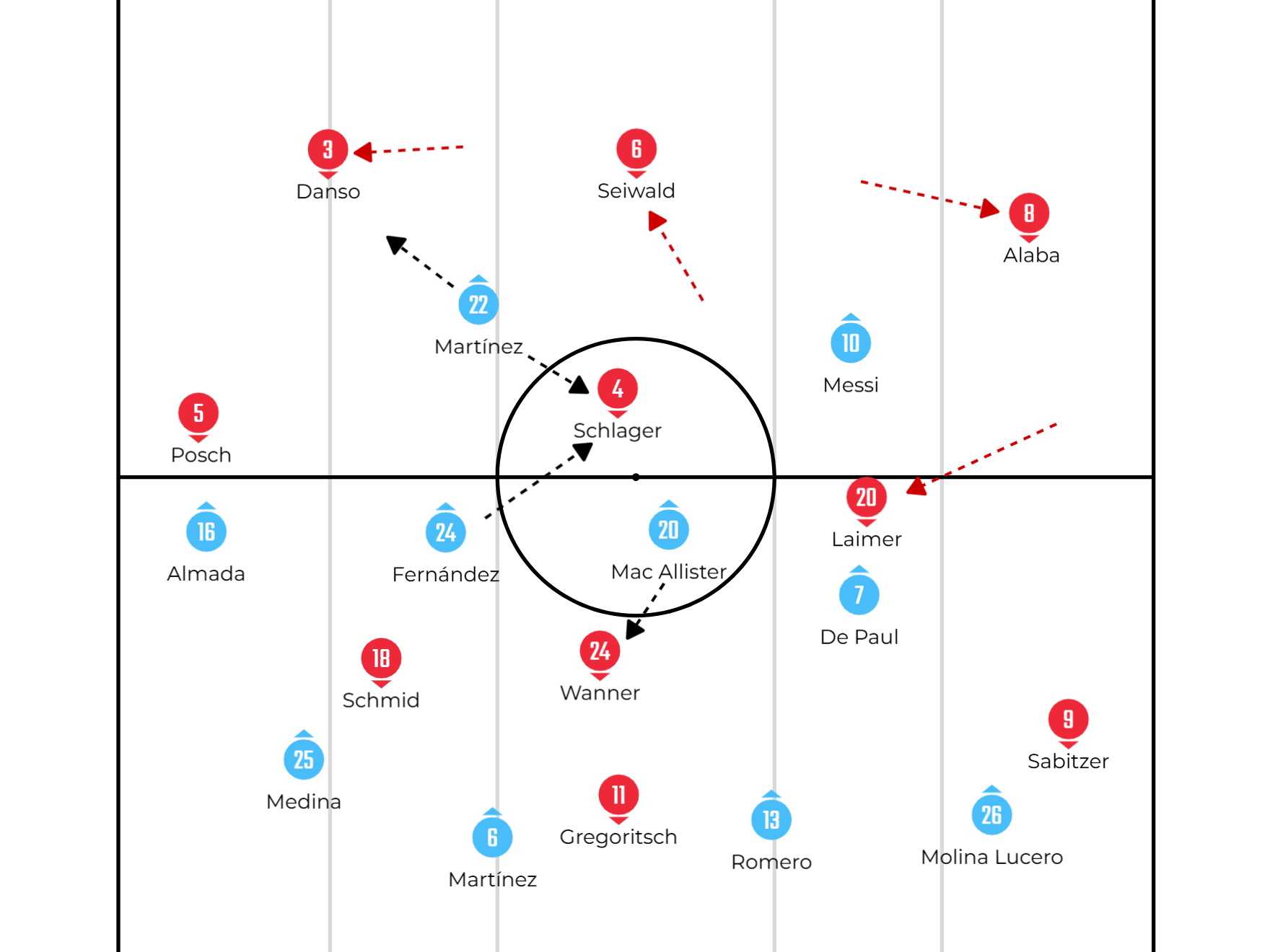
Argentina’s mid-block; No pressure on the center backs. The spare men in midfield covered while Argentina have extra numbers behind the ball.
Later on in the second half, fresh legs in Julián Alvarez and Nico González added more threat in attacking transitions for Scaloni’s side. They had chances to put the game to bed but just missed that extra pass in front of goal. Delay wasn’t denial for Messi. Having stayed on the pitch till late in the game, Messi’s impact was still evident in stoppage time. After the ball was cleared away from Argentina’s half, Messi was the outlet in his own half. Alvarez and Leandro Paredes made runs into the spaces Austria left in their defence with Messi finding Alvarez in front of goal.
Alvarez’s shot was saved in which Paredes receives the ball and makes the pass to Messi. Messi’s effort finally goes in after a blocked attempt on the first try to complete a brace in his second game this tournament. Messi became the top goal scorer in the tournament after two games again, rounding off his superb performance with two goals.
Takeaways
Argentina once again showcased a clear tactical identity built around intelligent rotations, positional fluidity, and collective intensity. Their ability to play through Austria’s pressing structure with quick combinations, third-man movements, and Messi’s deeper involvement consistently created advantages between the lines.
Defensively, Scaloni’s side displayed excellent discipline in their mid-block, restricting central access and forcing Austria into sterile possession. The balance between patience in build-up and aggression after regaining the ball highlighted a mature and well-coached performance.
While Messi’s brilliance ultimately decided the game, Argentina’s success was rooted in their collective structure, control of space, and relentless tactical execution throughout the match.
Use the arrows to scroll through all available match plots. Click to enlarge.
Check the match plots page for plots of other matches.
Comments