Argentina – Cape Verde: Argentina’s Extra Time Winner Sinks Cape Verde Hearts After Thrilling Battle (3-2).
Cape Verde’s persistence was enough to extend their qualification hopes for an extra thirty minutes but Argentina’s quality in decisive moments proved to be the difference between both sides. Lisandro Martinez and Lionel Messi’s impact was the difference between with both putting in shifts in the attacking third.
Tactical analysis and match report by Ebuka Ogoegbunam.
We decided to make this article free to read. If you want to support our work, consider taking a subscription.
After Argentina’s qualification to the knockout stages, winning Group J, many suggested they had one of the easiest routes to advance further in the tournament. There have been many surprising results in this World cup and Cape Verde have been in these matches where they’ve surprised many, especially in the opening game against Spain.
Throughout the tournament, Cape Verde hadn’t lost a game coming into this one, drawing all their games in the group stage while keeping two clean sheets in those three games. Argentina was going to be a huge test and although they were underdogs coming into this game, they’ve already been underdogs in the games they’ve played so far and have come out unbeaten.
Lionel Scaloni rotated the Argentina squad after their last win against Jordan. Emiliano Martínez stayed in goal alongside a defensive back four of Nahuel Molina, Cristian Romero, Lisandro Martínez and Facundo Medina protecting him.
Enzo Fernández and Alexis Mac Allister played in midfield with Thiago Almada operating on the left while Rodrigo De Paul played on the right. Lionel Messi, who was joint top with most goals in the tournament so far, paired up with Lautaro Martinez in attack. Argentina continued with the 4-4-2 shape they’ve used all tournament.
Cape Verde’s 4-3-3 shape had Vozinha in goal, following a backline of Steven Moreira, Roberto Lopes, Diney Borges, Sidny Lopes Cabral. Kevin Pina was the sole pivot of Cape Verde’s midfield with the support of Laros Duarte and Deroy Duarte in the same zone. Jovane Cabral, Ryan Mendes and Nuno da Costa were the front three for Bubista’s Cape Verde.
Cape Verde’s defensive focus
Argentina’s 4-4-2 shape in recent games has been key in utilizing the central areas as a focal point in attack. On the ball, Argentina’s 4-4-2 shape had the fullbacks occupy the width, while the wide attackers were used differently. On the right side of the pitch, De Paul was used more as a midfielder, dropping into the backline and distributing the play.
Almada was used higher up in the attacking third on the left hand side. With support coming from Enzo, Almada was given more freedom to operate higher up. Messi operated more on the right side of the pitch, dropping into the midfield to link the play as he was the creative spark in the team.
Cape Verde’s 4-1-4-1 high block and 4-5-1 low in their block, they wanted to cover the central pockets with the three players in that zone. Cape Verde didn’t put pressure on the Argentina backline and wanted to remain in their shape. The central spaces clogged up forced Argentina into playing long ball and accessing wide areas.
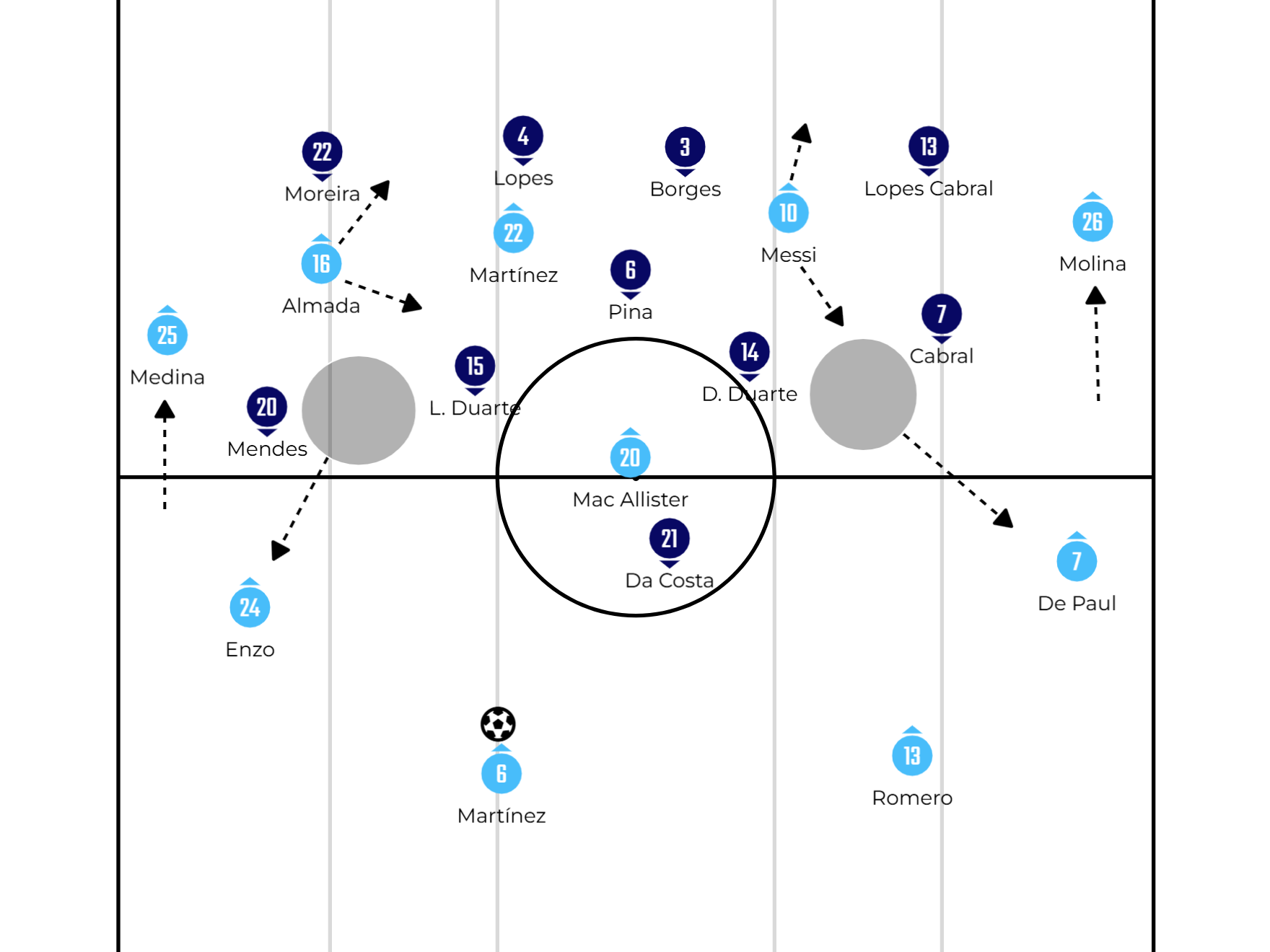
Argentina’s fullbacks pushed high up the pitch with Enzo and De Paul in deep areas during the build up.
Molina and Medina weren’t threats in the wide areas when they received the ball. They used these opportunities to funnel the ball backwards or into central areas. The Argentine fullbacks didn’t use these wide zones to penetrate the Cape Verde backline but they made runs beyond the backline to attack the space in behind.
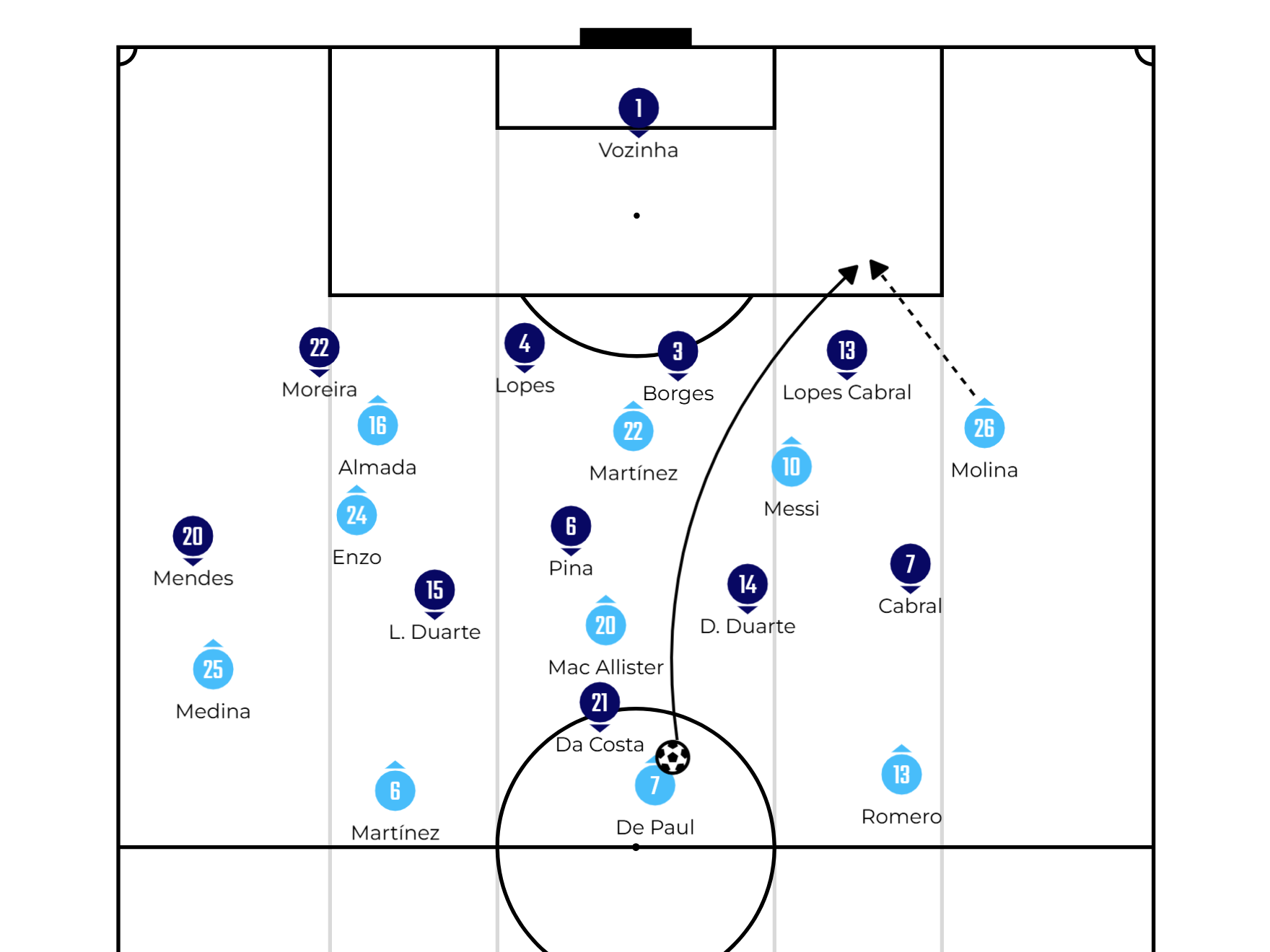
Molina makes a run beyond the Cape Verde defensive line.
Take what the defense gives you
Cape Verde’s approach to restrict central progression allowed Argentina to funnel the ball centrally through wide areas. This way, Argentina was closer to goal with the ability to use their quality to find teammates between the lines. Argentina had to adapt, and with Cape Verde not putting pressure, the center backs had time and space to play a pass and find their teammates high up the pitch.
Argentina’s opening goal was a sequence that came as a result of Lisandro’s quality on the ball. His long ball from deep found Messi’s run in the box for his seventh goal of the tournament.
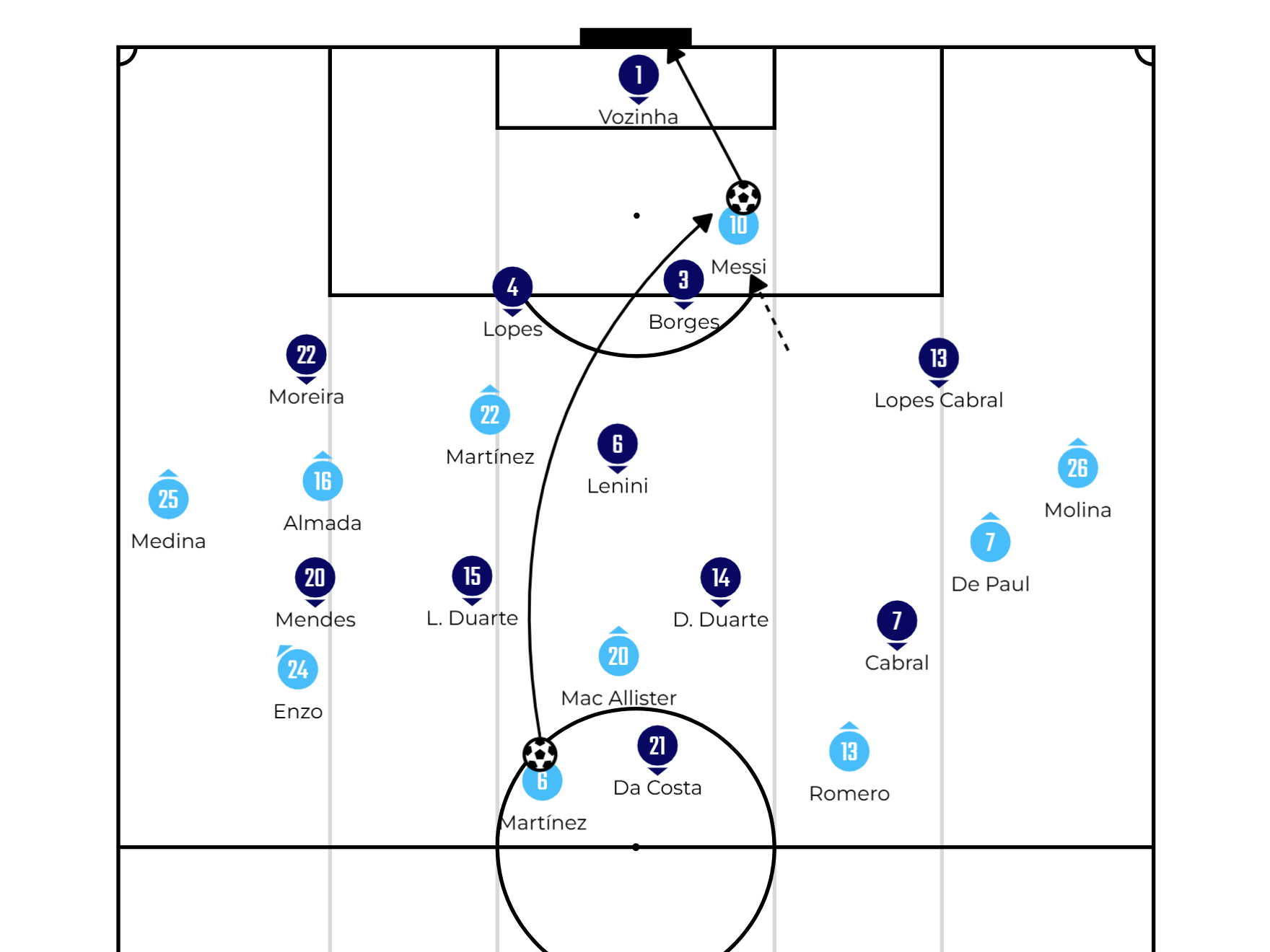
Lisandro’s long pass to Messi for Argentina’s opener.
Argentina’s direct approach through the central areas, led to turnovers, enabling Cape Verde to counter attack. Cape Verde failed to take advantage of the opportunities that came their way in transition and this allowed Argentina to quickly regain momentum in the game.
Later in the game, Argentina got more comfortable playing through the lines and this was through the quality of Lisandro Martinez. His ball playing ability helped Argentina play in these central areas and start combinations between Messi, Enzo and Lautaro. Long and short passes, Lisandro was the facilitator from deep.
Cape Verde Pressure
Cape Verde played in a 4-3-3 shape in possession against Argentina’s 4-4-2 mid block. Lautaro had to cover lots of ground in the press in the first line of the press. He had to mark Pina, who was the sole pivot in Cape Verde’s midfield. When Lautaro was dragged into midfield due to Pina’s position, this was a trigger for Enzo to jump to the center back and Lisandro to jump to Deroy Duarte. Argentina’s press made life difficult for Cape Verde when they put pressure. This was a major reason for Cape Verde’s struggle in the first half.
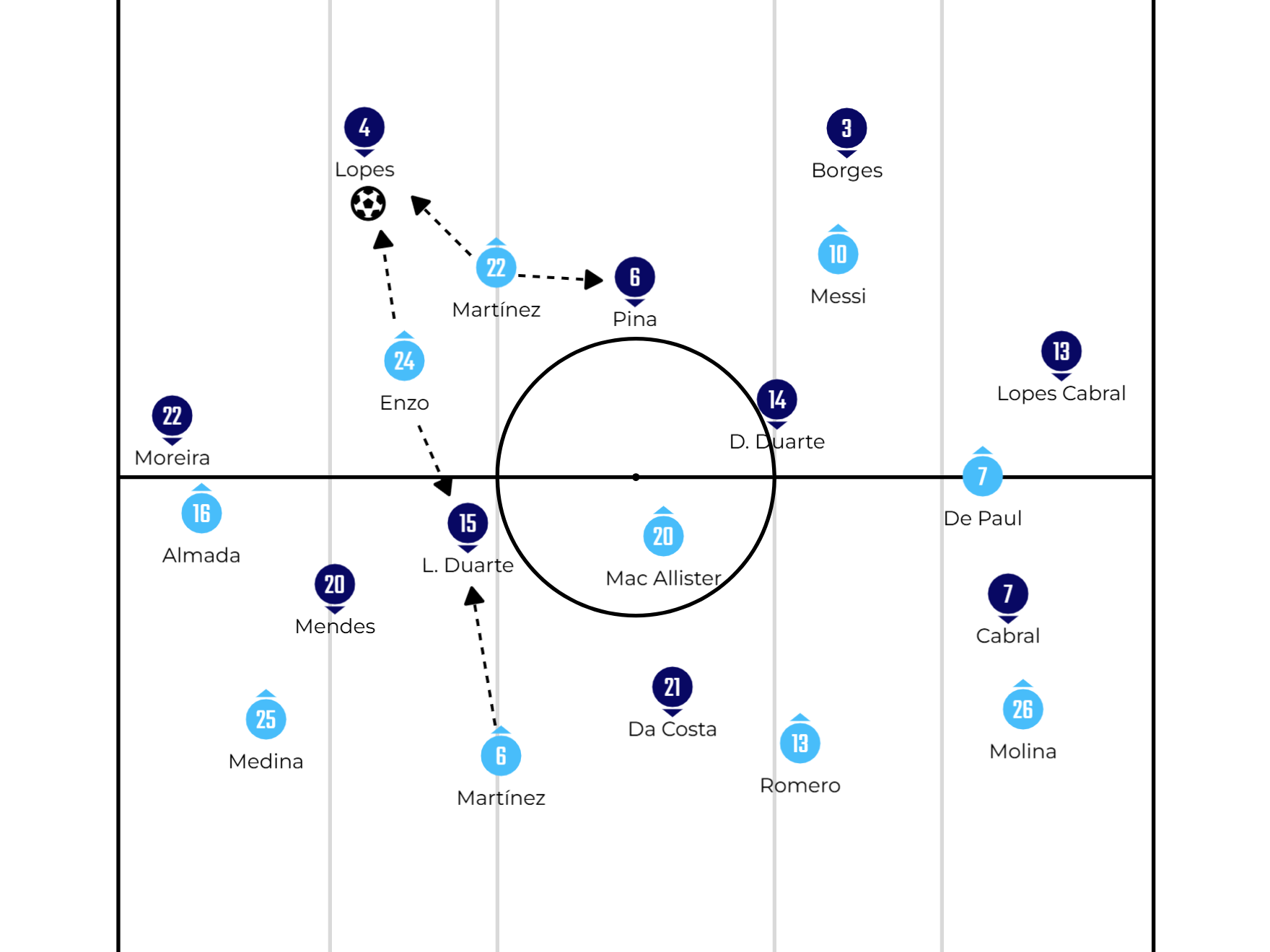
Lautaro’s dual role in the Argentine press. Enzo and Lisandro jump when press is triggered.
Unlike Argentina, the wide channels were a primary route for Cape Verde to attack the box. Although they failed to execute effectively on that side of the pitch, the winger, fullback and the midfielder (ball side) always wanted to combine and put balls into the box.
Later in the second half, we saw this with Cape Verde’s equalizer. Mendes found Deroy Duarte in the half space which allowed him to squeeze a shot past Martinez through the legs of Lisandro. Cape Verde made their momentum count, even with the short period of time it lasted.
Cape Verde held Argentina to extra time but they didn’t hold them for so long after conceding within the first two minutes of that period. Messi’s corner was met by Mac Allister who flicked in on to the far post, where Lisandro was able to set up a powerful strike into the net.
Late on, Cape Verde used every bit of momentum they could get to push forward and their prayers were answered towards the end of the first half after a wonder strike from the edge of the box by Lopes Cabral. Cape Verde’s resistance to give up showed spirit and fight. However, Argentina found a way from another set piece. Messi’s corner was met by Romero who headed the ball towards goal. A slight deflection from Borges eased the balls movement into the back of the net.
For the third time in the game, Argentina led. Cape Verde had a late surge, but Argentina did just enough to calm the storm.
Takeaways
Argentina eventually found a way through, but this was far from the comfortable victory many expected against the former world champions. Over 120 minutes, Lionel Scaloni’s side relied on their experience, technical quality and set-piece efficiency to overcome a Cape Verde side that refused to back down. Lisandro Martínez’s influence from deep and Lionel Messi’s creativity in decisive moments ultimately proved enough to separate the two teams, but Argentina were pushed to their limits throughout the contest.
Cape Verde deserve enormous credit for a fearless and disciplined display. Their defensive organization frustrated Argentina for long spells, while their attacking intent ensured they remained a threat whenever opportunities presented themselves. Twice they fought back, forcing the game into extra time and refusing to let the occasion overwhelm them. Against one of the tournament favourites, they showed remarkable resilience, belief and tactical discipline.
Although their World Cup journey comes to an end, Cape Verde leave the tournament with their reputation significantly enhanced. They demonstrated they belong on this stage, competing toe-to-toe with one of international football’s biggest nations.