

Arsenal – Chelsea: Arsenal see off Chelsea to secure place in EFL final (1-0)
On February 3rd, 2026, the Emirates Stadium played host to a high-stakes tactical stalemate that eventually swung in Arsenal’s favor. Holding a 3–2 aggregate lead from the first leg, Mikel Arteta’s side showcased a masterclass in risk management and structural discipline. Despite the Blues dominating territory for large spells in both halves, a 97th-minute counter-attack finished by Kai Havertz ensured the Gunners booked their place in the EFL Cup final.
Tactical analysis and match report by Aderemi Qoyum.
Missing the creative spark of Bukayo Saka and the magic of Martin Ødegaard due to injury, the Gunners lined up in a disciplined 4-3-3. Kepa Arrizabalaga started in goal against his former employers, shielded by a back four of Jurrien Timber, William Saliba, Gabriel Magalhães, and Piero Hincapié. In the absence of their captain, Eberechi Eze was tasked with being the primary creative needle, supported by the double-pivot engine of Martin Zubimendi and Declan Rice. Up front, Viktor Gyökeres acted as the physical focal point, flanked by Noni Madueke and Gabriel Martinelli.
Under the relatively new leadership of Liam Rosenior, the Blues arrived with a clear contain and strike directive, utilizing a 3-5-2 that prioritizes verticality. Robert Sánchez stood behind a central trio of Wesley Fofana, Trevoh Chalobah, and Jorrel Hato. Malo Gusto and Marc Cucurella provided the width as wing-backs, while Moisés Caicedo, Andrey Santos, and Enzo Fernández formed a combative midfield. The attacking duo of Liam Delap and João Pedro aimed to exploit long balls and direct transitions, specifically targeting the channels, which they failed to do well.
Keep the ball, do not force the play
The first half was defined by a specific tactical battle during Arsenal’s deep circulation. Arsenal showed zero intent to rush play; comfortable with their aggregate lead, they prioritized ball retention, circulating the ball in a patient U-shape across the backline to manipulate Chelsea’s shifting.
Chelsea’s press from their midblock structure was specifically designed to disrupt Arsenal’s build up: João Pedro shadowed Rice to prevent him from turning, while Enzo Fernández and Liam Delap bent their runs inward to pressure the center-backs and cut off the passing lanes to the fullbacks. To prevent wide progression, Chelsea’s wing-backs, Gusto and Cucurella, pushed aggressively high to jump on the ball-side Arsenal’s full-backs. To establish control, Declan Rice dropped into the defensive line, primarily between Saliba and Gabriel, to get some space away from João Pedro.
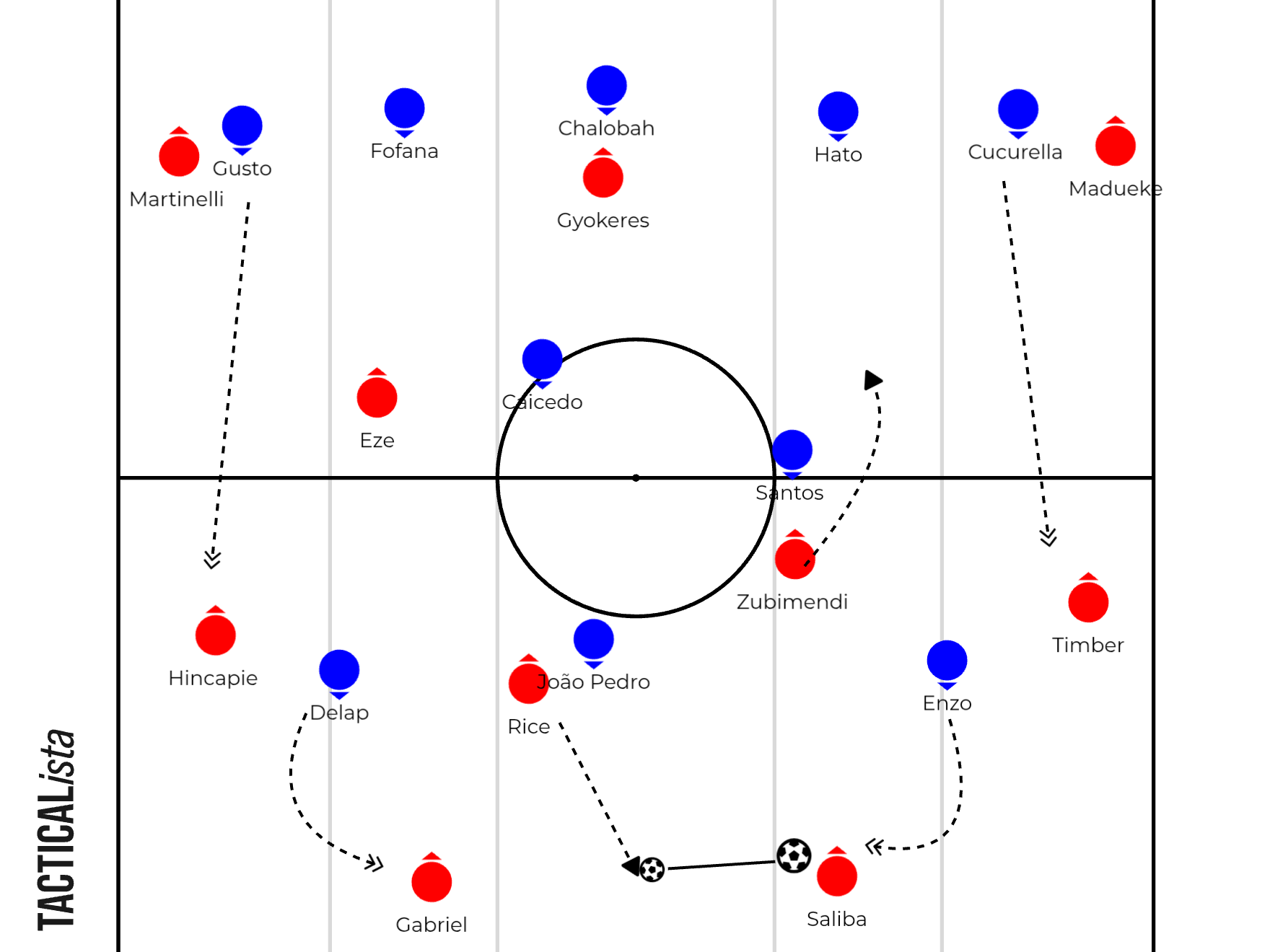
Minute 10′: Arsenal’s build up shape, with Rice dropping into defence to find space to receive and dictate.
This pressing structure created a shifting dilemma for Chelsea. Their wing-backs struggled with the constant “jumping out and dropping off” required to maintain a five-man defensive line while simultaneously pressuring the wings. As Arsenal moved the ball horizontally, the Chelsea block had to travel vast distances to stay compact. However, Arsenal still found progression difficult until Jurrien Timber began inverting into the midfield.
By stepping into the half-space, Timber helped form a box midfield alongside Zubimendi, Rice, and Eze. This tactical adjustment handed Arsenal a 4v3 numerical superiority in the center of the pitch. Most importantly, it dragged Cucurella into a central dilemma—stay wide to mark Madueke or tuck in to track Timber? When Cucurella chose to tuck in, it opened a direct, diagonal passing lane from Saliba to Noni Madueke on the right wing, allowing Arsenal to bypass the first two lines of the Blues’ press and establish residency in the final third.

Minute 14′: Timber joining the midfielders to overload the midfield while dragging Cucurella along, aiding progression.
Hincapie stops Chelsea’s long ball tactics
When Chelsea looked to build from the back, they encountered Arsenal’s aggressive man-to-man press. Viktor Gyökeres led the charge, harrying Trevoh Chalobah and quickly closing down Robert Sánchez as Fofana and Hato were well marked by Martinelli and Madueke respectively. Caicedo was tracked by the energetic Rice, Eze on Andrey Santos and Zubimendi keeping tabs on Enzo Fernandez. This forced the Chelsea keeper to bypass the midfield entirely and go long—a strategy that played directly into Arsenal’s hands.
The target for these clearances was almost always Liam Delap, but the young striker endured a nightmare evening against an aggressive Piero Hincapié. Operating as the defensive-minded left-back, Hincapié dominated the physical duel through superior anticipation, calculated aggression and upper-body strength. Delap lost the most duels in the game (8), while Hincapié was statistically the most dominant defender on the pitch, winning 8 duels and recording 5 tackles.
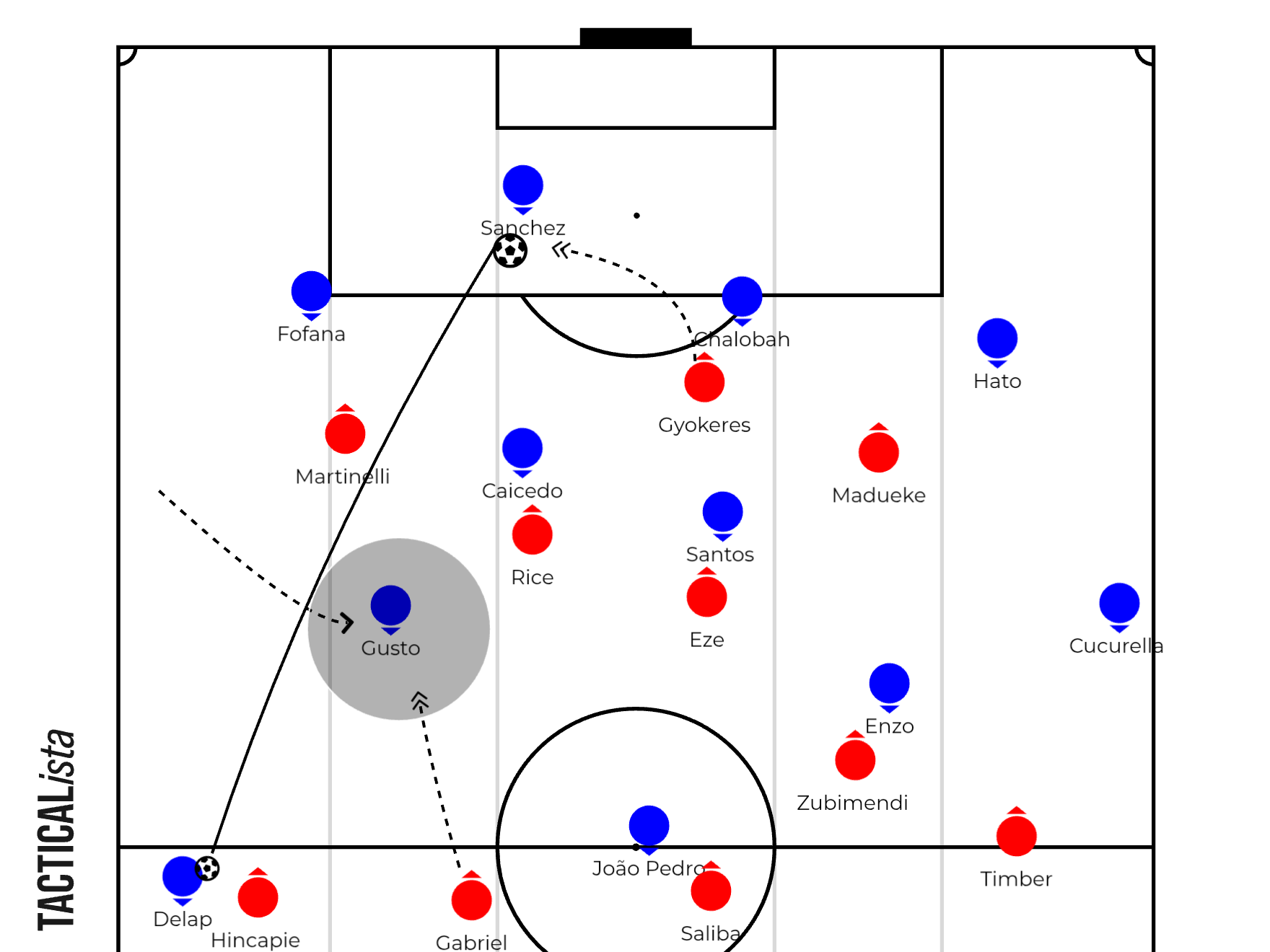
Minute 22′: Chelsea pressed by Arsenal as Sanchez goes long to Delap
When Arsenal opted not to press high and retreated into a 4-2-4 mid-block, Chelsea settled into their own 3-2-5 progression shape, with both wing-backs pushed high as Delap and Gusto rotated between the halfspace and the wing. The problem for Rosenior was that Cucurella and Gusto posed very little 1v1 threat against Arsenal’s solid full-backs.
Meanwhile, João Pedro frequently dropped deep to bait Saliba into fouls, successfully winning free kicks and disrupting Arsenal’s rhythm, even if he couldn’t find a way through to goal. Chelsea’s major success in this phase came through the movement of Enzo Fernández. By finding pockets of space away from Zubimendi at the edge of the box, Enzo managed three stinging shots from the same angle, forcing Kepa into one vital save in the first half.
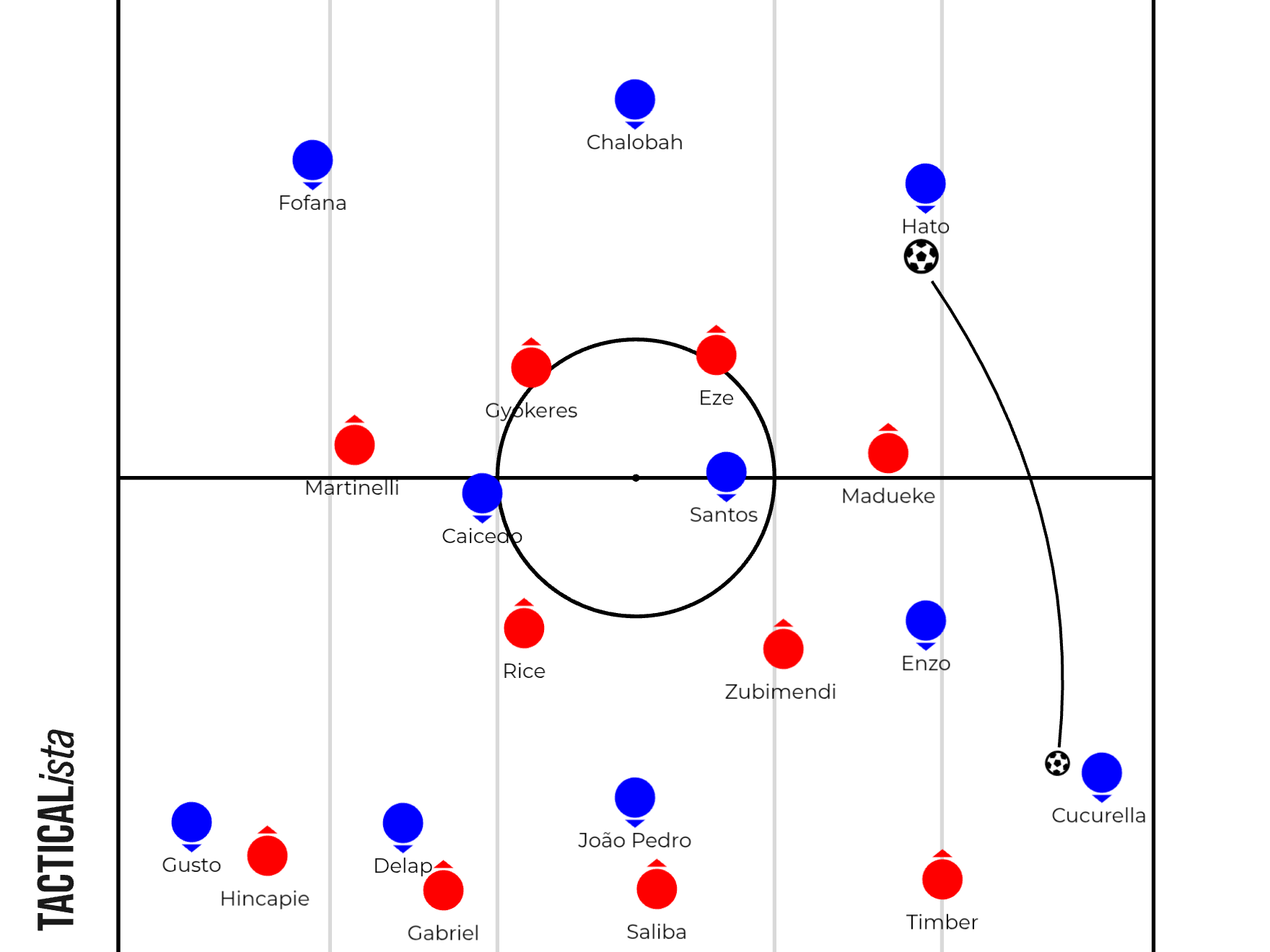
Minute 40′: Chelsea’s 3-2-5 progression shape v Arsenal 4-2-4 mid-block shape
Rosenior makes changes
Recognizing the stalemate, Liam Rosenior made a decisive double change at the hour mark. Estêvão and Cole Palmer were introduced for Hato and Delap, prompting a shift to a traditional back four. Estêvão initially moved to the left wing, while Palmer played as a roving playmaker in the right half-space.
This tactical pivot dramatically improved Chelsea’s pressing efficiency. Unlike the first half where they struggled to press Arsenal aggressively in their 5-2-3 shape, the change in formation helped Chelsea to press more aggressively. Palmer locked onto Rice, João Pedro pressured Gabriel, and Malo Gusto pushed high to pin Hincapié. With Enzo sticking to Saliba and Estêvão tracking Timber, Arsenal’s short passing options evaporated. For the first time in the match, Arteta’s men were forced into a cycle of “long and lose.” By forcing the Gunners to kick the ball away, Chelsea effectively monopolized possession and built sustained momentum.
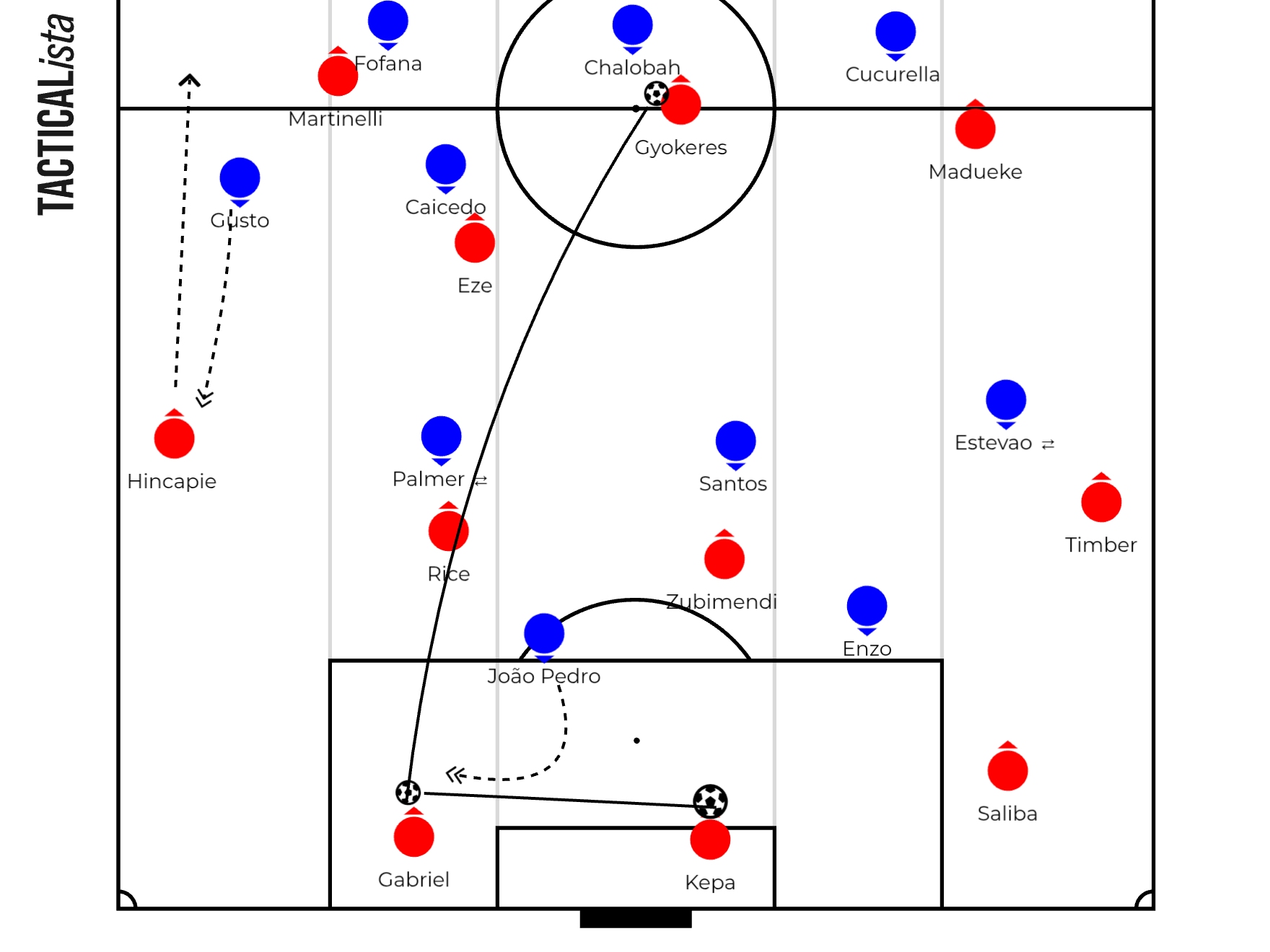
Minute 64′: Chelsea’s refined second-half man-marking press. This forced Arsenal to go direct to Gyokeres.
Palmer leads the charge
In possession, Chelsea became far more threatening with the new personnel. They maintained a 3-2-5 shape, but with a more dangerous balance. Estêvão held the maximum width on the left wing, providing a much higher 1v1 threat than Cucurella ever did, although Estevao still struggled to get past a rock solid Timber. This setup forced the Arsenal defense to shift further backwards, which in turn opened up more space for Cole Palmer in between the lines as he moved freely to get on the ball to try to create something for the Blues.
With Gusto continuing to overlap on the right, Arsenal were pinned into a deep 4-4-2 low-block that struggled to clear its lines. Despite this territorial siege, creativity and the free role of Cole Palmer, Arsenal’s box defending remained elite. Saliba and Gabriel repelled cross after cross, showcasing why they are considered one of the most formidable pairings in world football. Every time Chelsea seemed to find a gap, a red shirt was there to block the lane or win the second ball.
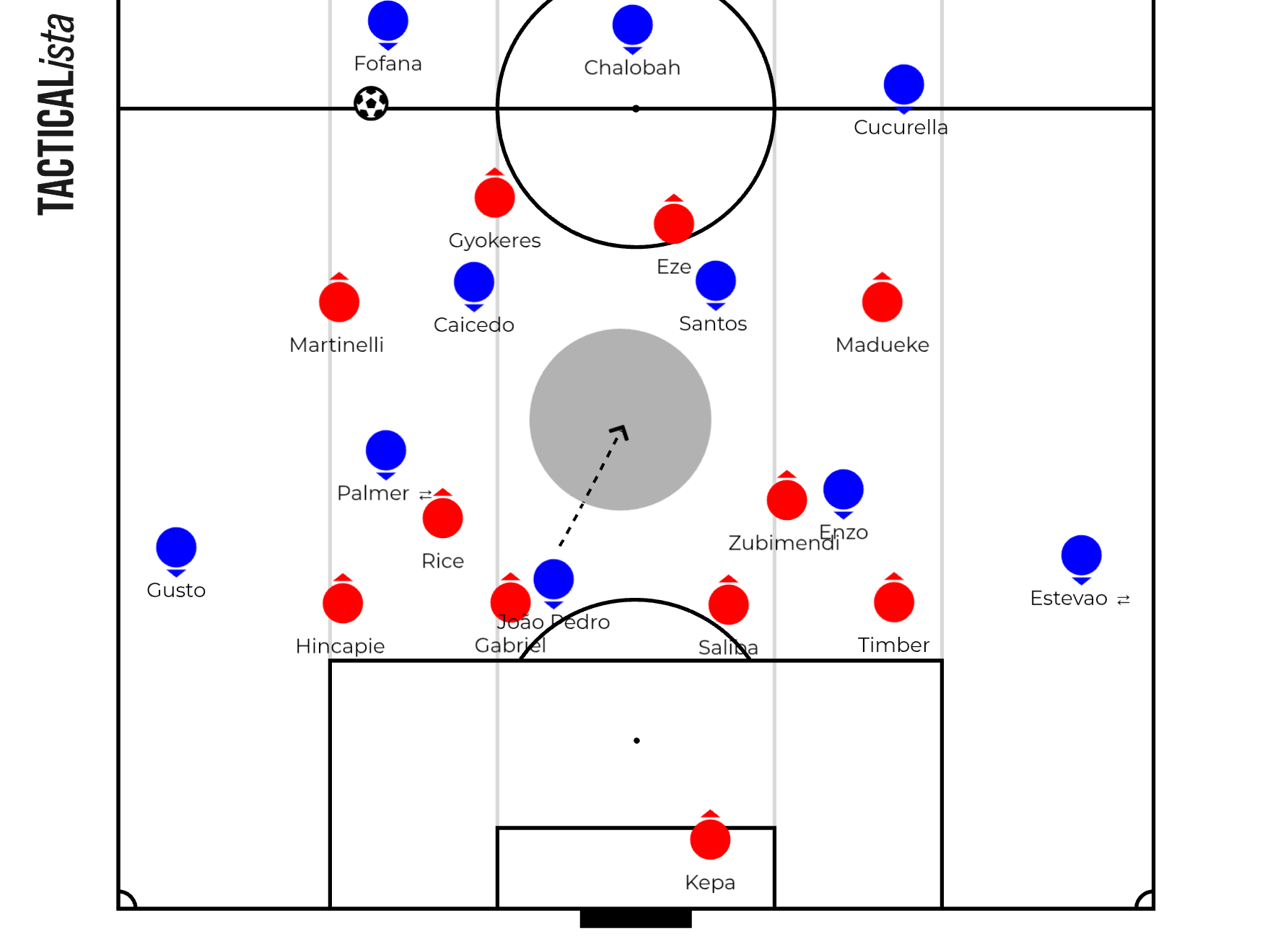
Minute 67′: Chelsea’s new attacking shape with Estêvão wide left and Palmer in the half-space
The stoppage-time sucker punch
The climax of the match arrived in the 97th minute. With Chelsea committing every outfield player forward for a final desperate attack, a poor long ball from Cucurella was cleared towards Trossard by the indomitable Hincapié. Leandro Trossard, who had recently come on, teed up Declan Rice with a clever well-timed pass.
Rice, seeing the entirety of the Chelsea half vacated, ran into space to receive with intent. He slid a perfectly weighted, one-time, left-footed pass to the substitute, Kai Havertz, who had timed his run to perfection. Havertz, showing the ice-cold composure that has defined his Arsenal career in big moments, rounded Robert Sánchez with a single touch and slotted the ball into the empty net to sink his former employers.
Takeaways
Arsenal’s ability to survive Chelsea’s tactical shift in the final 30 minutes speaks to a profound defensive maturity. They showed they could win without their primary creators by relying on structural discipline and individual brilliance in the duel.
For Chelsea, the introduction of Estêvão and Palmer showcased a much more dangerous version of Rosenior’s blueprint, but their inability to win aerial duels in the final third or convert territorial dominance into high-quality chances proved costly. Arsenal march on to Wembley, having once again proved that their floor is as high as any team in Europe.
Use the arrows to scroll through all available match plots. Click to enlarge.
Check the match plots page for plots of other matches.


Comments