
Bahia vs Palmeiras: Palmeiras pull away at the top of the table in one of the best tactical games of the year (1-2)
Palmeiras are now the outright leaders of the Brasileirão and are off to a very strong start to the season. On Matchday 10, they faced another team among the best in the league and won. In the story of the match, they scored first, conceded the equalizer and saw Abel Ferreira make punctual changes that helped rebalance the game. By the end of the night, it was not tactics that decided the match, but there is a lot of strategic merit in the game, from the two longest running projects in Brazil.
Tactical analysis and match report by Marcus Arboés.
Bahia, the Brazilian team from the City Group, is coached by the legendary former goalkeeper Rogério Ceni, known for his many free kick goals during his career at São Paulo. Now a football coach, he has a very technical team. With few absences, he lined up the team with Léo in goal; Nicolás Acevedo, David Duarte and Santiago Ramos (former Barcelona B) as center backs; Caio Alexandre and Jean Lucas as pivots, Everton Ribeiro (former Brazil National Team) as the number ten; Luciano Juba as the left fullback and Olivera (former LAFC) on the right; in attack, Erick Pulga played on the left wing and Everaldo as the target man.
Abel Ferreira continues to deal with important absences. Without Vitor Roque and with two left fullbacks injured, he had to use a young academy player. The team lined up as follows: Carlos Miguel (former Nottingham Forest) as goalkeeper; Giay, Gustavo Gómez (Paraguay National Team), Murilo and the young Arthur Gabriel in the defensive line; Andreas Pereira (former Fulham) and Marlon Freitas as the double pivot; Arias (former Wolverhampton) on the left wing and Allan on the right wing; Maurício (Paraguay) as a second striker and Flaco López (Argentina National Team) as the number nine.
Bahia’s possession play
Rogério Ceni had already shown hints of the type of coach he would become even when he was a legendary goalkeeper, as he took free kicks, penalties and scored many goals. His teams are always very offensive and like to maintain possession in the opponent’s half through a positional structure. At Bahia, he has the second longest running project in the top division of the Brasileirão, behind only Abel Ferreira at Palmeiras. Against any opponent, Bahia try to impose themselves technically.
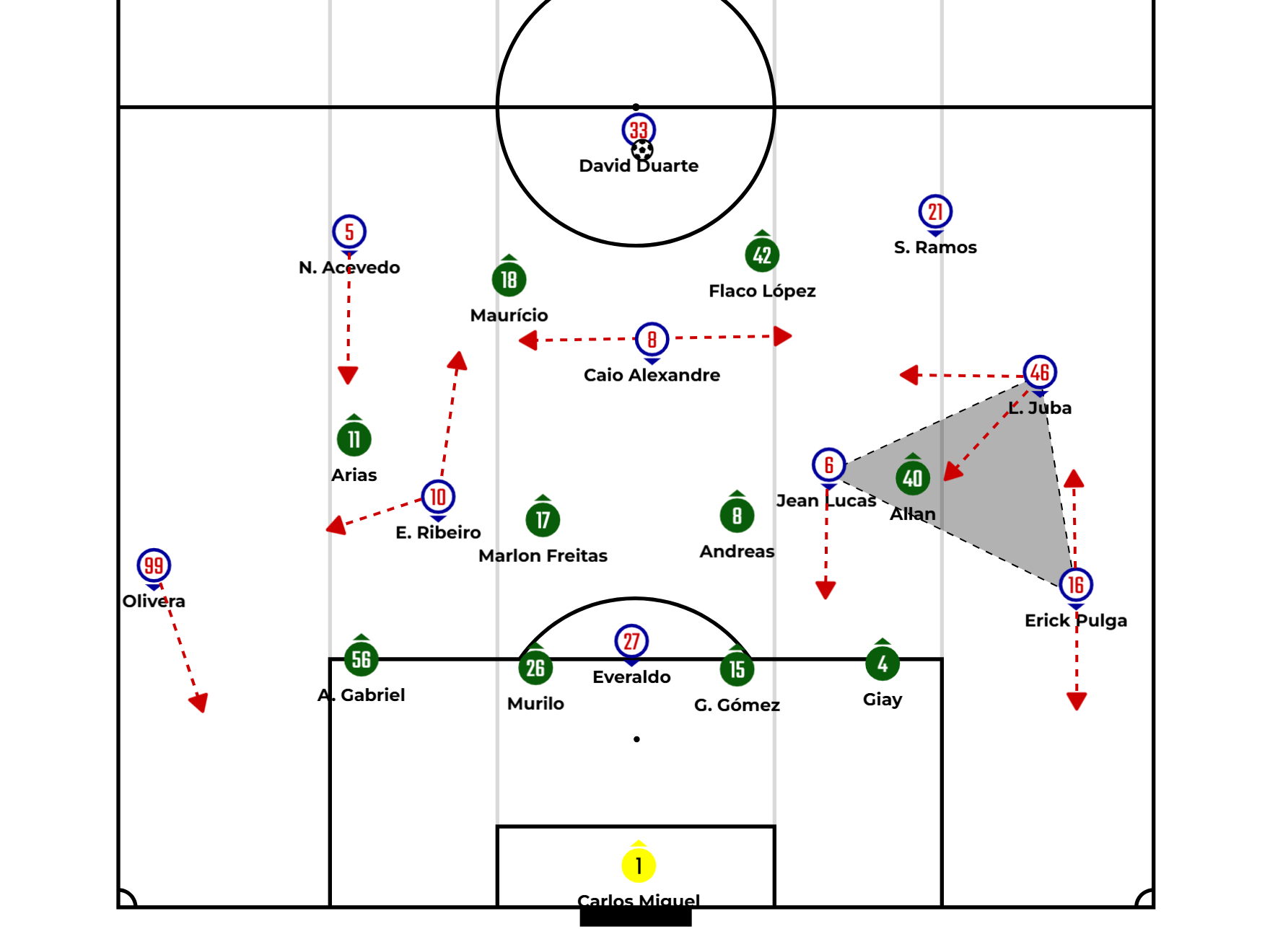
Bahia attack in a positional 3-2-5 shape against Palmeiras defense in a 4-4-2 formation.
Bahia and Palmeiras always deliver great tactical battles. In the first half especially, Bahia managed to retain possession in several moments, also because Palmeiras adopted a more reactive approach. The team under Rogério Ceni took many risks due to their level of exposure in the attacking half. The main plays came from the left side, with Bahia building in a 3-2-5 positional formation.
Out wide, Bahia always tried to progress through triangles, where the role of left winger Erick Pulga was to vary his height or move into the half space, attracting defenders; the role of left fullback Luciano Juba was to move inside like a pivot, helping in build up and creating dynamics in this triangle; and finally, Jean Lucas, as a pivot, attacked the available spaces created by rotations and attraction of opponents. At times, Caio Alexandre appeared as a deeper support option and Everton Ribeiro floated inside to unlock plays, with more freedom.
On the other hand, Everton Ribeiro, in this playmaking role, often dropped deeper to attract marking and free space for Jean Lucas to project from left to right, using Olivera, positioned wide, as support. Right side triangles rarely happened in the match. They usually occurred when center back Acevedo stepped forward to create an overload out wide. Acevedo, in fact, played with great freedom to carry the ball, offer support or even attack space to finish from the front when the team concentrated on the left side of the attacking half.
The lethal build up of the new Palmeiras
In the match against São Paulo, we had already seen how the new Palmeiras of Abel Ferreira attracts the opponent’s high block pressure to one side to switch play to Jhon Arias on the opposite side, verticalizing the game in classic Portuguese tactical style. This happened even more against Bahia, who always press high, than in the previous derby, and created very interesting situations.
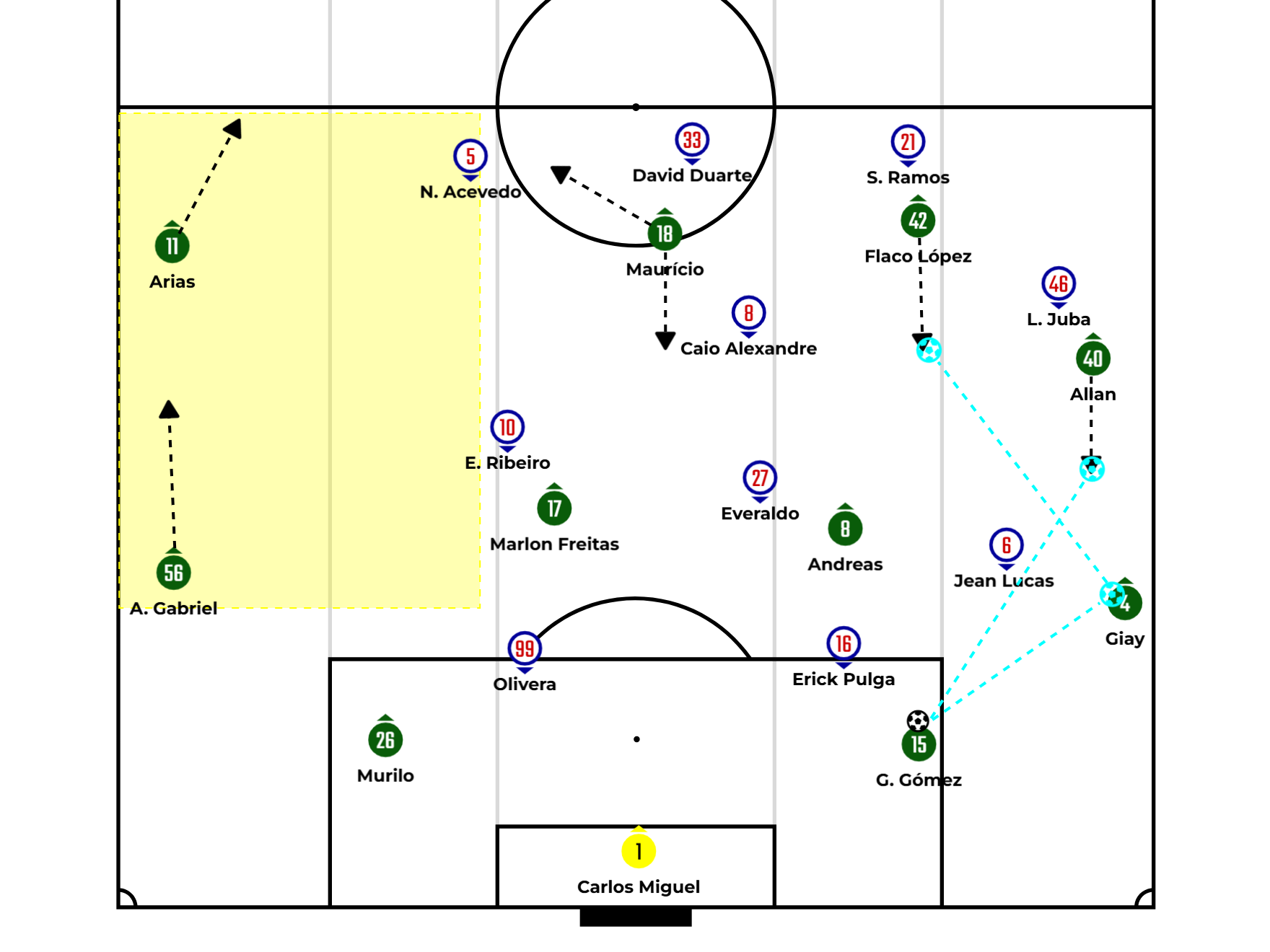
Palmeiras build up with positional dynamics in a 4-2-4 shape.
The intention of Palmeiras build up is to leave the Colombian Arias on the opposite side in advantage to progress with speed, often with the overlap of the left fullback. For that, the team organizes itself in a positional 4-2-4 formation. Giay and Gustavo Gómez start the build up looking for Flaco López inside and Allan out wide, making support runs, meaning dropping with their back to goal to connect with Andreas Pereira and Marlon Freitas facing forward. The pivots are mainly responsible for long diagonal passes to the opposite side, or even full switches of play.
The problem for Bahia’s marking is that this return pass is usually played in a timing window that affects the counter movement of Bahia’s defensive lines, which are changing direction. This allows Andreas Pereira and Marlon Freitas to get free with an open angle to find Arias. In this case, Bahia press high with man oriented marking in a 4-1-3-2 outline.
I believe some adjustments could have prevented this progression. In this formation, the wide players with the ball, Erick Pulga and Olivera, apply the first pressure, while Jean Lucas, Everton Ribeiro and Everaldo form the second line, stepping up to press depending on the side of build up. The issue is that among them, only Jean Lucas is truly a strong defender. One option would be to defend in a mid or low block, or place Everton Ribeiro in the first defensive line, switching positions with Olivera, who would have the physical capacity to react to switches and double up on Jhon Arias more quickly.
Abel Ferreira’s offensive strategies
Since last season, when Palmeiras started playing with a front two, the team began to prioritize more direct attacks in offensive organization, with pivots and center backs launching wingers, strikers and sometimes even fullbacks into wide channels. Without Vitor Roque and with Maurício as a second striker, the team prioritizes aerial diagonals to find Arias and Allan in one against one situations on the flanks.
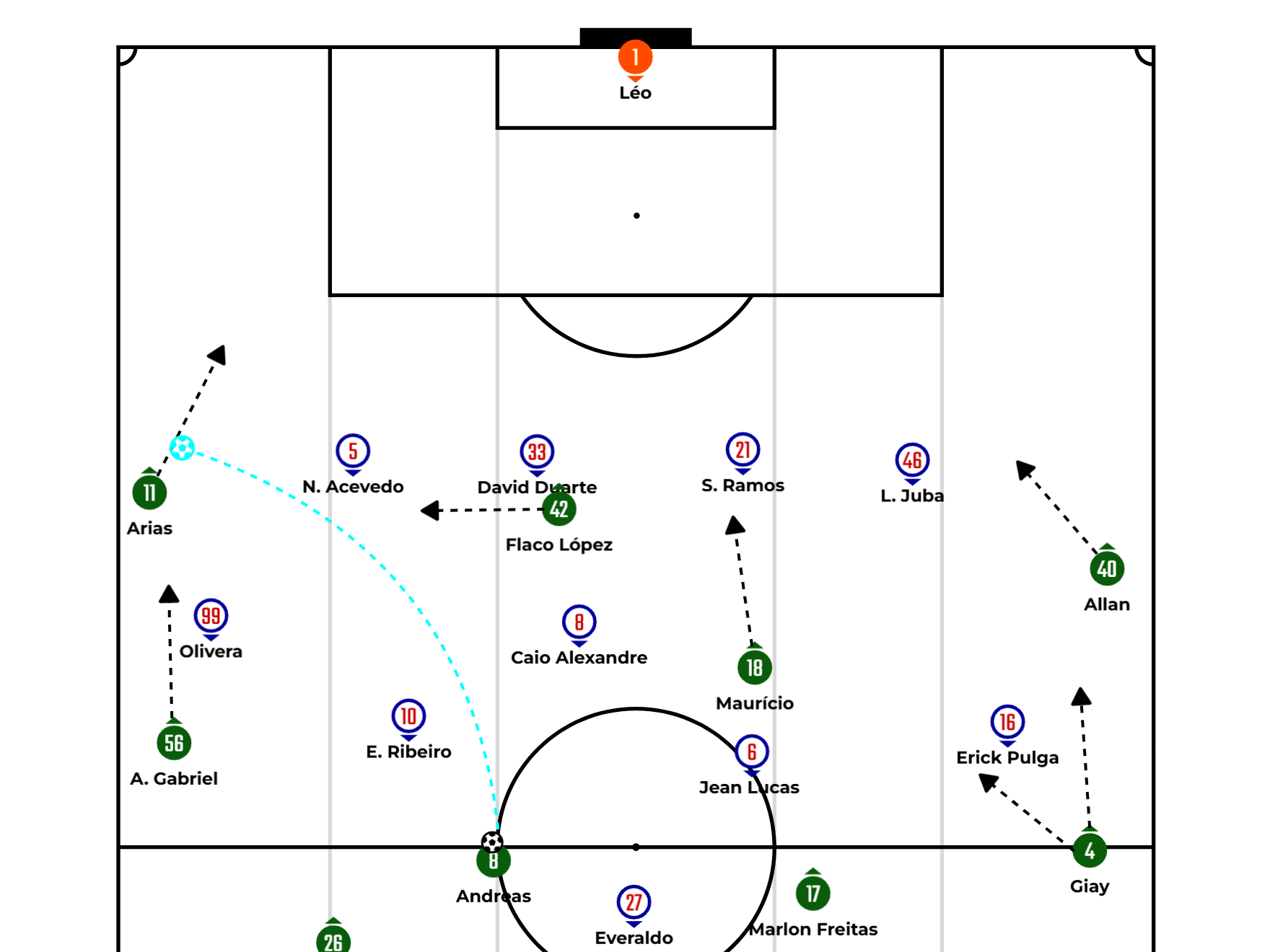
Palmeiras attack in a 4-2-4 outline, looking for aerial passes toward the wingers.
Just like in the first phase of build up, Andreas Pereira and Marlon Freitas are responsible for stretching the game, while the rest of the team manipulates the opposition’s marking so that Arias and Allan can receive in advantageous situations out wide and progress through individual quality. When not isolated, dribbling or finishing, they look for overlaps, inside or outside, from the fullbacks, but often receive inside support from one of the forwards for quick combinations.
That is exactly how the first goal happened. Bahia defended in a compact mid block in a 4-5-1 formation, where Olivera ended up in a position that left a gap out wide, as the last defensive line was very narrow. From a long pass by Andreas Pereira, Arias received with advantage, carried the ball forward, created uncertainty and combined with Flaco López on an overlapping run to score. Simple football, but effective.
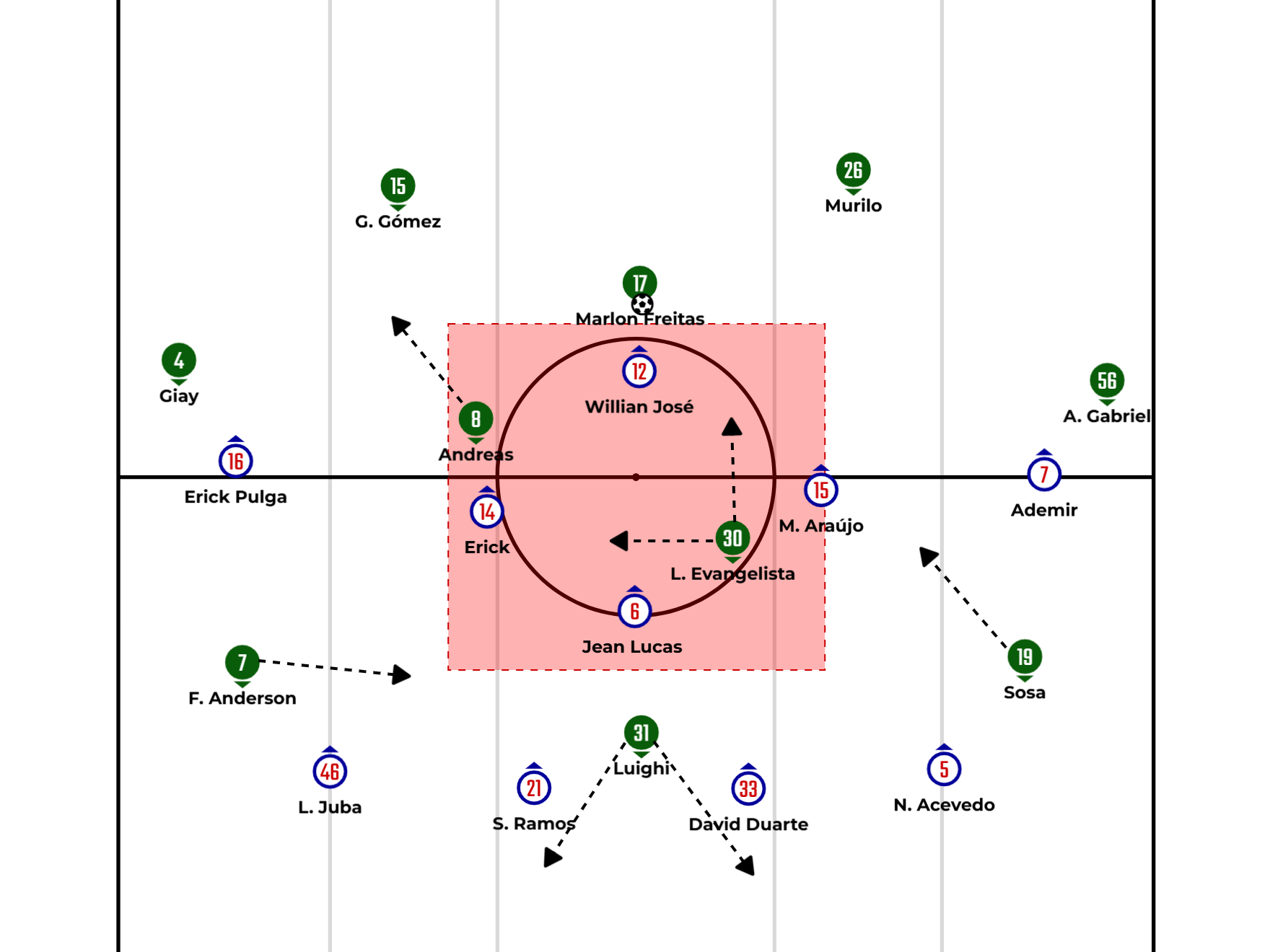
Second half adjustment with Palmeiras attacking in a 4-3-3 outline and Bahia responding with three central markers.
Efficiency is Palmeiras main principle. The team does not need to play beautifully, but it is effective. Even with Bahia having more shots and more possession at home, Abel Ferreira side managed to win 2-1, but not without difficulties. In the second half, Bahia improved their pressing and the build up, which had previously been right sided, shifted to the left, but lacked coordination and the young fullback Arthur Gabriel made several mistakes due to exposure, which seemed to affect his confidence.
In addition, Bahia started to win more duels and find more central spaces. To respond, Abel Ferreira made four changes: he introduced Luighi, a striker more focused on runs in behind than support play, Sosa and Felipe Anderson, who are wingers capable of supporting and finishing, and Lucas Evangelista, a second pivot with playmaking ability. Evangelista replacing Maurício shifted the tactical system into a 4-3-3. Now Palmeiras had three midfielders to find the wingers out wide or Luighi attacking space behind the last line.
Bahia equalized with a headed goal from a set piece by center back David Duarte. To respond to Palmeiras control in midfield, they made several changes. They replaced the right winger for fresh energy, brought in Erick for Caio Alexandre and Michel Araújo for Everton Ribeiro, making the midfield more physical and closing central spaces. The match remained balanced, with chances for both sides, but from a corner delivered by Andreas, Santi Ramos ended up scoring an own goal.
Takeaways
With this result, Bahia missed the chance to enter the direct qualification spots for the Libertadores, remaining in fifth place with 17 points. Even so, they have been one of the best teams in the Brasileirão. After beating Athletico and losing to Palmeiras, they will face another tough match against a team that did not start the league well but is recovering, Mirassol.
On the other hand, Palmeiras took advantage of Fluminense’s draw to extend their lead at the top, opening a five point gap over second place. These are wins in direct clashes at the top of the table in the last three matches and five consecutive victories in the Brasileirão. In midweek, they drew with Junior from Colombia in the Libertadores, and will now face a major clash against their biggest rival Corinthians, now coached by Fernando Diniz.


Comments