Colombia – Ghana: Colombian Control As Ghana Fail To Muster Attacking Threat (1-0)
Colombia eventually emerged victors in their Round of 32 clash against Ghana in Kansas City, winning by a 1-0 margin to qualify for the Round of 16 at the 2026 FIFA World Cup. A goal from Jhon Arias in the first half was enough to settle the game in the end although Colombia dominated proceedings, with Ghana failing to conjure up any meaningful attacks.
Tactical analysis and match report by Gaurav Krishnan.
We decided to make this article free to read. If you want to support our work, consider taking a subscription.
It was South America vs Africa as Nestor Lorenzo’s Colombia side went up against Carlos Queiroz’s Ghana in the Round of 32. Colombia have emerged as dark horses in this World Cup putting in some admirable performance in possession and in their OOP phases.
The African teams have generally been reliant on their physicality and industry at this World Cup. However, despite Ghana’s valiant attempts at securing a historic win and qualifying for the Round of 16, it just wasn’t to be especially considering Ghana effectively failed to threaten the Colombian goal all game.
Colombia stole ahead early on in the game as Jhon Arias scored for the South Americans as they dominated possession in the game with 61% of the ball compared to Ghana’s 39%.
Ghana’s game plan was to sit in their mid to low block and aim to frustrate Colombia and then hit on the counter. However, that gameplan quickly evaporated after Arias’ opener early in the first half, urging Ghana to attack the game. But Queiroz’s tactics remained pragmatic enough to not concede another as Ghana looked to punish Colombia’s possession-based play but couldn’t create at the other end of the pitch.
In the end, Ghana couldn’t muster a victory to get over the line and progress into the Round of 16. This was also typified by the xG difference between the teams. Colombia created five big chances with an xG of 2.04 while Ghana created zero big chances apart from shots from distance in the game mustering a paltry 0.27 xG (as per Sofascore).
Colombia qualified for the Round of 16 where they will now face Switzerland on the 7th of July & in truth the scoreline could’ve been more if it wasn’t for the Ghana goalkeeper Ati Zigi.
Colombia lined up in a 4-3-3 formation. Camilo Vargas started in goal with a back four of Daniel Munoz at right-back, Davinson Sanchez and Jhon Lucumi at center-back with Johan Monjica at left-back. The midfield trio comprised Jefferson Lerma, Jhon Arias and Gustavo Puerta. While James Rodriguez started on the right flank, Luis Diaz on the left flank with Jhon Cordoba as the striker.
Ghana lined up in a 4-1-4-1 shape. Lawrence Ati Zigi started in goal with a back four of Marvin Senaya at right-back, Derrick Luckassen and Jerome Opoku at center-back and Gideon Mensah at left-back. Thomas Partey anchored the midfield pivot with Caleb Yirenkyi and Kwasi Sibo just ahead in midfield while Inaki Williams started on the right flank, Antoine Semenyo on the left flank and Jordan Ayew starting as the central striker.
Colombia Take The Lead Early On
Colombia built from the back rather easily. Davinson Sanchez and Jhon Lucumi split wide or stepped into midfield, allowing Camilo Vargas to distribute or play short. The midfield trio of Jefferson Lerma sitting deeper, Gustavo Puerta and Jhon Arias who were more progressive, formed a flexible 3-2 or 2-3 or at times a 2-2 structure depending on full-back positioning. Daniel Munoz frequently tucked inside or advanced into the right half-space to create overloads, while Johan Mojica stayed wider on the left for width and crossing options.
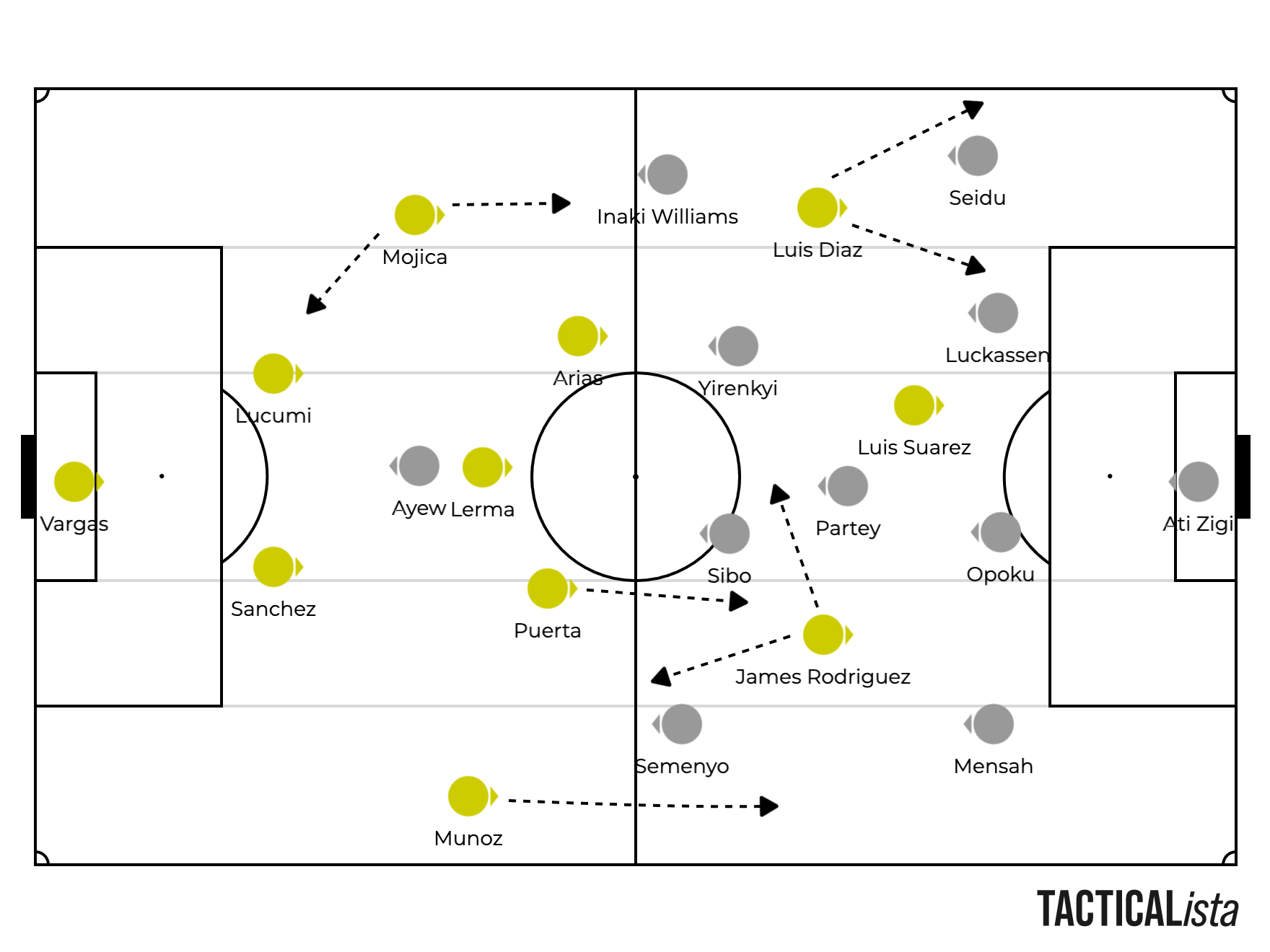 How Colombia set up in their 4-3-3. Munoz at full back constantly overlapped on the right, while Mojica either dropped into the back three or held the width. James Rodriguez frequently dropped into the midfield pockets as Puerta made progressive forward runs and carries. Diaz meanwhile either overlapped or underlapped with inside runs on the left as Suarez also drifted wider from his central striker position.
In the attacking phase, Colombia often shifted into fluid 4-2-3-1 or 3-2-5 shapes which also became a 3-1-6 or 2-2-6 at times, with several positional interchanges. James Rodriguez dropped into pockets between Ghana’s lines to receive and dictate, while Puerta provided box-to-box energy and progressive carries, complementing Arias’ late arrivals or inside runs. The front three rotated as well, Luis Diaz made diagonal runs behind the Ghana right-back, Cordoba and later Suarez who came on for the former held up or made runs in behind, and wide players combined with overlapping or underlapping full-backs.
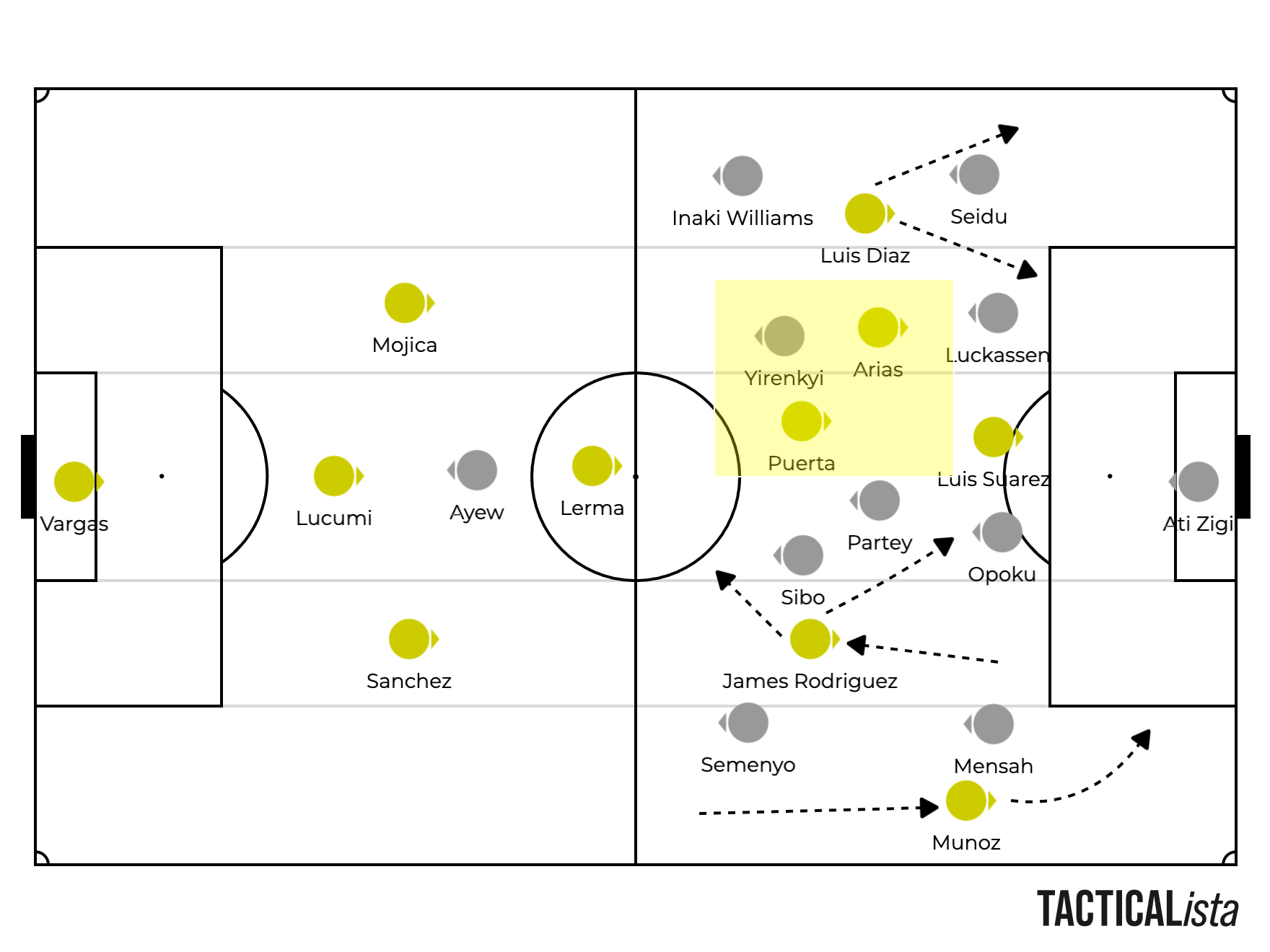 Colombia build in a 3-1-6. Lerma forms the central midfield base. Puerta and Arias advance forward creating a 2v1 against Yirenkyi. James Rodriguez drops into the pockets as Munoz overlaps and stretches the right flank while Diaz also does the same with inside and outside runs on the left. Suarez meanwhile is the central striker outlet.
Ghana’s OOP approach was a disciplined compact mid-to-low block in a 4-5-1 shape when the wide players dropped which was also a 4-1-4-1 in slightly higher phases. Partey sat as the deepest midfielder screening the pivot zone and central corridor. The four midfielders Yirenkyi, and Sibo and the two wide players tucking in compressed space between lines, denying Rodriguez or Puerta easy reception in dangerous pockets. The back four stayed narrow and compact to protect the centre, accepting that Colombia would use width. Ghana did not press high consistently especially from goal kicks but instead invited Colombia forward before looking to win second balls or spring counters. Ground duels were a strength for Ghana who won 55% of them, but this came at the cost of being pinned back.
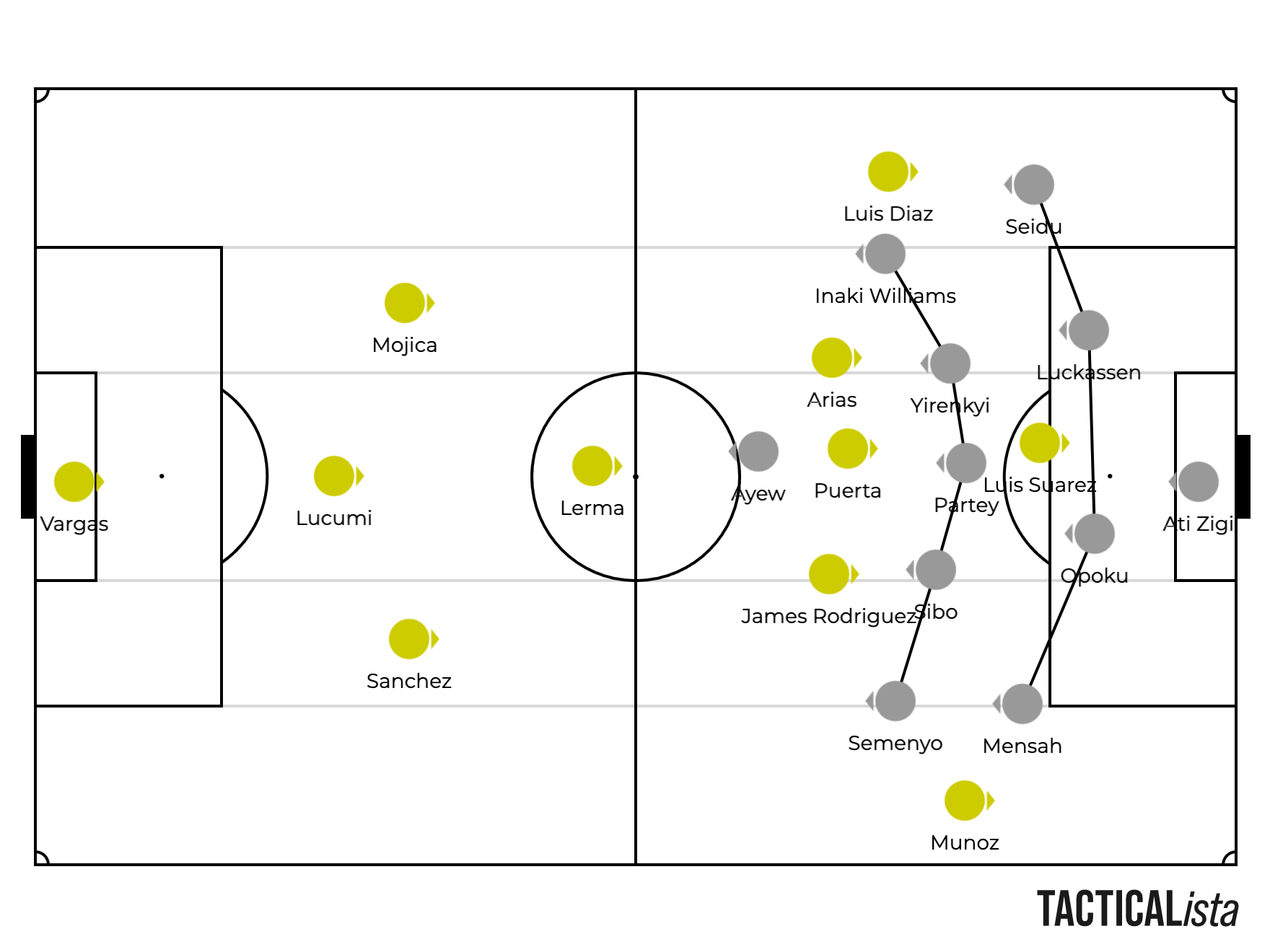 Ghana sit in their disciplined 4-5-1 OOP mid-to-low block as Colombia attack in a 3-1-6 IP shape
The decisive 14th-minute goal stemmed directly from Colombia’s right-side tactical adaptations and a momentary Ghana defensive lapse. Cordoba’s early groin injury forced Luis Suarez on at the 8th minute mark. Munoz played a ball into Suarez on the right and the substitute muscled past his marker, delivering a sharp low cross, and Arias arrived unmarked at the far post for a clinical finish. Ghana’s early sub where Senaya came off injured, and the disruption of their right-side shape left Arias free as Colombia exploited the transitional moment perfectly.
Ghana Struggle To Mount A Comeback
Ghana’s 4-3-3 in possession was more direct and vertical. Partey anchored build-up from deep, often receiving from the centre-backs. The wide players Williams right, and Semenyo left stretched play, while Yirenkyi/Sibo provided central support. Ayew acted as the outlet for long balls or hold-up play to facilitate transitions. Ghana struggled with progressive passing in the final third with only 55% accuracy on 86 attempts and relied on individual dribbles or quick forward passes rather than structured build-up combinations. Their 39% overall possession reflected Colombia’s control rather than a deliberate low-block choice in every phase.
Colombia pressed with intensity and triggers. The front three had clear roles as Suarez post-sub cut off Partey’s receiving angles from the Ghana backline as Diaz engaged the right-back Seidu immediately during build-up. Meanwhile, James Rodríguez positioned to block central midfield lanes. This was often a high or mid-press in a zonal 4-4-2 base that could shift to man-oriented triggers. When successful, it won the ball high and enabled quick transitions. Even after taking the lead, Colombia maintained a relatively high defensive line and organised structure, limiting Ghana to minimal dangerous entries.
Out of possession in deeper areas, Colombia defended in a compact mid-to-low block often a zonal 4-4-2 or 4-5-1 shape, with Lerma screening centrally and full-backs staying compact. Colombia’s aerial dominance with a 58% win rate and 25 clearances helped protect the Colombian box. They conceded few shots on target and forced Ghana into low-quality efforts from distance.
Colombia Seal It
In the second half, Colombia continued to dictate but became slightly more measured in their approach. Diaz had a goal disallowed for offside in the 56th minute and then saw a close-range effort saved by Ati Zigi. Ghana introduced pace as Fatawu came on for Williams at 62’ and later Nuamah for Ayew and Adu for Yirenkyi in an attempt to stretch Colombia and create transitions, but the Black Stars still registered zero shots on target across 90 minutes. Their 52 final-third entries however were similar in number to Colombia’s at 55 but far lower in quality.
In their late-game tactics, Colombia shifted toward possession retention and game management. Quintero replaced Arias in the 73’ minute for creativity, control and key passes in the final third. Diaz came off late for fresh legs as well. Ghana pushed numbers forward in desperation but lacked the precision or sustained pressure to trouble Vargas in the Colombian goal meaningfully. In the end, Colombia’s possession, organised defending and aerial strength prevented any serious comeback from Ghana, who in truth struggled to create and meaningful openings or shots on target.
Takeaways
This game showcased Colombia’s posession-based domination and saw the South American side convert a decisive chance and they threatened through the game but had Diaz’s goal ruled out for offside. Overall this was a game of asserting control for Colombia which saw them see out the result.
For Ghana, their woeful showing in front of goal was of course the clear standout talking point. The Black Stars were physical and kept it compact at the back for many phases, as Colombia scored only the solitary goal, however, their sheer lack of attacking impetus or fashioning clear-cut chances was glaringly evident. In the end, Ghana only managed a 0.27 xG and zero shots on target as they bowed out of the World Cup.
We decided to make this article free to read. If you want to support our work, consider taking a subscription.
Use the arrows to scroll through all available match plots. Click to enlarge.
Check the match plots page for plots of other matches.