

Czechia – Mexico: Three Wins Out Of Three For Mexico (0–3)
Co-hosts Mexico secured an emphatic and historic conclusion to their 2026 FIFA World Cup group stage, easing to a 3-0 victory over Czechia at a celebratory Mexico City Stadium. Javier Aguirre’s rotated side shook off a cagey, difficult opening period to unleash an absolute lethal transitional play during the second half. A 54th-minute breakout strike from youngster Mateo Chávez broke the deadlock before predatory finishes from Julián Quiñones and substitute Álvaro Fidalgo sealed the triumph. The game also saw Mexico legend Ochoa come on for his sixth World Cup. The result marks the first time in El Tri’s history that they have swept a World Cup group stage with a perfect nine points.
Tactical analysis and match report by Aderemi Qoyum.
We decided to make this article free to read. If you want to support our work, consider taking a subscription.
The encounter presented a distinct contrast in objectives. While Mexico entered the fray having already locked down a knockout berth, Aguirre utilized the opportunity to adjust his deck, handing a historic debut to 17-year-old sensation Gilberto Mora alongside a starting nod for Mateo Chavez. Nominally arranged in a balanced 4-1-2-3 structure, El Tri’s blueprint aimed to replicate their previous fluid positional mechanics. With Rangel in goal, César Montes and Israel Reyes marshalled the defense flanked by Jorge Sánchez and Mateo Chávez. In the center, captain Edson Álvarez anchored the midfield as the single pivot, liberating Luis Romo and Mora to orchestrate higher up, while Roberto Alvarado and Julián Quiñones supported central spearhead Guillermo Martínez.
Conversely, Miroslav Koubek’s Czechia arrived desperate for all three points to harbor any hope of advancing as a best third-placed side. They rolled out a rugged 5-2-3/3-4-2-1 formation on paper, anchoring Matěj Kovář in goal behind a defensive unit comprising David Douděra, Tomáš Holeš, Robin Hranáč, Ladislav Krejčí, and Vladimír Coufal. Michal Sadílek and Lukáš Červ formed a central double pivot engineered to block passing lanes, while Pavel Šulc and Denis Višinský tucked closely behind Adam Hložek to launch quick, direct vertical counters.
Czechia’s great start
The opening exchanges of the match belonged firmly to Czechia, who surprised the co-hosts by dominating the territorial battle through a 4-2-4 build-up routine. Miroslav Koubek structurally asymmetricalized his team: right wingback Vladimír Coufal pushed extremely high to operate as a right winger, while left wingback David Douděra initially remained deep, creating a temporary back four alongside the center-backs. Further up the pitch, Denis Višinský and Pavel Šulc occupied aggressive, high positions in the halfspaces right on the halfway line, flanking Adam Hložek who pinned the Mexican center-backs deep.
To bypass Mexico’s defensive block, Czechia relied heavily on goalkeeper Kovář acting as a vital extra outfield player. Kovář displayed immense composure, deliberately baiting the press of Guillermo Martínez or Gilberto Mora before calmly passing to his centre-backs or threading risky vertical passes into the central double pivot of Sadílek and Červ stationed close together just ahead of their own box. Both players specialized in sharp, rapid bounce passes in and around the first line of pressure. They would absorb the contact, quickly bounce the ball wide to Hranac or Krejčí, who then carried the ball progressively forward into the middle third.
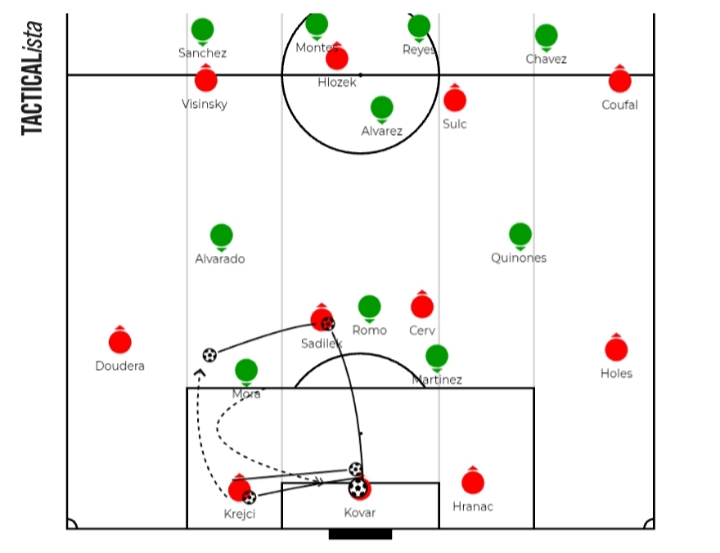
Minute 10′: Czechia’s asymmetrical 4-2-4 build-up shape utilizes Kovář to draw out Mexico’s diamond 4-4-2 press and progress through the double pivot.
Mexico attempted to counteract this with a fluid diamond 4-4-2 pressing structure, but initially struggled to find answers. Mora would step up next to Martínez to pressure the central defenders, while wide attackers Quiñones and Alvarado stayed narrow and compact to monitor Holeš and Douděra while providing close support to Romo. Romo was handed the taxing assignment of tracking Czechia’s double pivot, shifting aggressively toward whichever midfielder was ball-side, while the far-side winger was expected to tuck inside as a secondary cover.
At times, the system morphed into a flat 4-4-2 press as defensive anchor Edson Álvarez boldly pushed high up the pitch to jump onto Sadílek, allowing Romo to fully lock onto Červ. However, Czechia’s slick, structural spacing consistently manipulated these triggers early on. Whenever Mexico managed to coordinate an effective press to trap them wide, Czechia would intelligently bypass it by going long to Adam Hložek. The striker did a magnificent job as a focal point, holding off challenges to win eight of his thirteen contested duels while winning a match-high 3 fouls to consistently relieve physical pressure.
Czechia with no shot on target
Once Czechia successfully bypassed the initial pressing line and progressed into the consolidation phase, their shape transformed into an expansive 3-2-5 structure. David Douděra was released from his deeper defensive duties, exploding high and wide to occupy the maximum width of the left flank, while Coufal mirrored him on the right. This structural shift forced Mexico into a reactive out-of-possession adaptation.
Roberto Alvarado was forced to drop completely back into the defensive line, tracking the lung-bursting overlaps of Douděra to create a temporary, survivalist back five. In front of captain Edson Álvarez, who sat as the deepest midfield shield, the trio of Quiñones, Romo, and Mora formed a compact second line of defense directly behind Martínez, desperately attempting to clog up the central lanes.
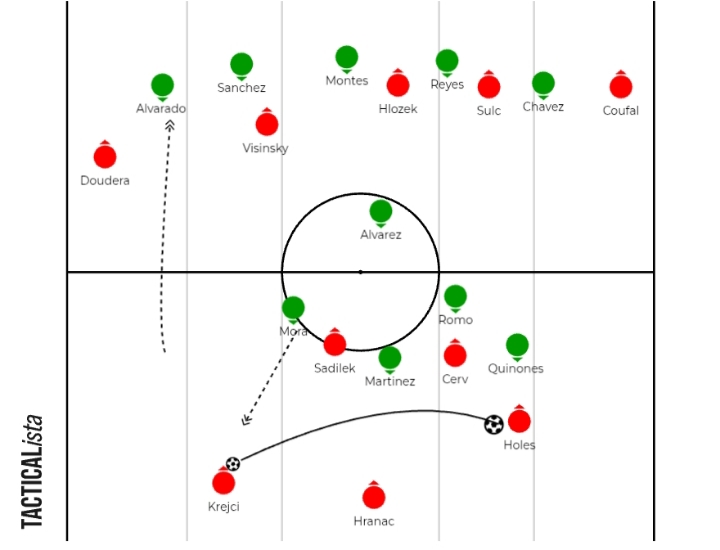
Minute 20′: Czechia’s 3-2-5 progression phase pushes Mexico into a mid-block, with Alvarado dropping to form a temporary back five.
The notable absence of midfield metronome Érick Lira and defensive powerhouse Johan Vásquez severely hampered Mexico’s early on in the game. Both players had been absolute pillars of El Tri’s suffocating possession dominance throughout the first two group matches, and without their structural familiarity, Mexico looked remarkably disjointed and unable to retain the ball under Czechia’s high-intensity physical duress.
The savior for the co-hosts arrived via the cooling hydration break midway through the first half. The brief tactical interlude allowed Aguirre to completely recalibrate his team’s defensive reference points and stabilize their possession patterns. Armed with renewed momentum, Mexico wrestled control back for the final twenty minutes of the half.
When Mexico attacked, they were okay with both Chavez and Sanchez making attacking runs, while Romo was also allowed to overload the central areas alongside Quinones and Mora. Mexico were more lively on the right through Alvarado and Sanchez. Their sustained possession finally began to pin Czechia back, culminating in a golden opportunity in the 39th minute. After an intricate combination sequence, Israel Reyes found space inside the box and unleashed a stinging effort, forcing Kovář into a brave, spectacular punch to clear the imminent danger and keep the scoreline level at the interval.
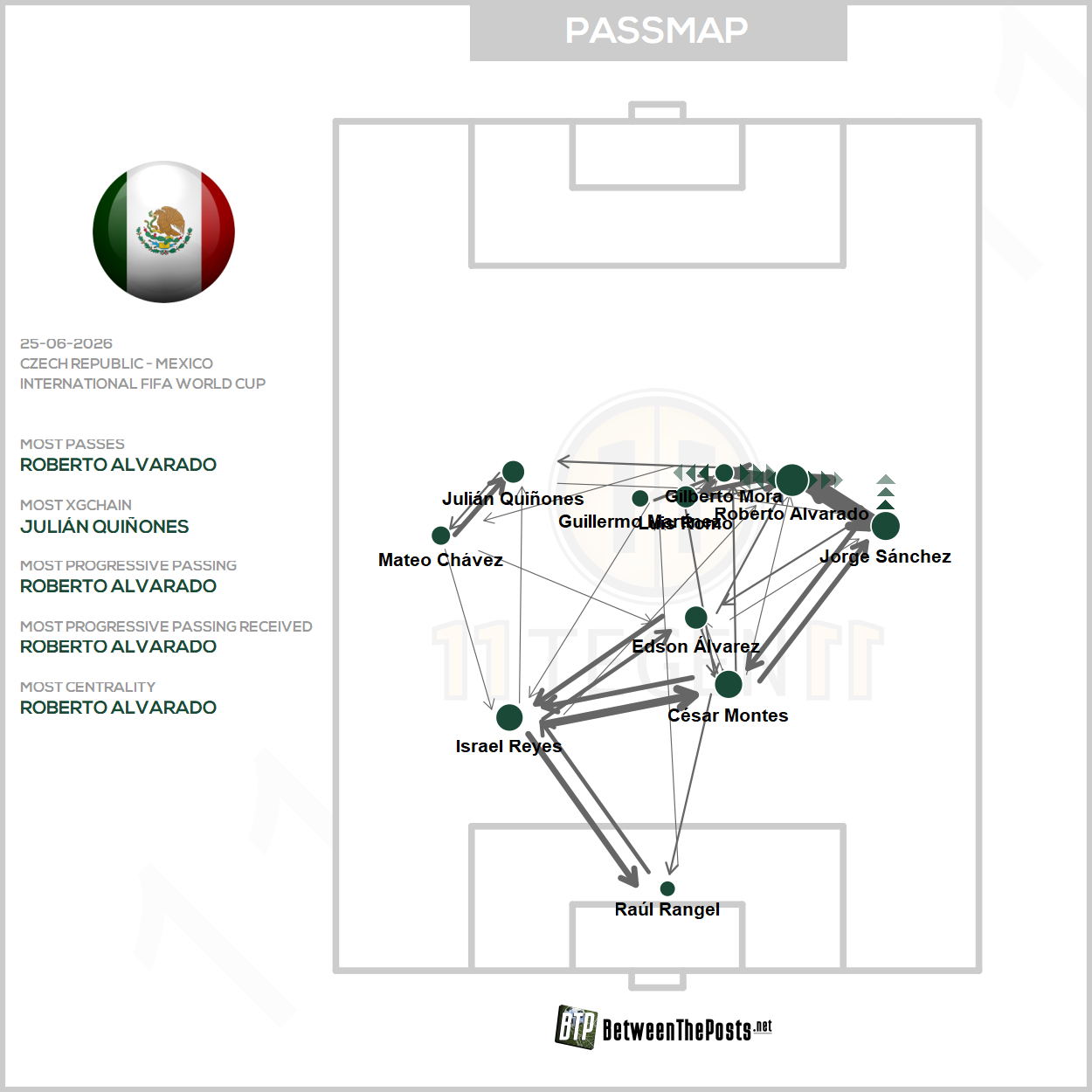
Mexico’s Passmap shows how many bodies they pushed forward when they attacked. The presence of Alvarez in midfield freed both fullbacks and CMs to attack based on where they look to create from.
Fast breaks lead to goals
If the first half was a tactical game of controlled structural schemes, the second half became an absolute clinic in devastating transitional execution by Mexico, capitalizing on high-speed vertical counters immediately after defensive actions.
The opening goal in the 54th minute came after Mexico did brilliant work to defend several consistent Czechia set-pieces in quick succession. After clearing the final delivery, an explosive attacking transition was sparked by Luis Romo, who displayed immense upper-body strength and technique to hold off three Czech players on the halfway line before slipping a perfectly weighted pass to Mateo Chávez on the right. Chávez made a blazing, lung-bursting run past Michal Sadílek before cutting inside and slotting a precise finish home with his weaker left foot.
Just seven minutes later, a secondary quick assault doubled the advantage. This time, the young Gilberto Mora carried the ball forward with great acceleration before threading an intricate vertical through ball to meet the underlapping run of Jorge Sánchez, who had caused so much troubles, on the right flank. As Sánchez broke clear through on goal, Matěj Kovář rushed out aggressively to snuff out the danger; however, his retreating defender Tomáš Holeš made a complete mess of the clearance, and the resulting clearance rebound hit Sánchez and fell perfectly for Julián Quiñones to calmly prod the ball into the empty net.
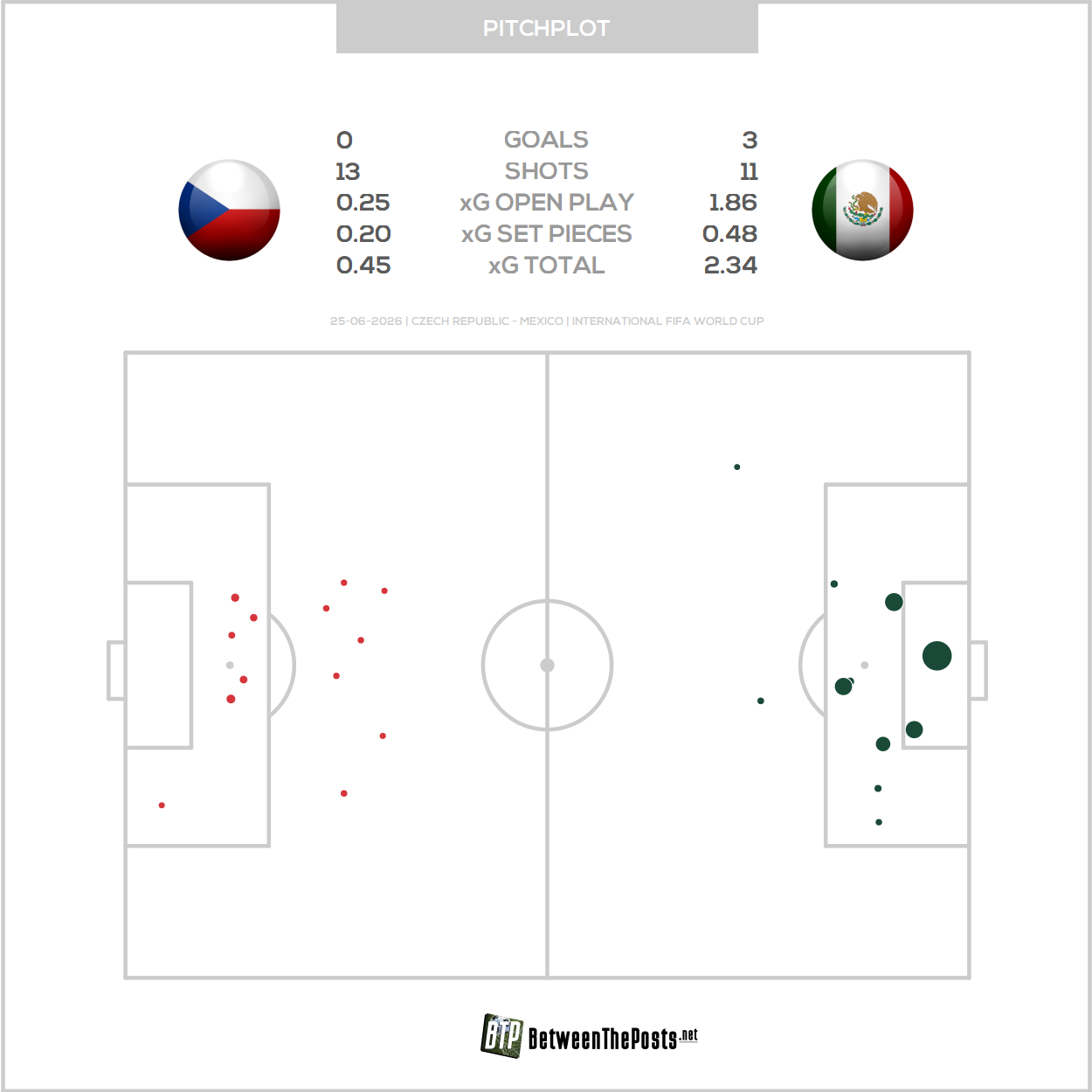
The Pitch Plot shows how Mexico took control of the game and were more threatening with their shots than Czechia were.
Faced with a quick double-blow and impending elimination, Miroslav Koubek immediately rolled the dice with a series of adjustments. Lukáš Provod was introduced in the 56th minute just after the opening goal, followed closely by the dual introduction of Tomáš Souček and Patrik Schick immediately after the second goal conceded. These personnel changes brought a total structural shift as Czechia abandoned their back five for a more aggressive back-four system.
Pavel Šulc shifted out to the left wing while Provod moved to the right. This new-look Czechia began to press with immense purpose and sheer physical aggression, opting for a strict man-to-man defensive structure against Mexico’s short build-up. The visitors arranged themselves in a matching 4-4-2 press to disrupt Mexico’s structural 4-2-4 build-up shape; Souček advanced high up the pitch to join Schick in the first line of pressure, while Krejčí stepped boldly forward into the midfield whenever necessary to track the elusive movements of record-breaker Gilberto Mora.
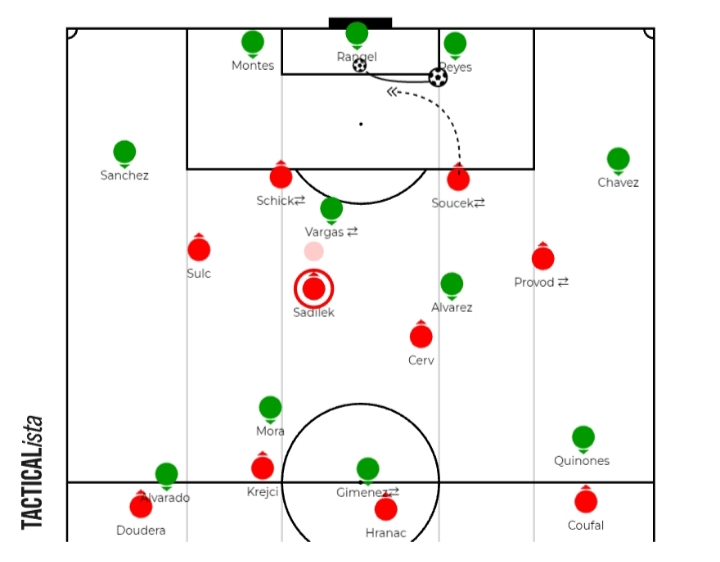
Minute 66′: Czechia’s pressing shape immediately after conceding the second goal.
Special moment for the legendary Ochoa
Despite the mounting Czech pressure, Aguirre showed tremendous game management by introducing highly effective substitutions to seal the result. In the 72nd minute, the historic debutant Mora was handed a resounding standing ovation as he was replaced by Álvaro Fidalgo to inject complete technical security into the engine room. Shortly after, the stadium erupted as 40-year-old legendary goalkeeper Guillermo “Memo” Ochoa subbed on alongside Jesús Gallardo, marking a highly emotional and historic tournament appearance.
Czechia’s direct approach was neutralized completely by the fresh legs before Mexico put the ultimate exclamation point on the evening in the 94th minute. After substitute Santiago Giménez saw his initial strike saved exceptionally well by Kovář, the rebound broke out to Roberto Alvarado on the edge of the penalty box, then he picked out Fidalgo, who beautifully curled a magnificent strike directly into the top-left corner to finalize the 3-0 scoreline.
Takeaways
Mexico displayed immense tactical adaptability and tournament maturity, weathering an incredibly sophisticated early tactical blueprint from Czechia before completely taking over the game. Their ability to survive without Lira and Vásquez, calibrate mid-match, and punish Czechia via lethal transitions highlights their elite credentials.
Topping the table with a perfect nine points in the bag, El Tri carries historic, unprecedented momentum into the Round of 32 at the Estadio Azteca where they’ll face Scotland.
For Czechia, a strategic first-half display ultimately unraveled due to lack of attacking qualities and transitional vulnerabilities, ending their World Cup dream while proving that Aguirre’s men possess multiple ways to win a football match.


Comments