

Defensa y Justicia – Vélez Sarsfield: Defensa hold Vélez after an impressive defensive showing (1–1)
Defensa y Justicia turned discipline into dominance, locking the game down and daring Vélez Sarsfield to find a way through. An early strike forced Vélez into chase mode against a stubborn 5-2-3 block that shut central doors and owned the key spaces. Even a second-half corner breakthrough couldn’t fully shift the tide as this was a night defined by Defensa’s steel and structure.
Tactical analysis and match report by Ebuka Ogoegbunam.
Both sides arrived unbeaten, with top spot on the line. Defensa y Justicia brought three clean sheets from their last four into a stern examination against a Vélez Sarsfield side that had scored in every league outing. Fresh off a thrilling victory over Boca Juniors, a high-flying Vélez chased back-to-back wins to underline their title credentials. Defensa also looked to make it two wins in a row following their win against Newells Old Boys.
Guillermo Barros Schelotto’s side remained unchanged from the Boca Juniors game. Álvaro Montero retained his place in goal. A defensive line of Emanuel Mammana, Lisandro Magallán, Elías Gómez, and Joaquín García made the back four. Claudio Baeza and Tobías Andrada continued to start in the middle, with Diego Valdés ahead of them occupying the attacking midfielder role. Matías Pellegrini and Manuel Lanzini started as the wingers, looking to continue their fine form in front of goal after recent results. Florián Monzón led the line in the attack.
Mariano Soso also made no changes from the last game. Cristopher Fiermarín started in goal with a back three of Damián Fernández, Emiliano Amor, and Lucas Souto. Ayrton Portillo and Samuel Lucero played as wingbacks, with Santiago Sosa and Aarón Molinas pairing up in midfield. Juan Gutiérrez, Rubén Botta, and Juan Miritello made the front three.
Defensa’s Defensive Structure
Defensa’s structure wasn’t only about spaces restricted on the pitch, but also how they adapted these shapes during certain moments of the game. In the early moments of the match, Defensa set up in a 5-2-3 block off the ball against Vélez’s 4-2-3-1 in possession.
Vélez attacked with their wingers in narrow positions and their fullbacks wide and high up in the final third. This 2-2-6 shape initiated Schelotto’s plan to attack with six in the last line against Defensa’s back five.
The Defensa forwards hesitated to press the center backs on the ball and covered the passing lanes into the Vélez’s defensive midfielders. When the ball shifted wide into the fullbacks, the press became more active with Portillo and Lucero jumping to Gómez and García, respectively. Miritello, Botta, and Gutiérrez covered the middle and closed down fullbacks when the team defended deeper.
The lack of pressure on the Vélez center-backs gave them time on the ball, but Defensa’s mid-block left few spaces to exploit. When Defensa dropped into a low block, they defended very narrowly, leaving almost no gaps between the lines. With Lanzini and Pellegrini positioned tightly, they were rarely able to find pockets of space, as Souto, Amor, and Fernández applied aggressive coverage in the middle.
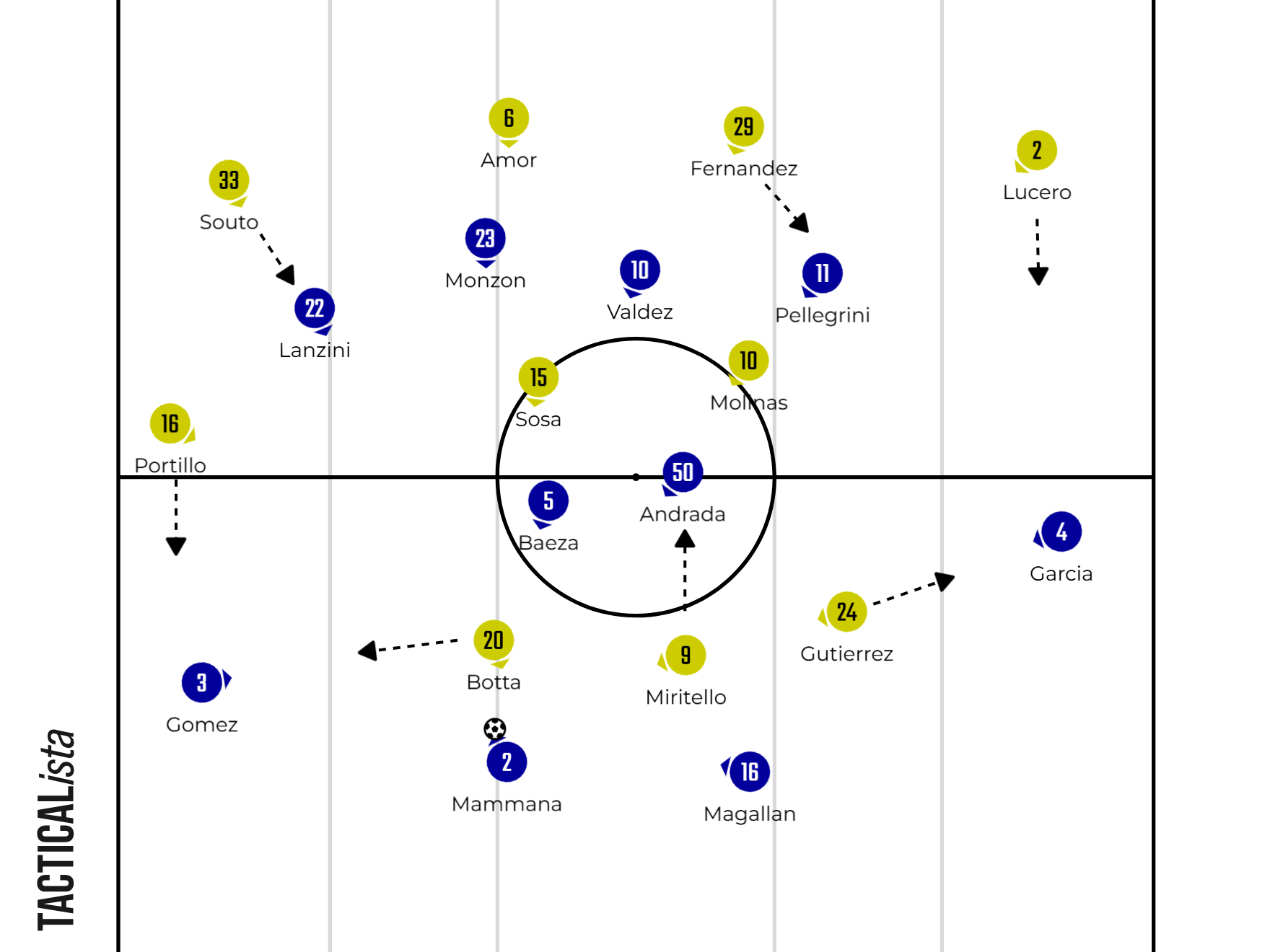 Defensa’s mid/low block is aggressive in the wide areas with jumping fullbacks as well as being compact in the middle with willing forwards and aggressive center backs.
The defensive work of Miritello, Botta, and Gutiérrez added solidity to Defensa’s block, allowing their teammates to defend the deeper areas more effectively with a numerical advantage.
Defensa’s high press emphasized stability over aggression. Portillo stepped up to pressure Gómez, while Molinas took a screening role in the middle, covering Andrada and Baeza in the same zone. Despite Vélez creating an overload in the early phase of build-up, they were unable to capitalize on it.
When Vélez tried to play through the two central midfielders, they conceded possession at the edge of their own box, leading to a big chance for Defensa.
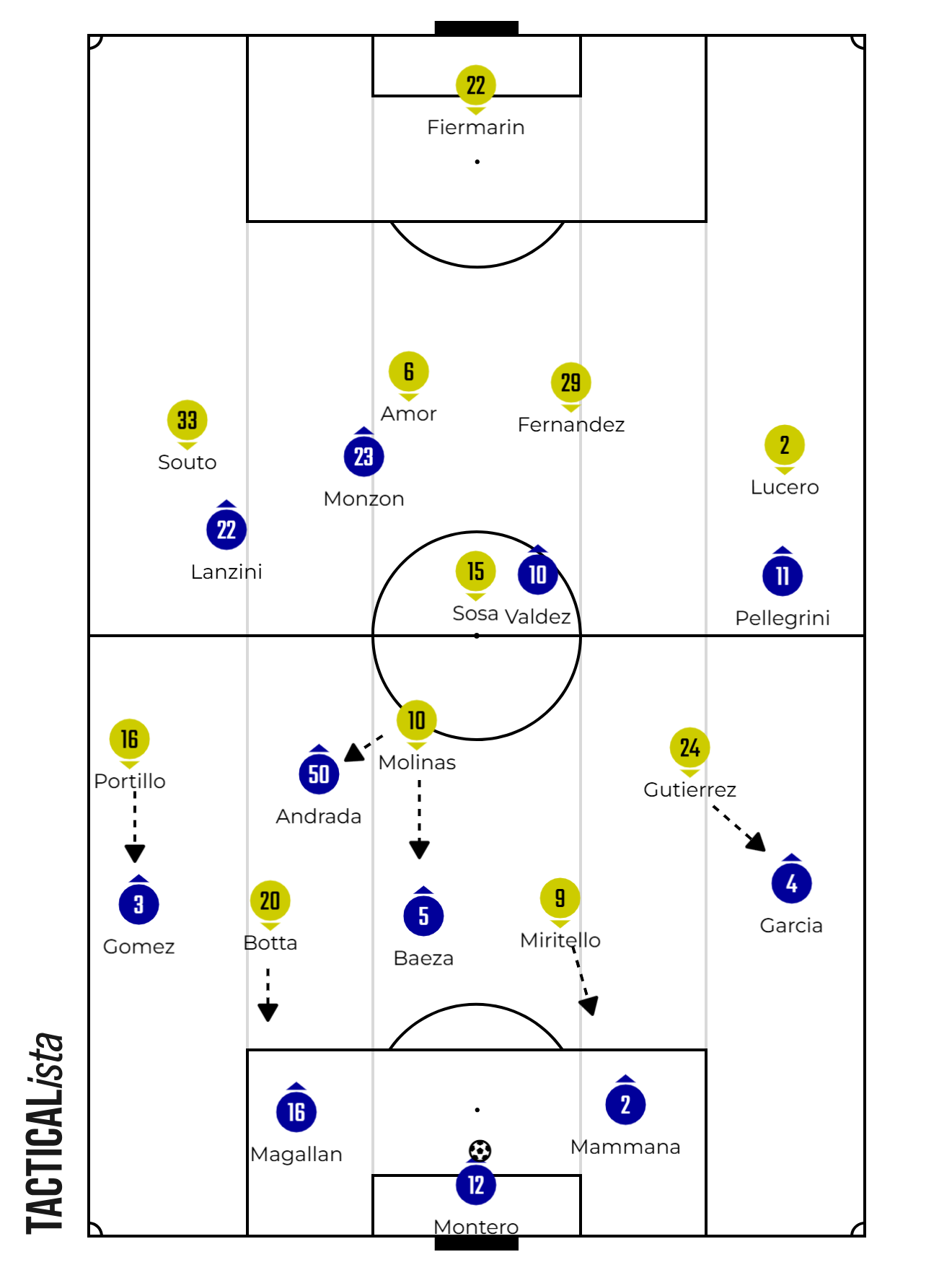
Defensa’s 4-1-3-2 press with the +1 in the defensive line. Molinas’ screening role and Portillo pushing up to Gómez.
Vélez’s weak points
Vélez were very aggressive on and off the ball, but their high press wasn’t exactly a situation Defensa struggled with. In the first half, Vélez pressed in a 4-1-3-2 diamond. Valdés and Monzón led the press with Andrada and the narrow wingers in the second line of three in the press.
Defensa’s Portillo, like in the press, pushed up during build up. Souto moved to the right side, and the wingers in narrow positions dropped deep at times to overload Vélez’s midfield.
Defensa consistently played through the press by manipulating the positioning of Baeza, drawing him out of the central lane and using Miritello as a vertical outlet to advance play. With Lanzini and Pellegrini tucking in narrowly during the press and Baeza operating as the lone pivot, the central space became an obvious target.
Mammana and Magallán were reluctant to step out and track Miritello when he dropped between the lines, which left a pocket of space in front of the back line. That hesitation allowed Defensa to penetrate centrally and create artificial transitions.
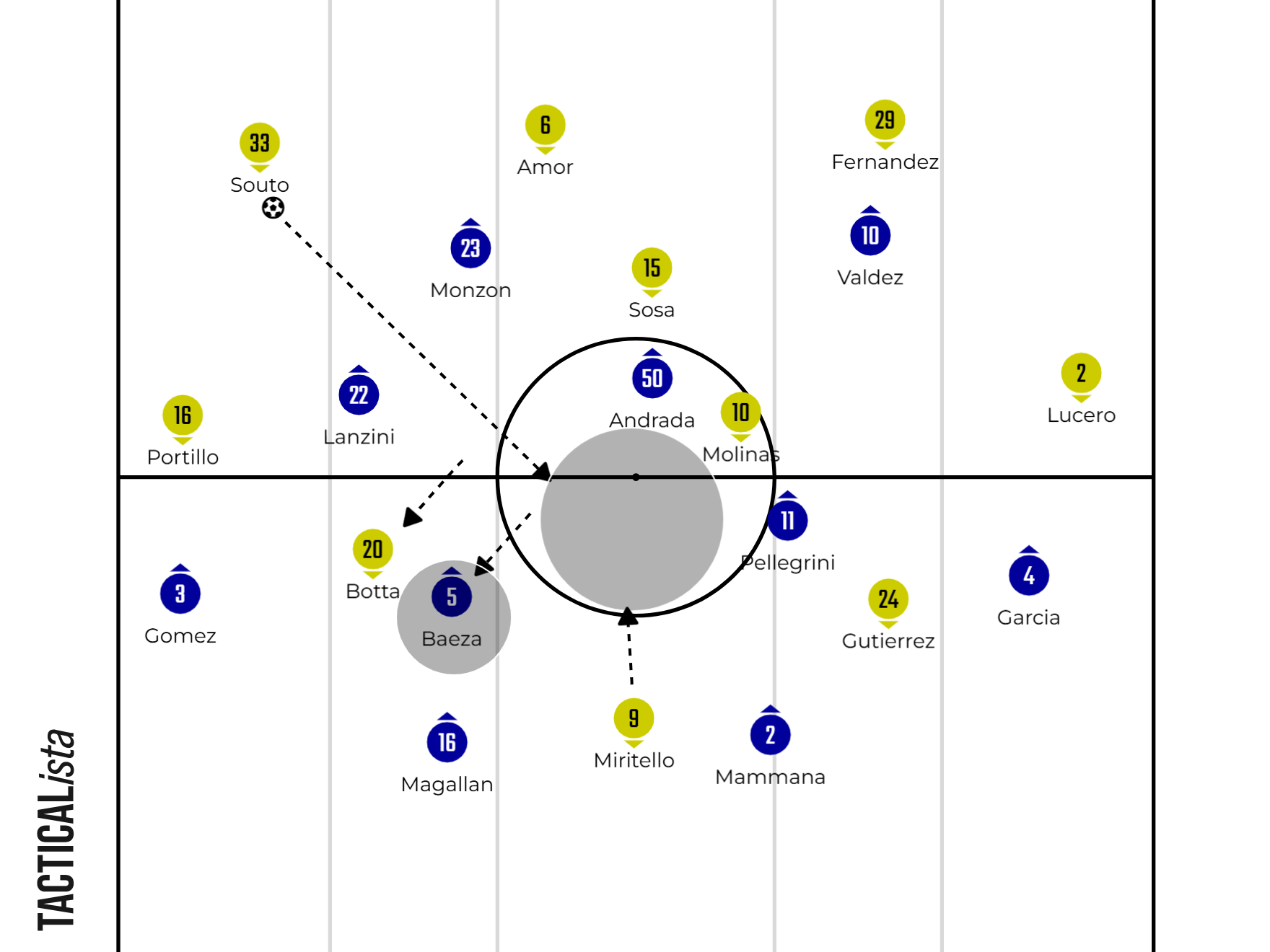
Botta drags Baeza away from the central space in midfield. Miritello drops to the space conceded with the Vélez center backs.
However, the injury to Valdéz early in the first half resulted in a change of pressing structure. Godoy replaced Valdéz in the press, but Lanzini covered the Defensa’s pivot, Pellegrini moved to the left side, while Andrada dropped to the right side of the diamond press.
Defensa used their overloads better than their opponents. Vélez’s diamond press allowed the fullbacks, Souto and Lucero, to be free. Defensa exploited this route, finding the players in wide areas through their goalie in build-up. A few times, the Vélez press allowed some inside passes when their players jumped to press the players out wide.
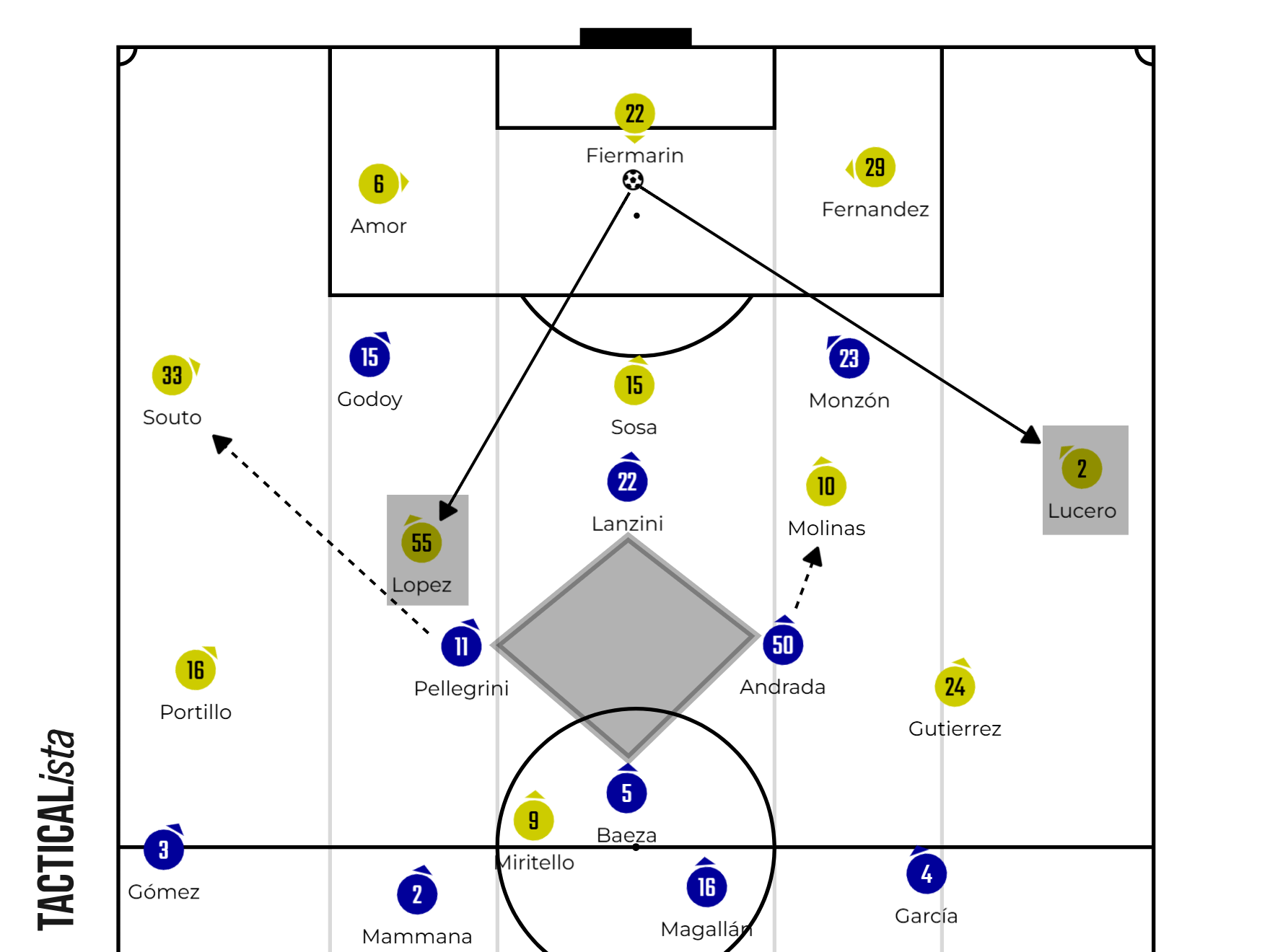
Defensa exploited Vélez’s press through effective use of the overloads to get past the first line of the press. Using the outside and inside channels to find gaps to progress.
Unfortunately, Vélez’s counterpress made it harder for Defensa to advance higher up the pitch after beating the first two lines of the press. Their counterpress helped them control transitions, especially defensive transitions. When Vélez failed to control these transitions, it became a huge risk because of their shape in possession.
Vélez’s 2-2-6 shape conceded large spaces in transitions with both fullbacks high up. When the midfield lines were broken during attacking transitions, Defensa had enough space to be a threat. This was the template for their first goal. Vélez failed to control transitions, and this led to Defensa breaking lines with a quick one-two pass to bypass Baeza, Vélez’s holding midfielder.
Molinas played a through pass to find Gutiérrez, who made a run in between the defender and the fullback to create room for a curler outside the box. This goal showed how effective Defensa can be early in the game during counterattacks.
Defensa’s adjustments as Vélez equalize
Defensa’s tough 5-2-3 shape forced Vélez to dig deep into their offensive arsenal. The wingers being inside and the fullbacks holding the width allowed fluid attacking dynamism. Garcia and Gómez put a lot of crosses in from deep areas to find a man in the box. Defensa’s back line defended these crosses well and clogged up central areas.
However, Defensa struggled to defend the edge of their box on several occasions. Andrada was unable to capitalize on these opportunities, as he had few chances in those areas. In the second half, Defensa shifted from a 5-2-3 formation to a 5-3-2, bolstering the midfield and reinforcing their lead. This tactical adjustment made perfect sense in that moment in the game.
Defensa’s 5-3-2 shape enabled them to press the opposition fullbacks more effectively with the midfielders rather than their fullbacks jumping.
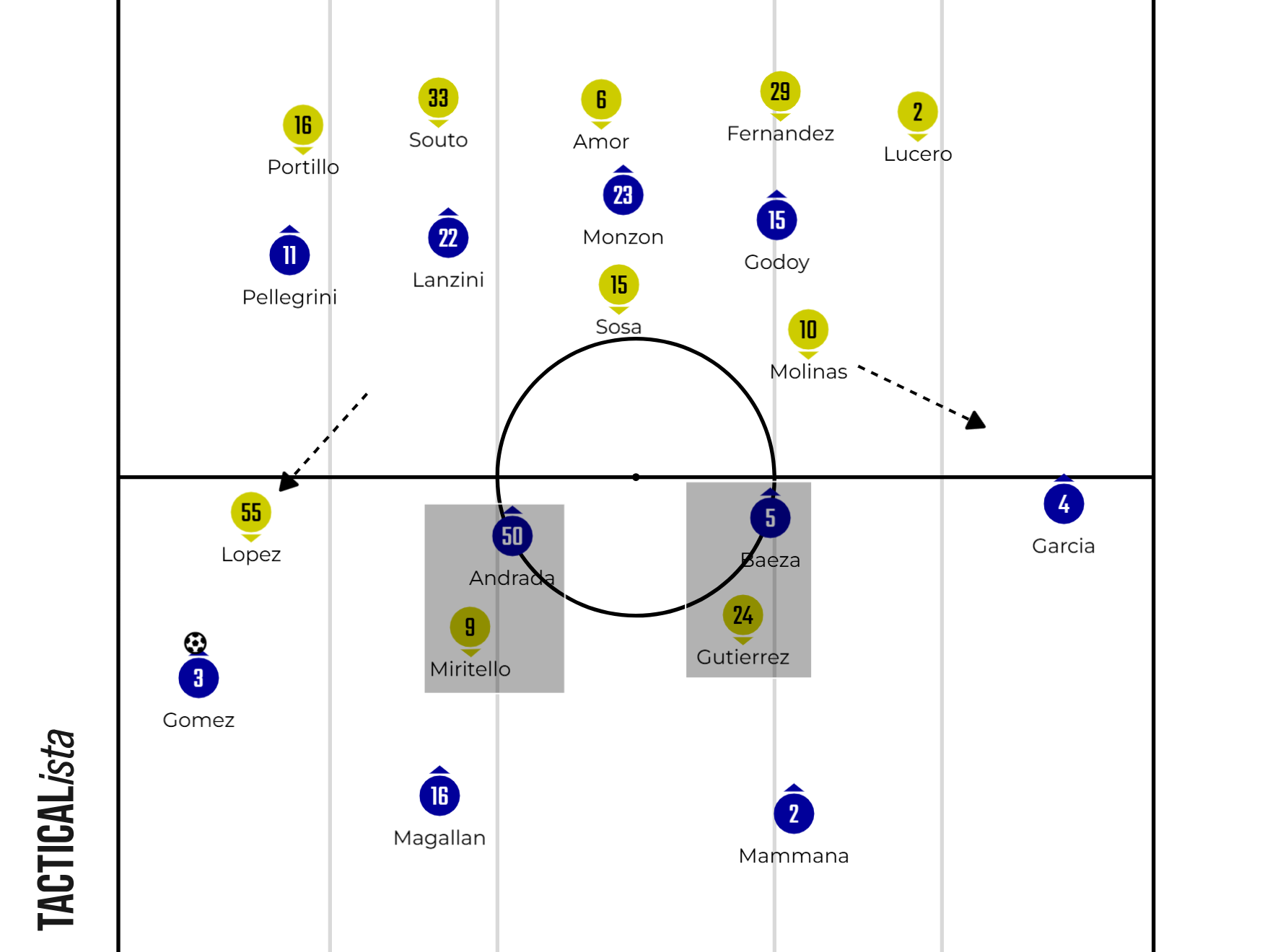
Lopez and Molinas jump to the wide fullbacks while Portillo and Lucero tuck into narrow positions. Defensa’s block became more compact as a result of this.
Vélez found their breakthrough from a corner, as Manuel Lanzini’s inswinging delivery caused uncertainty in the six-yard box. The goalkeeper misjudged the flight, allowing the ball to drift to Pellegrini at the far post, who reacted decisively to finish emphatically into the roof of the net.
The equalizer shifted momentum, with Vélez increasing territorial control, but Defensa maintained their compact defensive structure and resisted sustained pressure to secure the draw.
Takeaways
Defensa y Justicia and Vélez Sarsfield played out a tactically defined 1–1 draw shaped by contrasting spatial priorities. Defensa’s narrow 5-2-3, later a 5-3-2, compressed the central corridor and blocked vertical lanes, forcing Vélez wide and turning their possession into predictable, low-penetration attacks.
As a result, Vélez’s possession translated into territorial control rather than central progression, with their primary threat emerging from wide deliveries and second-phase situations instead of sustained interior combinations.
Meanwhile, Vélez’s aggressive 2-2-6 occupation secured territorial control but weakened their rest defence. As a result, when their counterpress was bypassed, Defensa could exploit the space around the single pivot and attack transitional gaps. The outcome reflected structural trade-offs with no winner in the contest.
Both teams remain unbeaten with Vélez at the top of the Apertura. Pellegrini’s fine form continues after scoring his third goal in two games. Defensa would do more on the attacking end of the pitch, scoring five goals in their last five games. Overall, Defensa would feel they dropped two points after a fantastic defensive display.
“Match plots will be added as soon as possible.”


Comments