

Flamengo – Cruzeiro: Flamengo shows changes to win reunion of coaches with their former clubs (2-0)
A lot has changed in the last three months. Filipe Luis, who had been highly successful with Flamengo as a coach, did not have a good start and was dismissed after excessive pressure from the fans. Portuguese coach Leonardo Jardim (former Monaco), who had left Cruzeiro by choice, took over the club from Rio de Janeiro. But this was not the only reunion: Cruzeiro’s new coach is Tite, former Brazil National Team and Flamengo. In this matchup, Flamengo won on Matchday 5 of the Brasileirão.
Tactical analysis and match report by Marcus Arboés.
Why dismiss such a successful coach like Filipe Luís? That is a good question. In Brazil, directors often dismiss coaches due to immediate pressure for results. But Leo Jardim took charge of the team and already won the Campeonato Carioca, the regional tournament of the state of Rio de Janeiro, even without playing well. Now the new manager lined up the expected team: Rossi in goal; Emerson Royal (former Milan) and Alex Sandro (former Juventus) as fullbacks; Léo Ortiz and Léo Pereira as centerbacks; Pulgar and Jorginho (former Chelsea) as defensive midfielders; Arrascaeta (Uruguay National Team) playing inside, Lucas Paquetá (former West Ham) on the right and Everton Cebolinha (former Benfica) on the left wing; Pedro remains the target man.
On the other hand, although Cruzeiro started the 2026 Brasileirão very poorly, they were crowned champions of the Campeonato Mineiro, from the state of Minas Gerais, defeating Atlético Mineiro, their biggest rival. While Flamengo had few absences, Cruzeiro had two very important ones: striker and top scorer Kaio Jorge and starting defensive midfielder Lucas Romero. Because of that, Tite lined up: Cássio as goalkeeper; Fagner (former Brazil National Team) and Kaiki as fullbacks; Fabrício Bruno (former Flamengo) and Villalba as centerbacks; Matheus Henrique (former Sassuolo) forming the double pivot with Lucas Silva (former Real Madrid), with Matheus Pereira as the number ten; Néiser Villarreal entered as the replacement nine and Christian played as the right midfielder. The main highlight is Gerson, who played as the left midfielder, since he had been a Flamengo idol, left in a controversial way and months later was signed by Cruzeiro, being treated by Flamengo fans as a traitor.
What changed with Jardim’s arrival?
What really catches my attention is the choice of Flamengo’s board to appoint a coach whose style of play is completely different from the previous one, which can create a major clash of ideas and methodologies. Filipe Luís preferred a team that maintained possession through positional play and pressed high, while Leonardo Jardim, since his Monaco days, prefers vertical, fast, relational and reactive football. The current team obviously still draws from the previous work, but there are some clear changes.
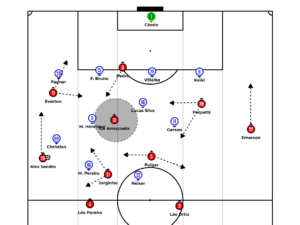
Flamengo attack with Paquetá and Everton Cebolinha moving from outside to inside from a 4-2-3-1 outline.
The tactical system starts from a 4-2-3-1 shape, just like Filipe Luís used, but there are clear differences in the use of some players and in certain intentions. Lucas Paquetá, the biggest signing in the club’s history, returned without performing at the level of his ability, and many analysts, commentators and fans had been criticizing how the previous coach used the midfielder, usually wide on the wing or positioned between the lines. In this match we saw Paquetá leaving the right wing for Emerson Royal to advance, dropping deeper to influence as a third midfielder, often receiving facing forward to find a pass that would break lines.
In this type of play, which happened around four times in the first half alone, Arrascaeta, who is usually the team’s free and influential number ten, gains more height and moves in the shadow of the defense. Since he is not a sprinter, this movement is short and subtle, and Paquetá is the right player to share the responsibility of playmaking. This type of situation shows a greater emphasis on quick and vertical attacks, different from the more controlled offensive organizations. In addition, the fullbacks began alternating their forward runs, just like Cruzeiro and Monaco used to do. With these situations, Cruzeiro often had to defend in a 4-4-2 formation, usually being forced to track back while marking.
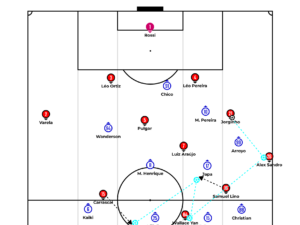
Scene of Carrascal’s goal, starting from a short buildup, using depth as a tool to gain advantage.
From a short buildup starting in their own half after recovering possession, Flamengo showed a big difference: instead of slower and more controlled attacks, they tried to accelerate the game, even without having great sprinters in the attack. Instead of the previous symmetrical buildup, we no longer see the same attempt to generate small advantages from a more strictly positional logic.
The third man dynamic, present in Filipe Luís’ positional play, is still used to progress even if the team is not fully practicing that idea anymore. The team organizes a ladder structure, meaning a diagonal progression where three players form a line that disrupts the opponent’s marking: Alex Sandro uses Samuel Lino as bait to attempt the pass to Wallace Yan, now looking for Samuel Lino facing forward. The pass was intercepted by the defense, but the idea of using Wallace as the second man to free Lino still worked. Carrascal took advantage of the lack of attention and the gap between Kaiki and Villalba to attack the space and score the second goal.
What changed with Tite’s arrival?
If you look for analyses of Leonardo Jardim’s Cruzeiro in 2025, you will see that the style of play was very different from what Tite is now implementing, and actually similar to what Flamengo currently intends to do. Today Cruzeiro plays a more positional style, with one of the defensive midfielders dropping either wide or centrally into the first line during buildup, while the other compensates in the second line, usually behind the first pressing line. See below:
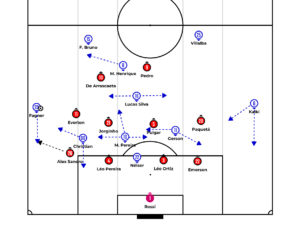
Cruzeiro positional attack in a 3-1-5-1 outline, with a trio of midfielders inside, against Flamengo’s zonal defense in a 4-4-2 formation.
Matheus Henrique creates a 3v2 superiority in the buildup, either wide or centrally, with Lucas Silva looking for the space behind Pedro and Arrascaeta. Although this is a more positional structure than before, Tite kept the use of three players inside: Christian, Matheus Pereira and Gerson play with some freedom across the three central corridors, generating proximity and advantages through short passes, aiming to use the fullbacks in width, occupying the wide corridors in a positional manner.
Gerson and Matheus Pereira have shown better chemistry in position rotations, combinations and close support. Good situations were created this way, but Cruzeiro was not very effective. Neither Néiser nor Chico da Costa managed to replace Kaio Jorge’s absence. To neutralize them, Flamengo did the simple thing: they defended zonally in a 4-4-2 shape, using pressing jumps in specific spaces, such as a fullback stepping out of the line to press whoever received in width, preventing Cruzeiro from crossing. The compactness of the last lines also made short-space interactions between Cruzeiro’s midfielders more difficult.
The biggest highlight of the match was Flamengo’s offensive transition. After recovering the ball, the team tried to accelerate instead of slowing down and organizing with possession. Paquetá was the main target of the counterattacks, often receiving the first pass to attempt long balls, alternating that role with Arrascaeta. Later, Luiz Araújo and Carrascal shared those functions.
If one of Flamengo’s problems was having Arrascaeta and Pedro to press in a high block, the team now has a more passive and less pressing approach, preferring to defend in a mid block or even a low block. Even so, despite not being his natural strength, Pedro was very active defensively. His goal in the opening minutes came from taking advantage of a simple buildup mistake by the opponent. Minutes later he also won the ball again in buildup and nearly provided an assist.
Takeaways
With the victory, Flamengo moved up to sixth place with 7 points from 4 matches played, as the match against Mirassol was postponed. Leonardo Jardim introduced intentional changes to the team, but we can still see many characteristics from the previous work, including the positive elements left from Filipe Luís’ excellent period as a coach. In the next match, what will we see more clearly? Flamengo will face Botafogo and it is still early to have certainty about the final game model.
Meanwhile Cruzeiro is still without a win in the Brasileirão and, after conceding two goals, dropped to the bottom of the table with only 2 points earned. There was barely time for the fans to celebrate the state title before the crisis of results continued in the national competition. Now Tite’s team faces Vasco, who are recovering after hiring Renato Gaúcho as their new coach.


Comments