

Flamengo – Palmeiras: Flamengo shows efficiency and wins the game of the year in the title race (3-2)
The most anticipated match of Matchday 29 and one of the most important of the season took place at the legendary Maracanã Stadium, with the two league leaders facing each other, both coming from strong wins. Flamengo had less of the ball, attacked less, but delivered a masterclass in efficiency and individual quality by beating Palmeiras 3–2, drawing level on points in the league table.
Tactical analysis and match report by Marcus Arboés.
We decided to make this article free to read. If you want to support our work, consider taking a subscription.
After defeating Botafogo 3–0 in the last derby, Flamengo repeated almost the entire lineup, with only one change: Rossi in goal, Emerson Royal (former Milan) and Alex Sandro (former Juventus) as fullbacks, Léo Ortiz and Léo Pereira as center-backs, Jorginho (former Arsenal and Chelsea) and Pulgar (former Chile National Team) as holding midfielders, Samuel Lino (former Atleti) and Luiz Araújo (former Lille) on the wings, and up front the duo of stars, striker Pedro and attacking midfielder Arrascaeta (Uruguay National Team).
While Flamengo had won comfortably, Palmeiras had thrashed Red Bull Bragantino 5–1, staying ahead in the Brasileirão title race and keeping the same core lineup, except for goalkeeper Weverton, who was injured. In his place, Carlos Miguel started in goal, Khellven and Piquerez (Uruguay) as fullbacks, Gustavo Gómez (Paraguay) and Bruno Fuchs in defense, Aníbal Moreno (Argentina) as the defensive midfielder, followed by Andreas Pereira (former Fulham) as central midfielder. In a 4-1-3-2 shape, Maurício played as the right winger, Felipe Anderson (former Lazio) on the left, and Vitor Roque (former Barcelona) formed the attacking duo with Flaco López (Argentina).
A masterclass in efficiency by Flamengo
Playing at Maracanã, Filipe Luis’ Flamengo saw Palmeiras winning most duels and having more possession until an uncalled penalty in the first ten minutes. Yet, on their very first attack, starting from the build-up and the technical quality of Pedro and Arrascaeta, just like in the match against Botafogo, the home side opened the scoring through the Uruguayan, who tied Kaio Jorge in the top scorer chart.
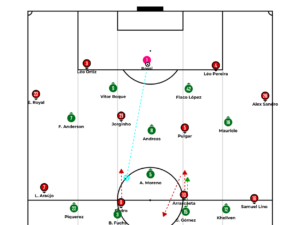
Flamengo’s build-up in a 4-4-2 lineup with Pedro and Arrascaeta manipulating the individual marking matchups of Palmeiras’ defensive line.
In the play leading to the first goal, goalkeeper Rossi joined Flamengo’s build-up, forming a first line of three with the center-backs. As Palmeiras defended with individual matchups in a 4-1-3-2 shape, with forwards and midfielders shifting to the ball side, Flamengo circulated possession to open central spaces. Rossi then found a progressive pass breaking Palmeiras’ defensive lines into the area that Aníbal Moreno should have been protecting.
Beyond that tactical detail, another major factor in this goal was the relational advantage between Pedro and Arrascaeta, whose chemistry allowed them to manipulate Palmeiras’ defensive pairing. Flamengo’s players dropped deeper, drawing Palmeiras’ defenders out of position. Pedro held up the ball with his back to goal, nullifying Bruno Fuchs’ marking, while Arrascaeta made a counter movement behind Gustavo Gómez, received Pedro’s through ball, and scored the opener.
This type of interaction between the duo, along with Flamengo’s technical and tactical resources to escape Palmeiras’ high press, appeared several more times throughout both halves.
Palmeiras’ dominance
Although Flamengo had opened the scoring and finished the first half on top, it was Palmeiras who saw more of the ball and created interesting opportunities, operating from a 4-1-3-2 shape and exploiting their main strength: ball circulation in the final third to find a wide man in advantage and look for a cross, a pattern seen in other matches as well.
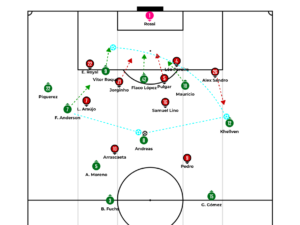
Palmeiras’ attack with fullbacks wide, using Andreas Pereira as a circulation pivot to target offensive aerial play, against a disorganized Flamengo with one man down.
Flamengo defended in a 4-4-2 shape, protecting the spaces between lines and depth effectively, though Palmeiras still managed to progress until a key moment when Léo Ortiz picked up an injury. While he was being treated, Abel Ferreira’s side took advantage of the numerical superiority, quickly switching play from left to right through Andreas Pereira’s quick passing ability, ironically the same player who, when at Flamengo, made the mistake that gifted Palmeiras the title in a final.
Khellven received the ball wide, and neither Alex Sandro nor Samuel Lino had time to press him. He crossed between two defenders for Vitor Roque, who outjumped everyone and headed the ball past the keeper, leveling the score. Once again, Palmeiras took control, maintaining offensive volume and danger, but they did not anticipate the impact Pedro would have later in the first half.
Pedro, the protagonist
If in the previous match Pedro had already shown he deserved to start, he earned another chance from the coach and, to the misfortune of defender Bruno Fuchs, played an outstanding game, holding the ball with his back to goal, managing strength and skill spaces to generate danger in the few attacking chances Flamengo had.
In another situation where Flamengo advanced easily after breaking Palmeiras’ high block pressure, winning one or two physical duels along the way, they reached their second goal. Pedro clashed with Bruno Fuchs, his main victim in the match, who fell and could not recover in time to stop Emerson Royal’s progressive pass to the Flamengo striker getting free. Fuchs mistimed his challenge and conceded a penalty on Pedro. Jorginho, experienced in the role, converted against debutant goalkeeper Carlos Miguel.
Minutes later, Aníbal Moreno completely lost focus when positioning himself for a long ball. Pedro used his long stride to intercept, cutting the pass and laying it off to Arrascaeta, who immediately returned it for Pedro to score his second of the game and Flamengo’s third. The key detail of this goal is symbolic: when Pedro was a substitute, the coach publicly mentioned his lack of commitment to defending. This time, he pressed and created the goal himself with merit.
The second half scenario
The main story of this match unfolded in the first half, but as Palmeiras is a team known for impactful comebacks, chasing difficult scorelines with incredible mental strength, as seen against São Paulo, nothing could be ruled out. In the second half, Abel Ferreira started without changes, and the script remained similar to the first: Palmeiras dominated possession while Flamengo showed efficiency through Pedro and Arrascaeta, though without scoring.
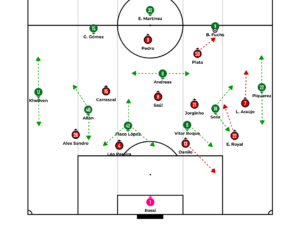
Palmeiras attacking in a 3-1-6 formation with fullbacks wide and wingers tucked inside.
Filipe Luis made substitutions aiming to improve depth in transitions, but not much came from that. Abel Ferreira moved his wingers inside on both flanks, doubling up with the fullbacks to attack the wide channels, but Flamengo’s defensive marking and tracking neutralized most of these attempts.
In the end, Palmeiras only managed to score through a quick transition after committing fully to attack. It was Gustavo Gómez, the center-back who had already been acting as an auxiliary striker, who reduced the deficit. However, it was too late, and Flamengo secured the win.
Takeaways
Pedro was the great protagonist of the night, but Palmeiras also showed its strengths. Not enough to win, but enough to remain on top. They would stay there even if they had lost by a larger margin, since the tiebreak criteria start with number of wins, followed by goal difference, and then goals scored. Even with Flamengo winning both league meetings against Palmeiras this season, they remain second due to the tiebreak rules, despite being level on points (61).
Ten matches remain for each side, and they could still meet again later this year in another final, the South American continental tournament Copa Libertadores. Flamengo hosts Racing from Argentina midweek in the first leg of the semifinal. Palmeiras, on the other hand, faces LDU from Ecuador on Thursday. If both win their ties, they will meet once again in a Libertadores final and play yet another decisive match in 2025.
Use the arrows to scroll through all available match plots. Click to enlarge. Check the match plots page for plots of other matches.
We decided to make this article free to read. If you want to support our work, consider taking a subscription.


Comments