France – Morocco: Defense Key To Les Bleus’ Suffocating Show (2-0)
It was to be a repeat of the 2022 World Cup semi-final in more ways than one as France met with Morocco in Boston for 2026’s opening quarter-final. Four years ago, France would eliminate the tournament’s dark horses 2-0. This time around, Morocco had shed the element of surprise surrounding their team’s success, but they could not shed the same fate as they were once more undone by the same scoreline.
Tactical analysis and match report by Nick Hartland.
We decided to make this article free to read. If you want to support our work, consider taking a subscription.
France survived the Battle of Philadelphia with a Kylian Mbappé penalty settling an ugly affair. They’re a team that have become better associated with flowing football at this World Cup, with Didier Deschamps firmly taking the handbrake off, but against Paraguay, they were forced to dig deep and win ugly against a team that was inclined and allowed to embrace a rougher playing style.
Morocco’s passage into the quarter finals saw them plot a path past the Netherlands and then dump co-hosts Canada out of the cup with a 3-0 win. Mohamed Ouahbi is looking to match his predecessor, Walid Regragui, who made history when he guided Lions de l’Atlas to their first World Cup semi-final in 2022. However, to do this, he’ll have to surpass the team that stopped them in Qatar.
Deschamps kept with the 4-2-3-1 formation. Mike Maignan was in goal with a defense of Lucas Digne, William Saliba, Dayot Upamecano, and Jules Koundé. In midfield, Adrien Rabiot and Manu Koné were the double pivot. On the wings, Désiré Doué (in place of Bradley Barcola) and Ousmane Dembélé, with Michael Olise in the middle. Up top, Kylian Mbappé.
No surprise, Ouahbi went with the same shape. Yassine ‘Bono’ Bounou behind the backline of Salah-Eddine Oulad M’Hand, Noussair Mazraoui, Issa Diop, and Achraf Hakimi. Ayyoub Bouaddi and Neil El Aynaoui were partnered in midfield. Ahead of the double pivot, Chemsdine Talbi and Brahim Díaz on the flanks, with Azzedine Ounahi as the number ten. Bilal El Khannouss replaced the injured Ismael Saibari in attack.
Siege warfare in Boston
There was the distinct impression of a siege to the game as France hammered at Morocco’s defensive structure, searching for the weak spot that would surrender control of the tie. Morocco defended in a 4-4-2 medium-to-low-block. Ounahi and Khannouss patrolled from the front, looking to close down the ball carrier and block out the passing lanes into the center, while Bouaddi and El Aynaoui lurked deeper, waiting to jump on Olise between the lines. Morocco wanted France to shift the ball wide, where they would then go 2v1 against the winger, in a similar principle to how Paraguay defended against Les Bleus.
On the left, Talbi worked in tandem with Salah-Eddine, while on the right, Díaz and Hakimi were backed by Bouaddi, who would often desert the center to help support two players better known for their attacking threats rather than their defensive commitments. This could create a bit of tension within the defensive shape, as a pocket would open temporarily in the center. It was up to Bouaddi to read the situation and recover quickly.
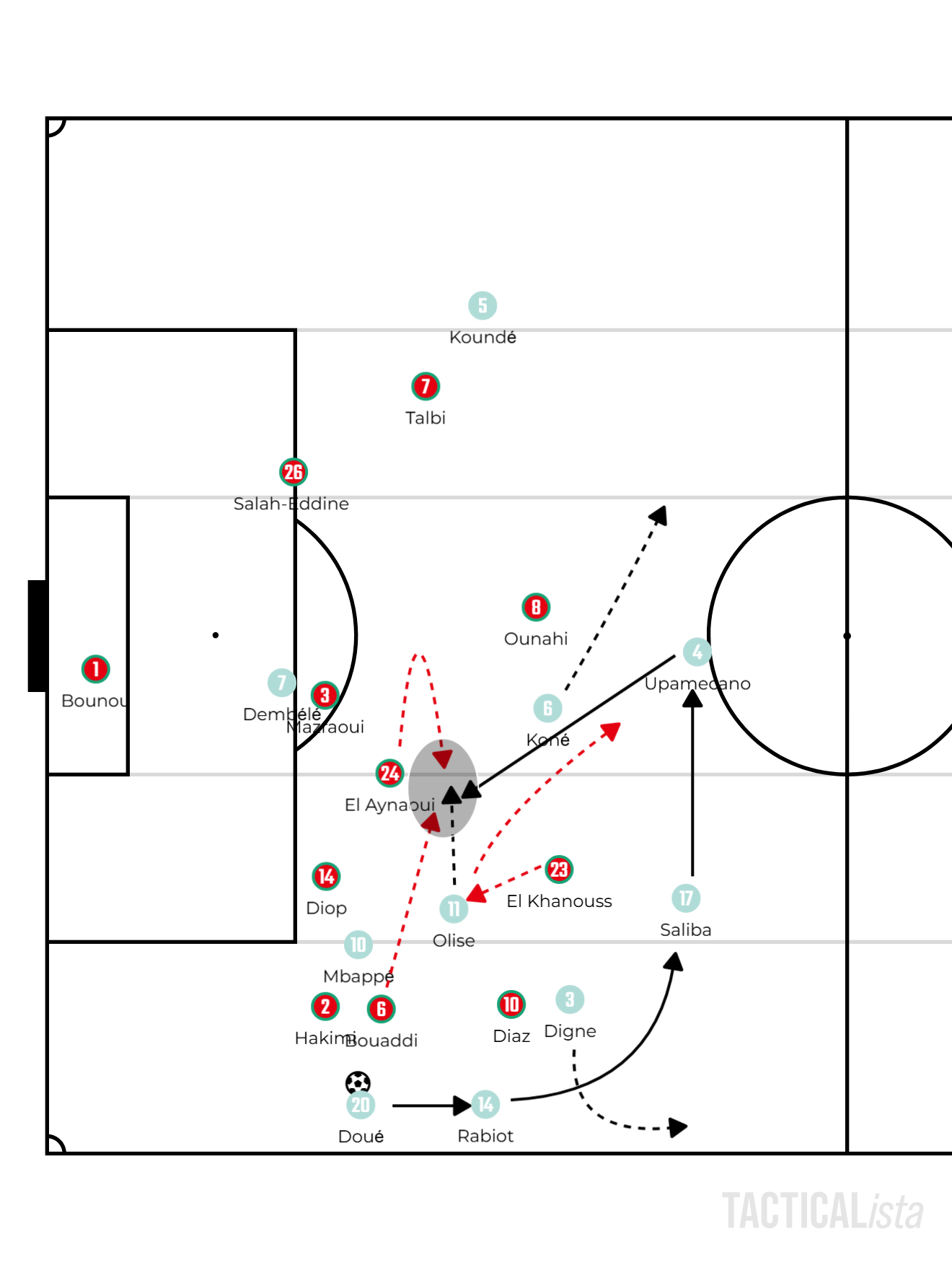
21st minute: France probe Morocco’s low-block looking for central access. Bouaddi supports Hakimi to create the 2v1 against the ball-side winger. This leaves Olise open. El Khannouss responds and tracks back. Doué is prevented from progressing; France recycle. Morocco expect right-sided focus and shift accordingly. El Khannouss closes down Upamecano. His movement leaves Olise free. A diagonal opens up central access. Bouaddi and El Aynaoui respond to the danger, pincering the Bayern man.
This defensive structure generally worked in the first half to limit France from creating too many chances from open play. It wasn’t quite the same as in the Round of 16 when Les Bleus were completely blunted by Paraguay’s low block, and as a result, there were moments when France found a way to engender dangerous situations, when Morocco weakened the center, by finding quick switches to give their wingers (particularly Doué on the left) a crossing opportunity.
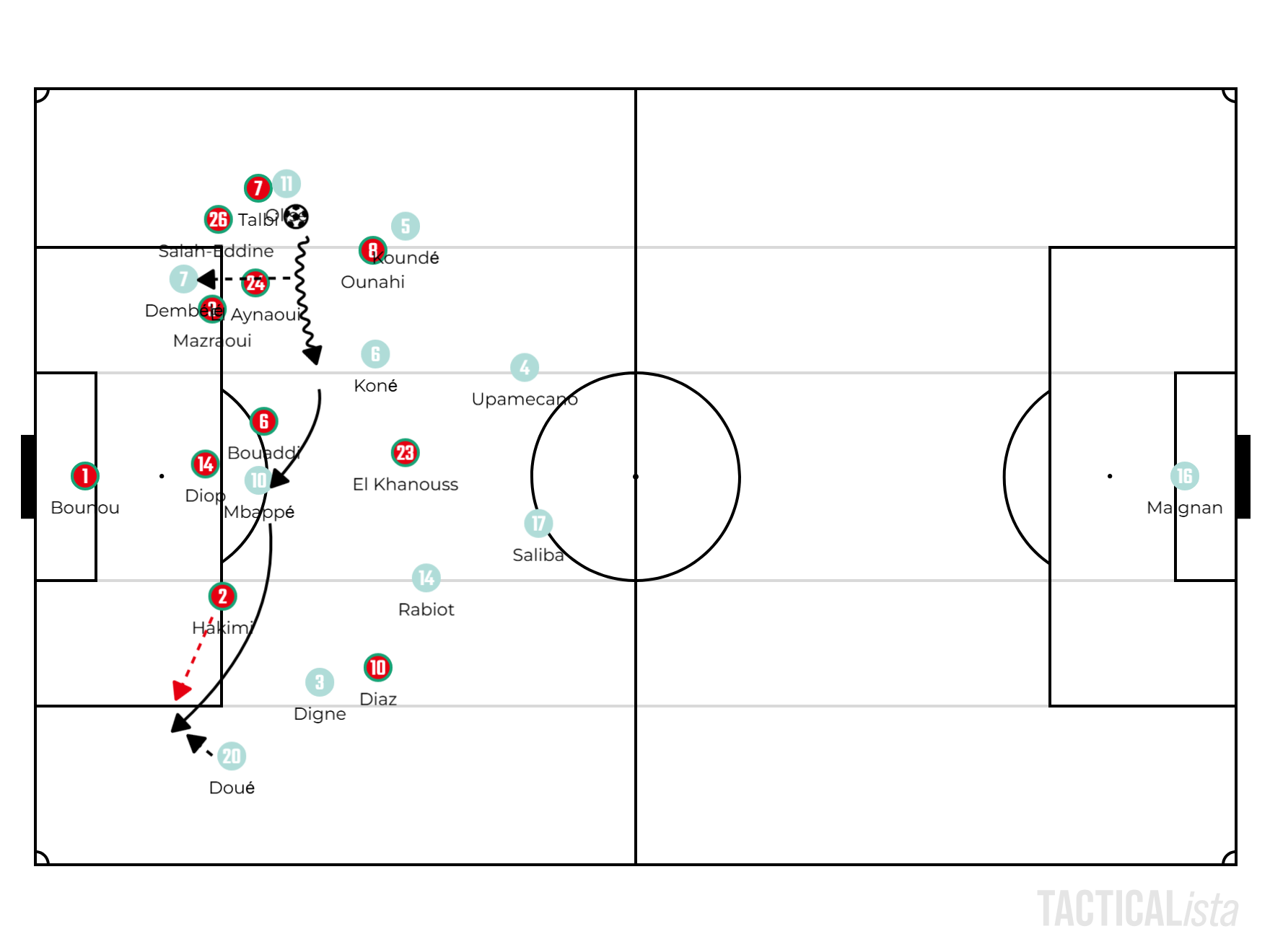
18th minute: France switch from right to left. Dembélé makes a clever run, giving space to Olise in the center. Olise cuts in and passes to Mbappé, who spreads the play wide. Morocco are unable to create their 2v1 with Díaz pinned by Digne. Barcola receives the ball and has a crossing opportunity.
Morocco’s in-possession structure reveal weakness
There were some interesting ideas at play in Morocco’s in possession structure. They started in a 4-2-4 build-up shape with both fullbacks holding deep positions. As they advanced, they would take on a fluid shape. El Aynaoui dropped into the backline, freeing the fullbacks to progress into asymmetrical roles. Hakimi would take up a more advanced position on the right, while Salah-Eddine would often invert into midfield, moving into El Aynaoui’s starting position until the midfielder stepped out again.
This wasn’t a novel approach from The Atlas Lions. Morocco have been keen across the tournament to maximise Hakimi’s attacking threat, similar to the way his club side, Paris Saint-Germain, draw the best out of him. He was often supported by Bouaddi, situationally pushing out of the double pivot and into the half-space, such as during the match against Brazil. However, the further up the pitch Morocco progressed, the more their right flank was left exposed to attacks in transition.
And it was this weakness that looked to be France’s biggest weapon in breaking the first-half siege. In the 25th minute, Morocco tilted to the right, Díaz held the width, while Bouaddi rotated with Hakimi. The midfielder attacked the box on the underlap, and the right back took up a deeper shape to maintain Morocco’s rest defense. In theory, this worked; France cleared their lines in the box, and the ball fell to Hakimi. However, in practice, there was an issue.
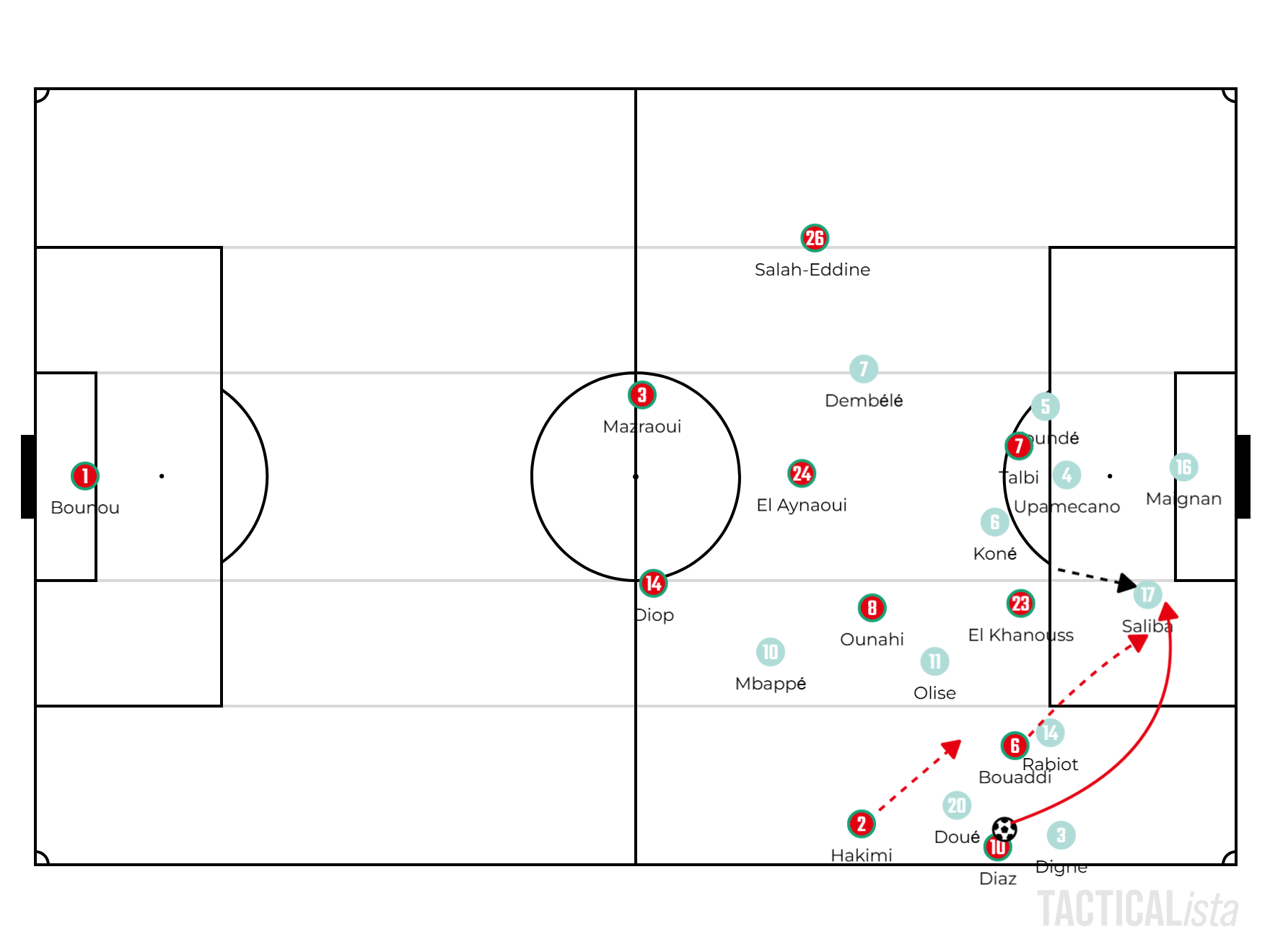
25th minute (part i): Morocco tilt to the right. Saliba intercepts the cross. Hakimi positions himself in anticipation of the second ball. Note the space down his flank.
France’s out-of-possession structure is their unsung hero
France’s out-of-possession work has gone under the radar at this tournament compared to their glittering attack (even though the two are fundamentally linked). France were excellent at winning the second ball, creating a compact shape with short distances between the defenders. So when Hakimi received the ball and took a poor touch, France closed ranks. Doué dispossessed the fullback, while Olise was close by to sweep up the loose ball.
From there, France could spring forward. Olise down the central channel, while Mbappé burst down Morocco’s vacated right. Olise released the ball to his captain, and Mbappé entered the box, where he was brought down by Mazraoui. It was an obvious decision, but it would take three minutes and 11 seconds for VAR to accept it. When finally given the all-clear, Mbappé’s tame effort penalty was saved. It was hard not to feel that the delay had contributed to an atypical attempt from the striker.
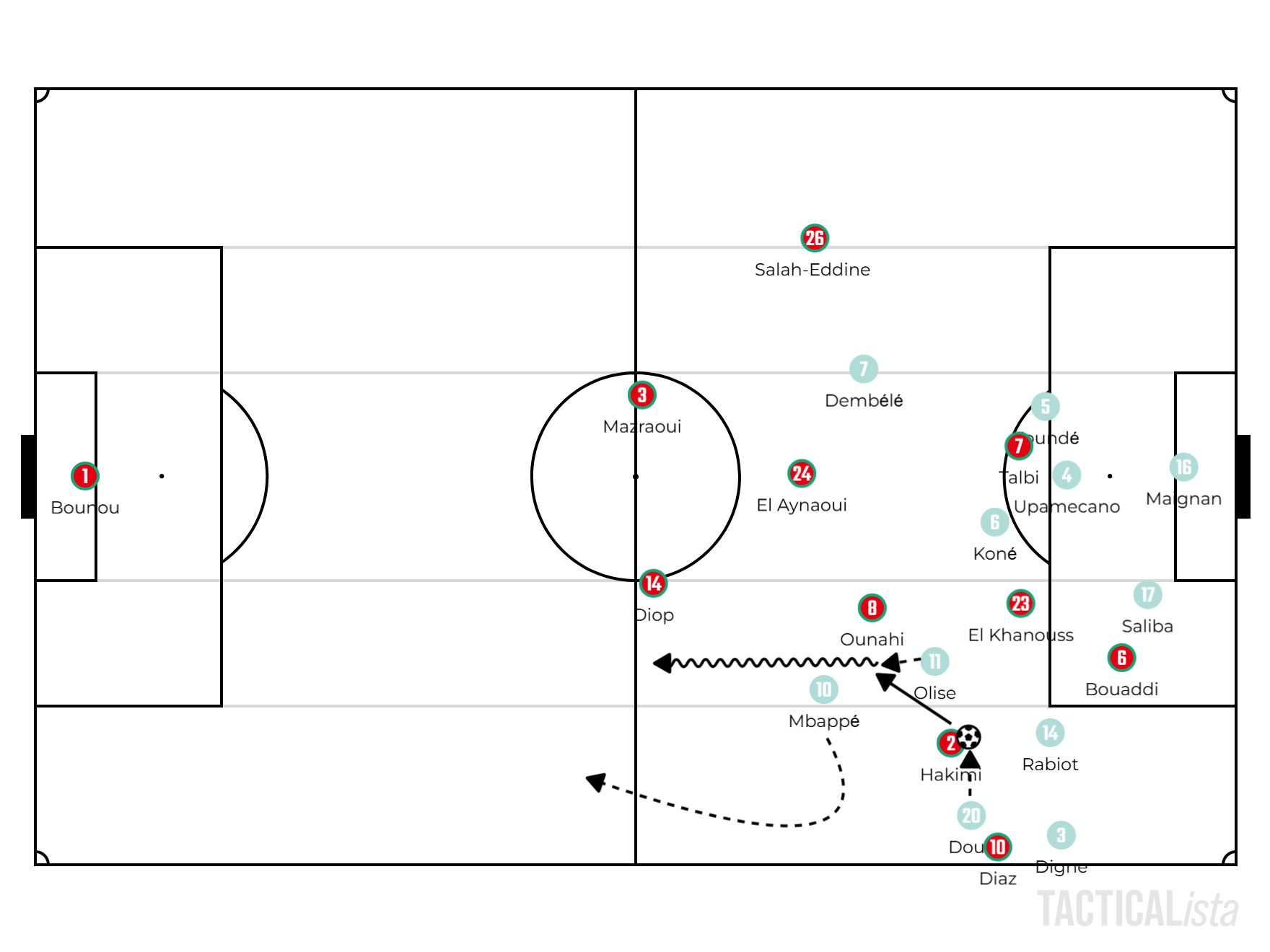
25th minute (part ii): Doué attacks the second ball and knocks it loose. Hakimi is now out of action, leaving the right side of Morocco’s defense exposed to Mbappé.
There was something suffocating about France’s defensive work. According to Opta, Morocco lost possession in their defensive half 39 times across both halves (25 in the first half and 14 in the second). Deschamps had his side defend in a hybrid press that would engage high up the pitch before dropping into a more solid 4-4-2 medium block, and an aggressive counterpressing system that took advantage of France also maintaining short distances between players when in possession.
The effect was startling. Morocco created next to nothing throughout the game. They registered just two shots before reaching the final ten minutes of regulation time. By the end of the match, Morocco would generate just 0.14 expected goals from their five shots (only one of which was on target).
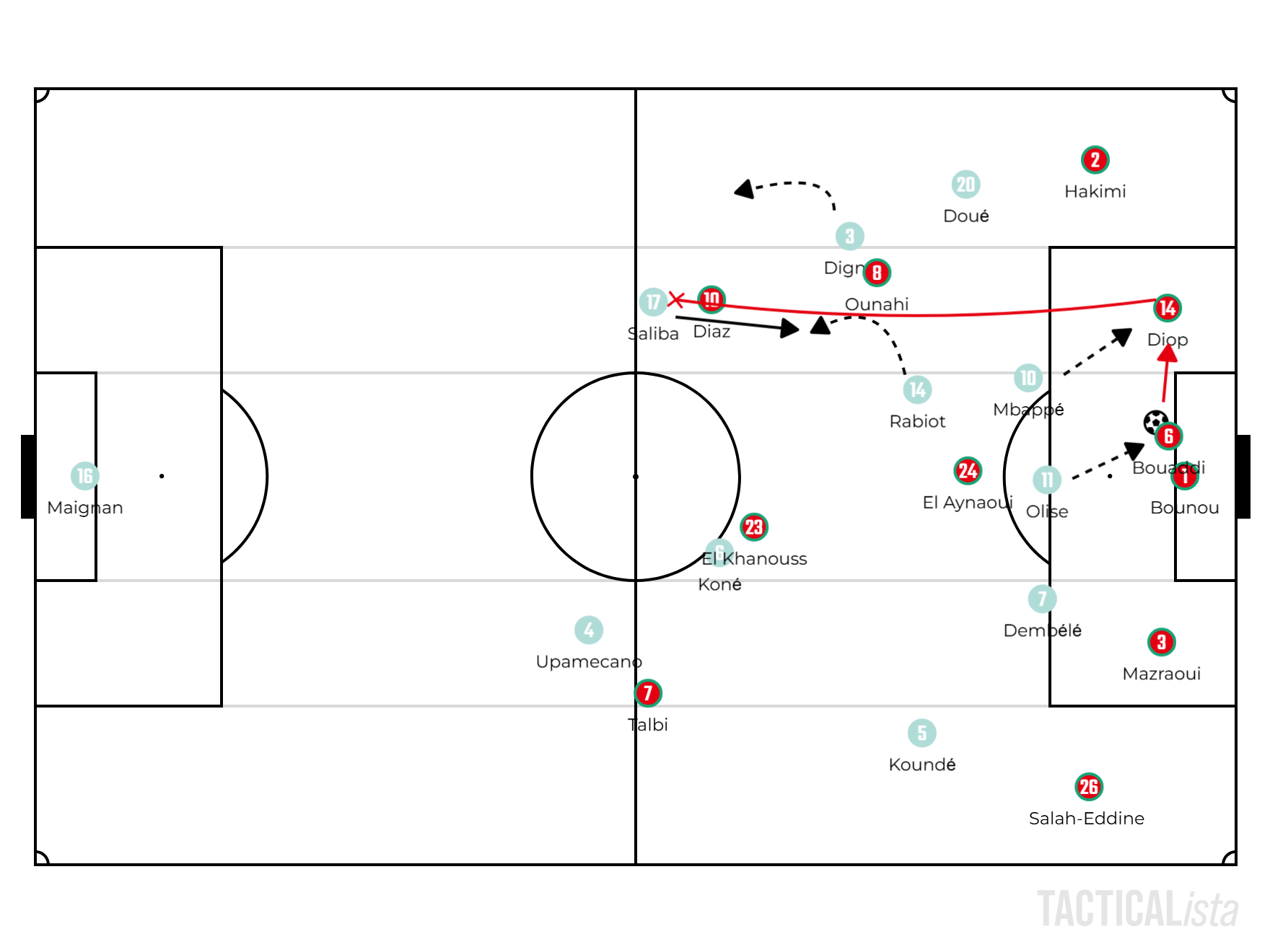
49th minute: France force a turnover. France go man-to-man at Morocco’s goal kick. Diop is pressured into going long. France have the physical advantage and Saliba intercepts. Rabiot jumps from El Aynaoui to Ounahi, then anticipates the header.
The inevitable as France lift siege
On the hour mark, the siege would finally be lifted as Mbappé made amends for his penalty. The opener would come from France winning the second ball from Mazraoui’s clearance off a Digne cross. Rabiot would win the aerial duel against Ounahi and head the ball forward. Doué anticipated where the ball would land and passed it to Mbappé. Diop stepped off him slightly in the box, leaving a small enough pocket for the striker to shoot and curl home.
Ouahbi responded immediately, taking off Bouaddi and El Khannouss, and replacing them with Sofyan Amrabat and Soufiane Rahimi. However, they would hardly be on the pitch long before France doubled their lead. Olise swapped positions at a throw-in, with Olise receiving the ball wide from Koundé. The Bayern man picked out Mbappé, who laid it backwards to Dembélé. Amrabat didn’t have the legs to shift over and protect the center, so Dembélé was free to run at the D, where he picked his spot and fired home.
Morocco would control the lion’s share of possession after the second goal, but it never felt like France were in danger. As soon as France had scored, there was the sense that the result would be inevitable. Warren Zaïre-Emery was brought on for his first minutes at the World Cup in place of Koné to secure the result. The one worry for Les Bleus was Mbappé’s enforced switch; the striker was replaced by Jean-Philippe Mateta and was later icing his foot on the bench.
Takeaways
After conceding twice in the group stages, France have yet to ship any further goals. The attack was once again purring against Morocco after stalling to Paraguay, but the true delight for France supporters was how committed and effective this team looks in defending. Many would have expected Morocco to have caused Les Bleus the biggest scare at the tournament, but it’s an insight into how finely tuned Deschamps has made this side that even this match wasn’t to be a contest.
It wasn’t to be for Morocco and Ouahbi as they were unable to match their history-making efforts in 2022, falling short of reaching the semi-finals for a second consecutive tournament. It was a testament to how far the nation has come that there was disappointment that they couldn’t do the same. However, it would be harsh to think that it was a failure for The Atlas Lions. Morocco at this tournament have proven that they were no flash in the pan.
Use the arrows to scroll through all available match plots. Click to enlarge.
Check the match plots page for plots of other matches.