
France – Sweden: France Keep Fire Burning With Stroll Into Round of 16 (3-0)
After the Netherlands and Germany fell, goals from Kylian Mbappé and Bradley Barcola would ensure that France wouldn’t become the latest European giants to exit at the Round of 32. Instead, Les Bleus were at their imperious best as they comfortably dispatched Sweden and set up an encounter with Paraguay. The question is, has Deschamps’ side been tested yet?
Tactical analysis and match report by Nick Hartland.
We decided to make this article free to read. If you want to support our work, consider taking a subscription.
France were in irresistible form coming into the Round of 32. For the first time since the 1998 World Cup, they entered the knockout rounds having won all their group games. The attack was on fire with ten goals spread across three games, even if there were perhaps a few questions left unanswered for a defense that shipped two goals despite going largely untested.
The return of Didier Deschamps at the touchline would be a welcome sight after he traveled home to France following the death of his mother. The decision from FIFA to deny the team their request to wear black armbands during the Norway victory in respect for his loss was unsurprisingly rejected by an organization that decided without consensus to change football into a four-quarter sport for this tournament.
Sweden’s reward for qualifying from a difficult group, which included Japan and the Netherlands, was to land one of the tournament’s favorites. Graham Potter’s short tenure in charge of the nation has so far been a series of baptisms by fire, so why would it have been any different once they reached the knockout rounds?
Potter went with a 4-4-2 shape. Jacob Widell Zetterström was in goal, with a defense of Gabriel Gudmundsson, Victor Lindelöf, Gustaf Lagerbielke, and Daniel Svensson. In midfield, Yasan Ayari and Lucas Bergvall were flanked by Elliot Stroud and Anthony Elanga. Up front, Alexander Isak and Viktor Gyökeres made up the strike partnership.
No surprises, Deschamps kept with the 4-2-3-1 formation. Mike Maignan was behind Lucas Digne, William Saliba, Dayot Upamecano, and Jules Koundé. The double pivot of Adrien Rabiot and Aurélien Tchouaméni from the opening game was reinstated. On the wings, Bradley Barcola and Ousmane Dembélé, with Michael Olise in the middle. Completing the eleven was Kylian Mbappé in attack.
Rabiot carries; France throw fluid shapes
Isak would have the first shot on target in the game, but the Swede’s strike was not to be a teaser for what was to come. The match quickly settled into a rhythm with France controlling the ball and Sweden largely dropping into a 4-4-2 low block (after ten minutes where they experimented with pressing France’s early build-up). Potter’s men wanted to sit back and block out the center funnelling France wide.
Sweden’s decision to no longer press France’s build beyond the opening exchanges meant that Rabiot’s influence on the game grew in the first half. The AC Milan midfielder was allowed to pick up the ball from the defense and then carry it up the pitch unopposed. His movement meant that France could easily progress from their build-up phase into their more advanced attacking phase, and in turn kept the pressure on Sweden throughout.
Higher up the pitch, France were fluid. Mbappé’s not like an orthodox striker and will not sit occupying the center-backs. He drifts around looking for connections. His movement forces the other attackers to respond and occupy different spaces, and for these connections between players to emerge and disappear at will. It was hard for Sweden to defend this, as it was difficult to predict where French players would end up, when there was a constant sense of movement and counter-movement.
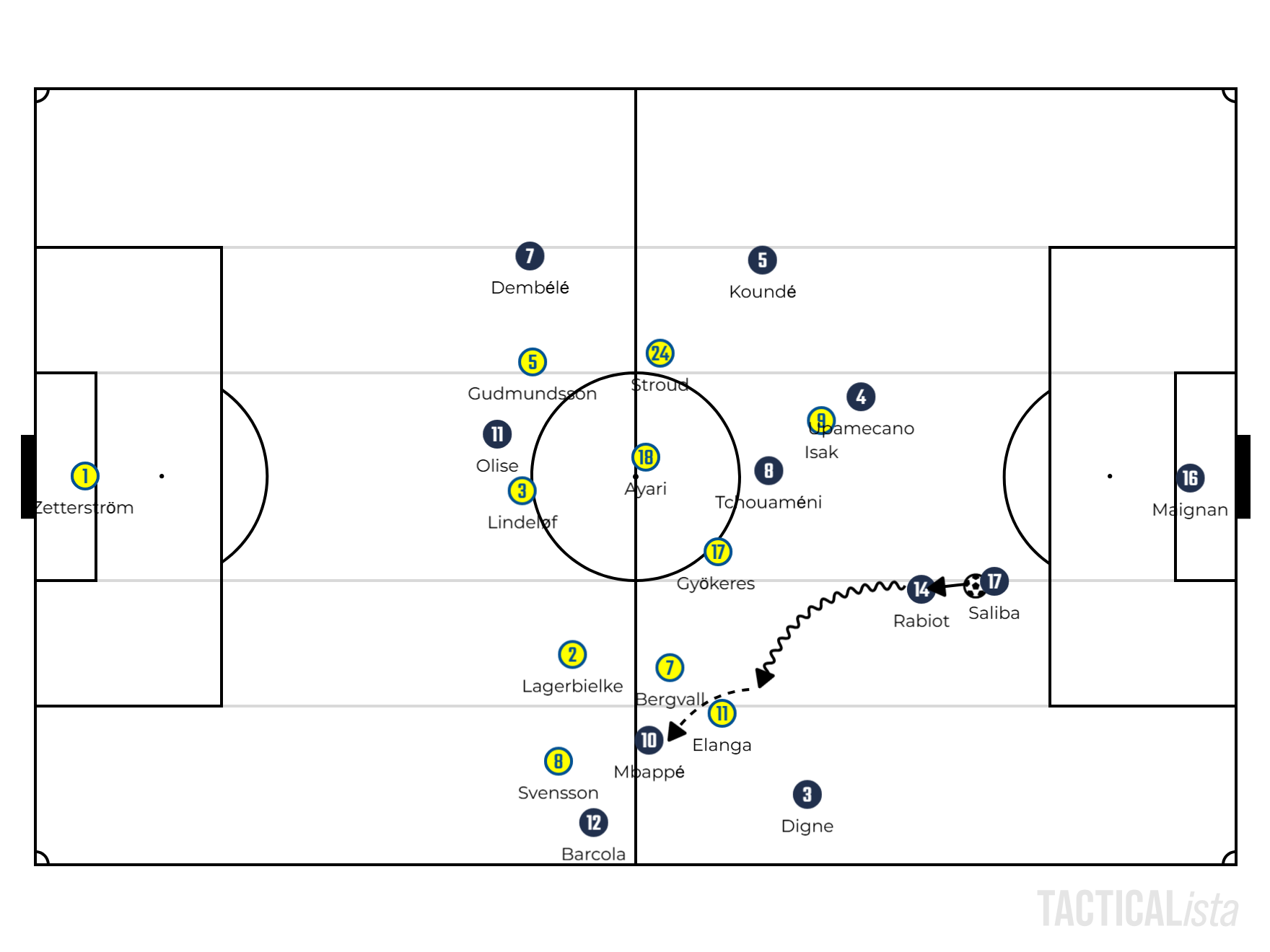
35th minute: France’s build-up left unopposed. Sweden were focused on containment over engagement, which meant Rabiot could pick the ball up from deep and then carry it to the halfway line before being blocked off. Mbappé drops away from the striker role to create a connection with Barcola, allowing Olise to take up the central spot.
Sweden’s plan
In possession, Sweden wanted to stretch the game and play quick balls over the top for Isak, Gyökeres, or Elanga to chase down. However, as Sweden’s neighbor, Norway learned from France’s previous fixture, progressing up the pitch was a double-edged sword. When Sweden committed men forward and pushed their defensive line higher, space would open up behind the backline for France to hit in rapier-like transitions.
Due to this, France were content with not pressing aggressively from the front in every situation. Instead, France found joy in setting up a 4-4-2/4-4-1-1 medium block that coaxed Sweden into more advanced positions. The aim was to then try and aggressively win the ball back once Sweden had overextended, so that there was space in transition for France’s attackers. In part, it looked as if this was the game plan behind why Barcola was picked over Désiré Doué on the left of the fluid front four.
Of the two Paris Saint-Germain wingers, Barcola provides more threat in transition because he likes to run in behind the backline, rather than Doué, who prefers to run at the defense or to receive the ball to feet. From the start, he, alongside Mbappé, looked to be the key targets for when Olise wanted to pick out a runner behind the defensive line.
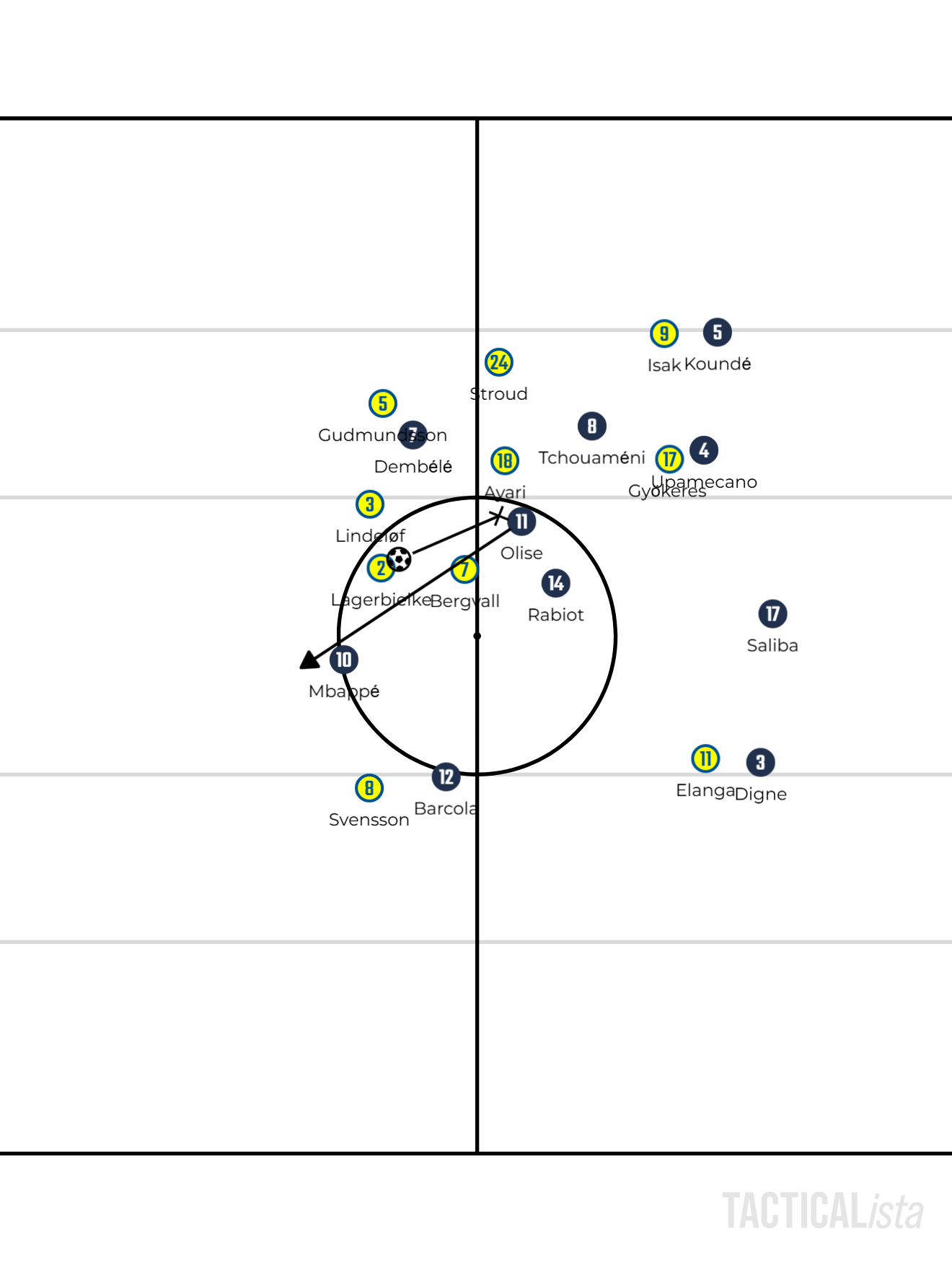
20th minute: Lead-up to disallowed goal. France set up in a midblock from Sweden’s goalkick. The ball reaches Tchouaméni, who heads it forward. Lagerbielke intercepts and tries to play the forward pass to Gyökeres. Sweden have advanced forward, leaving space behind. Mbappé puts the ball in the back of the net, but mistimes his run.
Mbappé makes it one
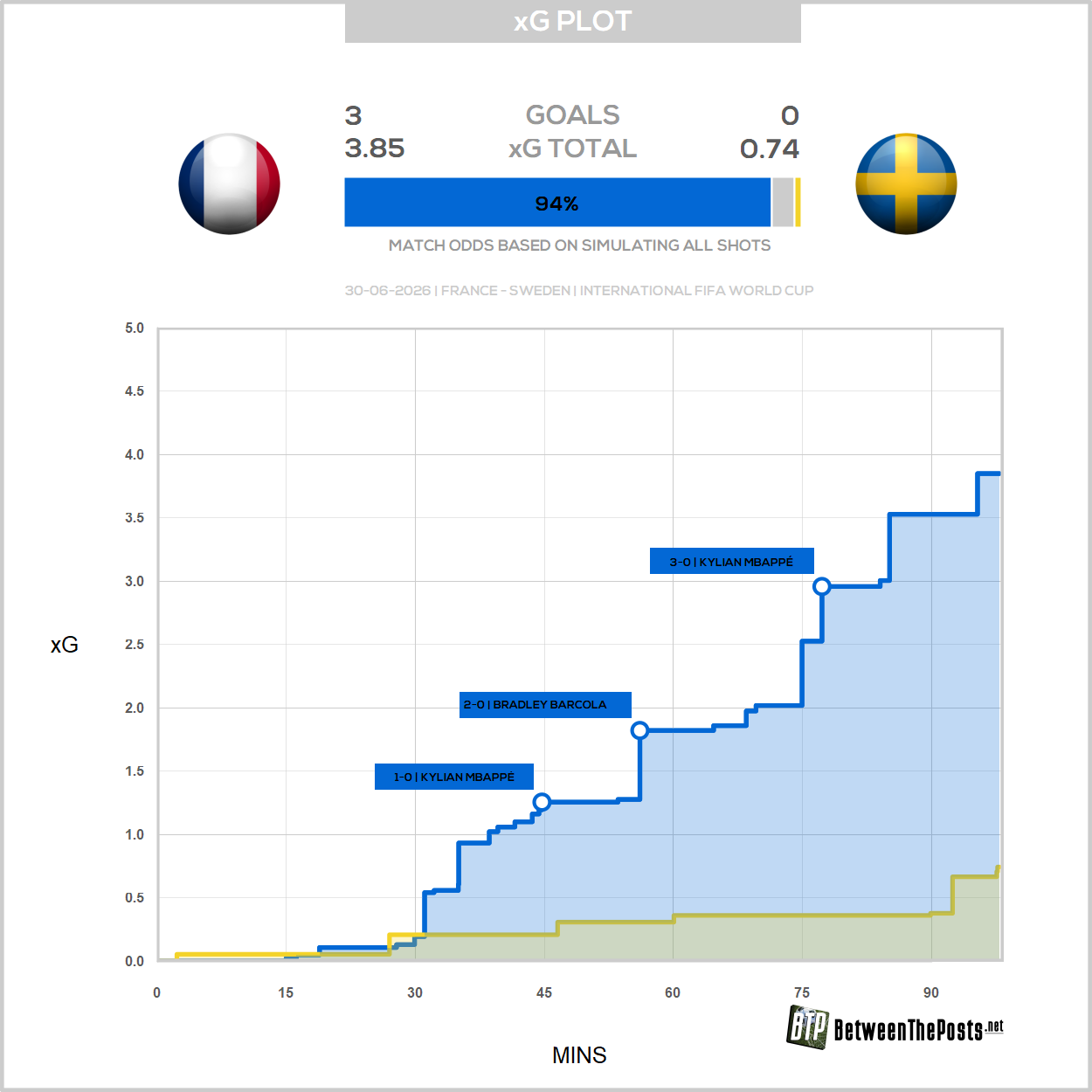
Mbappé would ensure, on the stroke of half-time, that France would go into the break with a well-earned lead when he scored off a corner routine that demonstrated the fluid attacking connections Les Bleus can create. Dembélé would play it short to Olise, and then received the return pass. As this was happening, Mbappé made the third-man run, which was not picked up on by the Swedish defense. He sped into a pocket of space within the box and received the ball, then cut inside and finished with a curling effort.
Sweden should have then leveled the scores in the very next play as France’s concentration dropped following the goal (similar to what happened against Norway, and perhaps something that should be paid further attention to). However, Gyökeres punted the ball over the bar. Soon after, Elanga was brought down in the box by Digne, but the fullback was given a let-off with the attack having started in an offside position.
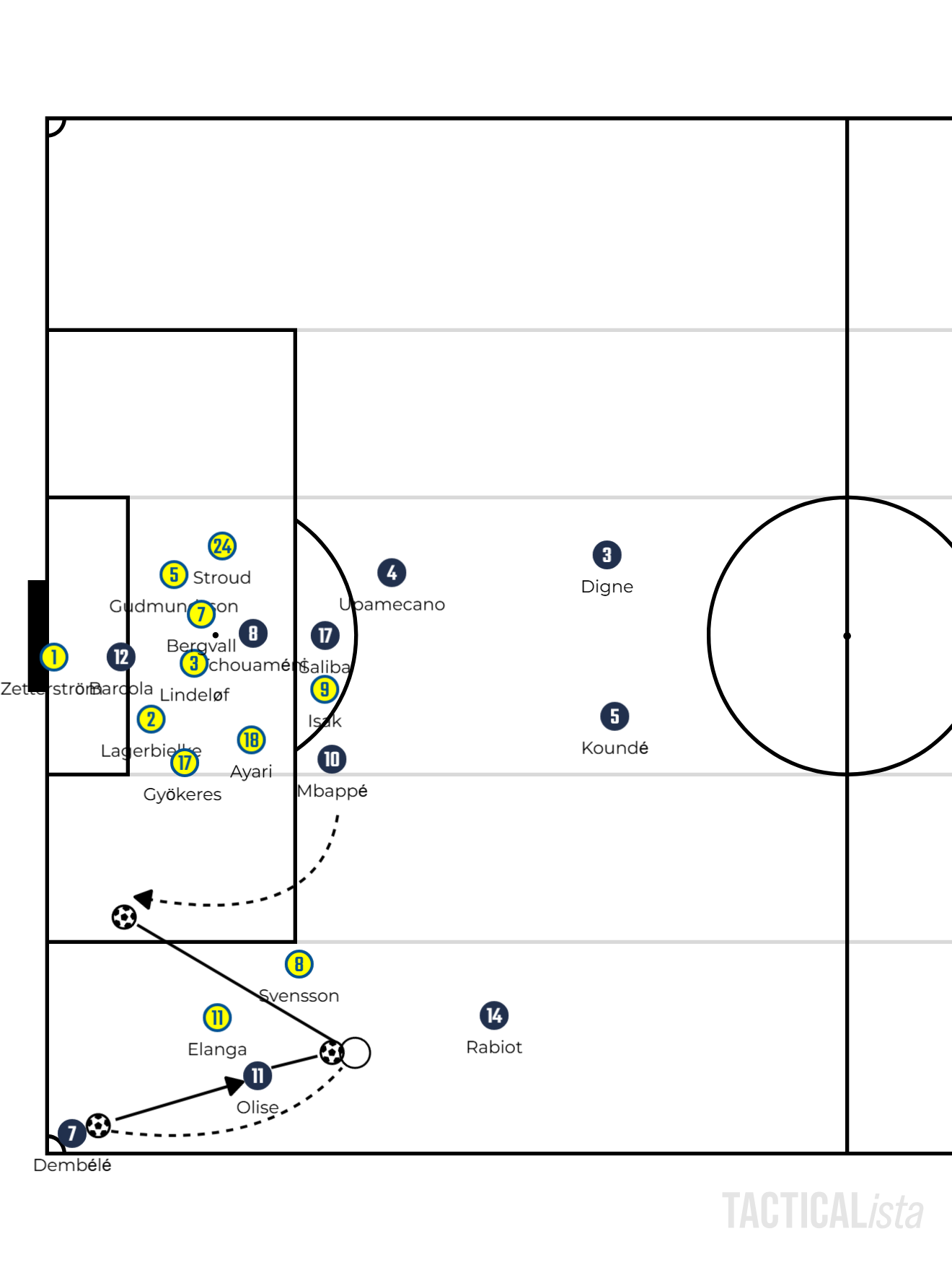
45th minute: Lead-up to Mbappé’s opener. Dembélé plays the short corner to Olise, and then makes the run. Mbappé makes the third-man run and receives the ball. Sweden’s zonal defending is unable to pick up the fluid movement. Isak should have followed Mbappé, but he instead left the dirty work to his strike partner.
Where’s the Achilles’ heel?
France have shown that they’re a well-drilled side out of possession, particularly in counter-pressing and recovering the ball quickly. Deschamps has his team set up in possession with short gaps between the players, which has created an effective rest defense structure as they can spring to action in numbers when the ball is lost to try and win it back as swiftly as possible.
It’s France’s commitment to working hard in the moment when possession was lost that meant that Sweden often struggled to hit passes to Isak and Gyökeres in transition, as their passing lanes into the strikers were suffocated. This nullified what most people expected to be Les Bleus’s Achilles’ heel coming into the tournament (something that only seemed to be confirmed after the first half of the opener against Senegal).
Protection was one aspect of France’s counterpress, but the more glamorous side was that it was the reason behind their second goal. Lagerbielke picked up possession in the second half and was immediately put under pressure by Barcola. The center-back was rushed into a pass that was cleaned up by Tchouaméni. The midfielder released the ball to Olise, who then threaded it to Barcola, who finished the move.
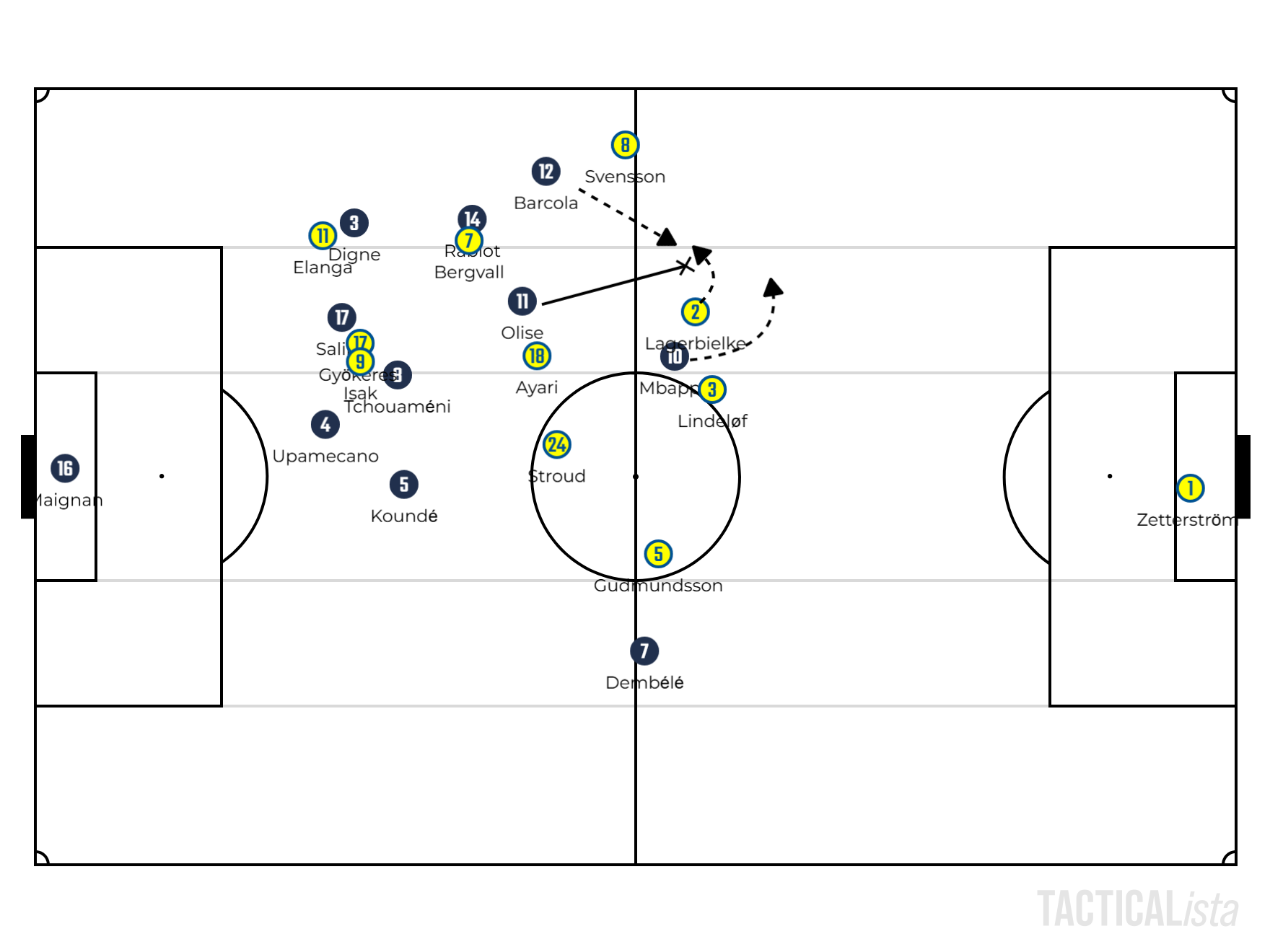
52nd minute: France counterpress after losing possession. Olise’s pass is intercepted. There are short distances between the France players, so Barcola can immediately put the receiver under pressure. Lagerbielke is rushed into a poor decision, leading to the goal in transition.
Mbappé make it three
The final nail in the coffin would come in the 74th minute as Mbappé found the third of the evening with a lovely bit of combination play between himself and Olise. After which, with three goals to the good, Deschamps could turn to his bench and bring on Rayan Cherki, Théo Hernandez, Malo Gusto, Jean-Philippe Mateta, and Désiré Doué. A sheer embarassment of riches.
Takeaways
After four games at the World Cup, there’s still the sense that this France squad haven’t yet been tested. Especially, defensively. I think at this point, perhaps what this suggests is less that France haven’t been tested, and more that this is a ridiculously brilliant team that should be long savored. To put it in another way, there’s a very good reason why they are favorites to win the tournament.
Sweden’s exit means that all of Group F have been eliminated from the competition before the Round of 16. There are perhaps no other teams that have landed quite as tough a draw as Potter’s men. And they can leave the competition having done their best. There will be some what-ifs for the squad, especially with Gyökeres’ first-half miss, but even if that had been scored, one expects it would have been a long night.
Use the arrows to scroll through all available match plots. Click to enlarge. Check the match plots page for plots of other matches.


Comments