

USA – Bosnia and Herzegovina: Reduced to 10 Men, USA Still Too Strong for Bosnia (2-0)
United States secured their place in the Round of 16 of the 2026 FIFA World Cup with a resilient and hard-fought 2-0 victory over Bosnia and Herzegovina at a raucous, sold-out San Francisco Bay Area Stadium. Mauricio Pochettino’s side navigated a turbulent second half—which saw goalscorer Folarin Balogun sent off in the 64th minute—to protect their advantage and advance to the world’s biggest stage’s secondary phase. A clinical first-half strike from Balogun and an exquisite, late free-kick from midfielder Malik Tillman provided the definitive goals, matching a historic milestone for the Stars and Stripes on home soil.
Tactical analysis and match report by Aderemi Qoyum.
We decided to make this article free to read. If you want to support our work, consider taking a subscription.
The match unfolded as an absorbing battle between structural manipulation and low-block defensive survival. Bosnia and Herzegovina deployed a defensive, compact 5-3-2 low-block structure designed to compress vertical passing lanes, restrict inside space for the creative outlets of the USMNT, and launch direct aerial counter-attacks through the physical presence of Edin Džeko and Ermedin Demirović.
The United States dictated the tempo through extended periods of possession, controlling up to 75 percent of the ball across the opening thirty minutes. Pochettino opted for a fluid 4-1-2-3 system on paper that frequently altered its spacing to generate overloads across the wide channels and isolate Bosnia’s wingbacks. The definitive tactical advantage for the United States stemmed from their structural maturity after going down to ten men, restricting Bosnia’s ability to create high-value central openings despite the visitors enjoying a numerical advantage for nearly thirty minutes.
The strategic layout for this knockout clash saw both managers employ highly calculated setups. The USA took the pitch with Matt Freese in goal, executing another crucial clean sheet performance. The nominal backline featured veteran captain Tim Ream alongside Chris Richards, Alex Freeman, and Antonee Robinson. Operating across the engine room, Tyler Adams anchored the base as a single pivot, flanked by the energetic profiles of Weston McKennie and Malik Tillman, while Sergiño Dest and Christian Pulisic started on the wings. Folarin Balogun led the line as the central striker.
Conversely, Bosnia and Herzegovina relied on a heavy-set 5-3-2 alignment curated by their tactical staff to absorb sustained box entries. Nikola Vasilj started between the posts behind a five-man defensive wall featuring fullbacks Amar Dedić and Sead Kolašinac flanking center-backs Nikola Katić, Stjepan Radeljić, and Tarik Muharemovic. A midfield trio consisting of Ivan Šunjić, Armin Gigović, and the young Kerim Alajbegović was tasked with suffocating the interior half-spaces, while Ermedin Demirović and the iconic Edin Džeko led the vertical transition lines up top.
USA’s fluid 3-1-6 overloads Bosnia’s defensive block
Once the United States established sustained possession, their shape adjusted into an aggressive 3-1-6 in-possession structure designed to systematically manipulate Bosnia’s dense five-man defensive line. In this fluid layout, Christian Pulisic and Weston McKennie occupied the left and right half-spaces respectively, while Malik Tillman operated with total positional freedom centrally behind Folarin Balogun. Tillman moved fluidly both vertically and horizontally to link play, causing immense friction between Bosnia’s defensive lines and forcing their midfield to drop excessively deep.
To stretch the visitors horizontally across the entire width of the pitch, advanced wingbacks Robinson and Dest pushed high and wide to sit level with the Bosnia backline. The American structure became incredibly dynamic through rehearsed rotations, as the width-holders constantly exchanged positioning with their corresponding half-space partners to unbalance Bosnia’s defensive duties.
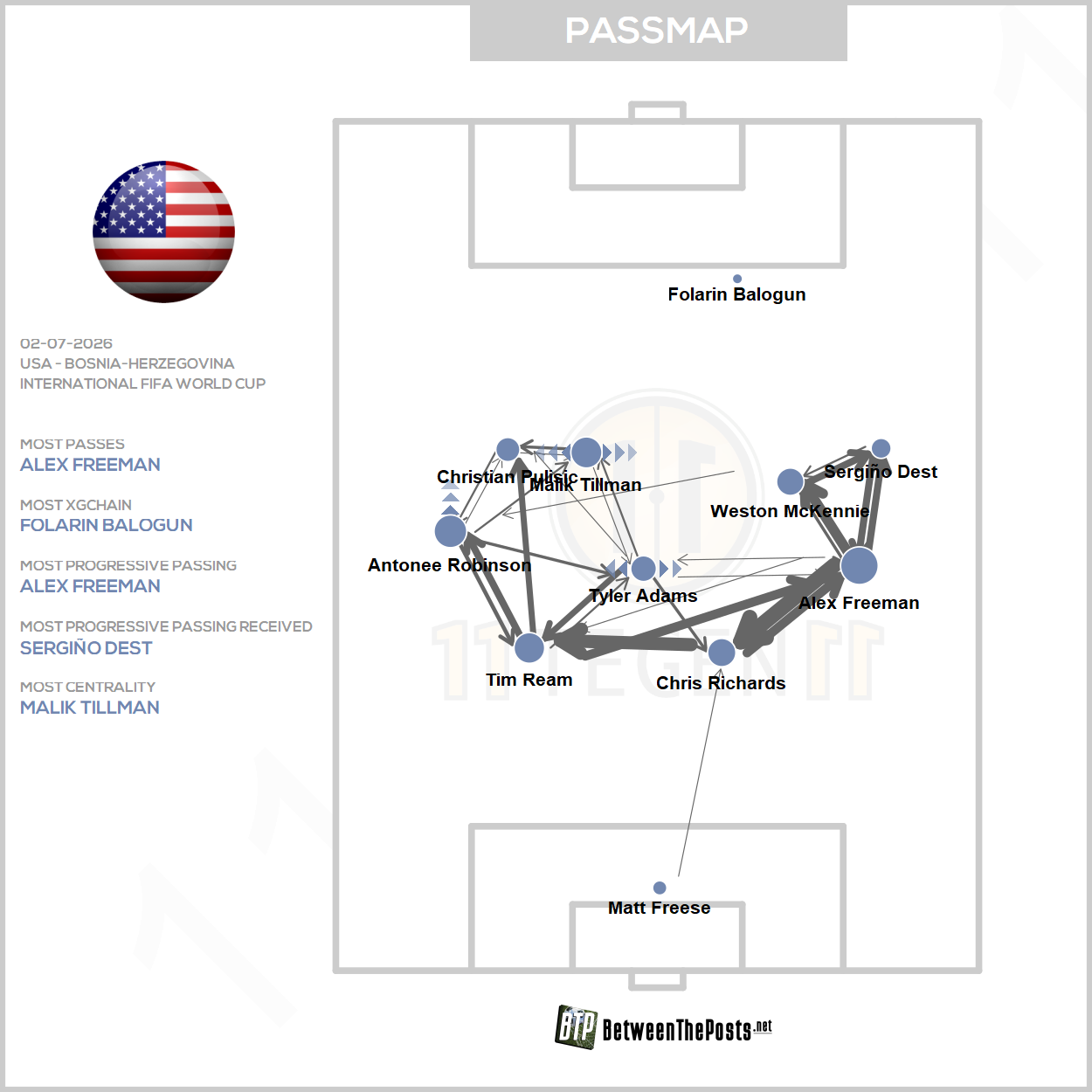
USA’s Passmap shows the right-side overloads and combination. Freeman constantly finding McKennie and Dest.
When Bosnia’s narrow defensive block successfully compressed the central lanes, it forced Pulisic and McKennie to drop deeper into zones 10 and 12 respectively to escape the congestion, get on the ball, and spark forward progression. Initially, Bosnia and Herzegovina successfully contained these early waves of pressure, using their numerical advantage inside the penalty box to intercept early service.
Goalkeeper Nikola Vasilj performed under immense duress, diligently marshaling his box against high-volume crossing delivered from both flanks. However, the continuous, synchronized counter-movements of McKennie and Dest eventually paralyzed Bosnia’s wide defenders, leaving them completely unable to pass off their marking duties without exposing catastrophic gaps in the channels behind them. Folarin Balogun kept making channel runs on both sides to receive in any vacated spaces.
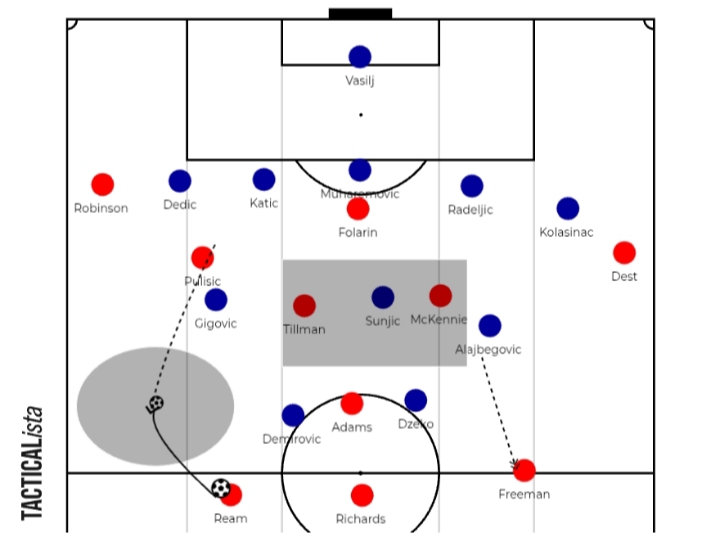
Minute 14′: USA’s fluid 3-1-6 in-possession structure overloads Bosnia’s compact 5-3-2 out-of-possession defensive shape. Pulisic dropping to receive outside the block.
Press high, win the ball, attack quickly
When possession was lost, the United States instantly shifted into an aggressive, suffocating defensive press. From deep goal kicks, Bosnia and Herzegovina completely avoided trying to build out from the back, opting instead to go long to escape the frontline pressure. However, when play broke down in the middle or final third, Bosnia found themselves relentlessly chased back. Every single USA player jumped straight at any Bosnian player closest to them the moment the ball turned over, choking out counter-attacking transitions before they could form.
This intense counterpress yielded what looked like the opening goal in the 31st minute. Malik Tillman won the ball back cleanly high up the pitch, immediately poking it toward McKennie. The midfielder wasted no time threading a first-touch pass to Folarin Balogun, who controlled it beautifully under heavy pressure and fired a low shot into the bottom corner. The celebrations were cut short, however, as the linesman raised his flag for a tight offside call. Minutes later, the exact same high-pressure style finally broke the deadlock.
Another fierce counterpress from the USA forced Bosnia backwards, playing the ball all the way to Nikola Vasilj in goal, who immediately hoofed it long under duress. The direct clearance landed cleanly with veteran center-back Tim Ream, who accurately passed forward to Tyler Adams who quickly flicked a pass into space for Tillman. He slipped a ball toward Balogun, which found the striker through two fortuitous deflections off Bosnian defenders. Facing Vasilj one-on-one in the 45th minute, Balogun made no mistake, sliding his finish home to reward the USA’s first-half dominance.
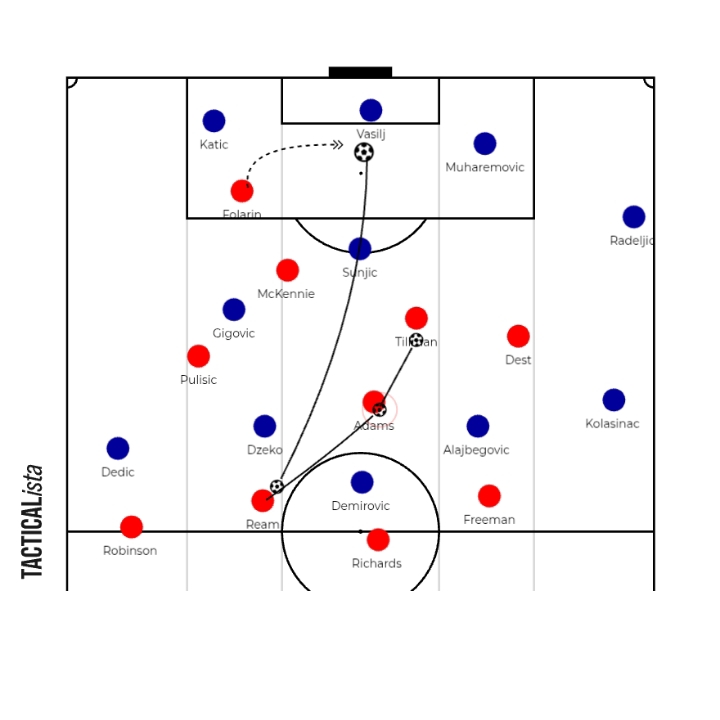 Minute 45′: The high counterpress sequence leading to Tillman’s progressive pass and Balogun’s opening goal.
Red card? No problem for USA
The tactical landscape shifted dramatically in the second half, heavily influenced by personnel changes. Sergej Barbarez made an aggressive triple substitution in the 51st minute, withdrawing Armin Gigović, Ivan Šunjić, and talismanic striker Edin Džeko. The match swung even further into the visitors’ favor in the 64th minute when Folarin Balogun caught Tarik Muharemović on the ankle with his studs in a heavy challenge. Following a VAR review, the referee issued a straight red card, dismissing the American goalscorer.
Pochettino reacted instantly to the numerical disadvantage, reorganizing the remaining ten players into a disciplined, compact 4-4-1 defensive block. Bosnia capitalized on their one-man advantage to pin the USA deep in their own territory, attacking with an expansive 3-2-5 structure.
In this attacking shape, fullbacks Sead Kolašinac and Amar Dedić pushed exceptionally high and wide to stretch the American block, while 18-year-old talent Kerim Alajbegović drifted inside to operate in the left half-space. Substitutes Ermin Mahmić and Benjamin Tahirović held down the midfield base, while Esmir Bajraktarević pushed into the frontline to support Ermedin Demirović up top.
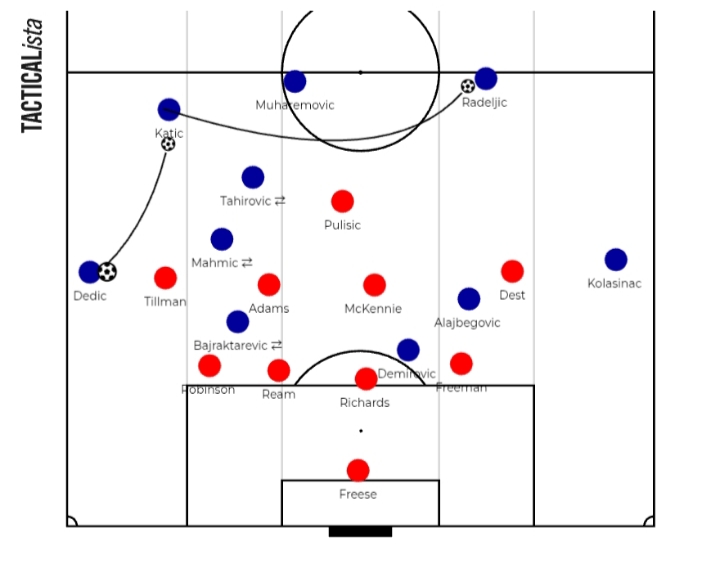
Minute 66′: Bosnia’s attacking 3-2-5 shape probing the USA’s compact, ten-man 4-4-1 defensive block.
Despite the relentless territorial pressure, Bosnia struggled to break through the disciplined American lines. They lacked the attacking qualities to threaten the USA defence. Pulisic goal in the 78th minute was disallowed as he was well offside.
The final blow came in the 82nd minute against the run of play. Dest carried the ball forward on a rare transition and drew a crucial foul roughly 20 yards out on the left side of the penalty area. Malik Tillman stepped up to take the direct free-kick. He struck a spectacular, swerving effort over the wall that flew into the back of the net with enough velocity to beat Vasilj, sealing a hard-fought insurance goal for the hosts.
Takeaways
The United States delivered a mature and highly strategic performance, utterly dominating the first half through their territory-pinning 3-1-6 structure and a lethal counterpress.
While Balogun’s second-half red card threatened to unfoil the opening victory, the team’s seamless adaptation into a rigid defensive block shut down any real danger. Bosnia and Herzegovina enjoyed a prolonged numerical advantage but failed to create any high-value scoring opportunities against the resolute American backline.
With this statement win behind them, the USA carries massive momentum into the next phase of the tournament. Pochettino’s men will face a high-stakes Round of 16 clash against Belgium on July 7th at the Seattle Stadium in Washington.


Comments