
Mexico – England: Weathering The Storm In The Azteca (2-3)
England were able to take the lead in the first half with a Jude Bellingham double after playing a conservative game against the hosts. In the second half, a red card forced them to defend deep with ten men. Grit, determination, and some astute tactical adjustments saw them through in the end.
Tactical analysis and match report by Josh Manley.
We decided to make this article free to read. If you want to support our work, consider taking a subscription.
After coming from behind to beat DR Congo in the Round of 32, England now faced the formidable task of beating Mexico at the Azteca Stadium. Of the 89 competitive games that El Tri had played in the Azteca prior to this match, they had won 70, only losing twice. With a hostile atmosphere and high altitude to adjust to, it was crucial for England to be fully ready from the first whistle here.
Mexico lined up in a 4-3-3 formation, with a back four of Jorge Sánchez, César Montes, Johan Vásquez, and Jesús Gallardo. The midfield trio comprised Gilberto Mora, Érik Lira, and Luis Romo, while Raúl Jiménez led the line up front, flanked by Roberto Alvarado and Julián Quiñones.
Thomas Tuchel also continued with the 4-3-3 system for England, with Jarell Quansah being selected as the right back due to fitness issues for Reece James and Djed Spence. Ezri Konsa, Marc Guéhi, and Nico O’Reilly completed the backline. Elliot Anderson, Declan Rice, and Jude Bellingham were the midfielders, while the frontline was formed by Bukayo Saka, Harry Kane, and Anthony Gordon.
Taming the Azteca
England’s first priority was to try and calm the game and prevent Mexico from getting momentum in the early stages. They were largely able to achieve this through the stability in possession provided by the use of goalkeeper Jordan Pickford in the first line of buildup.
When England had the ball, they would build up in their 4-3-3 shape but tried to avoid high Mexico pressing situations in which they were forced back into their own box and short passes would be risky. Instead, they would play long to try and hit the space behind Mexico’s defense.
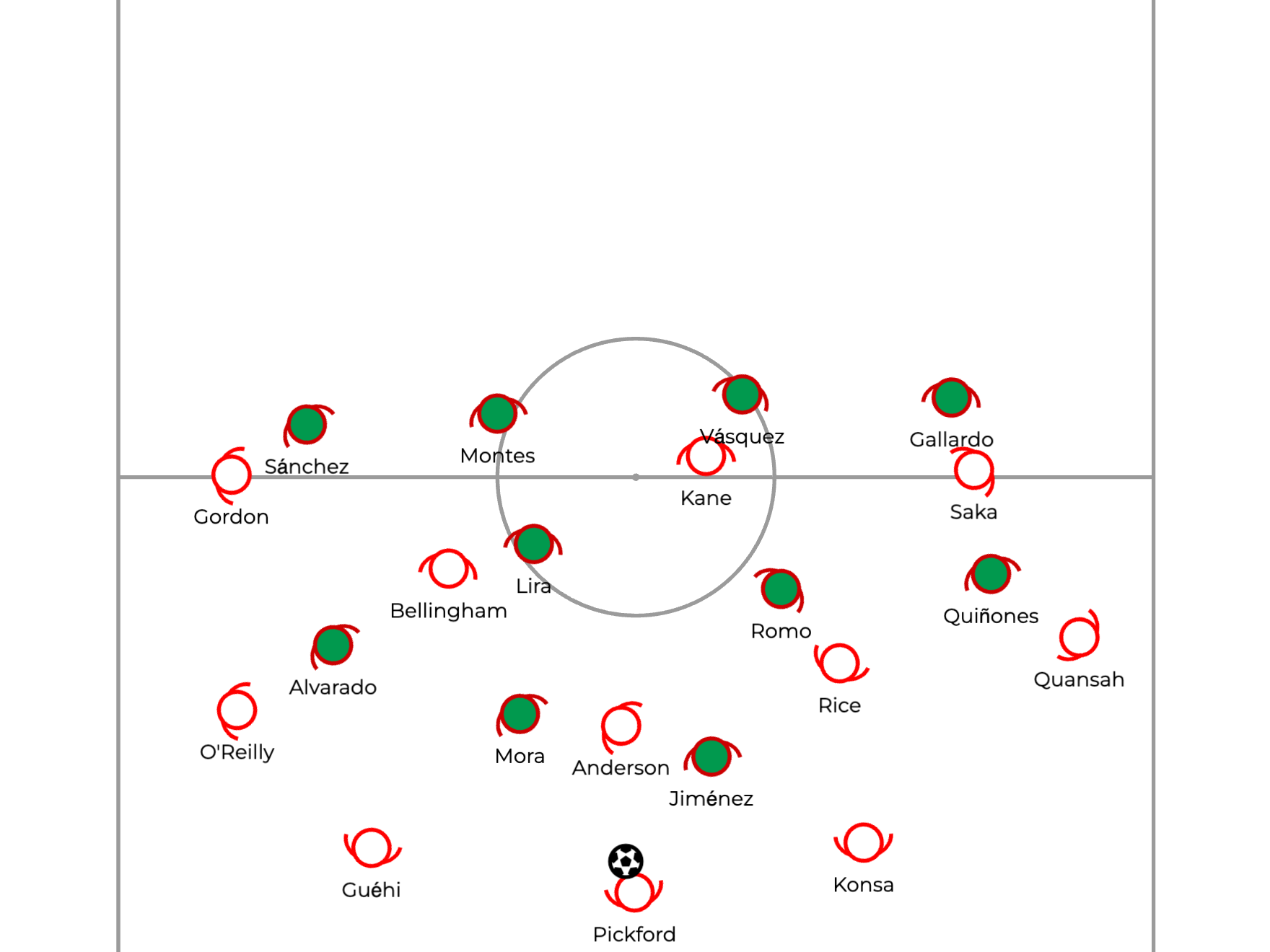
England using Pickford as part of the first line in buildup.
England wanted to start their possession phases against a Mexico mid block, whereby Pickford would push up into the defensive chain, adding an extra man and making it harder for Mexico to establish access to the ball.
On an individual level, England were also happy to break the game up by drawing fouls from the Mexico press, preventing the hosts from gaining the aforementioned momentum.
England’s 4-3-3 system prominently featured the wing rotations seen in previous games. The most common variations that they ended up in were for Rice to drop deeper on the right side with Quansah pushing forward while Saka pushed onto the last line, slightly indented to pin the Mexico left back. At the same time, Kane would often be slightly offset to the right in his forward role.
On the left side, Bellingham pushed high, while Gordon provided width and O’Reilly started lower, able to invert when needed. Bellingham was very much a protagonist in this game from early on with England seeking his ball-carrying ability as an outlet against the Mexico press.
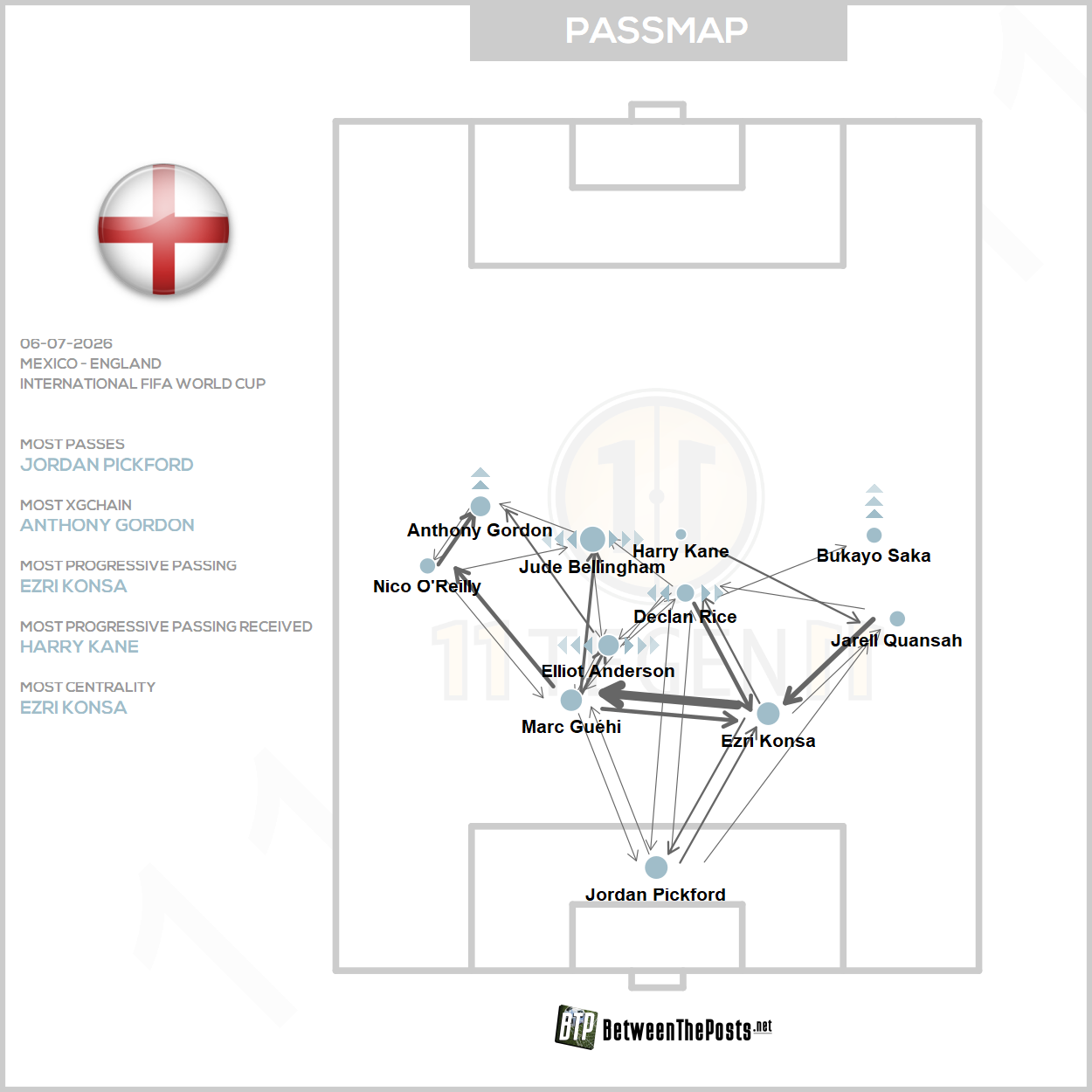
Pickford having most passes tells the story of his involvement in England’s possession scheme.
Javier Aguirre’s men were pressing in a man-oriented fashion, with Mora jumping forward from their initial 4-3-3 shape to get closer to Anderson, while the other central midfielders went man for man against Bellingham and Rice, although Romo would abandon Rice when he dropped too deep.
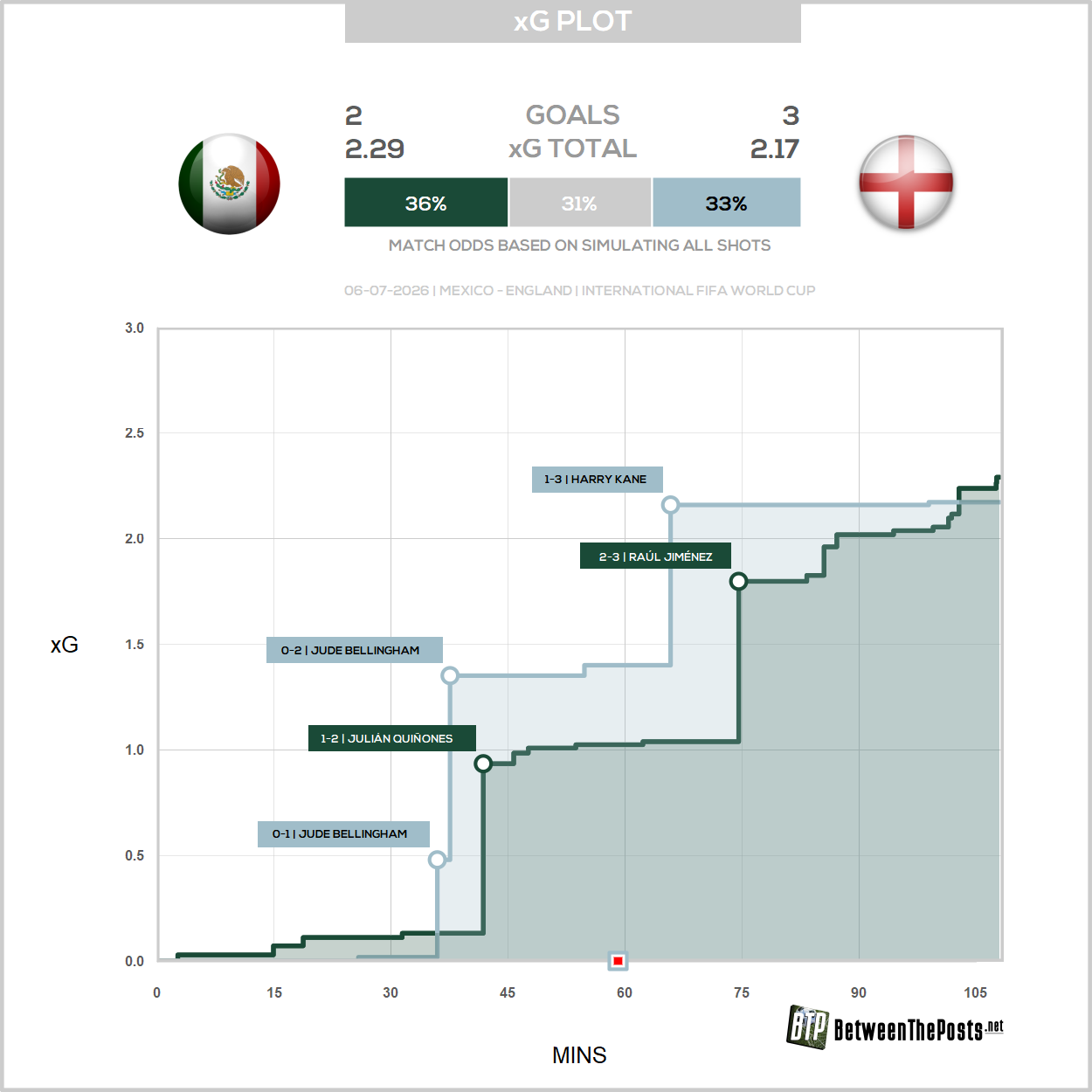
Ten minutes before half time though, Bellingham became much more than just an outlet. In an England transition attack in which Rice had carried the ball down the right, Saka received and took on his opponent. Bellingham stormed in at the far post with a diving header to meet the resulting Saka cross, making it 1-0 to England.
Immediately from the kick-off, England squeezed Mexico in midfield and won the ball back, transitioning again down the right where Kane put in a low cross for Bellingham arriving at the perfect time again to make it 2-0.
Survival mode
Things seemed to be going perfectly for England as half time approached. This notion was quickly shattered when a Mexico set-piece led to Quiñones lashing the ball past Pickford on the half-volley just before the break, reducing England‘s lead to one.
The first fifteen minutes of the second half heralded both bad and good news for England. The extremely bad news concerned the red card for Quansah for a dangerous tackle. With England reduced to ten, Tuchel was forced to sacrifice Saka to allow John Stones to shore up the defence, with Konsa moving to right back.
The silver lining was that just a few minutes later, a long Pickford ball to Kane was flicked on to Gordon running in behind, and the new Barcelona man was brought down by Mexico’s goalkeeper, with Kane burying the resulting penalty to make it 3-1.
The stakes for the final thirty minutes were now clear: ten-man England would need to defend for their tournament lives while Mexico threw everything at them in front of a baying home crowd.
In the first half, England had defended mostly in a 4-4-2 shape, caused by Lira dropping in to form a back three in Mexico’s possession phases, meaning Bellingham would stay advanced next to Kane as part of England’s man-oriented defensive scheme.
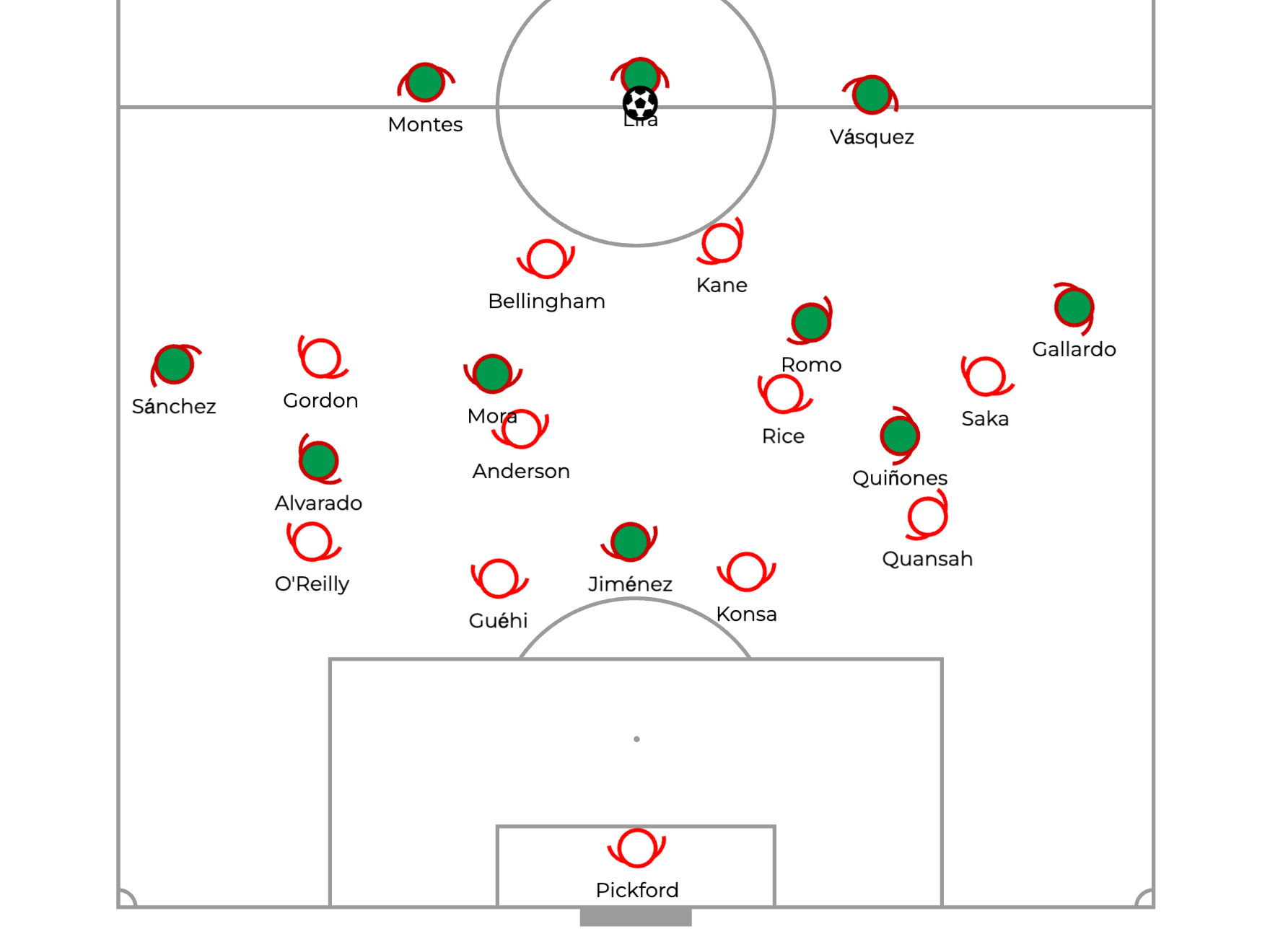
England’s defensive scheme in the first half.
England did not usually go into a high press. Perhaps this was an attempt to manage the altitude by reducing the amount of high intensity sprints needed. Either way, they generally defended in a low block with the wingers tracking back against the advancing Mexican fullbacks.
After the red card, England were initially defending in a 4-3-2 shape with Kane and Gordon up front. After Mexico made it 3-2 with a penalty of their own though, Tuchel decided to make his changes.
The big decision was the switch to a back five. Spence and Dan Burn were introduced in place of O’Reilly and Anderson. England now defended in a 5-3-1 shape with Spence at left back and Burn as left center-back. Bellingham, Rice, and Gordon formed the midfield line.
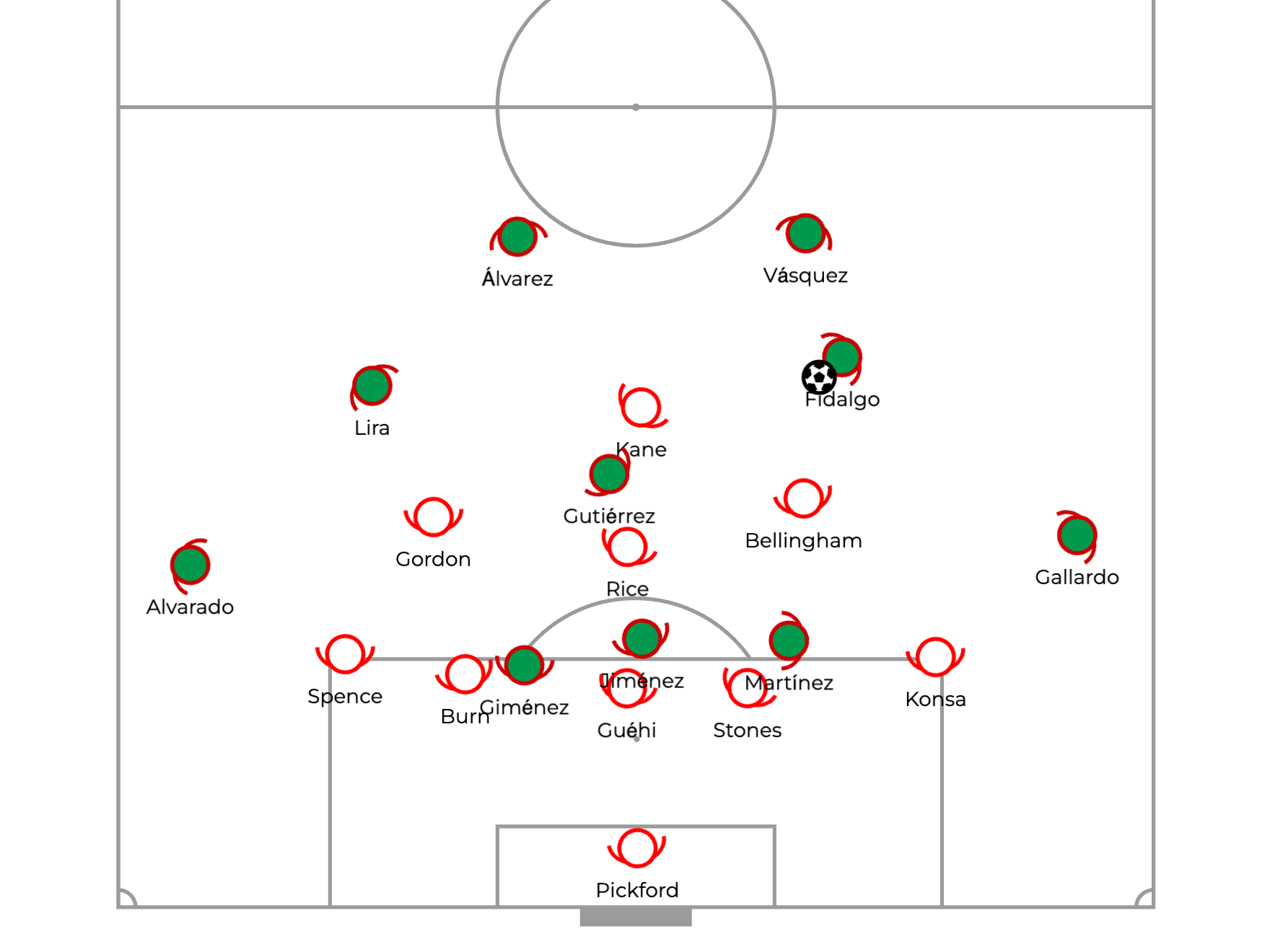
England defending in a 5-3-1 shape after the red card.
Mexico’s strategy against the England low block was heavily based around crosses. Guillermo Martínez was brought on later to add more height to the box, and it quickly became clear that a key aspect for England to manage in this game would be to get out to pressure the wide areas quickly in order to limit the quantity and quality of crosses into the box.
This was a punishing task with the fatigue that was quickly accumulating in the legs of the England players, defending with ten men in high altitude against a relentless Mexico bombardment. The hosts were essentially attacking in a 2-5-3 shape with three narrow strikers in the box.
Mexico’s main supplier of crosses was Gallardo from the left back position. This likely played a role in Tuchel’s decision to add fresh legs down this side going into the lengthy period of added time. Morgan Rogers replaced Kane with Bellingham moving up front and Rogers playing on the right of midfield to help Konsa manage the wide area.
Defending this lead was not simple for England, and they relied on some heroic emergency defending in the box from the likes of Stones, Guéhi, and co. Finally, though, they were able to weather the storm and secure their place in the next round.
Takeaways
Mexico pushed England all the way here, never making things easy for the visitors. Their second half play against the low block could maybe have used a little more variation in terms of the crossing-focused approach, but overall they gave a good account of themselves.
For England, the show goes on as they prepare to meet Norway in the next round. This was very much a case of managing the game throughout the ninety minutes for Tuchel’s men. From quelling the Mexico press in the first half and eventually hitting their opponents on the transition, to being under siege in the second half, England had to win in a way that was not glamorous.
The in-game management from Tuchel was brave in a sense – many may have felt that it was too early to go to a back five when he did, though it was vindicated as the extra aerial presence of Burn proved valuable. The idea to sacrifice Kane to try and stem the flow of crosses from Mexico’s left through Rogers’ introduction was similarly brave.
Use the arrows to scroll through all available match plots. Click to enlarge.
Check the match plots page for plots of other matches.