
Paris Saint-Germain – Arsenal: One Finds The Risk, The Other Is Reluctant (1-1, 4-3 On Penalties)
A Champions League final that can be summarized by risk. Luis Enrique found a solution to Paris Saint-Germain’s first-half problems, even if they were not at their creative peaks. Mikel Arteta struggled to get his team out of the situation they put themselves in, a shoot-out defeat that handed PSG their second consecutive trophy.
Tactical analysis and match report by Joel Parker.
We decided to make this article free to read. If you want to support our work, consider taking a subscription.
Last season’s Champions League semi-finals pitted these two teams in very different headspaces. PSG had built momentum with knockout wins against Premier League opponents, but was still yearning for the ultimate trophy that Qatar Sports Investment had built towards. Arsenal had found its defensive strength under Mikel Arteta, but had yet to break the hoodoo placed upon them.
Thirteen months later, they would meet again, this time at the final hurdle. Enrique delivered the Champions League and insisted on his team’s motivations being stronger than those of the opponent in the pre-match press conference. The formula has not changed; offensively irresistible with positional rotations that keep possession away from opposition clutches. If last season’s run was about big performances, this was about big scorelines (eight goals against Chelsea, four against Liverpool and the crazy 5-4 semi-final at the Parc des Princes against Bayern Munich). In Ligue 1, a less convincing run-in but a title wrapped up early for key players to nurse back to full fitness.
Arsenal may have lost both legs of that semi-final, but did not travel to Budapest in despair. The Premier League trophy was finally in their clutches, having established themselves as one of the most solid out-of-possession units over the past few seasons, as well as their dominance in dead-ball situations. In the Champions League, the shadows of their 2006 run-in to Paris loomed, as Arsenal did not lose a single game throughout the entire competition. With one jinx already broken, Mikel Arteta was hungry to finish another.
Enrique’s doubts to the starting eleven would be Achraf Hakimi, who was recovering from an injury to his right thigh, and Ousmane Dembélé, who had been managing a calf issue in the final weeks of the season. However, both were declared fit before the weekend, and Enrique named an unchanged outfield eleven that brutally dismantled Internazionale in last season’s final.
Arteta also had issues at right fullback, as he would still be without Jurriën Timber (only fit for the bench), so Cristhian Mosquera would move back into that position. Across the pitch, some other big calls would be made: Kai Havertz trusted over Viktor Gyökeres, Myles Lewis-Skelly ahead of Martin Zubimendi and Piero Hincapié, the more solid defensive choice over Riccardo Calafiori at left fullback.
A goal to set the game state
The big curiosity of this final would be how Arsenal would set-up against a PSG unit that attracts to progress. On the left side, Fabián Ruiz peeled to the left touchline, even replacing Nuno Mendes in the fullback spot, so that the Portuguese player could sprint on the inside, but Arsenal’s 4-2-4/4-4-2 formation remained disciplined. From the center, Havertz and Martin Ødegaard shielded the pivot and jumped outward to encourage PSG to play to the channels.
Whilst Arteta’s team pressed high in the opening phases, it was always with a dose of caution. When Mendes dribbled inside of Bukayo Saka, after two minutes, Ødegaard dropped and Lewis-Skelly shifted to make the space as compressed as possible, the attempted pass out to the right being blocked in the process. When Dembélé also came towards the left touchline, Declan Rice followed and PSG would not perform the countermovement to connect between the lines. Enrique’s team may have teased rotating in the space down the left flank, but the Arsenal block appeared difficult to pry open.
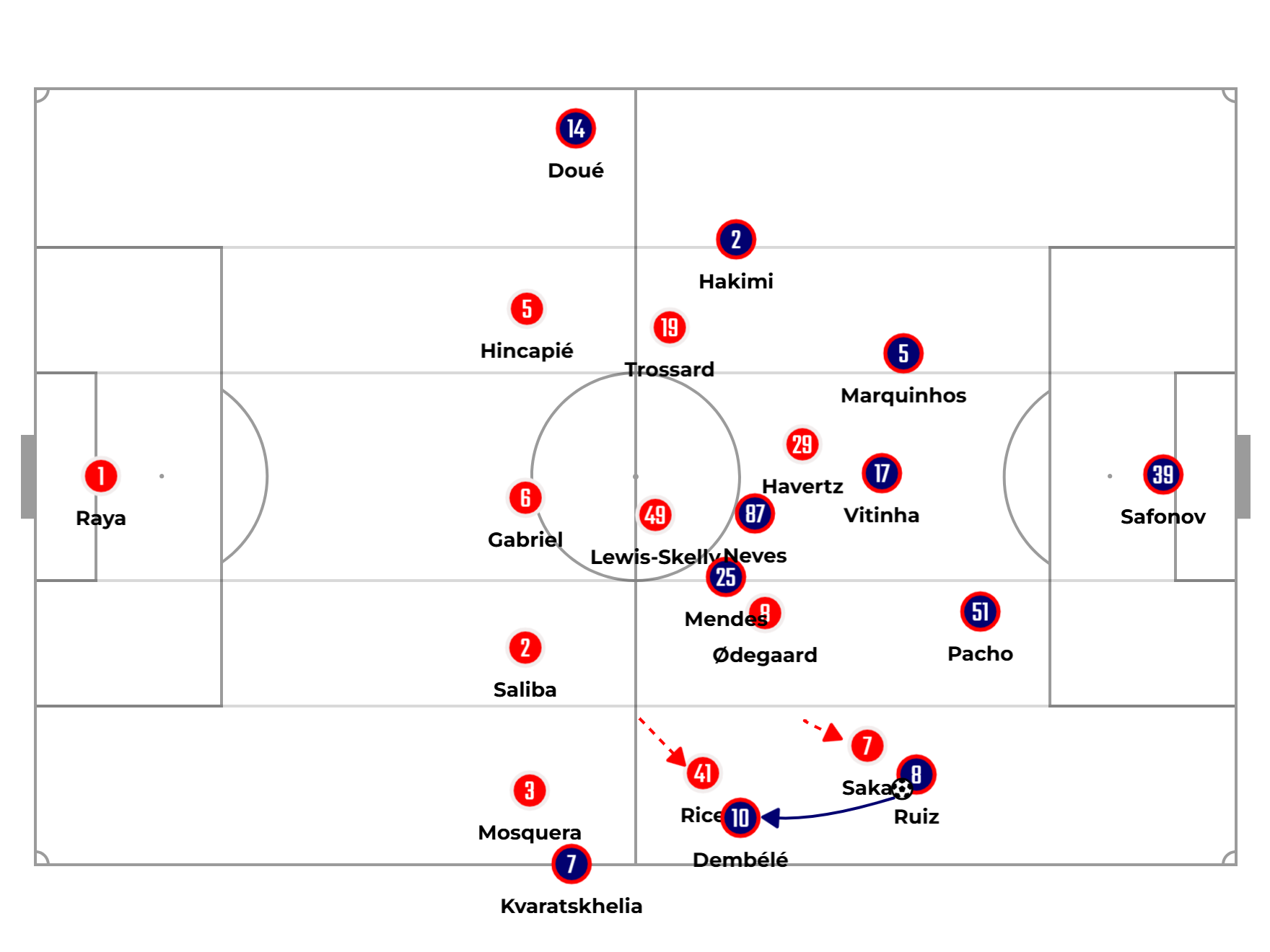
2nd minute: PSG attracting on the left side of their buildup versus Arsenal’s 4-2-4 medium block. As Ruiz and Dembélé dropped onto the outer channel, no countermovement was made to disrupt the inside of the block, even though Mendes had dropped into an inverted position in this phase. As a result, Saka and Rice could jump outward whilst Ødegaard’s cover shadow blocked off the inside pass. Dembélé would pass back and PSG recirculated.
Four minutes in, Arsenal would strike. PSG jumped man-to-man after conceding a free-kick in the Arsenal half and Havertz controlled a high ball from Rice. Marquinhos shifted over to intercept Hincapié’s pass, but in the process, he would smash the ball against Leandro Trossard and the German striker raced through. Havertz shot high from a tight angle, Matvey Safonov watched the shot go over him and into the roof of the net. A perfect start for Arteta’s team.
From this point, caution became the overriding factor. The Arsenal block dropped deeper to maintain its compactness and dull down the threat of a flexible opposition offense. With Arsenal in front, a final that neutrals were concerned for started to play out.
Rooted in the risk-averse
However, risk can be a two-way street. The threat from transition had already been presented and even if it would not lead to an attempt, lead to a foul and Arsenal’s display of set-piece dominance could come into full effect, something that PSG were clearly aware of. At the base, Vitinha remained close to the tiled three; João Neves situationally dropped, to make it a 3-2, and Ruiz’s wide-deep position meant that the three were in rest defense positions, but their circulation did not disrupt the deeper Arsenal arrangement.
Combinations were more fixated on the right side in the first period. Hakimi was the width provider as Désiré Doué dropped into pockets, whilst third man runs could come from Neves/Vitinha. However, even when the positions changed, there was no threat to the double pivot of Lewis-Skelly and Rice because there was no threat of runs being produced behind them or into the central spots. Plenty of touches were made around the outside of the Arsenal block, but there was not enough incision between the lines.
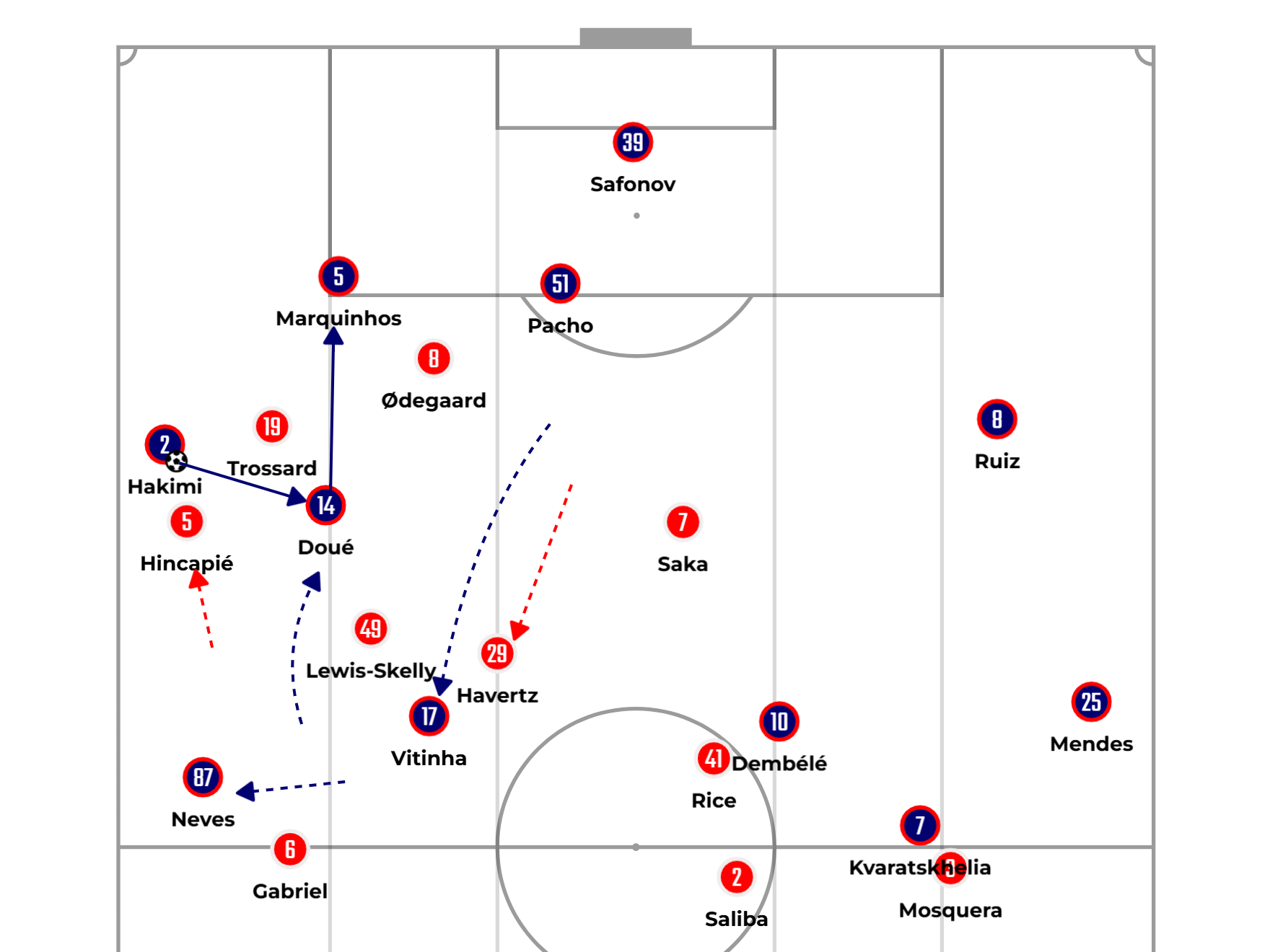
13th minute: Right-sided rotation that does not come off for PSG. After Marquinhos passed to Hakimi, Doué dropped towards the ball, Neves shifted out wide and Vitinha made a run out of the pivot position and behind Lewis-Skelly. However, Havertz followed, Lewis-Skelly remained in his position to block the direct passing option and unable to turn, Doué passed back to Marquinhos.
Consequently, the first-half performances of Khvicha Kvaratskhelia, Doué and Dembélé saw all three have little involvement around the penalty area, as PSG were constantly shifted out wide. Kvaratskhelia and Doué were repeatedly played on the touchline, and when either man dribbled inside, the lack of pinning or support runs in the halfspaces meant there were no bounce/wall pass options to build momentum. The Georgian winger made runs into the right halfspace, which did cause the occasional scare: Doué/Dembélé dribbles encouraged Trossard and Hincapié, whilst Hakimi moved into the box to pin Gabriel Magalhães. However, these runs came few and far between.
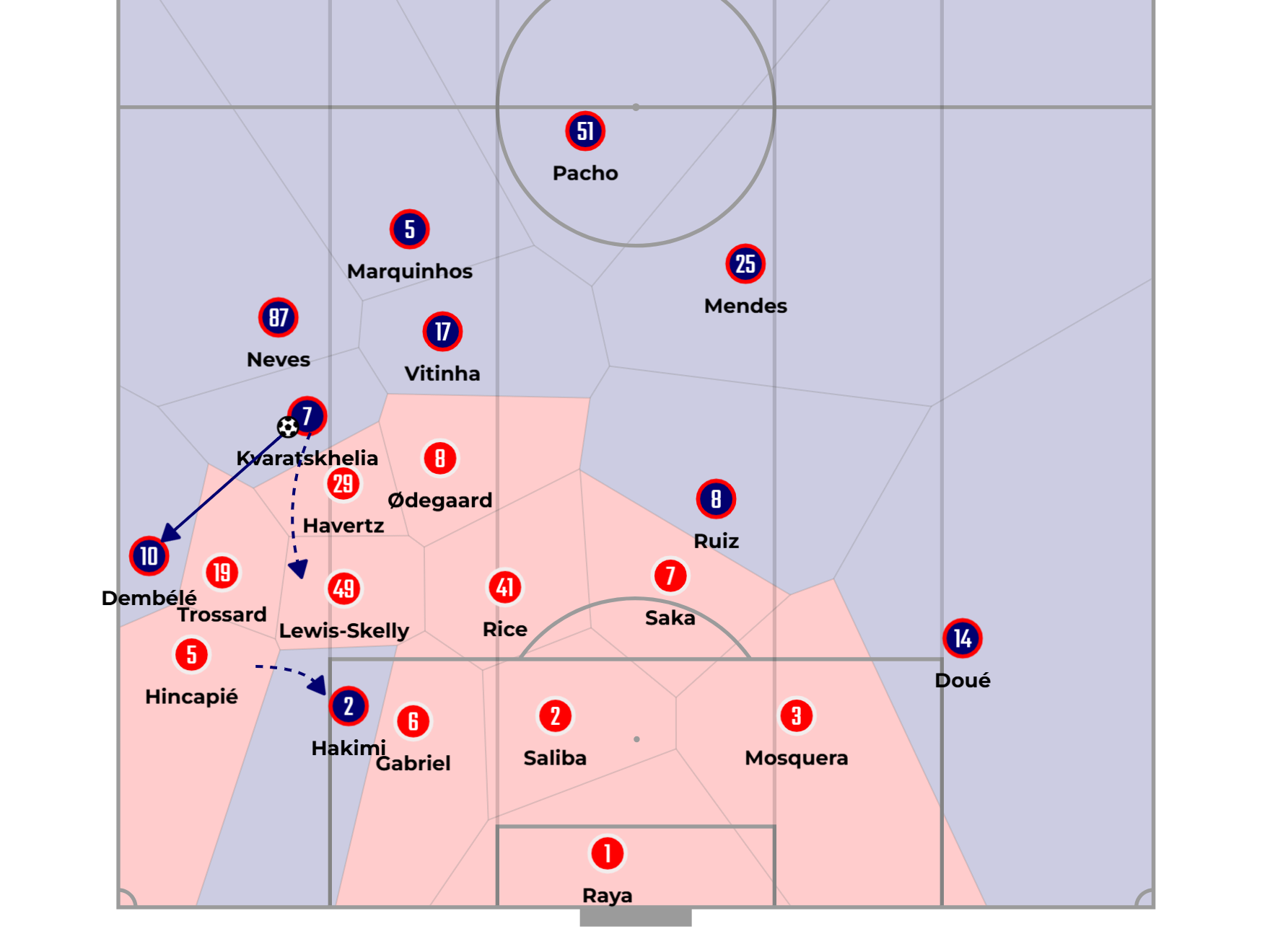
17th minute: PSG’s 3-1/3-2 at the base established the ball control, but left them light in numbers to attack Arsenal’s 4-4-2 deep block. Two defenders dropped onto Dembélé, whilst Hakimi moved inward to pin Gabriel. However, Lewis-Skelly could still follow Kvaratskhelia’s run into the halfspace. In this phase, Dembélé would find Kvaratskhelia, and made a run around Trossard/ Hincapié, but the Georgian could not reconnect.
When passes went more directly, PSG struggled to find fluency. Ruiz had the biggest threat in this regard when he rotated towards the center of the pitch and made a run behind William Saliba, who was a little more attracted to the inside attacker, with Mosquera occupied by Kvaratskhelia. On a couple of occasions, David Raya swept the long passes clear.
PSG had established dominance over the ball, just over three-quarters of the possession in the first period, but had nothing to show for it. Attackers were left isolated as Enrique’s team had reduced their own space from the first phase of the buildup. In return, Rice and Lewis-Skelly were very disciplined in remaining on the goal side of the (limited) inside runner, as Arsenal always doubled-up on the outside carrier. A defensively perfect first-half performance from Arsenal, whilst PSG had slipped into its own risk aversion.
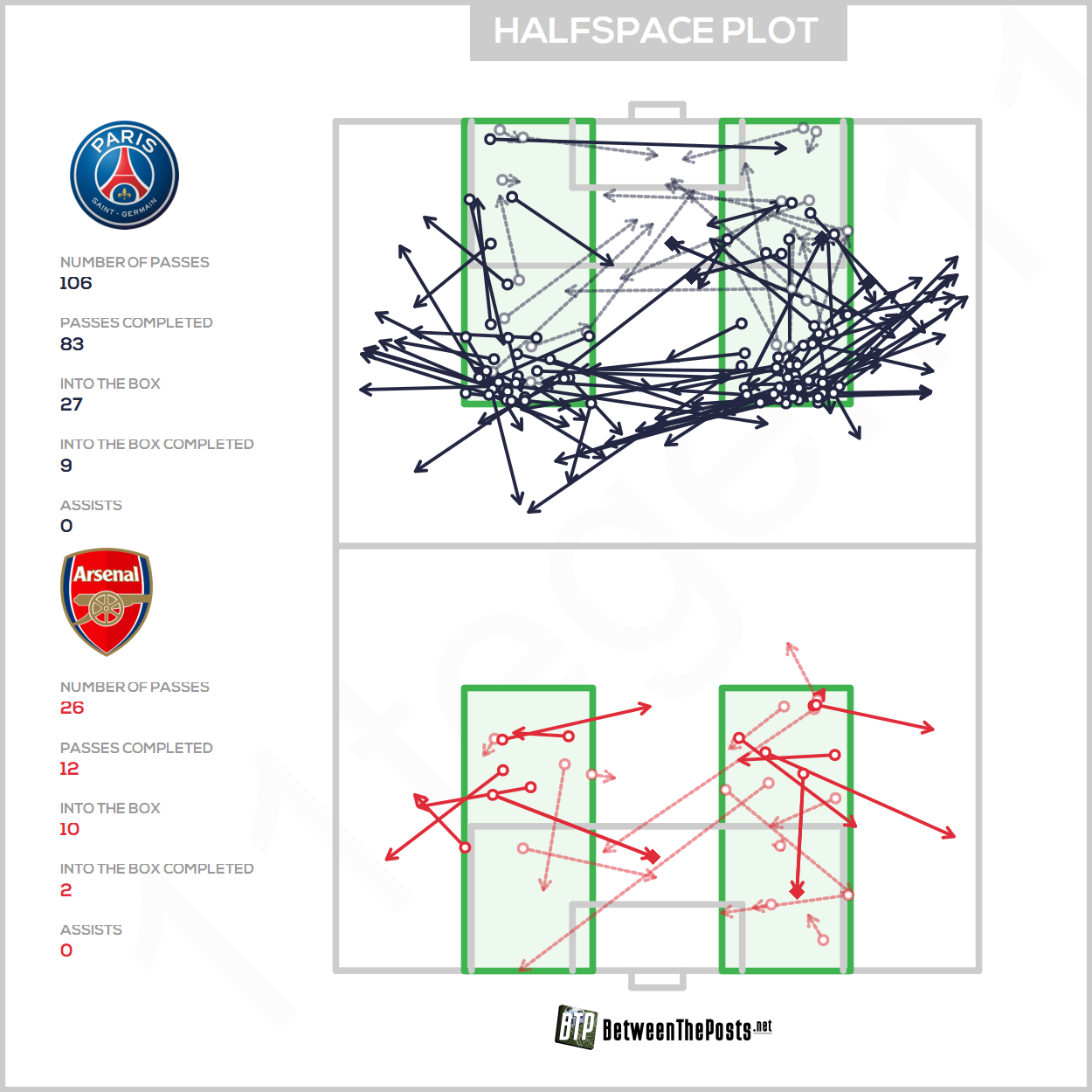
Halfspace plot can give us a good indicator, not only on PSG’s usage of the right side but also on the few occasions they got the ball into the box from this area.
Injecting more carries
At the start of the second half, it was clear that there was a new initiative from PSG’s buildup phase. Marquinhos and Willian Pacho were positioned deeper, and more advantageous movements were made from the pivot area when Neves swapped with Vitinha (or vice versa). With Dembélé and Kvaratskhelia dropping into deeper spots, the idea was to attract the Arsenal block into higher positions, and it worked as backward passes from the attackers or longer switches at the base encouraged Arteta’s team to make more aggressive jumps out of the medium block, and into its higher phase.
As a result, Ruiz could take Rice out of the equation by positioning himself on the touchline, against the defensive line. Mosquera was now more isolated against Kvaratskhelia as the Georgian dropped, whilst Lewis-Skelly would face an overload with Vitinha/Neves rotating into the deeper left halfspace from the pivot spot and Hakimi, who started to invert more from the right and into central spots.
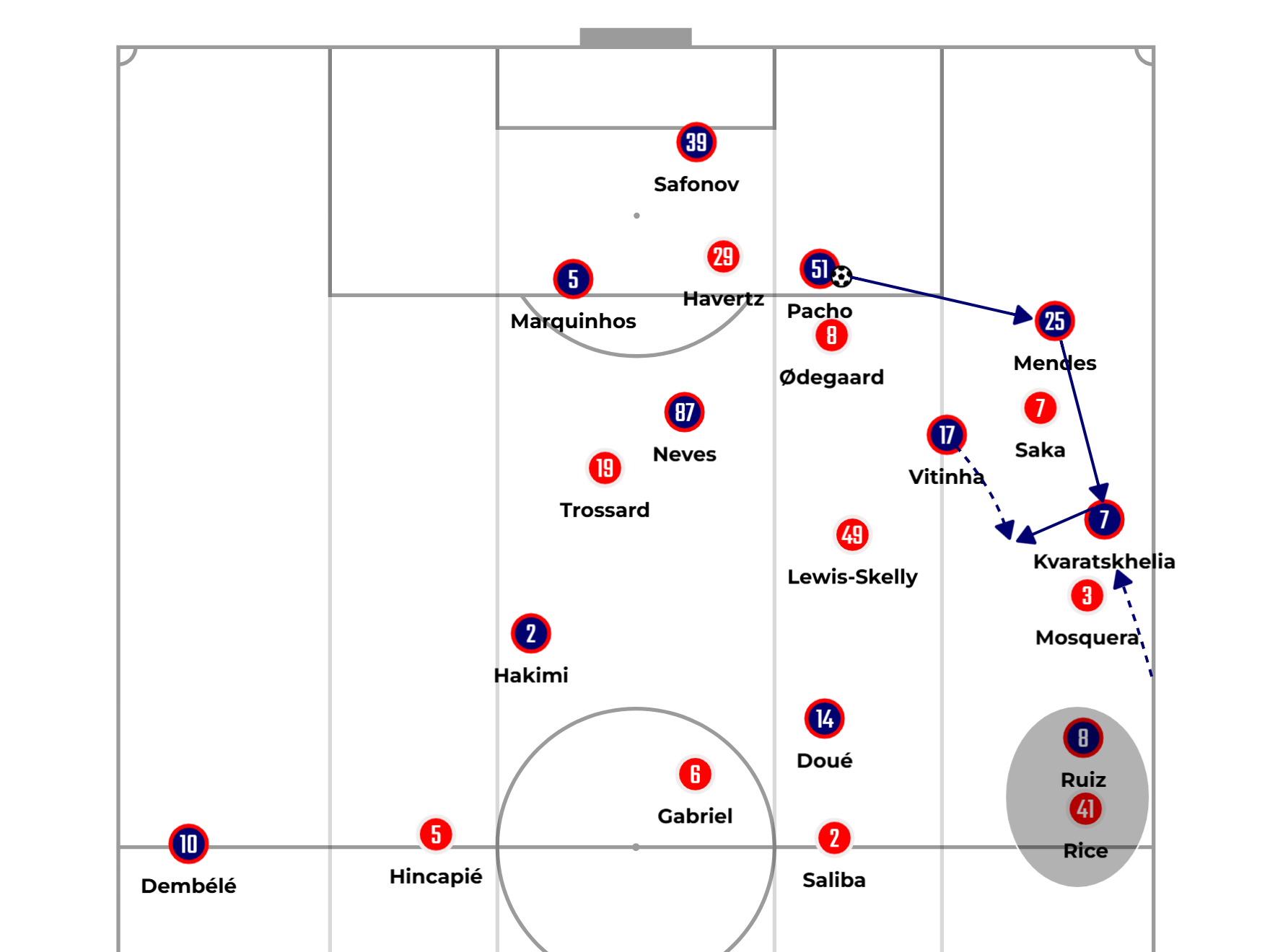
52nd minute: Better connections between the lines from PSG. On the left, Ruiz pushed high-left to take Rice out of the center. Not only did this create more space around Lewis-Skelly, but it also enabled Kvaratskhelia to drop and Vitinha to provide the countermovement that was not present in the first half. Ruiz connected further in the move. However, PSG were still not at their best and the next pass behind the defensive line would be recovered by Gabriel.
PSG had established its route to increase the tempo and spark some carries to be made from deep positions, especially in the deeper left halfspace, that lead to more attacks being partaken in the center. However, attacks still missed the cleanliness that could truly spark the front three into life, even if their interactions in dangerous zones started to increase. Even with this route established, cheap fouls conceded by Arsenal were the main source of PSG sustaining their spells in possession, as well as Arsenal’s out-of-possession structure still proceeding with absolute caution.
On the hour mark, the likes of Kvaratskhelia and Doué started to have more direct runs against the fullbacks, yet no PSG presence in the center could shift the defense or provide shooting output when the wingers got into these positions.
Nevertheless, from a second phase after a corner, a final-altering moment. PSG maintained the attacking position, and play moved down the left, where both the Georgian and Dembélé were positioned. A one-two saw Kvaratskhelia curve around Mosquera and the Spaniard brought him down inside the penalty area. Penalty awarded and Dembélé sent David Raya the wrong way to even the tie.
Transformative subs (and not for the better)
From this point onwards, the final declined in quality, as changes and the effects of a gruelling season began to take effect. Arteta made two substitutions directly after the equalizer. Timber replaced Mosquera, whose lack of football for two months kept him from his usual abilities. Ødegaard was also replaced by Gyökeres, who struggled to hold possession up and combine with teammates. Furthermore, the space between Gyökeres and Lewis-Skelly began to increase: so not only did Arsenal still not have a way to retain attacks but it was more comfortable for Dembélé and Hakimi or Doué and Kvaratskhelia to combine.
However, after a few long balls from Raya, the game started to have more transitional phases. Kvaratskhelia was the main protagonist in this regard, although the chance creation was still quite limited. With a bloody right leg, his night would end with seven minutes left as he was replaced by Bradley Barcola, whilst Arteta tried to change the dimensions again by swapping both wingers. Saka and Trossard were replaced by Noni Madueke and Trossard, but having made themselves comfortable with very deep defending, it was difficult for Arsenal to drastically shift the game state.
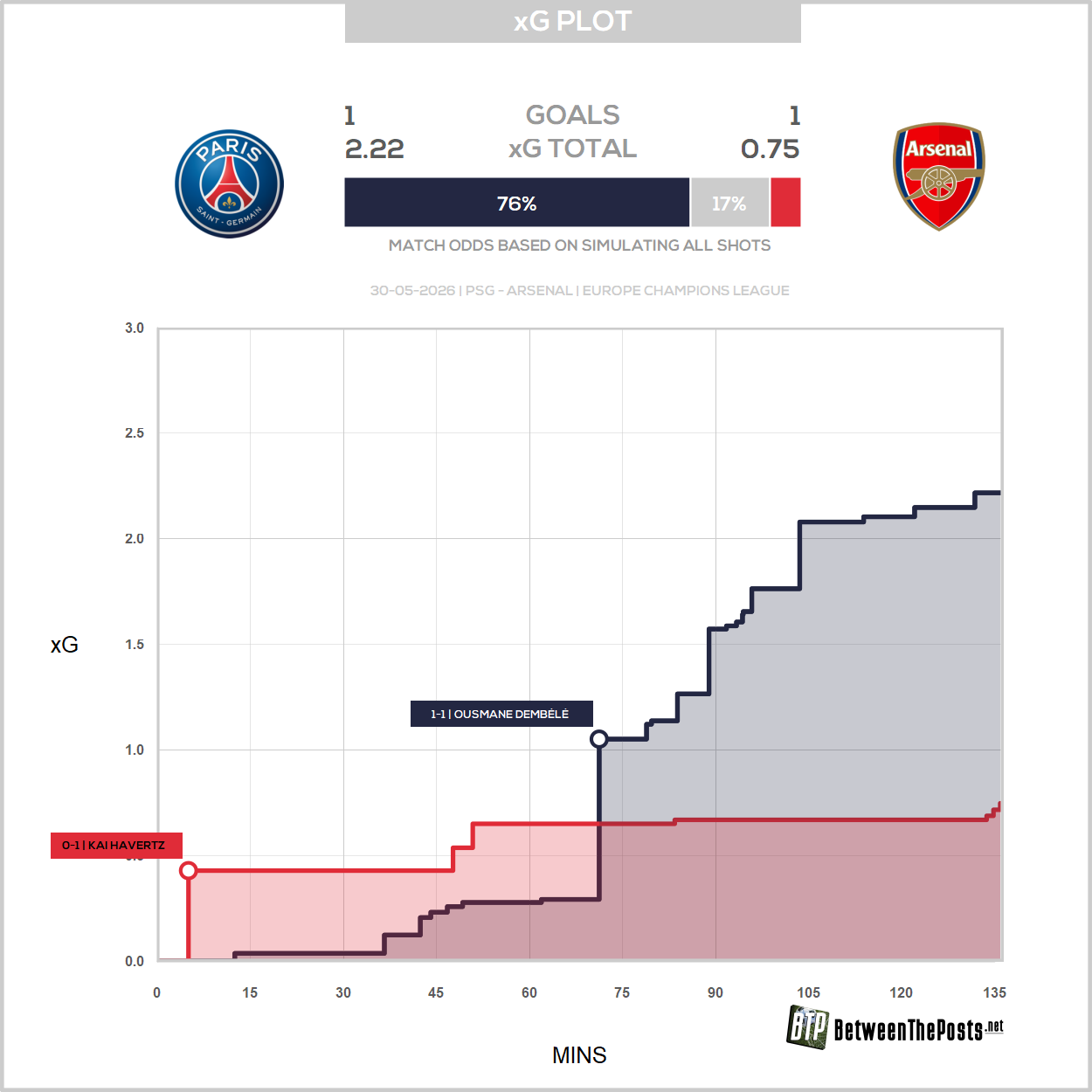
A flatlined Arsenal attack in the second half.
From a long throw-in into the PSG box, they counterattacked as Arsenal could not build on the second phase. Behind Saliba, Barcola steamrolled through towards goal only for an excellent piece of proactive goalkeeping to stop a direct one-versus-one.
PSG continued to threaten late in the game. A long switch from Pacho found Doué on the right side, and his dribble into the box caused problems. Skipping past Gabriel and attracting Lewis-Skelly, he teed up Vitinha to take an attempt on the edge, which sailed just over the crossbar and bounced off the roof of the net behind. The last great opportunity of the ninety ran through for Barcola, in a similar fashion to the events of his first run in behind. Barcola sprinted through, only for his final touch to take the angle away from him and his shot went just wide of the post.
Extra-time of few ambitions
Dembélé’s night was also over as he was forced off injured, just before the conclusion of the ninety. He would be replaced by Gonçalo Ramos, the most traditional striker out of this PSG unit. Arteta’s final subs saw Zubimendi replace Lewis-Skelly and Havertz come off for Eberechi Eze, and it was Arsenal that had threatening moments of extra-time, after Rice found Eze through the counterpress and he played Timber through on the outside to win a corner.
Corners were a limited resource for Arteta’s team, having taken zero throughout normal time (they had won one, but had taken too much time to take it at the end of the first half). At this stage, Madueke bore the responsibility, and his in-swinger delivery was not as dangerous as the balls that Saka could put in.
Arteta had the offensive options from the bench to change the game. However, the timing and switches he did make failed to improve the trajectory of the match. With two of the fluid three taken off for PSG, this should have been the moment when Arsenal took more risks out-of-possession. Warren Zaïre-Emery still brought some dynamism from the midfield, but possession remained within circulation once Lucas Beraldo entered midfield and Ilya Zabarnyi was the final substitute, in place of Marquinhos in the last quarter.
Despite Arsenal still limiting their risks, Madueke caused the most controversial call when he sprinted around Mendes and into the box, only to be brought down in the process. Both Rice and Arteta were booked in the protests. Nevertheless, extra-time saw less fluid circulation from PSG, whilst Arsenal did not do enough to disrupt it.
Penalty experience pays off
Going first, and shooting towards the PSG supporters, already gave them a massive advantage but this was a group who was already molded by the shootout. There was Anfield last season and even without Gigi Donnarumma, Enrique’s team had won the Super Cup, Intercontinental Cup and Trophee des Champions all via the spot kicks.
Ramos, Gyökeres and Doué all converted before Eze stepped up to take the second for Arsenal. His stutter swayed Safonov, only to stick it wide of the post. Mendes would be the next, only to be saved by Raya and Rice made no mistake to even the shootout scoring. Hakimi and Martinelli would make no mistakes as the fifth penalty beckoned.
Beraldo made sure to put the pressure on another Brazilian after he sent Raya’s very early dive in the wrong direction. Gabriel had to score to keep Arsenal’s hopes alive, but he would put his attempt over the crossbar. PSG winners of the Champions League, once again.
Luis Enrique: "¿Sabes qué es lo más bonito de un entrenador al nivel al que estamos tanto yo como mis compañeros? Que lo que piensas hoy vale para hoy, para mañana si ganas, pero para pasado ya no vale porque los rivales se adaptan continuamente. O sea que lo que dije en el final… pic.twitter.com/CcMr2saaRX
— Thomas Somoza (@ThomiSomoza) May 30, 2026
Takeaways
Champions League finals can be full of traditional tropes, cagey affairs with not much action, but they can also be an indicator of which way football is heading/been heading. In 2021, it was Chelsea’s deep block and transitions that showcased the elite were willing to revert to these defensive methods. In 2023, it was the physical dominance and rest defense of Man City, that highlighted the recruitment of out-of-possession performers (who could still be technically great at the same time).
Enrique’s PSG can hark back to teams that desire control of possession, but not the territory, if it means that they can enter higher zones at a faster tempo. Unlike their final performance against Inter, this was a final where risk-aversion played a key role, in the confines of their respective structures. PSG were able to break out of theirs, even if it wasn’t to their best, whilst Arsenal wilted, unable to change the dynamics of the match.
After their Premier League victory, perhaps we will see a bolder Arsenal in open play, now that the shackles are off. However, when the situation arises, Arteta still has some hurdles to clear regarding the use of his substitutes. But no coach can fly out of the gates. Enrique had difficult spells at Roma and Celta Vigo before reaching the top at Barcelona. A decade later, he is the toast of elite football.
Use the arrows to scroll through all available match plots. Click to enlarge.
Check the match plots page for plots of other matches.


Comments