

Milan – Roma: Allegri’s Discipline Prevails Over Gasperini’s Agressiveness (1–0)
In a tightly contested Serie A clash at the Stadio Giuseppe Meazza, Milan secured a 1-0 win over Roma thanks to a disciplined defensive performance. It was a match shaped by contrasting ideas: Milan choosing a structured defensive base with counter-attacking threats, and Roma attempting a high-tempo pressing and a fluid offensive game that ultimately couldn’t score a goal.
Tactical analysis and match report by Sebastián Parreño
Formations and initial structure
Milan played with a 5-3-2 out-of-possession formation. The back five in defensive transition comprised three central defenders: De Winter, Gabbia, and Pavlovic. They had two aggressive wing-backs in Saelemaekers (right) and Bartesaghi (left). The three midfielders ahead of them were Fofana, Modric, and Ricci. Up front, the duo of Nkunku and Leão, who offered mobility and pace. From the start, Milan’s objective with this set-up was to block central progression from Roma, placing three centre-backs and the two wing-backs tight to the flanks.
Roma, on their side, also opened in a 5-3-2 (or more precisely a 3-5-2 when attacking) formation: centre-backs Mancini, Ndicka, and Hermoso; wing-backs Celik (right) and Wesley (left). The three midfielders were Cristante, El Aynaoui, and Koné. The two attackers up front were Dybala (left) and Soulé (right), without having a clear center forward. From the start, Roma’s blueprint was clear: high press, wide overloads, free‐roaming forwards, interchangeable positions, very high wingbacks in an attempt to unsettle Milan’s defensive strategy and progress quickly through the centre and wide channels.
Early First Half: AS Roma dominance
From kickoff, one of the keys for Roma was pressing Milan’s patient buildup. Milan’s early buildup revealed vulnerability. Their first line in possession was De Winter and Pavlovic (wide, same line as GK Maignan); one step ahead, Gabbia jumped up from defense to be next to Modric. Ahead of them was Ricci, Nkunku dropping, and Fofana formed the next layer. So Roma went to counter with an aggressive man-to-man high press. Dybala and Soulé jumped aggressively on Milan’s central defenders (Dybala on Gabbia, Soulé on Pavlovic), while wing‐back Celik tracked Bartesaghi and Wesley hunted Saelemaekers. In midfield, Cristante pressed Modric, Koné tracked Ricci, and El Aynaoui kept tabs on De Winter, being the third man to join the attacking duo. Milan’s back three thus had to be alert to both internal midfield progression and wide overloads.
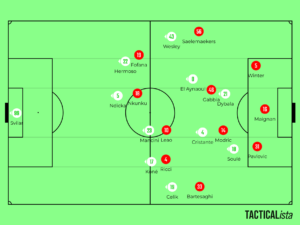
The Roma high press vs the Milan build-up
And Roma’s initial plan with the high press was very successful, forcing early turnovers, quickly winning the ball back, and creating multiple chances. For the first halfhour, Milan lacked rhythm, committed various mistakes, and Roma dictated the game. As Allegri admitted, Roma “deserved to take the lead in the first 35 minutes” because Milan “were getting everything wrong”.
In possession, Roma offered a very fluid attack. Both outside center-backs had the liberty of joining the attack if the ball was on their side of the field. When Mancini joined the attack from the right, it looked to form triangles with Celik and Soulé, trying to overload the Milan defense and confuse their positional defense by making a CB join the attacking line. To avoid being descompensated on the last line, the central midfielder of that side (Koné on the right) dropped into the vacated space, keeping the back three. On the left Hermoso also joined the attack from the back three line, but he did it more as a wingback, allowing Wesley to push into the attacking line with Dybala and Soulé. El Aynaoui was the one covering Hermoso there, creating a very interchangeable attack for Gasperini’s Roma.
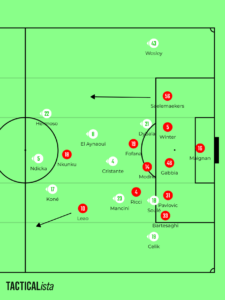
Roma In Possession, with Mancini joining the attack and Koné covering him. Leão attacked the space left behind by the RWB.
Mid First Half: How Milan turned the game around
Around the first half hour Milan began to settle. The biggest difference was that Milan began to find ways to bypass Roma’s high press. Milan started dragging the central players to wider areas, like Modric, creating a passing lane to the strikers. The GK Maignan had time and the ability to play perfect passes right to Leao and Nkunku, who came down to receive ground passes and could create third-man combinations with the midfielders. The Roma CBs were late on those situations, and they never managed to adjust this. This created multiple chances for Allegri’s team as it created some artificial transition chances for Milan. And that was the blueprint that Allegri wanted, as he found an answer in transitions for his time to create a lot of damage.
The goal and why it happened
The decisive goal came in classic Allegri fashion. Milan counter-attacked after regaining possession deep. Leão, starting from left, darted behind Roma’s wing-back line, exploiting the space knowing that Celik had a very advanced position. From there Leão cut the ball back into the box. Meanwhile Pavlovic, one of the centre-backs, had recognised the vacated space and made a forward run from box to box, literally. He received the Leão cut-back and finished. The timing of the goal was key, as scoring just before half-time is a momentum changer. It allowed Milan to move into the break ahead and play their game for the rest of the match.
Second Half: Milan control, Roma chase, key moments
After the break, Milan adjusted, knowing they had the lead. They shifted to a lower block, effectively turning the 5-3-2 into a compact defensive shape, ready to defend low without the ball and transition. They allowed Roma more possession but focused on controlling space in front of the defence, organising into a four-man midfield block with Ricci and Fofana more disciplined, Modric sat deeper, and the wing-backs were waiting for opportunities to attack.
Roma, now chasing the game, sought to ramp up the pressure. They substituted five minutes into the half (Pellegrini and Bailey replacing Soulé and El Aynaoui) and switched to a more fluid 3-4-3: Dybala as the striker, Pellegrini left, Bailey right, with Celik/Wesley supporting. The idea: overload in attack, stretch Milan’s low block, find gaps.
But Milan was ready. They defended with discipline, stayed narrow in the centre, and trusted their transitions. They used their wingbacks to follow Pellegrini and Bailey around, not allowing them to receive freely. The one key moment came when Roma were awarded a penalty for a Fofana handball on a free kick attempt by Pellegrini; Dybala stepped up and Mike Maignan saved it, denying Roma the equalizer.
Milan had a few good chances late themselves, again via Leão and Nkunku. But importantly, they controlled the game tempo, prevented Roma from constructing high-quality chances, and frustrated the attackers by shielding spaces and restricting line-breaking passes.
Takeaways
Milan’s win was not about dominating possession but dominating the intent of the game. Milan showed a solid structure, discipline and efficiency now under Allegri. Their three-man central defence plus wing-backs gave them a solid base out of possession. They blocked central progression, forced Roma wide, survived early pressure, and then transitioned decisively. The goal came because the structural design allowed a centre-back to run forward and exploit space, and the substitution/adaptation meant they could defend the one-goal lead with confidence.
Roma’s initial dominance, their pressing, their wide overloads all looked promising – but they couldn’t capitalize on their moments. Their freedom of movement (Dybala, Soulé) did cause disruption, but the downstream effect was leaving vacant spaces for Milan to exploit, which is exactly what happened. Additionally, once Milan went up in the game, they felt totally in control, and Roma failed to recalibrate effectively. Their high tempo and aggression did not translate into a goal and ultimately left them vulnerable. Allegri did what he’s known best for, a hard-fought, narrow 1-0 victory in which his team controlled the tempo of the game and did a lot of damage in transition. Now they have a chance to compete for the Serie A title with this formula.
We decided to make this article free to read. If you want to support our work, consider taking a subscription.
Match plots will be added as soon as possible


Comments