

Paris Saint-Germain – Olympique de Marseille: Total Humiliation For De Zerbi’s Miserable Marseille (5-0)
Total and utter humiliation awaited Olympique de Marseille as they travelled to the Parc des Princes to face bitter rivals Paris Saint-Germain. Marseille were perhaps hoping for a repeat of their home heroics earlier in the season, but instead they were in complete disarray. Five unanswered goals left this as the largest ever victory in Le Classique.
Tactical analysis and match report by Nick Hartland.
We decided to make this article free to read. If you want to support our work, consider taking a subscription.
Ligue 1 has been desperate for a title race since Luis Enrique took charge of Paris Saint-Germain in 2023. His first two seasons in the capital ended in procession victories with PSG swatting aside any semblance of competition, but this campaign has seen a slight departure from the norm.
Les Parisiens have looked far more fragile, and a sluggish start to the season has opened up a usually closed competition. Olympique de Marseille, under Roberto De Zerbi, had expected that it would be them to knock their eternal rivals off their perch, but it was instead RC Lens who would fly under the radar and challenge PSG’s stranglehold.
A defeat in Le Classique would drop PSG to second in the table. Incentive enough for Marseille on most nights, but they had more pressing motivations as they entered this match in danger of letting Olympique Lyonnais steal a lead on them in the race for automatic qualification to the UEFA Champions League. Anything but a victory would see Les Phocéens end the weekend in fourth.
Luis Enrique lined his side up in a 4-3-3 formation. In goal, Matvei Safonov kept Lucas Chevalier out of the line-up for another weekend. Nuno Mendes, Willian Pacho, and Marquinhos were joined in defense by Warren Zaïre-Emery, who replaced the suspended Achraf Hakimi. In midfield, João Neves, Vitinha, and Senny Mayulu. Up front, Bradley Barcola and Désiré Doué supported Ousmae Dembélé.
Roberto De Zerbi went with a 3-4-3 system. In a similar scenario to PSG’s goalkeeping situation, Gerónimo Rulli was dropped between the sticks for Jerffrey de Lange. In defense, Facundo Medina, Leonardo Balerdi, and Benjamin Pavard made up the back three. In midfield, a double pivot of Pierre-Emile Højbjerg and Quinten Timber, with Emerson Palmieri and Timothy Weah flanking as wing-backs. In attack, Ethan Nwaneri and Mason Greenwood sat behind Amine Gouiri.
Fluid rotations open up the wings
Les Phocéens approached this match with similar intentions to their victory over PSG in mid-September. They wanted to defend as far away from their own goal as possible in a 5-2-3 shape, with the midfield duo and the front three forming a tight unit to block central access. In September, this was the blueprint behind a disciplined effort that earned a hard-fought 1-0 win at the Stade Vélodrome. At the Parc des Princes, Marseille were anything but disciplined.
Marseille wanted to step up where possible and put pressure on PSG’s build-up shape. Marseille slanted towards the ball side to try to create a wide pressing trap, but PSG’s answer to this was simple: fluid rotations to open up the channels and play down the wings. As simple as the plan was, PSG’s execution was devastating, and in the 12th minute helped manufacture a 2v1 to take the lead.
Marseille stepped into a high block and tried to put pressure on PSG’s left flank and keep Mendes trapped. Doué drifted across from the opposite flank to take up a central position, while Barcola came short from the left wing. Mendes passed to Barcola and then entered the space vacated by his teammate. Barcola passed to Doué, who could then release Mendes down the now-empty wing for a third man run.
Nwaneri, Højbjerg, and Weah were all caught tracking the ball rather than the runner, which meant that Mendes was completely unmarked as he sprinted down the flank. Dembélé ran parallel to him down the right and towards the goal, creating a 2v1 against Balerdi, the only defender deep enough to provide a semblance of defense. It was a simple enough task for Mendes to draw Balerdi and De Lange to him and then release Dembélé for a simple tap-in.
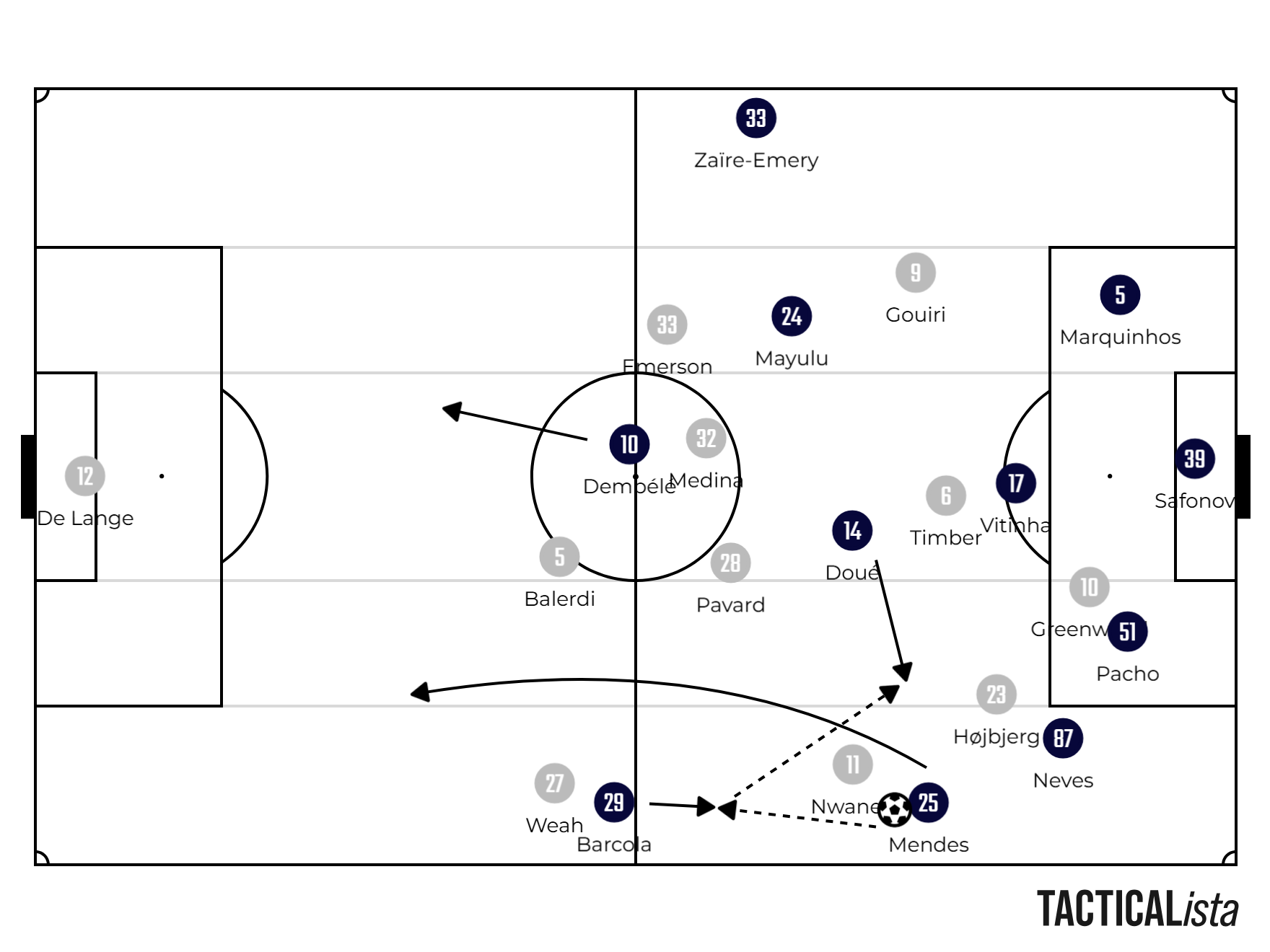
12th minute: PSG bypass Marseille’s wide pressing trap to open the scoring. Doué’s movement inside opens up a third-man run for Mendes to attack the space down the left-hand channel. Dembélé makes a run parallel to Mendes to create the 2v1 against Balerdi.
De Zerbi’s decisions under the spotlight
Marseille promised to show a bit of fight in the minutes following the goal. Les Phocéens were able to create space high up the pitch by drawing PSG into a press. Medina then hit the quick switch from deep and found Emerson out wide. The wing-back was able to feed the ball into the box for Gouiri to attack, but the striker could only poke his shot straight towards Safonov. The moment, as it turned out, would be Marseille’s best chance of a rotten evening.
Part of the problem for Marseille was that against PSG, they were never going to dominate the ball, so they needed to focus on transitions and attacking from deep with direct balls over the top of PSG’s high block. A game state that put the focus on De Zerbi’s decision to drop Rulli for De Lange. Rulli is excellent with the ball at his feet, whereas De Lange’s distribution often ended in a turnover, meaning that it was proving hard for Marseille to reliably escape from PSG’s relentless control of the ball.
Dominance of the ball invariably led to PSG finding ways to expose the limitations in Marseille’s defensive structure. Les Parisiens homed in on the left wing as the area to focus the majority of their efforts. PSG wanted to put four men in midfield to create a central overload with one of Doué, Zaïre-Emery, or Dembélé supporting the midfield three. This would drag Marseille into the center, before PSG then switched the play wide to Barcola for a 1v1 against Weah.
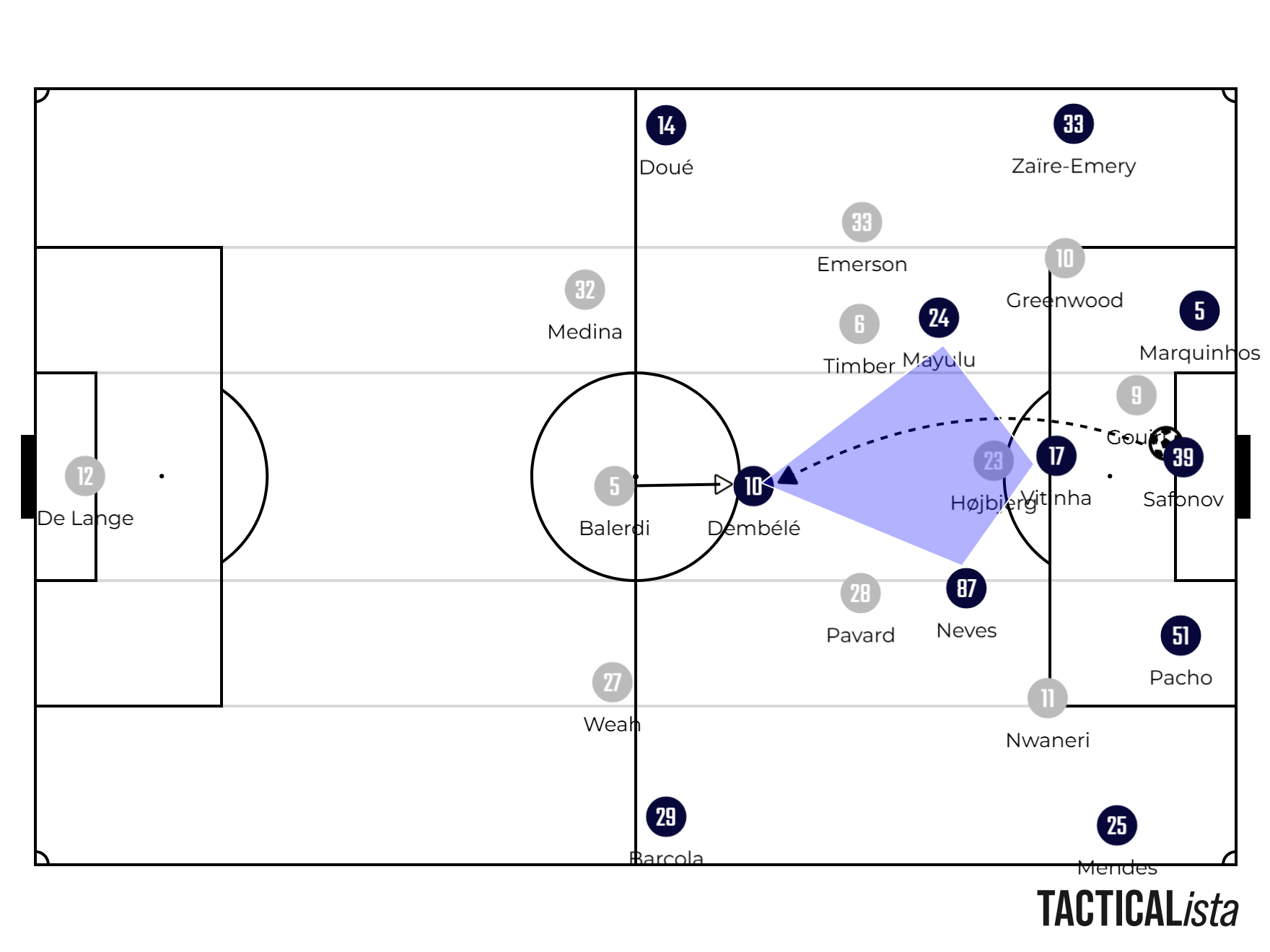
14th minute: PSG develop a central overload. Dembélé drops deep to create a diamond midfield with the three more orthodox players. Marseille are attracted inwards, with Balerdi having to step up to mark Dembélé to further reinforce the center and, by extension, weaken the wings. Space is created out wide with Weah, and Medina left in 1v1 duels with Barcola and Doué.
It was a plan that should have borne more fruit, but Barcola had one of his more frustrating nights. The former Lyon man seemed to perpetually mistime his run and attack from an offside position, and the times when he didn’t, he would either screw up his shot or the final pass. Invariably, PSG’s next goal would come from the opposite flank.
Dembélé received the ball wide and on the right following a mistimed interception from Balerdi. The Marseille captain recovered only to get beaten as he went for a poorly choreographed tackle. Dembélé slipped into the box and then dropped his shoulder to lose Medina and attack the near post. From a tight angle, he blasted his shot home. The opener had been an example of PSG’s fluid coordination of the Luis Enrique era; the second was a throwback to what had preceded him. It was the PSG that could light up a game with shows of individual brilliance.
Change in personnel, but not in outcome
2-0 down at half-time and with the threat of a long night ahead, De Zerbi looked to his bench for answers during the break. Igor Paixão was introduced for Nwaneri at the restart as Marseille shifted into a 4-2-3-1 shape. Paixão took up his usual spot on the left wing, while Greenwood shifted into the center as the no.10. Weah moved forward to take up Nwaneri’s vacated spot on the right, while Pavard became the right-back.
On paper, De Zerbi’s thought process was obvious as he was attempting to address the problems that his side had faced in the first half. Nwaneri had not done enough to protect Weah, and the hope was that with two defensive-minded players in Weah and Pavard protecting the flank, PSG wouldn’t be able to manufacture as many 1v1 attacking scenarios down Marseille’s right. The problem for Marseille was that it wasn’t so much an issue of personnel, but of intention.
More specifically, it was a question of PSG’s intentions. And theirs was unchanged from the first half. They wanted to create these central overloads that attracted Marseille inwards, so that the wings would then be opened up. It didn’t really matter who Marseille had on the pitch; if they wanted to protect the center, they would have to give up the wings. And so Pavard was left like Weah before him to contend with these 1v1s.
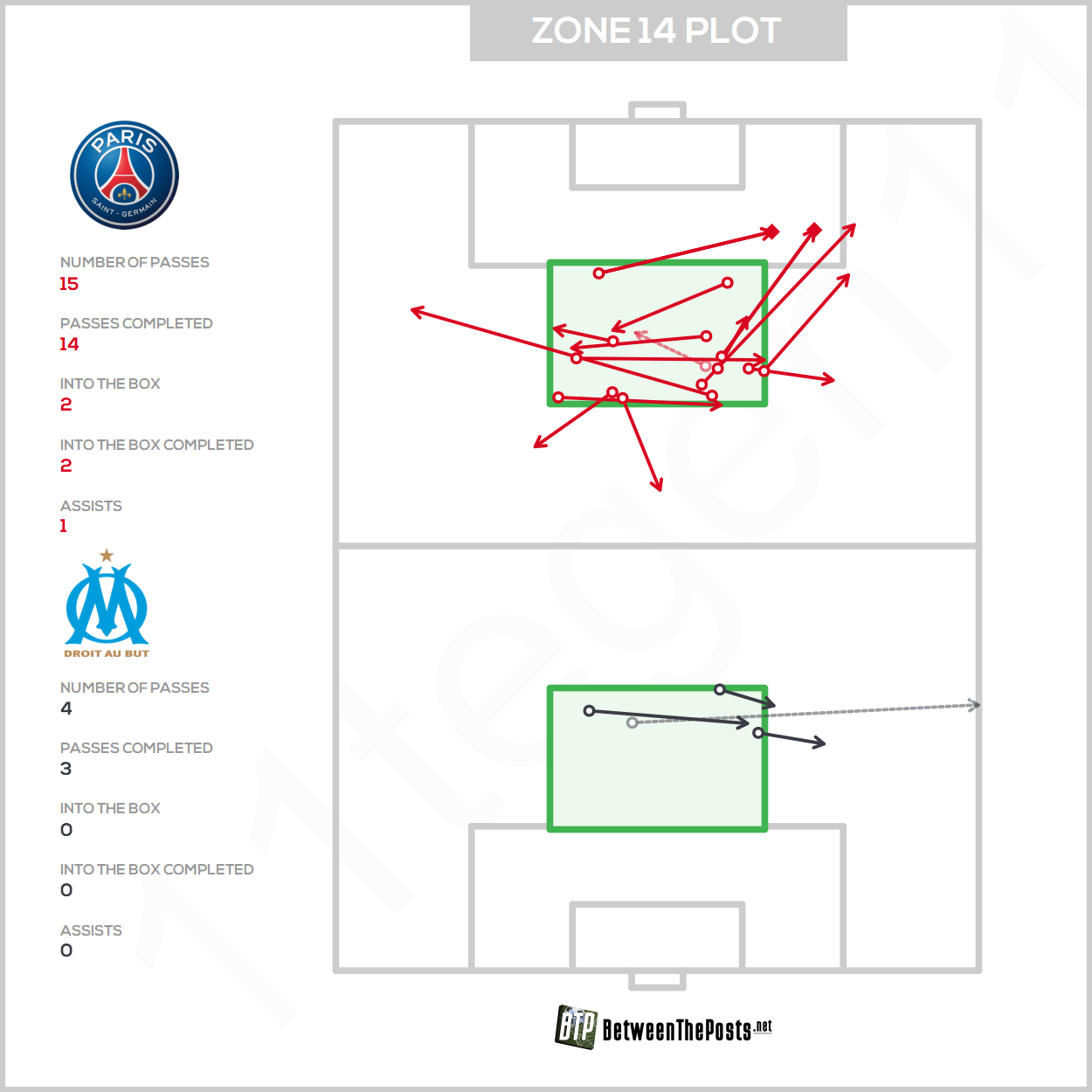
A fairly unusual Zone 14 Plot for both clubs. PSG’s shows the extent to which they were trying to shift the ball wide. Marseille’s demonstrates how little threat they carried in this game.
Transitions king
With Marseille needing to go for a goal, space began to open up for PSG in transition. Doué rang the warning bell when he got on the end of a transition attack kick-started by Mendes picking Greenwood’s pocket. Luis Enrique could taste blood, and he took off Doué for Khvicha Kvaratskhelia, while De Zerbi attempted to again address his right-sided issues by swapping Pavard for the midfielder Himad Abdelli.
Any semblance of structure Marseille had held onto collapsed immediately following this change, as they were hit by a hat-trick of goals scored in transition. Two minutes after the substitution, PSG scored their third. De Lange’s long ball was won by Pacho, allowing PSG to counter at speed. Neves was able to break free past the Marseille defence and then looked to cross to Kvaratskhelia. His pass was instead headed home by Medina for an own goal. And two minutes after this, PSG would make it four in the 64th minute.
Højberg’s errant pass out wide to Greenwood was picked up by Mendes. The left-back stormed down the wing, finding Barcola, who managed to bungle the ball to Dembélé. The Ballon d’Or winner looped a pass to Kvaratskhelia to finish for a sweetly struck volley. The night was far from over as the substitute Lee Kang-in, on for Barcola, would put the finishing touches on a night by striking home a move that started after Højbjerg lost the ball just outside the box.
By the 74th minute, France’s most prestigious fixture was over. De Zerbi and his players stood shellshocked. Unhappy history makers in the biggest defeat in Le Classique history. The only saving grace was that PSG didn’t score another, albeit not for a lack of effort on the part of a team that was relishing the embarrassment they were inflicting on rivals in name, but certainly not on the pitch.
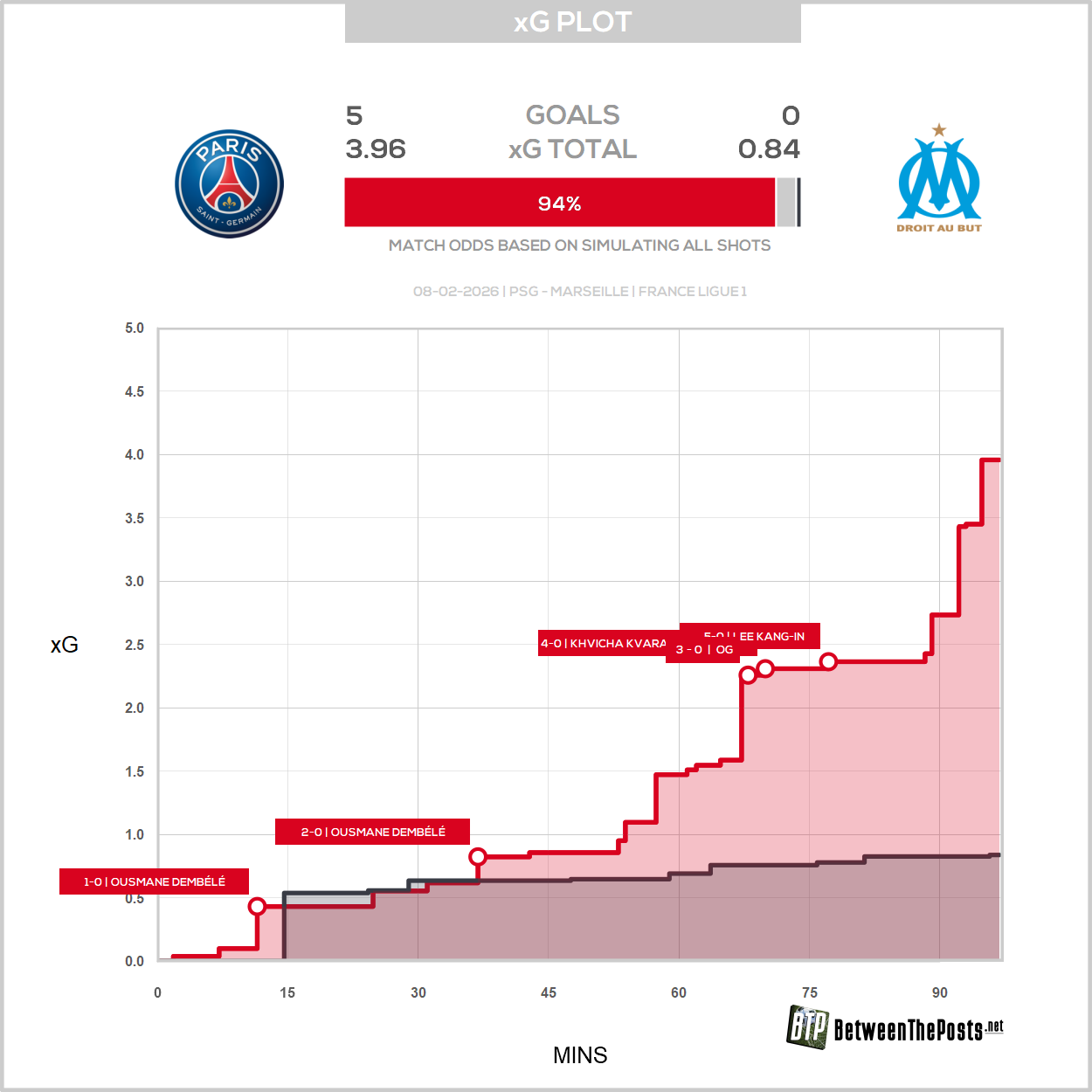
Takeaways
There’s a familiar feeling to the way PSG have gone about their business since the start of the year. Like last season, when they came alive following the winter break to romp to an unprecedented treble, they seem to have found their mojo. Everything looks as if it is clicking at exactly the right time, particularly in Ligue 1. Seven wins in a row in the league certainly puts the pressure on Lens not to make any further slip-ups, or the current two-point gap will simply grow out of hand.
It’s hard not to consider this result as anything other than the nadir for De Zerbi’s Marseille. It’s not uncommon for a Marseille manager to get soundly beaten by PSG, but the way in which the team was torn apart felt like a rare humiliation ritual. Every decision he and his team made only seemed to worsen the thrashing. Out of the Champions League, out of the league, and now in danger of missing out on automatic qualification to next year’s Champions League, patience might just be running out in a notoriously impatient city.
Use the arrows to scroll through all available match plots. Click to enlarge.
Check the match plots page for plots of other matches.


Comments