
Corinthians – Vasco: Coach Fernando Diniz wins reunion with former club and reaches six matches without conceding (1-0)
Fernando Diniz lost the Copa do Brasil final in 2025 to Corinthians while managing Vasco. However, both teams started the season poorly, leading to Diniz being dismissed by Vasco and Dorival being dismissed by Corinthians. As a result, Renato Gaúcho, former Fluminense coach, took over Vasco, while Fernando Diniz became the new Corinthians head coach. On Matchday 13 of the Brasileirão, the reunion between these figures took place and, even with a player sent off, Corinthians came out on top.
Tactical analysis and match report by Marcus Arboés.
Fernando Diniz was heavily criticized for his start to the year at Vasco, with strong media criticism regarding his poor results. However, he began his new cycle very well and had reached five matches unbeaten without conceding. Even so, Corinthians started the matchday in the relegation zone and had several absences: Hugo Souza, Matheuzinho, Kayke and Memphis Depay. The lineup was: the young Kauê in goal; Matheus Bidu at left fullback and Raniele, a pivot, playing out of position at right fullback; Gabriel Paulista (former Valencia) and Gustavo Henrique as center backs; Allan and André as the double pivot; Breno Bidon and Rodrigo Garro as midfielders, Vitinho (former CSKA) and Yuri Alberto as the attacking duo.
Renato Gaúcho, who had great success in the FIFA Club World Cup with Fluminense, took over Vasco with the mission of reorganizing the squad after Diniz’s departure. Results have come, but the team has been inconsistent, although it seems to have found a solid base in a 4-3-3 outline: Léo Jardim as goalkeeper; Paulo Henrique and Cuiabano (former Nottingham Forest) as fullbacks; Saldivia and Robert Renan (former Zenit) as center backs; a midfield trio of Cauan Barros, Tchê Tchê and Thiago Mendes (former Lyon); in attack, André Gomez on the left, Brenner (former Udinese) on the right and David as the number nine.
Key concepts of Dinizismo secure the result.
Corinthians entered the match with five consecutive clean sheets but had not yet won in the Brasileirão since Dorival Júnior’s departure. Even though a project requires training time for ideas to be fully absorbed, some core concepts of Dinizismo were decisive: “paralela cheia”, technical and emotional recovery of players and always helping the ball carrier.
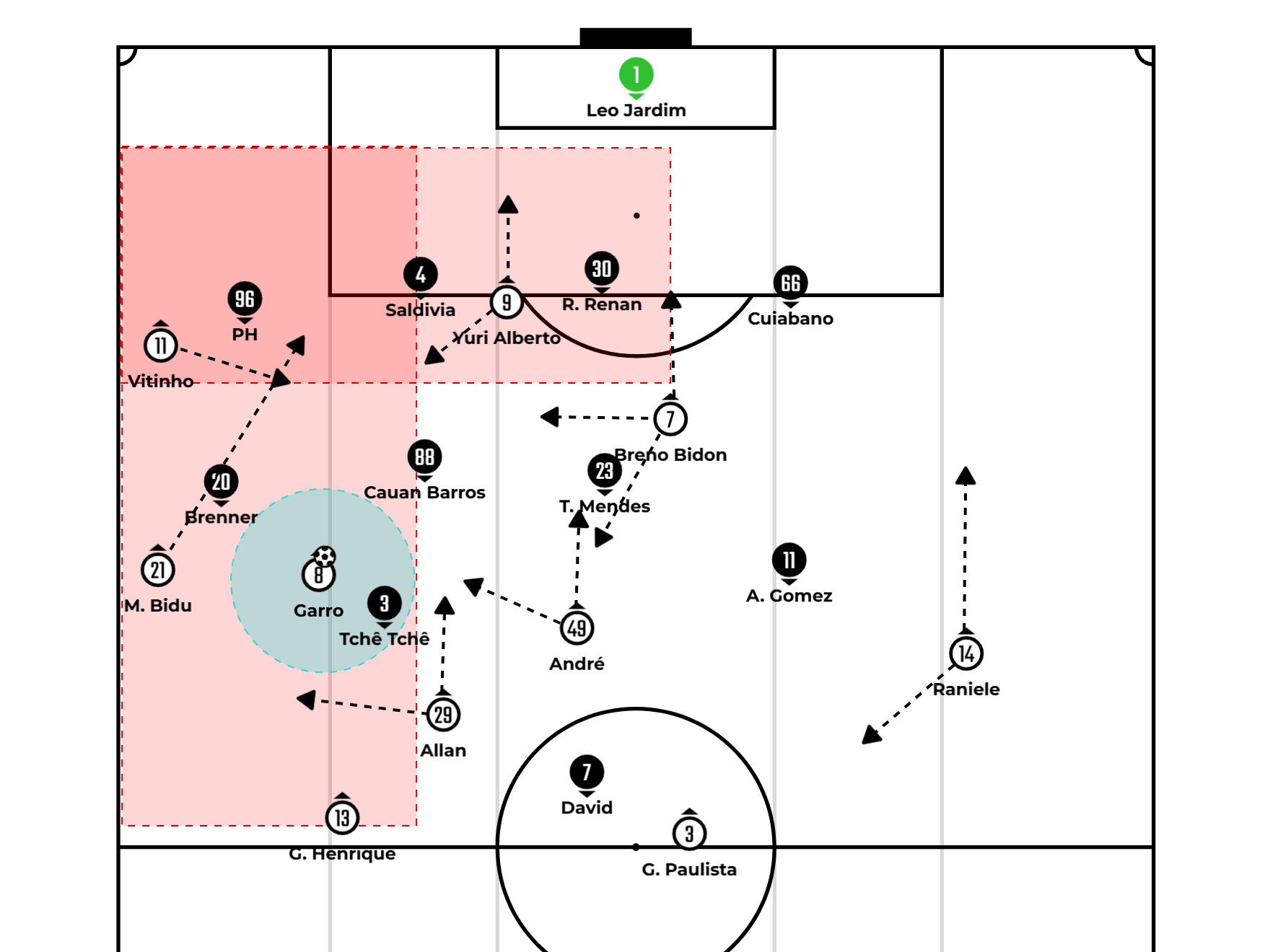
Corinthians attack with tactical asymmetry, with players clustering in the wide channel.
The first half was not particularly high quality, but Corinthians attacked more, played better and deserved the result they built. Most of the home team’s attacks came from overloading the left side, starting wide and finishing inside. The base of the positive result came from these dynamics, especially the concept of almost total positional freedom for players, making it difficult to define whether the offensive system was a 4-2-3-1 or a 4-2-2-2 formation due to its asymmetry.
In Brazil, there is a concept called “paralela cheia”, translated as overload flank. It happens when a team groups three or more players close together to progress vertically through numerical superiority on the flank, where a player moves, creating a vertical passing lane that runs parallel to and close to the sideline.
This occurs frequently in Dinizismo, managing touch and pass, attracting the opponent to create space, with players positioned at different heights. To enable this proximity, Fernando Diniz emphasizes the idea of helping the teammate, always offering multiple short passing options through support runs.
The Corinthians goal is a clear example: the team fills the wide channel and creates numerical superiority. Garro drops to receive while left fullback Matheus Bidu advances from outside to inside. Garro passes to Vitinho in width, who controls the timing and returns the ball after Bidu drags his marker. With one touch, Garro delivers a brilliant improvised pass for Bidu to finish and score with his weaker foot.
This move was rehearsed at least three times before the opening goal, showing clear intent. However, it was not the only pattern. At times, pivots Allan and André supported the wide overload, or Breno Bidon, the right midfielder, crossed the pitch to free Garro to play higher. The key point is that Garro, the team’s main playmaker, was always involved in build up as the central link.
Garro had a poor season last year, below his potential. Fernando Diniz arrived with the idea of restoring him, which is one of his strengths, enhancing players’ technique and confidence. Despite poor results at Vasco, he positively influenced several players, such as Paulo Henrique and Cauan Barros, who faced him in this match.
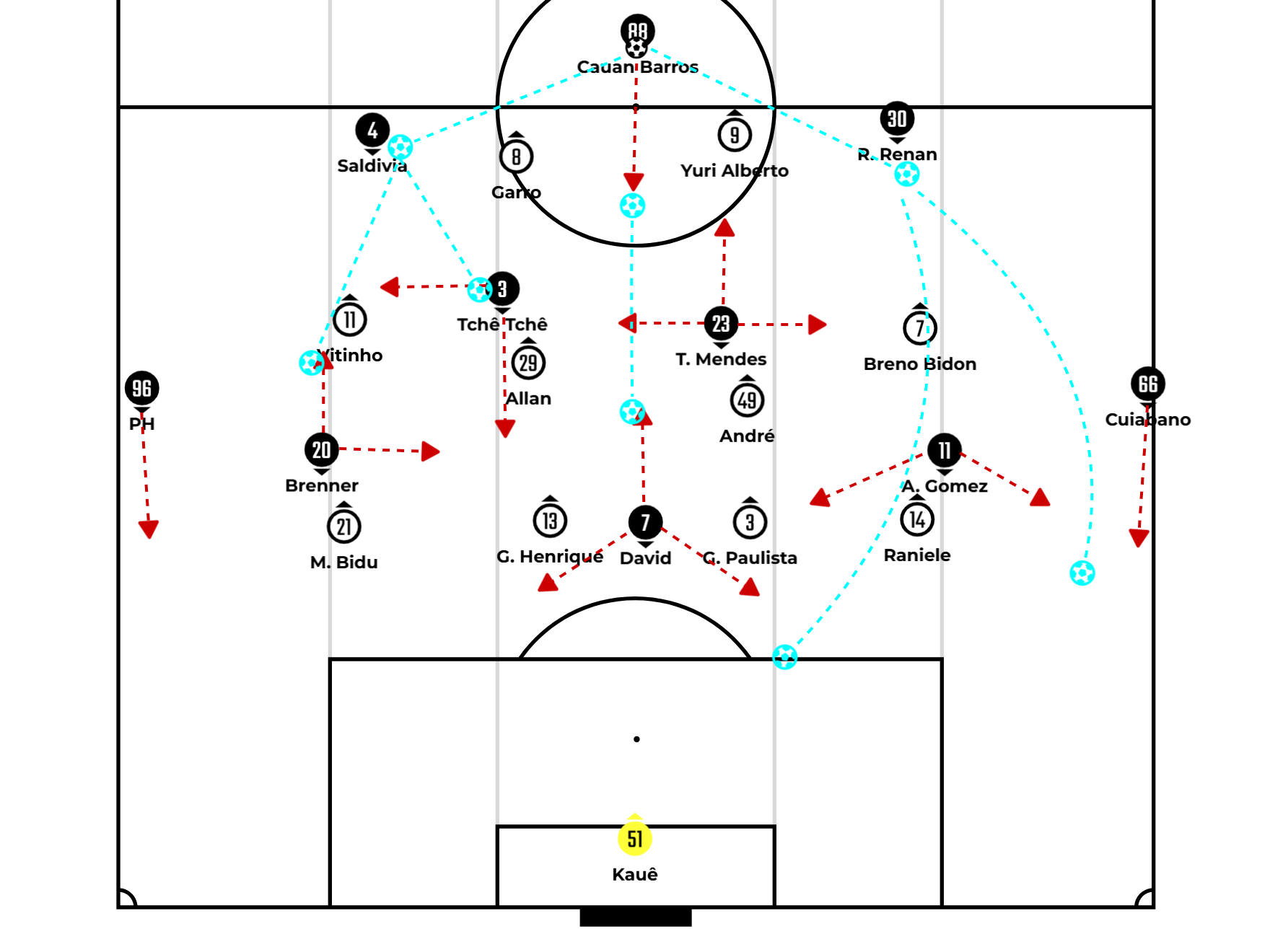
Vasco attack organized in a 3-4-3 shape against Corinthians defense in a 4-4-2 formation.
Vasco had few attacking moments, but when they advanced, one of the pivots, Cauan Barros, dropped between the center backs to initiate build up. As Corinthians defended in a compact 4-4-2 formation, the center backs attempted long balls toward David and Andrés Gomez behind the last line or switches toward Cuiabano and Paulo Henrique out wide. Centrally, especially Cauan connected with the other midfielders or Brenner and David dropping to receive with their back to goal.
At this point, another merit of the Corinthians coach became evident: Raniele, playing as an improvised right fullback, won almost all his duels. Diniz selected a player strong in one against one defending to contain André Gomez, Vasco’s most dangerous player, someone he knows well from his time at Vasco. Raniele’s focus in physical duels reflects the coach’s emphasis on intensity.
Counterpressing and defensive phase had been issues for the coach in recent years. However, Corinthians have performed well, largely due to their identity of high intensity and constant dueling. This helps sustain possession and protect against wide attacks, with Raniele playing a key role. Still, this intensity must be controlled, as André was sent off for an aggressive action while pressing high near the end of the first half.
Another defensive masterclass with fewer players
Two matchdays earlier, in Diniz’s first derby in charge of Corinthians, the team held a 0-0 draw against Palmeiras with two players sent off. It would not be easy for Vasco to break down Corinthians even with numerical superiority.
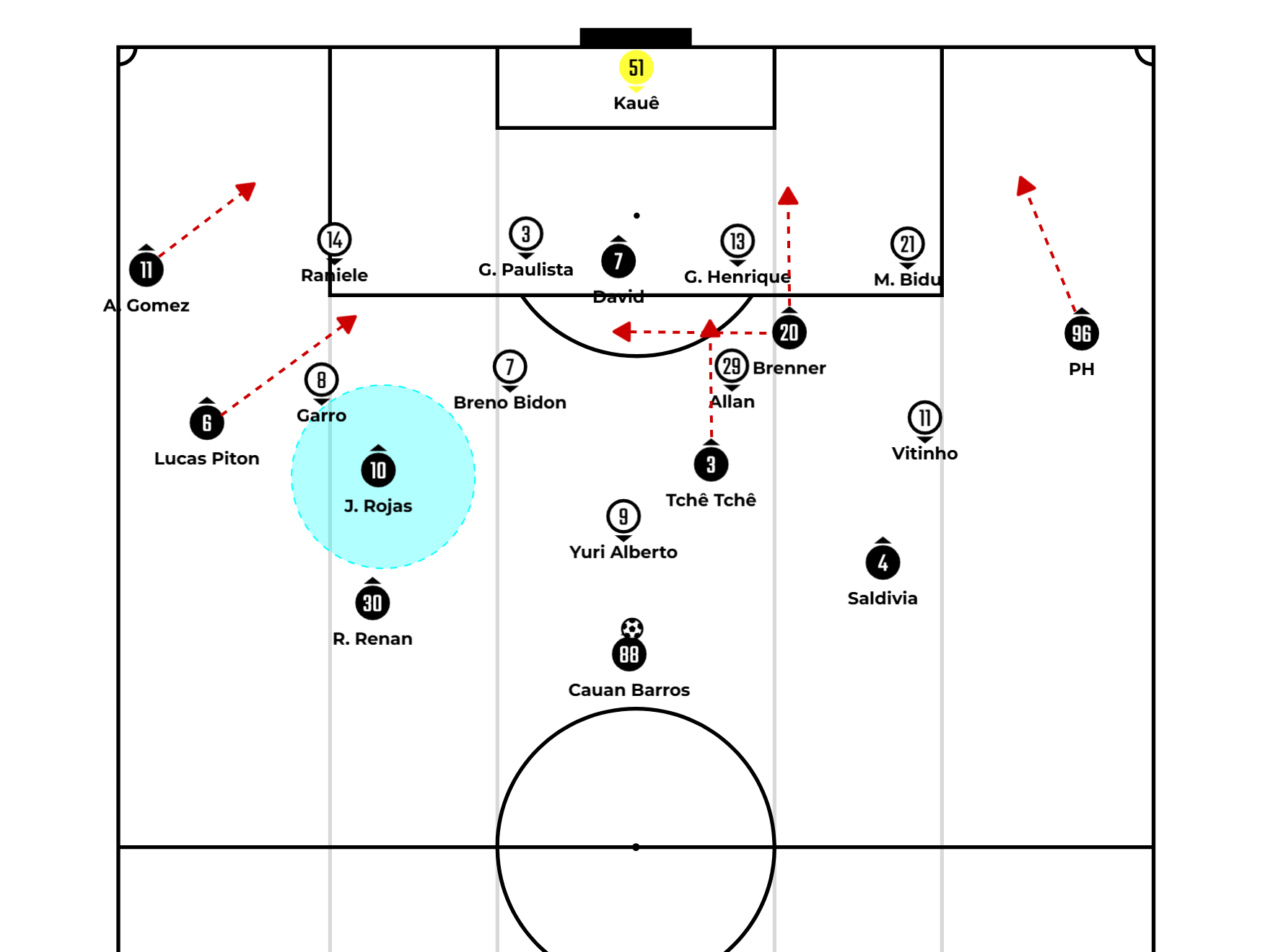
Vasco attacking in the second half in a 3-2-5 relational shape against Corinthians compact defense in a 4-4-1 formation.
The second half was attack versus defense. Renato Gaúcho introduced Lucas Piton, a more build up oriented fullback, replacing Cuiabano, and removed Thiago Mendes for a number ten, Rojas. The team theoretically shifted to a 4-2-3-1 outline, but in attack it became a 3-2-5 shape, following a relational/functional logic.
Cauan Barros operated almost as a center back in build up, while Tchê Tchê attacked available spaces. Among the fullbacks, Paulo Henrique played almost as a right winger, while Lucas Piton moved inside to drag markers and create space for Andrés Gomez, frequently found by Johan Rojas. The Colombian playmaker operated freely across both sides, mainly on the left, looking for passing windows. However, Brenner struggled in tight spaces and David tired.
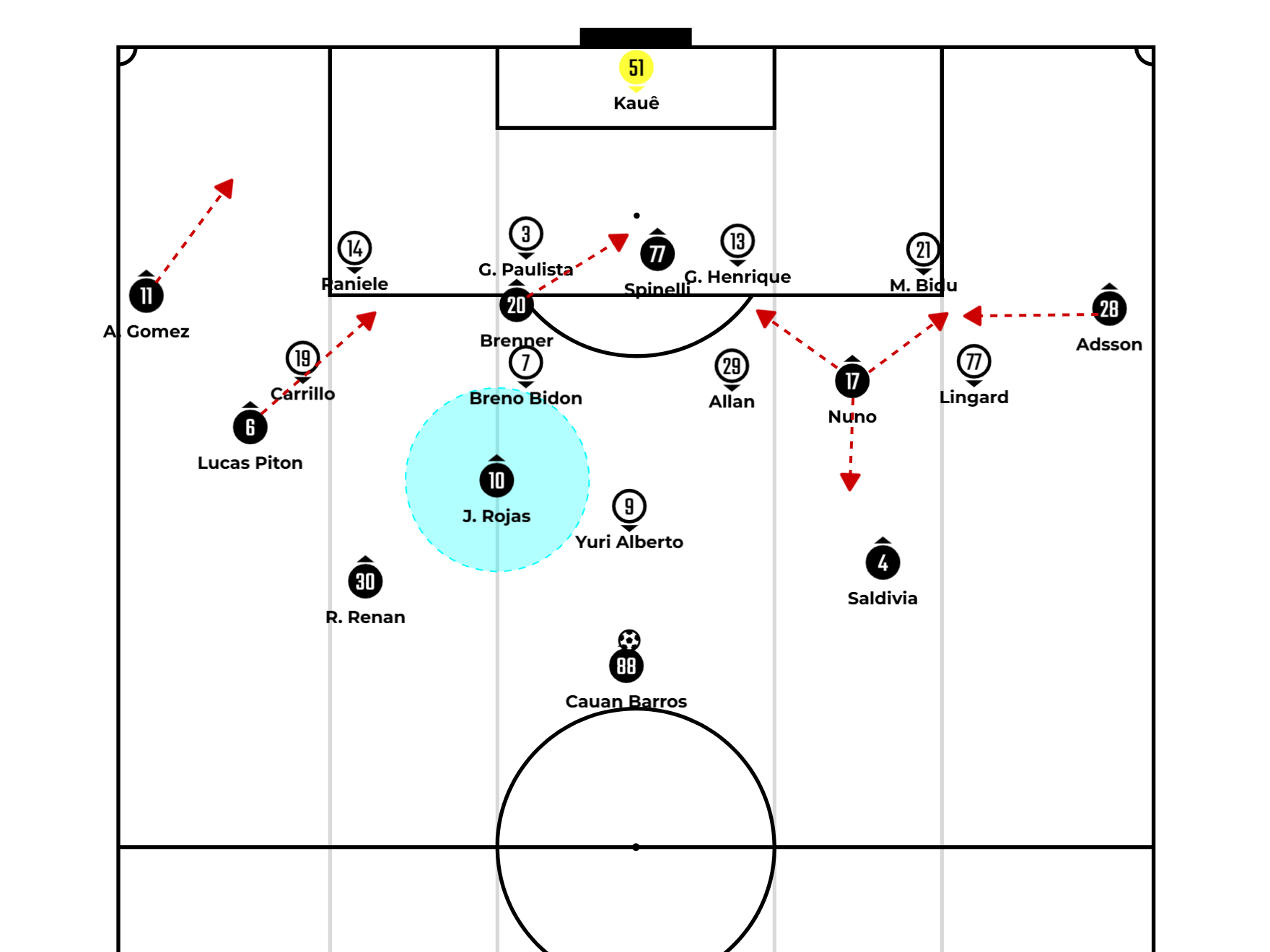
After substitutions, Vasco attack in a 3-1-6 shape with five attackers on the pitch.
Unable to find space, Vasco removed a pivot and a fullback to add two more wingers. Adson stayed wide on the right with freedom to move inside, while Nuno Moreira entered centrally. However, due to the lack of space between Corinthians lines in a 4-4-1 formation, he was neutralized, often stuck in the box and forced to drop deeper without effectively supporting Rojas in build up.
After the red card, Breno Bidon moved into a pivot role, while Garro dropped into the midfield line defensively. While under Dorival Júnior he was often spared defensive duties, here he contributed intensely. To deal with wide attacks, Diniz refreshed the midfield line with Carrillo and Jesse Lingard, former Manchester United, improving defensive coverage. Vasco created few crossing opportunities toward Spinelli, who was introduced to add aerial presence.
To make matters worse for Vasco, the best chances in the second half still came from Corinthians, who, despite not finishing well, created dangerous counterattacks. A scenario similar to the draw against Palmeiras, but this time ending in a 1-0 win.
Takeaways
Six matches, four wins and zero goals conceded. A defensively solid team secured its first Brasileirão win since Dorival’s departure. It was only a matter of time, as the positive impact of the new coach was already evident. Corinthians moved out of the relegation zone into 14th place. After a midweek Libertadores match, they will face Mirassol next Sunday.
Vasco, on the other hand, remain inconsistent, sitting in 10th place. Renato Gaúcho side will play Olimpia in the Copa Sudamericana during the week and face Flamengo in a derby on the weekend, one of the strongest teams in Brazil, currently near the top of the table.


Comments