

Corinthians – Palmeiras: Corinthians hold a draw with two men down in Fernando Diniz’s first derby as head coach (0-0)
In Brazil, Corinthians and Palmeiras form one of the biggest rivalries in the country, always surrounded by a hostile atmosphere. On Matchday 11, the teams faced each other and, even with two players sent off, Corinthians managed to avoid defeat against the Brasileirão leaders. The match marked Fernando Diniz’s first “Derby Paulista” as head coach, known for his unique and authorial style of play.
Tactical analysis and match report by Marcus Arboés.
Fernando Diniz had debuted as the new Corinthians head coach after the departure of Dorival Júnior, both former Brazil National Team coaches, and won with some bold changes. Without Memphis Depay but with Jesse Lingard on the bench, he set the team up in a 4-4-2 outline: Hugo Souza (Brazil) in goal; Matheuzinho and Matheus Bido as fullbacks, with Gabriel Paulista (former Valencia) and Gustavo Henrique in defense; André and Raniele as pivots; Breno Bidon and Garro as midfielders; the young Kayke as a second striker and Yuri Alberto as the number nine.
On the other side, Abel Ferreira, already dealing with important absences such as Piquerez and Vitor Roque, also lost Jhon Arias due to suspension and made one change, starting Khellven out of position instead of Arthur Gabriel, who struggled against Bahia. The lineup was: Carlos Miguel (former Nottingham) as goalkeeper; Giay, Gustavo Gómez (Paraguay), Murilo and Khellven in the defensive line; Marlon Freitas and Andreas Pereira (former Fulham) in midfield; Allan on the right wing, Sosa (former Nottingham) on the left wing, Maurício (Paraguay) as a second striker and Flaco López (Argentina) as the target man.
The new Dinizismo at Corinthians
“Dinizismo” is a philosophy aimed at giving players more courage, confidence and enjoyment, restoring their essence through a relational/functional style built on proximity around the ball and almost total positional freedom for outfield players, seeking to maintain possession and patiently manipulate the opponent’s marking. This approach gained notoriety in 2023 with Fernando Diniz winning the Libertadores and has influenced several coaches and schools around the world.
The issue is that after that, the coach went through poor spells. Fluminense went from peak to collapse in 2024, and his work did not resonate at Cruzeiro. Then, in 2025, he took over Vasco, where he improved the team, avoided relegation and reached the domestic cup final. However, results did not come in 2026, leading media and many observers to label him as a poor coach. Now he arrives at Corinthians trying to implement his method and philosophy to succeed again.

Corinthians “Dinizismo”, starting from a relational organization in a 4-4-2 formation.
Even though Palmeiras are league leaders, they’re not a team that stands out for sustained possession in the opponent’s half, as seen in other analyses on Between the Posts. However, not every team can sustain possession and play with courage against them. Corinthians did, and at least until the 35th minute of the first half, they were superior, even if the match did not feature many clear chances at that stage.
The relational/functional game of proximity is based on accumulating players to offer passing options, or as Fernando Diniz likes to say, offering help to the ball carrier. This clustering usually happens on the flanks, with the entire block moving together with freedom. At Corinthians, the coach uses a 4-4-2 with two pivots of different functions, one enganche midfielder Garro and one midfielder organizing play facing forward Breno Bidon. Both shift toward the side where the team is attacking, creating superiority.
The initial idea was to move Palmeiras compact 4-4-2 shape and progress through short vertical passes. When that was not possible, they looked for switches to the opposite fullback, not necessarily to attack immediately, but to reorganize and manipulate the defense again. Yuri Alberto acted as a target man, playing with his back to goal to provide support, while Kayke, as a second striker, attacked open spaces to receive in advantage and progress.
A match shaped by red cards
The narrative of this match could’ve been Fernando Diniz showcasing his philosophy and beating the league leaders, but in the 35th minute of the first half, when Corinthians were playing better, the young pivot André was sent off for making an obscene gesture toward the opponent. It may sound unusual, but the atmosphere in derbies of this magnitude is extremely tense, and just two weeks earlier another Corinthians player, Allan, had been sent off for the same reason, making the incident even more questionable.
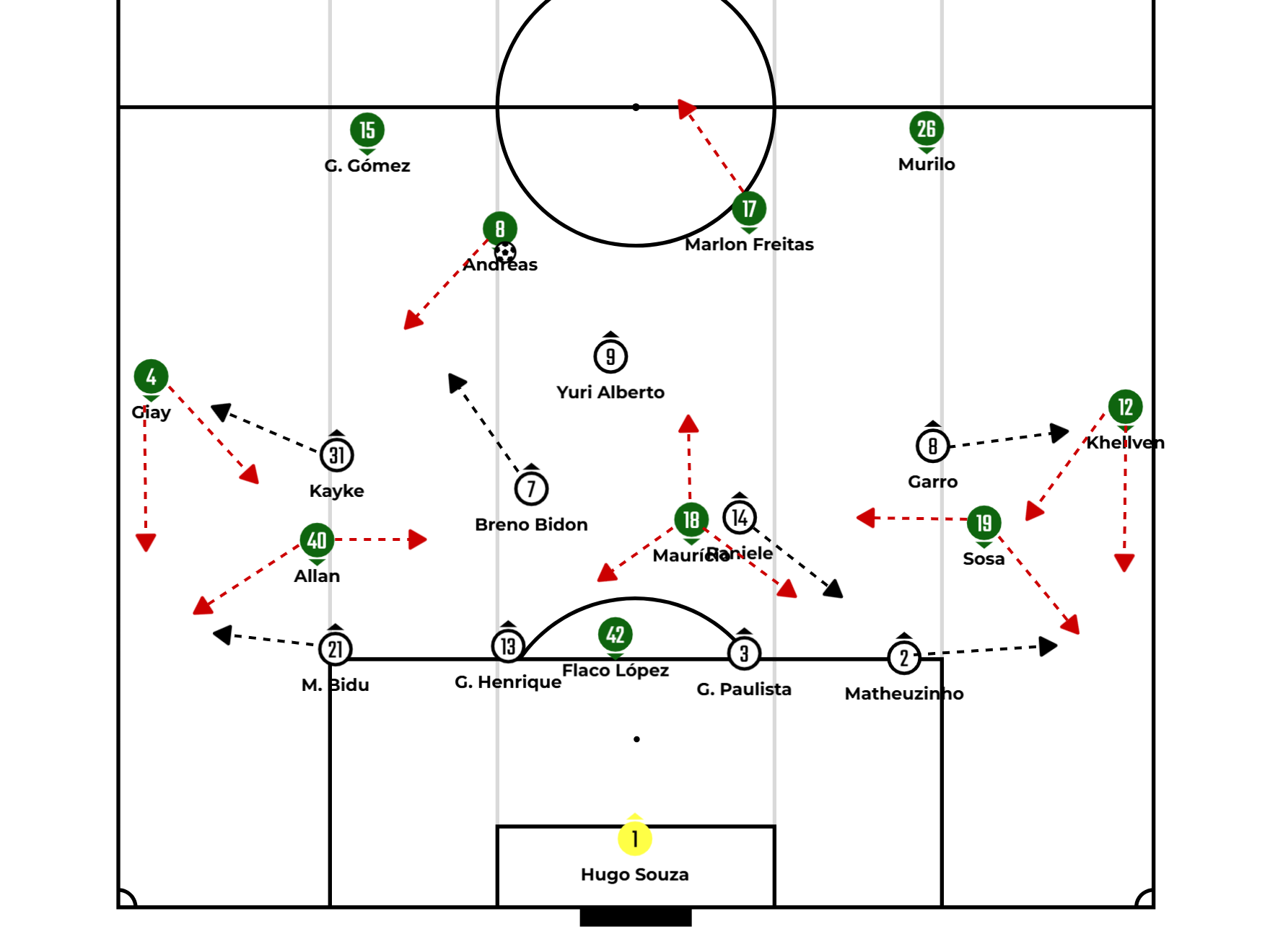
Palmeiras attacking in a positional 4-2-4 / 2-2-6 shape against Corinthians in a 4-4-1 formation with one man down.
If early in the match Corinthians pressed high and at times defended in a mid block, not always closing down Palmeiras short build up, after the red card that approach disappeared completely, as the team dropped into a low block 4-4-1. Breno Bidon, the second best marker in midfield, dropped as a pivot and Garro became the right sided midfielder in the second line.
Palmeiras, who usually attack in a positional 4-2-4 shape using Andreas and Marlon Freitas at the base to find switches or long diagonals to wingers and fullbacks, or even direct balls to the forwards, began to attack almost in a 2-2-6 formation, with fullbacks attacking space inside or outside and wingers moving inside or staying wide to receive one against one. However, Corinthians dealt with it well, with pivots marking through man oriented references and stepping up near Yuri Alberto to reduce the angles for Palmeiras midfielders.
Even with André sent off, Corinthians still managed at times to keep the ball and attack through quick combinations centrally, but without much effectiveness. To make things worse, midway through the second half, right fullback Matheuzinho struck an opponent and was sent off, leaving Corinthians, who had been better overall, with just nine players.
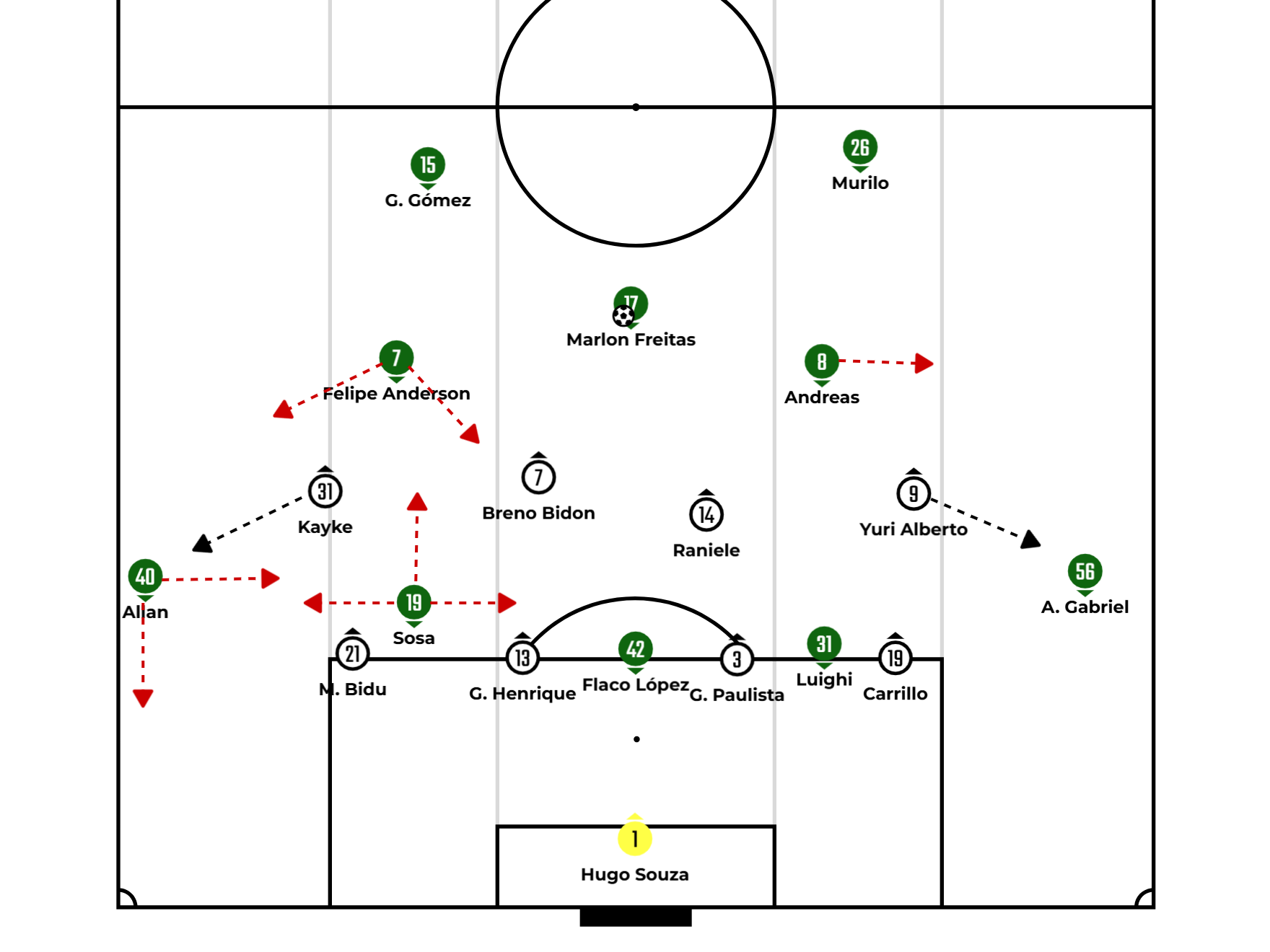
Corinthians shape with two men down after substitutions, defending in a 4-4-0 against Palmeiras attacking in a 2-3-5 outline.
Seeing that wide combinations were not working as well, Abel Ferreira tried to overload central areas through substitutions: Luighi, stronger in aerial play, replaced Maurício; Sosa switched sides to play inside between the lines; Felipe Anderson came on almost as a playmaker to help circulation alongside Andreas Pereira, replacing Giay; and the young Arthur Gabriel replaced Khellven to provide width at left fullback, forming a 2-3-5 formation.
But the need to defend in a 4-4-0 shape changed Corinthians behavior. The pivots no longer stepped up as much to press, as they had to stay compact, and they could not cover fullback jumps either, as they needed to protect central zones against good shooters, Sosa and Allan’s inside movements. As a result, the wide players in the second line Kayke, later replaced by Lingard, and Yuri Alberto were responsible for pressing players receiving out wide.
With this scenario, Palmeiras resorted mostly to crosses or individual actions from Allan and created some good chances, but were stopped by an excellent performance from goalkeeper Hugo Souza, the experienced center back pairing and Carrillo, who came on for Garro after the red card to play out of position at fullback. Interestingly, the best chance of the match came right after Matheuzinho’s red card. Felipe Anderson misplaced a pass and almost gifted a goal to Yuri Alberto, who was denied by a great intervention from Carlos Miguel.
Takeaways
The draw with two players sent off against the league leaders and biggest rival felt like a win for Corinthians fans. This is the kind of match where the club’s cultural identity of grit, commitment and intensity stands out, helping the group find unity and belief, even if not much of the coach’s ideas were seen, largely due to the red cards.
After a following win against Santa Fe in the Libertadores, the team reached three matches without conceding under Fernando Diniz, two wins and one draw, and despite the positive start, they remain near the relegation zone with 11 points. Next week, they face Vitória, a northeastern Brazilian team currently mid table.
Abel Ferreira remains hard to beat in the Brasileirão, but has now recorded two frustrating draws in a row, one in the Libertadores and this one in the league. Today, Thursday, they face Sporting Cristal to recover in the Libertadores, and on the weekend, Athletico Paranaense. This slip allowed the gap at the top to increase to six points, but Flamengo beat Fluminense in a direct clash and reached 20 points with a game in hand.


Comments