
Crystal Palace – Rayo Vallecano: Wharton Conducts Another Trophy for Glasner’s Palace (1-0)
Crystal Palace’s first international title under Oliver Glasner came through a performance that perfectly reflected the Austrian coach’s ideas: compact defending, ruthless verticality, and aggressive wing-back play. Crystal Palace defeated Rayo Vallecano 1-0 in a match where defensive structures and pressing mechanisms dictated the outcome of the game.
Tactical analysis and match report by Sebastián Parreño.
From the opening minutes, both teams approached the match with an extremely aggressive mentality without the ball. The game immediately became dominated by pressing structures rather than long spells of controlled possession. Crystal Palace set up their press with a narrow front three that tried to remove access toward Rayo Vallecano’s double pivot while simultaneously remaining close enough to jump onto the center-backs and goalkeeper. Whenever Rayo attempted to construct short build-up sequences near their own penalty area, Palace were ready to press instantly and force long balls. Rayo mirrored that intensity with similar aggression, meaning neither side enjoyed comfortable progression during the opening stages.
The direct nature of the match suited Palace early on. Rather than insisting on short circulation, they frequently targeted Jean-Philippe Mateta with longer passes. Mateta’s role became fundamental to Palace’s attacking stability. He consistently provided strong hold-up play, competed effectively in aerial duels, and generated second-ball situations through flick-ons and headers. Palace prepared these moments well structurally, often placing supporting runners around Mateta to attack loose balls and continue transitions forward.
Palace’s 5-2-3 Defensive Block Closed The Center
Although Palace finished the match with only forty-two percent possession, the game unfolded exactly according to their preferred dynamics. Glasner’s side are comfortable defending for extended periods because of the compactness and clarity of their structure. Out of possession, Palace defended in a 5-2-3 shape that aggressively protected central zones. The narrow positioning of the front three was especially important because it completely blocked direct access into midfield. Rayo struggled enormously to play line-breaking passes through the center or bypass Palace’s first pressing line. The wing-backs complemented this approach perfectly, remaining prepared to jump aggressively toward the opposition full-backs whenever the ball travelled wide.
The pressing responsibilities inside Palace’s front line were highly coordinated. Mateta frequently focused on screening central passing lanes and protecting access toward midfield, while Ismaïla Sarr and Yéremy Pino acted as the directional pressers. Their movements forced Rayo toward predictable areas while also enabling Palace to maintain numerical superiority around the ball. When Rayo attempted to use a double pivot during build-up, Palace’s midfielders were ready to step forward and assist Mateta in closing the additional passing option. The result was an extremely compact defensive block that suffocated central progression and denied Rayo the possibility of playing through the middle with consistency.
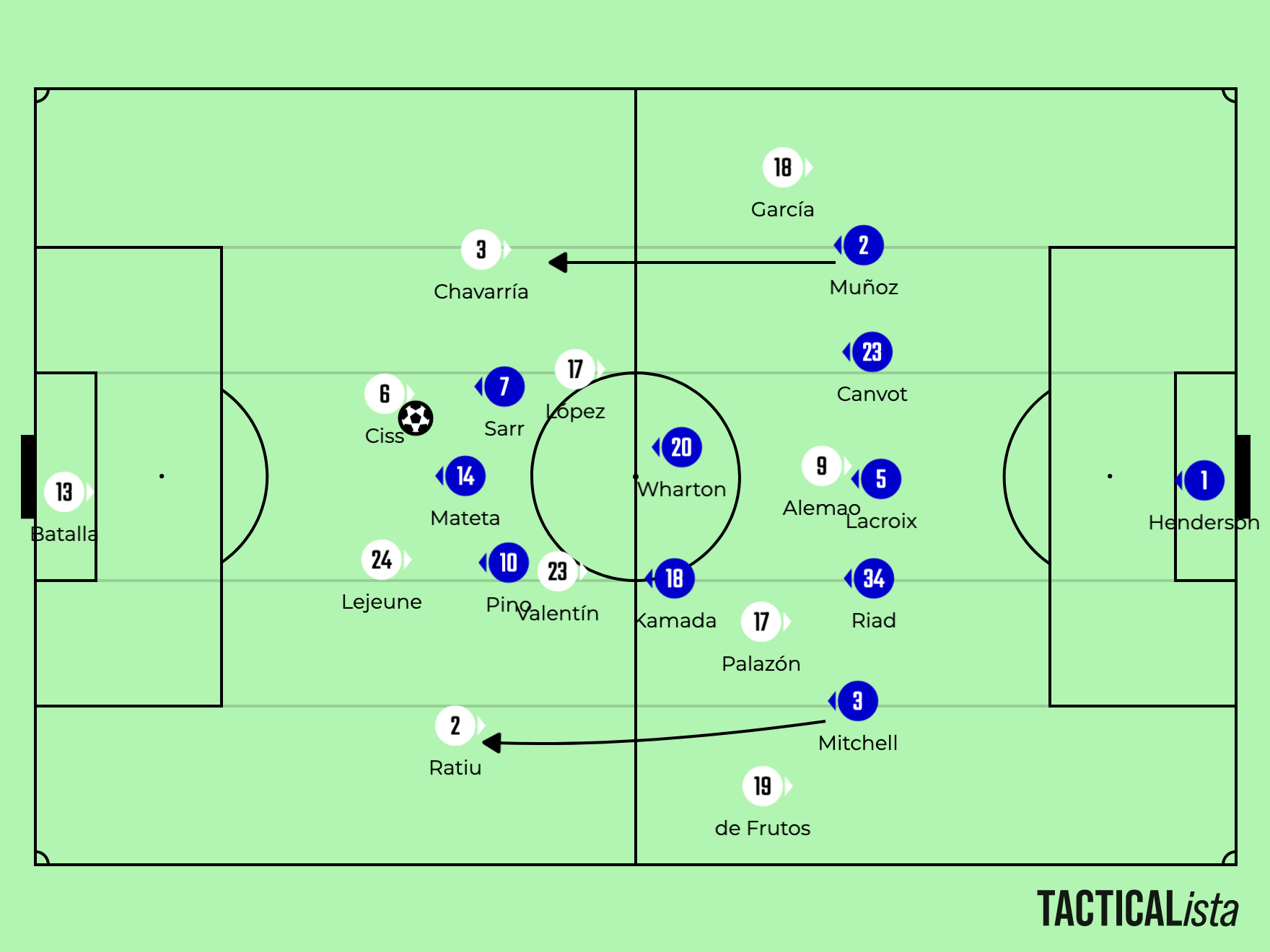
Rayo trying to bypass Palace’s 5-2-3 block, with the wingbacks having to make long jumps to Rayo’s fullbacks to press.
Palace’s pressing triggers were another decisive aspect of the game. Whenever the ball travelled backwards and Palace sensed a numerical advantage against Rayo’s first line, they immediately activated a more aggressive press. Their wing-backs pushed forward aggressively during these moments, turning Palace’s medium block into an intense high press within seconds. The speed of their reactions prevented Rayo from settling into stable circulation phases.
Palazón Tried To Manipulate Palace’s Defensive Shape
Rayo’s attacking structure revolved around the movement of Isi Palazón, who operated as the central attacking midfielder in their 4-2-3-1 system. Palazón functioned with considerable freedom, constantly drifting across the pitch in search of spaces inside Palace’s zonal structure. At times he dropped deeper to help progression, allowing right-back Andrei Rațiu to advance aggressively into higher positions. Simultaneously, the right winger moved inward into the half-space, opening the flank for Rațiu’s overlapping runs. Nearly every positional rotation on Rayo’s right side depended on Palazón’s movement and interpretation of space.
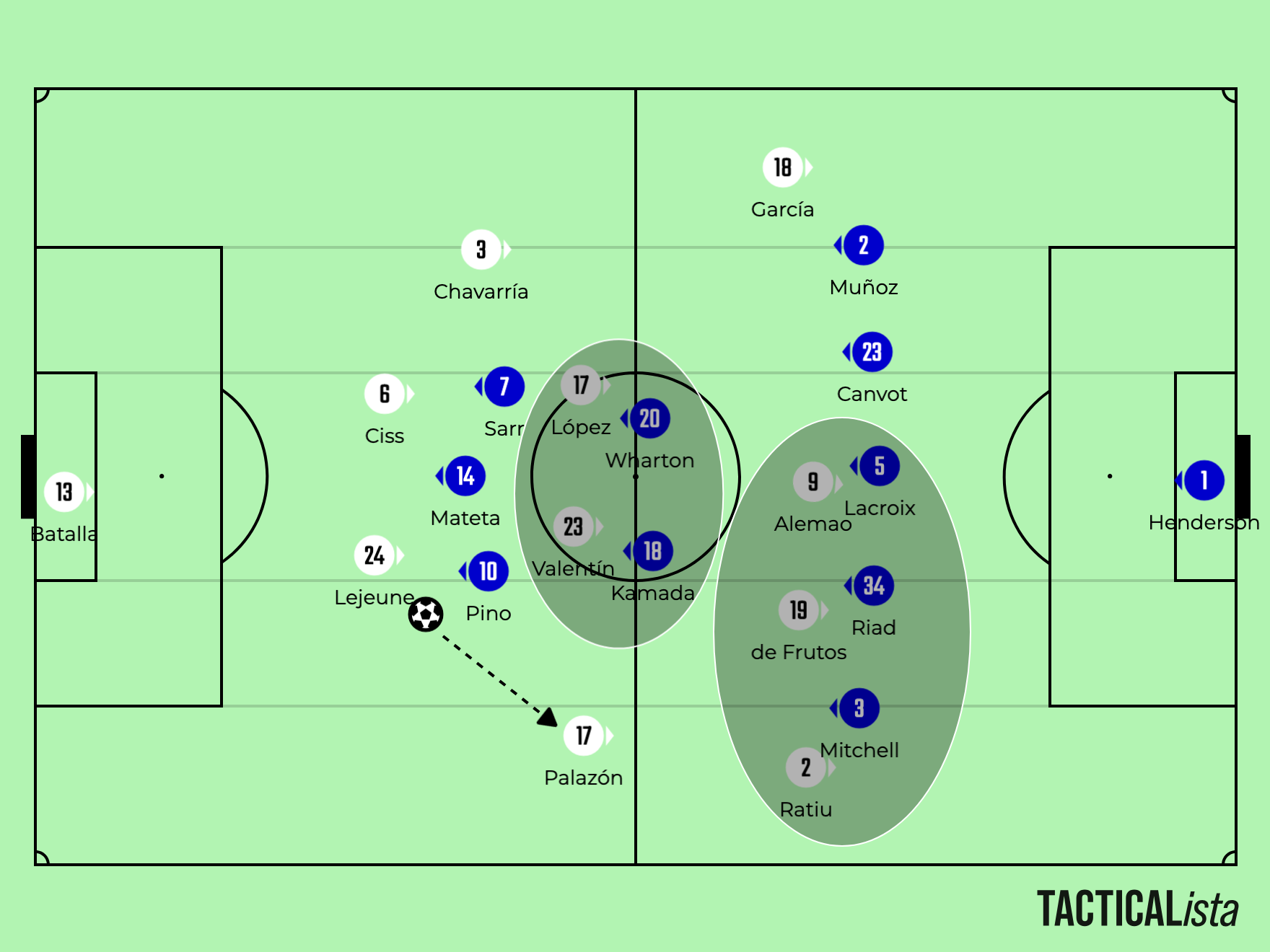
Rayo pinned both the last line and midfield of Palace by matching them man to man, allowing Palazón to be the free man on the side of the Palace block so he could progress with the ball.
However, Palace adjusted quickly whenever Palazón attempted to receive between lines. He often drifted toward wider zones because Rayo’s right winger pinned Palace’s center-back inward, but Palace reacted rapidly to close him down. Daichi Kamada in particular produced several timely defensive actions to prevent Palazón from receiving freely in dangerous spaces.
Despite the effectiveness of Palace’s defending, Rayo did identify some promising mechanisms to attack the structure. One recurring idea involved overloading Palace’s defensive line through asymmetric movements. The left winger drifted centrally while the left-back pushed high, creating temporary three-versus-three situations against Palace’s back line. From there, Palazón could move into wider midfield positions where he attempted to receive beyond Palace’s two central midfielders. The concept was intelligent because it tried to manipulate Palace’s midfield references and stretch their compactness horizontally.
Yet execution continually failed. On numerous occasions Palazón gestured for the ball while completely free, but Rayo simply could not find him. That inability to connect with their key playmaker ultimately became one of the defining tactical themes of the match.
Palace’s midfield behavior was another important detail in their defensive success. Their central midfielders aggressively tracked opponents who entered central corridors, especially when receiving between Palace’s front line. Adam Wharton was particularly proactive, often stepping forward toward Palazón whenever he dropped centrally. However, Palace balanced this man-oriented behavior intelligently. If an opponent dropped excessively deep into the defensive line, Palace’s midfielders prioritised protecting central space rather than following too far forward and destabilising the block.
Rayo’s Structural Adjustments Improved Their Progression
As the first half progressed, Rayo gradually adapted their build-up structure. Around the twenty-fifth minute, they began leaving only two players in the defensive line during possession. This created mixed consequences. On one hand, it became an immediate pressing trigger for Palace, who recognised opportunities to attack the reduced first line aggressively. On the other hand, when Palace remained inside their 5-2-3 mid-block, Rayo’s wider positioning stretched Sarr and Pino horizontally, occasionally opening central passing lanes into advanced midfielders.
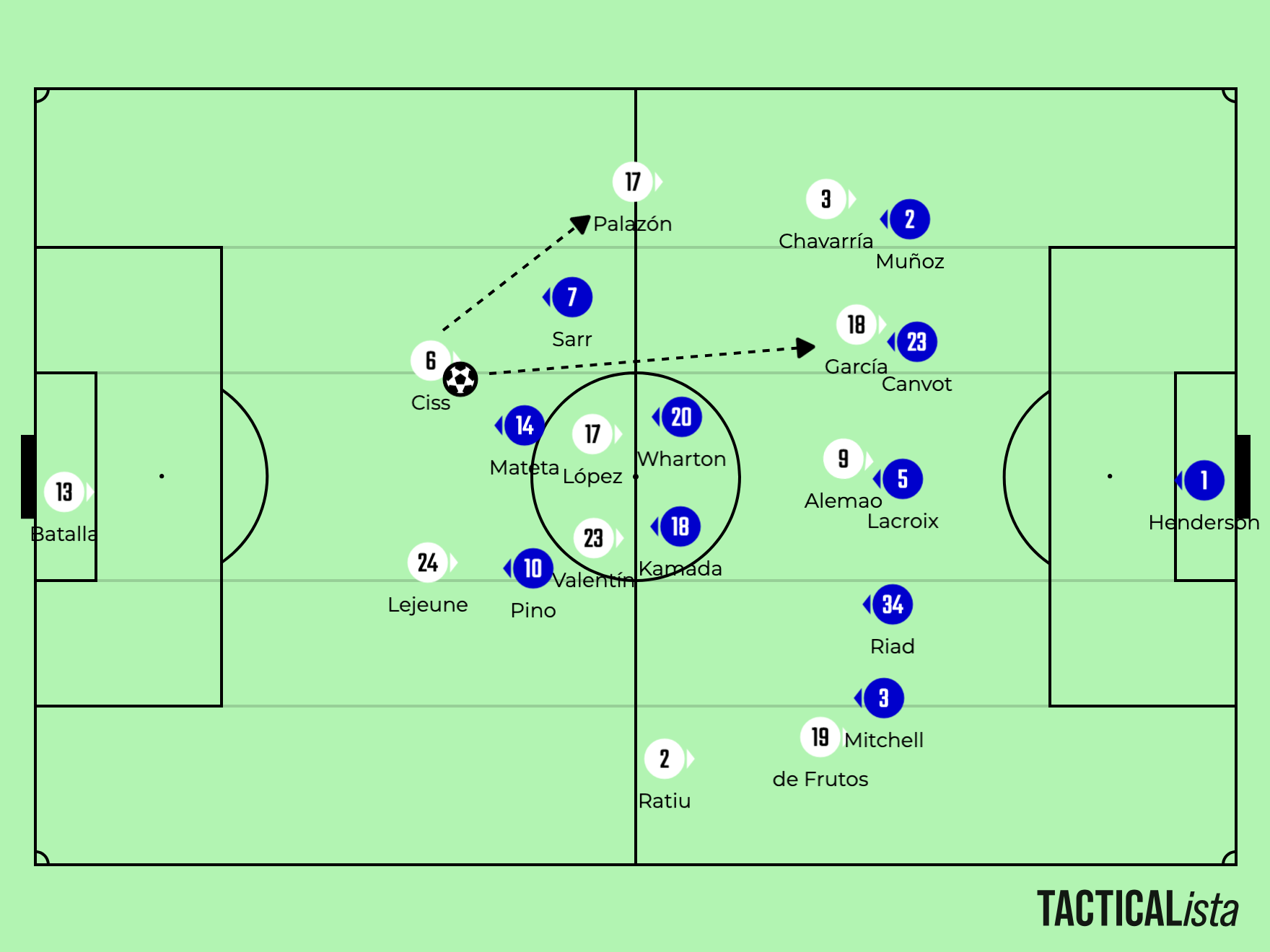
Moving both fullbacks up forced Sarr to go wider, which opened up different passing lanes for Rayo to progress, but the Spanish team did not exploit this enough.
Rayo also created temporary three-versus-two overloads against Wharton and Kamada in midfield, which finally enabled Palazón to receive facing forward during one promising attack. A quick combination on the left produced a dangerous cross, although the striker failed to convert the opportunity.
Later in the half, Rayo found additional progression routes on the flanks. Rațiu advanced much higher on the right side while the winger maintained an extremely wide position that pinned Tyrick Mitchell deeper. This created moments where Palace’s wing-backs could no longer jump onto the full-backs aggressively because they were occupied by the wingers. Consequently, Rayo enjoyed more space on the outside than they had earlier in the match. Yet despite improved territorial progression, they still failed to transform these situations into clear attacking danger.
Palace’s Wing-Backs Became The Main Attacking Threat
In possession, Palace’s structure remained highly consistent. Mitchell and Daniel Muñoz occupied the width as wing-backs while the front three controlled central zones. Sarr and Pino mainly operated inside the half-spaces around Mateta, looking for quick combinations and vertical connections.
Palace also cleverly targeted weaknesses inside Rayo’s narrow 4-2-3-1 defensive structure. Kamada frequently drifted wider toward the left side from midfield, creating angles for line-breaking passes and helping Palace progress around Rayo’s compact central block.
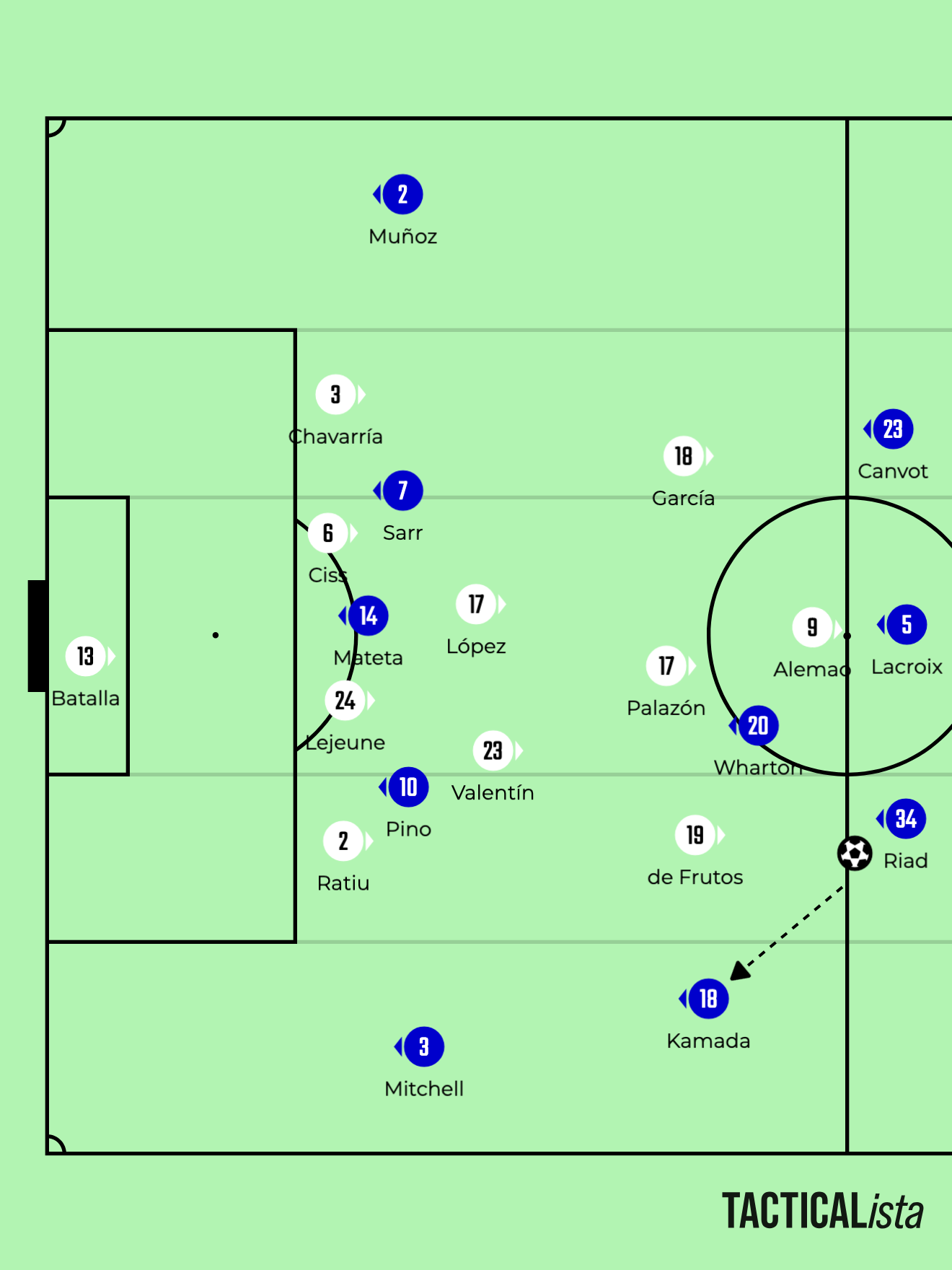
Palace’s solution against Rayo’s 4-2-3-1 was positioning Kamada outside of Rayo’s block, to then progress and overload their defensive line with 5 attackers.
One of the most impressive aspects of Palace’s attacking play was their occupation of finishing zones. Glasner’s side consistently placed at least three, and often four, players inside the penalty area during crossing situations. The wing-backs were essential to this approach because they continuously supported attacks from advanced positions.
Palace frequently created situations where one wing-back delivered crosses toward the far-post arrival of the opposite wing-back. Near the end of the first half, this nearly produced the opening goal when Mitchell arrived unmarked inside the box and headed narrowly wide following a Wharton delivery. The sequence exposed a breakdown in Rayo’s defensive assignments, particularly because Jorge de Frutos failed to track Mitchell’s movement properly.
Wharton And Mateta Punish Rayo’s Press
The decisive moment arrived shortly after halftime and perfectly encapsulated the dangers of disorganised pressing against Palace’s transition-oriented approach. Rayo committed too many players toward one side of the pitch while pressing, leaving the far side exposed. Palace escaped the pressure and quickly switched the ball into free space.
Wharton advanced aggressively through midfield before unleashing a powerful strike from outside the box. Goalkeeper Augusto Batalla could only parry the shot into Mateta’s path, allowing the striker to score the rebound. It was a sequence born directly from Palace’s ability to punish imbalance through rapid vertical progression.
Palace nearly killed the match moments later during a remarkable free-kick sequence in which they struck the woodwork three separate times. Those moments represented the game’s clearest attacking opportunities and reinforced the sense that Palace carried greater threat despite enjoying less possession overall.
The final stages followed a predictable pattern. Rayo controlled possession territorially but struggled to generate meaningful penetration against Palace’s disciplined defensive structure. Glasner’s team defended central spaces brilliantly, remained dangerous in transition, and preserved their advantage through compactness and tactical clarity.
Takeaways
Crystal Palace’s victory demonstrated the effectiveness of a highly coordinated 5-2-3 defensive structure built around compactness and aggressive pressing triggers. By protecting central areas so effectively and reacting quickly whenever Rayo exposed themselves during build-up, Palace controlled the match without needing sustained possession. Their wing-backs once again proved decisive both defensively and offensively, while Mateta’s physical presence and Wharton’s progression gave the team constant transition threat.
For Rayo Vallecano, the match highlighted both the solutions their bright coach can present, but how this only matters if the players can execute in the pitch. Their rotations around Palazón and their flank overloads occasionally disrupted Palace’s structure, but the inability to consistently find the free player undermined their best mechanisms. Despite periods of territorial dominance, they rarely translated possession into genuine danger against one of the most compact and disciplined defensive teams in Europe, who are now champions once again.
We decided to make this article free to read. If you want to support our work, consider taking a subscription.


Comments