

USA – Australia: Freeman puts impressive USA into knockouts (2–0)
Co-hosts United States of America secured their spot in the Round of 32 of the 2026 FIFA World Cup with a commanding and elegant 2-0 victory over Australia at a energetic Seattle Stadium. Mauricio Pochettino’s side defied the pre-match anxiety surrounding the absence of captain Christian Pulisic, launching into a dominant first-half display to break a 96-year curse and secure back-to-back opening World Cup wins for the first time since 1930. An 11th-minute forced own goal from Cameron Burgess through Flo Balogun’s electric run set the tone, before a historic header from breakout fullback Alex Freeman right before halftime sealed maximum points.
Tactical analysis and match report by Aderemi Qoyum.
We decided to make this article free to read. If you want to support our work, consider taking a subscription.
The encounter offered an exciting tactical battle between two sides coming off momentous opening-day victories. Australia, fresh off an impressive 2-0 win over Turkey, set up in a rigid, deeply compact out-of-possession structure designed to frustrate the hosts, deny central penetration, and catch the Americans on over-extended transitions, just like they did against Turkey.
Pochettino adjusted his blueprint in the absence of Pulisic, rolling out a 3-5-2 formation on paper that offered attacking dynamics for heavy offensive structural pinning. Matt Freese kept his place between the posts, shielded by a solid back three composed of Alex Freeman, Chris Richards, and the veteran Tim Ream. Operating across the wide spaces, Antonee Robinson and Sergiño Dest provided high-amplitude wingback dynamics, flanking a dominant central engine room of Tyler Adams, Weston McKennie, and Malik Tillman. Folarin Balogun and Ricardo Pepi started as a dynamic dual-striker partnership.
Australia’s manager Tony Popovic countered with a reactive 5-4-1 system engineered to absorb immense pressure. Patrick Beach anchored the side behind a defensive line featuring fullbacks Jordan Bos and Jacob Italiano flanking center-backs Alessandro Circati, Harry Souttar, and Cameron Burgess. A central midfield double pivot of Paul Okon-Engstler and Aiden O’Neill was tasked with suppressing the central lanes, leaving wide midfielders Mathew Leckie and Nishan Velupillay to support Mohamed Toure up front.
USA’s left-sided overloads dismantle the Socceroos’ mid-block
Once the USA established sustained possession, their nominal structure evolved into a highly aggressive 3-1-6 in-possession shape—which frequently resembled a patient 3-3-4 pattern during certain phases of play. With Tyler Adams acting as the sole holding pivot, the back three of Freeman, Richards, and Ream showed immense composure, recycling possession cleanly at the base of the pitch until a clear forward passing lane materialized.
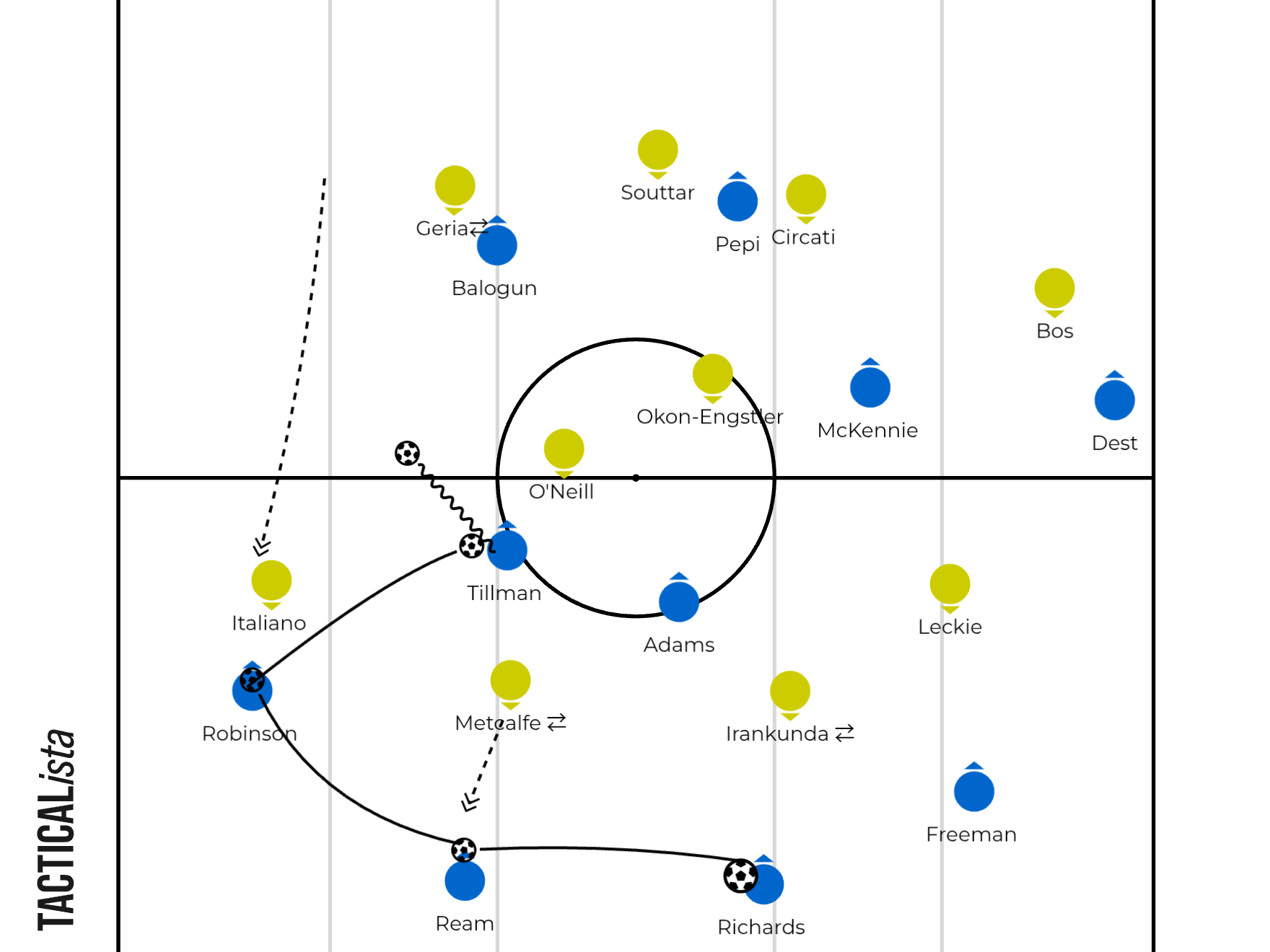
The primary mechanism for dismantling Australia’s 5-4-1 mid-block relied heavily on calculated left-sided overloads and structural manipulation. Malik Tillman, who majorly operated behind Balogun in the tournament opener, shifted slightly to the left halfspace here to construct a dangerous triumvirate with Robinson and the two splitting strikers. The USA focused heavily on dragging Jacob Italiano out of position. Robinson would deliberately drop deeper into the middle third, pulling Italiano up the pitch before launching progressive passes into the vacated space between the wingback and the wide center-back.
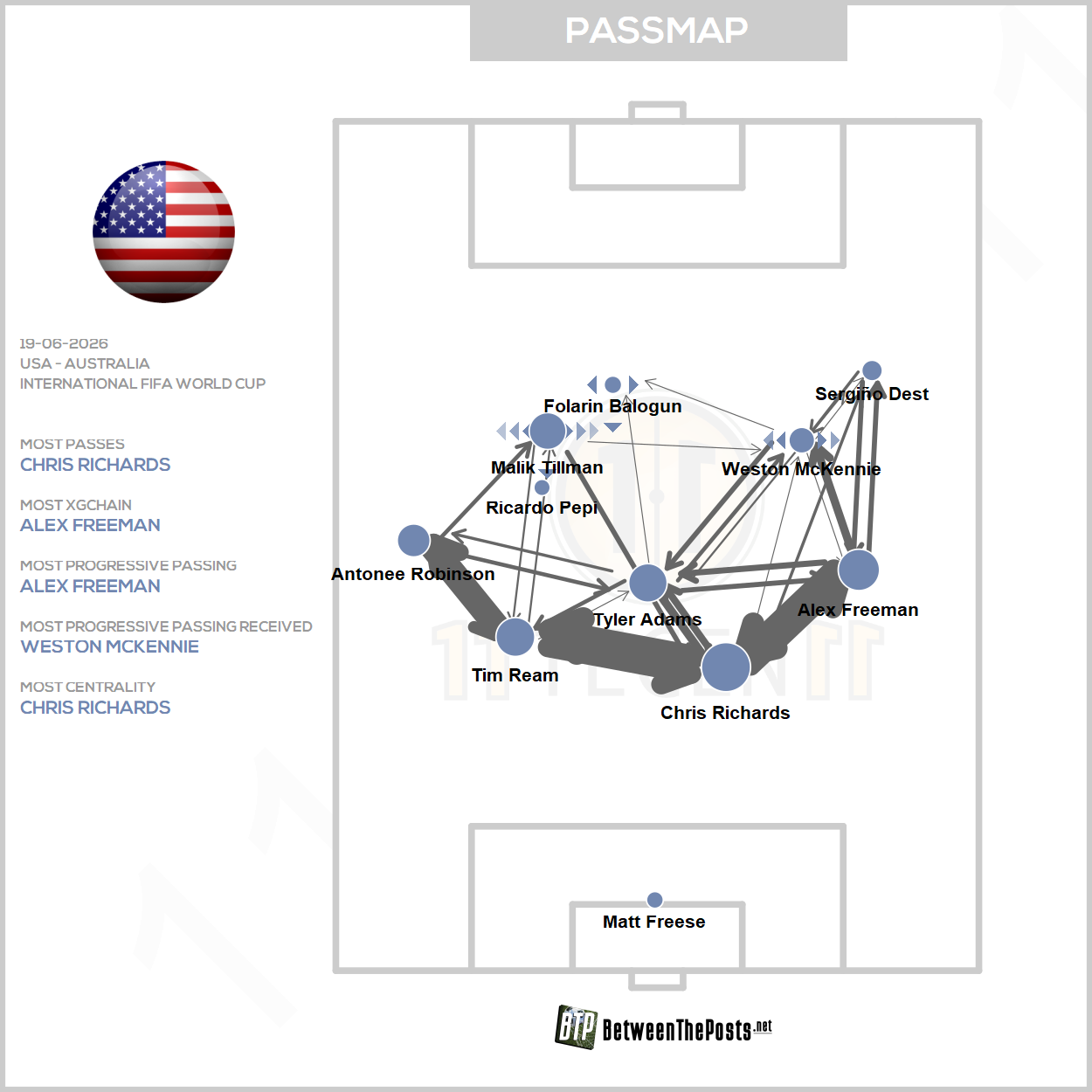
USA Passmap shows Robinson’s deep positioning and how much he receives from Ream and finds Tillman. Also shows how much USA passed the ball across the backline to keep Australia running all the time.
This spatial disruption mirrored the USA’s patterns against Paraguay where Robinson picked out Pulisic in space to eventually find Flo Balogunto score. To compound Australia’s defensive headache, Balogun and Pepi interchanged fluidly, alternating who would drift wide to isolate defenders in one-on-one situations. Balogun consistently drifted to the left flank, utilizing his raw pace and technical superiority to unbalance his marker, while Tillman timed underlapping vertical runs perfectly whenever Robinson held maximum width.
This exact mechanism created the 11th-minute opener; after the USA easily progressed into the middle third, Robinson from his deep position found Balogun in space on the left wing after Italiano is dragged out by his willingness to press. The striker showcased an incredible turn of pace to burn past his marker and charge towards the six-yard box, flashing a dangerous low cross that Cameron Burgess could only unfortunately bundle into the roof of his own net under immense pressure.
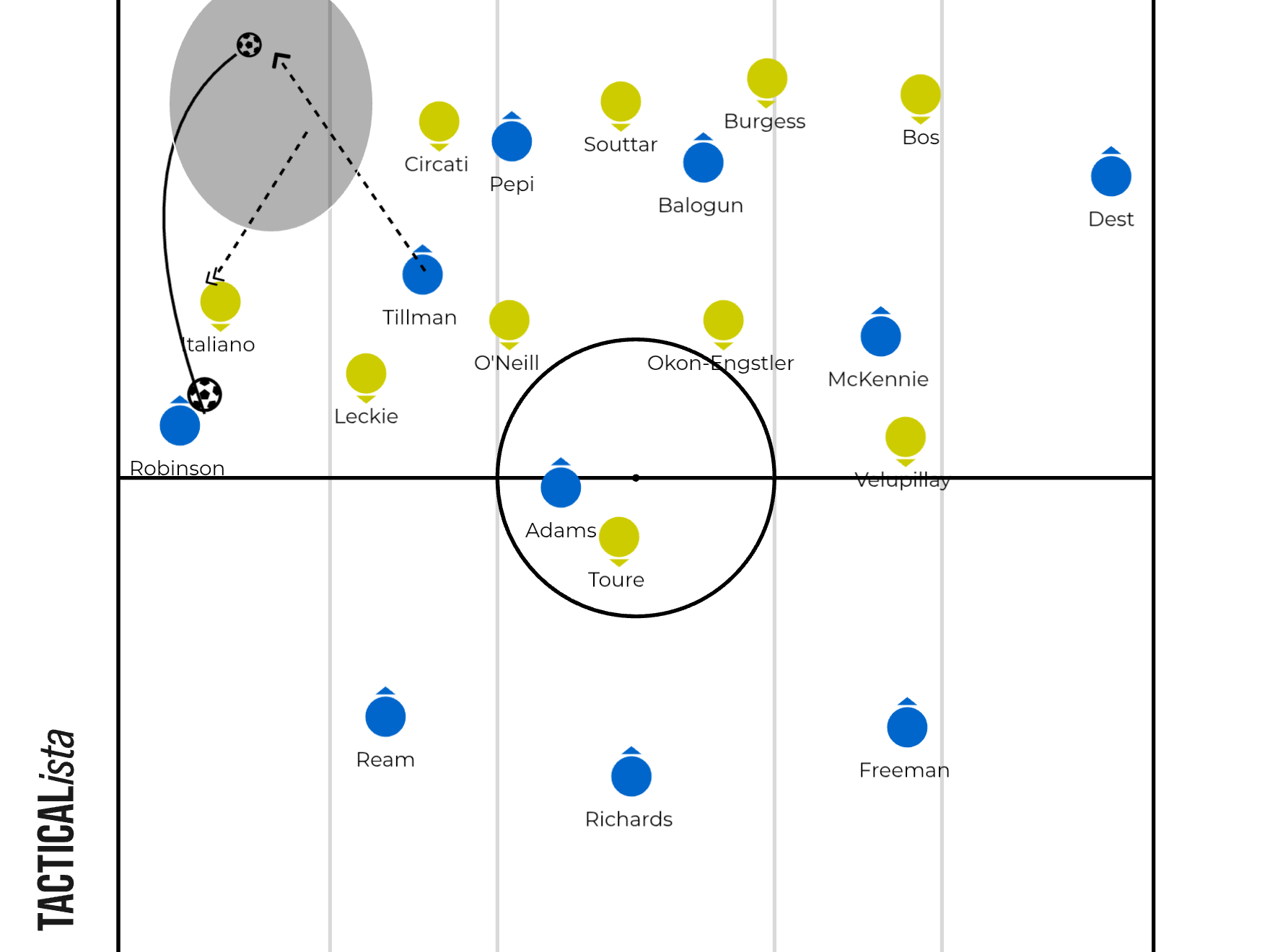
USA’s left-side combination sequence between Robinson and Tillman manipulates Australia’s 5-4-1 mid-block.
Freeman heads home the second
While the left flank pinned and penetrated, the USA’s right side established absolute dominance in the middle and final thirds through elite technical chemistry. Sergiño Dest and Weston McKennie operated on a highly synchronized wavelength, constantly rotating positions and exchanging sharp overlapping and underlapping runs to dismantle Australia’s defensive shape.
Stationed right behind them, Alex Freeman acted as the ultimate safety valve, staying close to the pairing to serve as a reliable recycle option whenever the immediate attacking spaces were closed down. Once possession was safely recycled through Freeman, Chris Richards stood ready at the heart of the back three to swiftly switch play to the opposite flank.
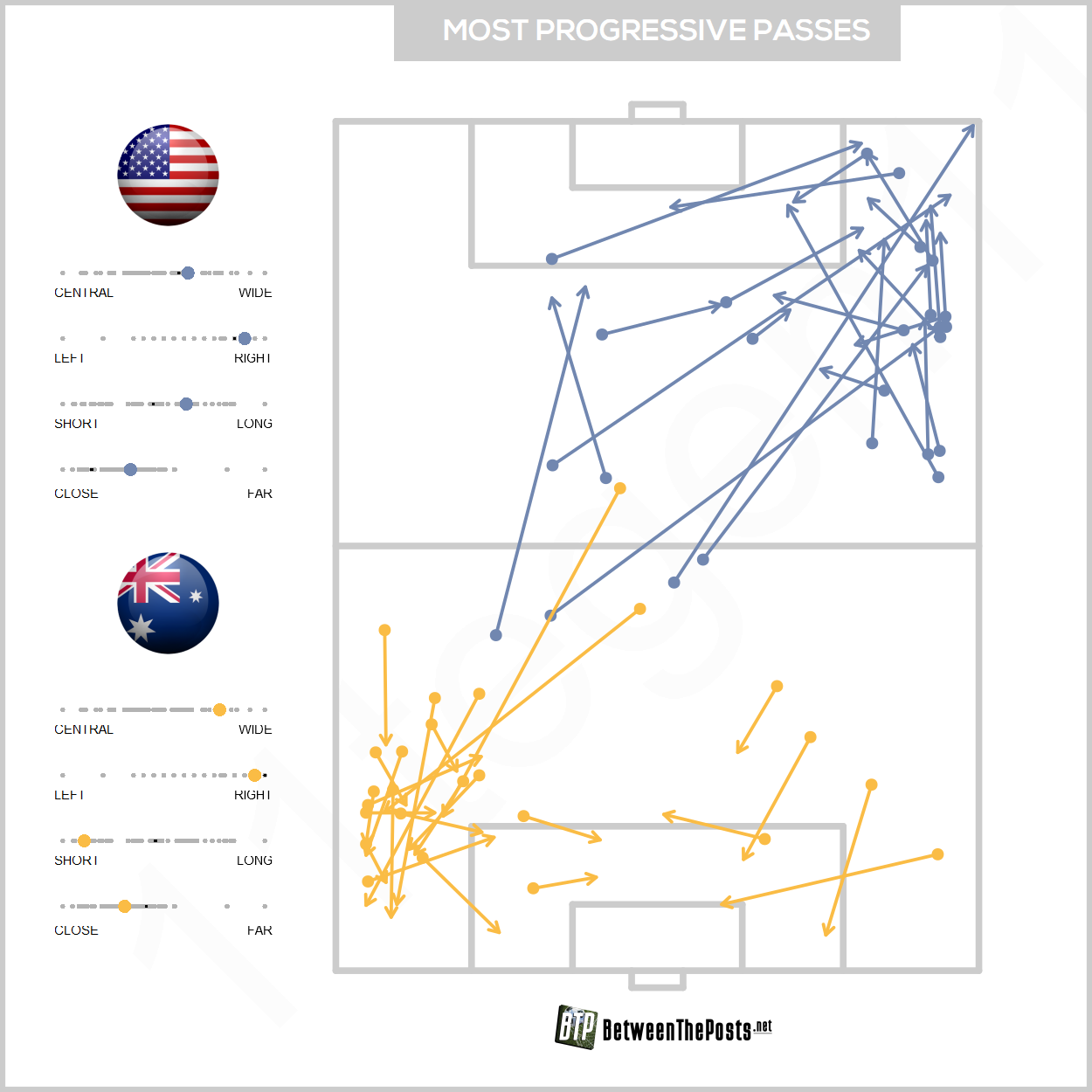
This constant horizontal shifting kept Australia’s 5-4-1 structure completely stretched and running under immense physical duress. Tillman also drifted across to the right side as part of his free-roaming overloading duties, making his movements nearly impossible for Okon-Engstler and O’Neill to track.
The relentless territorial pressure culminated in a second goal right before the interval. In the 43rd minute, Dest and Tillman combined magnificently on the right wing. Although they momentarily overplayed the sequence, allowing Burgess to step in and win the ball back, his aggressive intervention forced a foul near the byline.
The resulting free-kick was smartly worked, as the ball was rolled backward to Dest waiting at the top of the box. Dest unleashed a powerful strike that took a heavy deflection, looping high into the penalty area. Alex Freeman who was played perfectly onside by a retreating Jacob Italiano read the flight beautifully, out-jumping the goalkeeper Patrick Beach to nod the ball home. While initially ruled out by the assistant referee’s flag, a swift VAR review overturned the decision, confirming the historic goal.
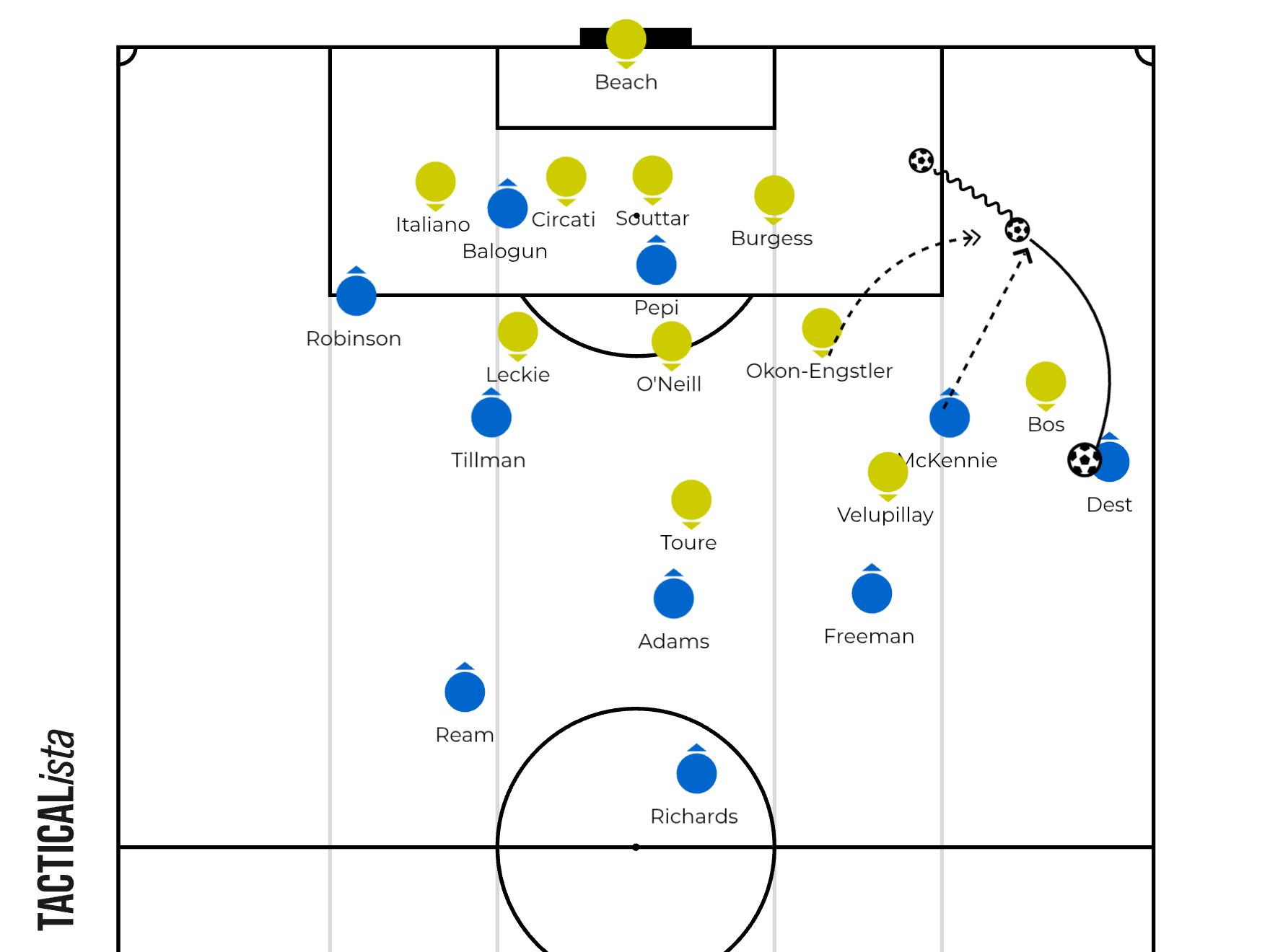
Minute 30′: The right-side combination between Dest and McKennie caused loads of troubles.
Australia’s substitutes test the hosts
Faced with a two-goal deficit and potential group elimination, Tony Popovic threw caution to the wind in the second half. Popovic introduced the explosive Connor Metcalfe and Nestory Irankunda, shifting the team’s approach from passive absorption to a high-intensity press designed to disrupt Freese’s short distribution and catch the USA in wide transition phases.
To facilitate this tactical alteration, in possession, Australia transformed into an expansive 3-2-5 in-possession structure that only came to life a few times in the first half. In this attacking shape, the wingbacks pushed into advanced winger roles while the wide midfielders tucked inside to join Irankunda in a high-intensity five-man frontline.
Minute 56′: Australia’s aggressive counterpress to put pressure on the USA backline and force them into errors.
The introduction of Cristian Volpato in the 61st minute added further tactical complications for Pochettino’s backline. Operating with immense flair and directness, Volpato became a massive headache in the halfspaces, completing a match-high 5 successful dribbles despite his limited minutes on the pitch. Led by the dynamism of Metcalfe and Irankunda, Australia’s slick passing combinations began carving routes through the central channels, testing the USA’s defensive resilience during sustained pressure.
However, this intense Australian pressure and individual threat ultimately proved insufficient to break down a deeply disciplined American unit. Recognizing his side’s mounting structural fatigue under the physical assault, Pochettino reacted with calculated, defensive-minded substitutions to fortify the lead. Sebastian Berhalter was brought on to inject fresh energy into the engine room, followed closely by Auston Trusty and Joe Scally to reinforce the flanks and drop the team into a secure low block.
This elite game management neutralized Volpato’s dangerous movements and blunted the aerial threat of Souttar late on, allowing the co-hosts to successfully preserve their clean sheet and see out the game with immense maturity.
Takeaways
The USA displayed immense maturity and depth, proving they can engineer high-level progression and breaking structures even without the presence of talisman Christian Pulisic. Their territory-pinning 3-1-6 shape and elite counter-pressing proved insurmountable for Australia’s initial game plan.
While the second-half display highlighted minor vulnerabilities against a 3-2-5 attacking shape, an aggressive counterpress and high-quality dribblers like Volpato, Pochettino’s defensive reinforcements successfully blunted the Socceroos’ momentum.
With six points secured, the USA have confidently booked their ticket to the Round of 32 and can rotate heavily in their final Group D showdown against Turkey in Los Angeles, while Australia face a must-win battle against Paraguay to keep their World Cup dream alive.



Comments