
Belgium – Iran: A Blockade And Passing Problems Places Belgium On The Timer (0-0)
Belgium is on the verge of exiting the World Cup early after the same issues appeared. On this occasion, Iran defended deeper with excellent organization, whilst Belgium flies the flag for one of the biggest teams struggling in this tournament.
Tactical analysis and match report by Joel Parker.
We decided to make this article free to read. If you want to support our work, consider taking a subscription.
After two draws in the opening games, Group G was neatly poised for a competitive and cagey conclusion, with not much between the teams.
Belgium struggled in the first half against Egypt: a block that did not disrupt circulation and a narrow, bunched attack with no synergy in buildup. The team improved as the attack grew wider, yet they went into this game without their spark in attack. Jérémy Doku was out with a virus; time for the old guard, or attackers of the next cycle, to step up under Rudi Garcia’s stewardship.
The story of Iran’s World Cup is centered off the pitch and the obscene conditions placed upon them from one of the co-hosts. These effects on-field preparations, FIFA is incapable of resolving travel issues, and Iran must travel from Tijuana for each game. Two comebacks against New Zealand have bolstered their chances of qualifying for the knockouts, but they possess less star power than the rest of the group.
With Doku out, Alexis Saelemaekers started for his first minutes in the World Cup. Romelu Lukaku also came in for Charles De Ketelaere and Amadou Onana was benched for Nicolas Raskin. The final swap was at left fullback, Maxim De Cuyper in for Timothy Castagne.
Amir Ghalenoei switched from a 4-4-2 to a 5-4-1 formation. This saw Shahriar Moghanlou move out of the striker position: Saleh Hardani, Hossein Kanaani and Ehsan Hajsafi moved into the defensive line. Ramin Rezaeian, who scored and assisted in the first game against New Zealand, moved from fullback to the right wing.
An Iranian blockade
Iran still had brief phases on the ball, in a structure that valued security over progression. Alireza Beinranvand, who has achieved two Guinness World Records for both the longest throw and drop kick of a football, was more than capable of getting the ball past the halfway line from his distribution. When the ball was in the air, Iran could match the Belgians and Garcia’s team was not always well-prepared when dealing with these exchanges; cheap fouls were being conceded.
From the corner’s second phase, Hossein Kanaani forced a good low save out of Thibaut Courtois and Saied Ezatolahi had a clean header at the back post on the subsequent corner, only to divert it wide. Iran thought they had the lead when they replicated the Dutch’s amazing short free-kick routine, to get an equalizer against Argentina in Qatar. However, Mehdi Taremi had moved a fraction too early and the goal was soon ruled out.
With 81% of the ball possession, the game was firmly fixed with Belgium attempting to break down the Iran defense. Iran bounced from a 5-4-1 medium block into a 6-3-1 low block, Rezaeian dropped into the defensive line and the jumps produced from the Iranian team were constantly outward to keep Belgium away from central progression. Despite both Nathan Ngoy and Brandon Mechele being comfortable in stepping outward, there were not enough risks from the base of the Belgium buildup, with players constantly dropping outside of the block to interact with possession and zero tensions being placed on the Iranian defensive block.
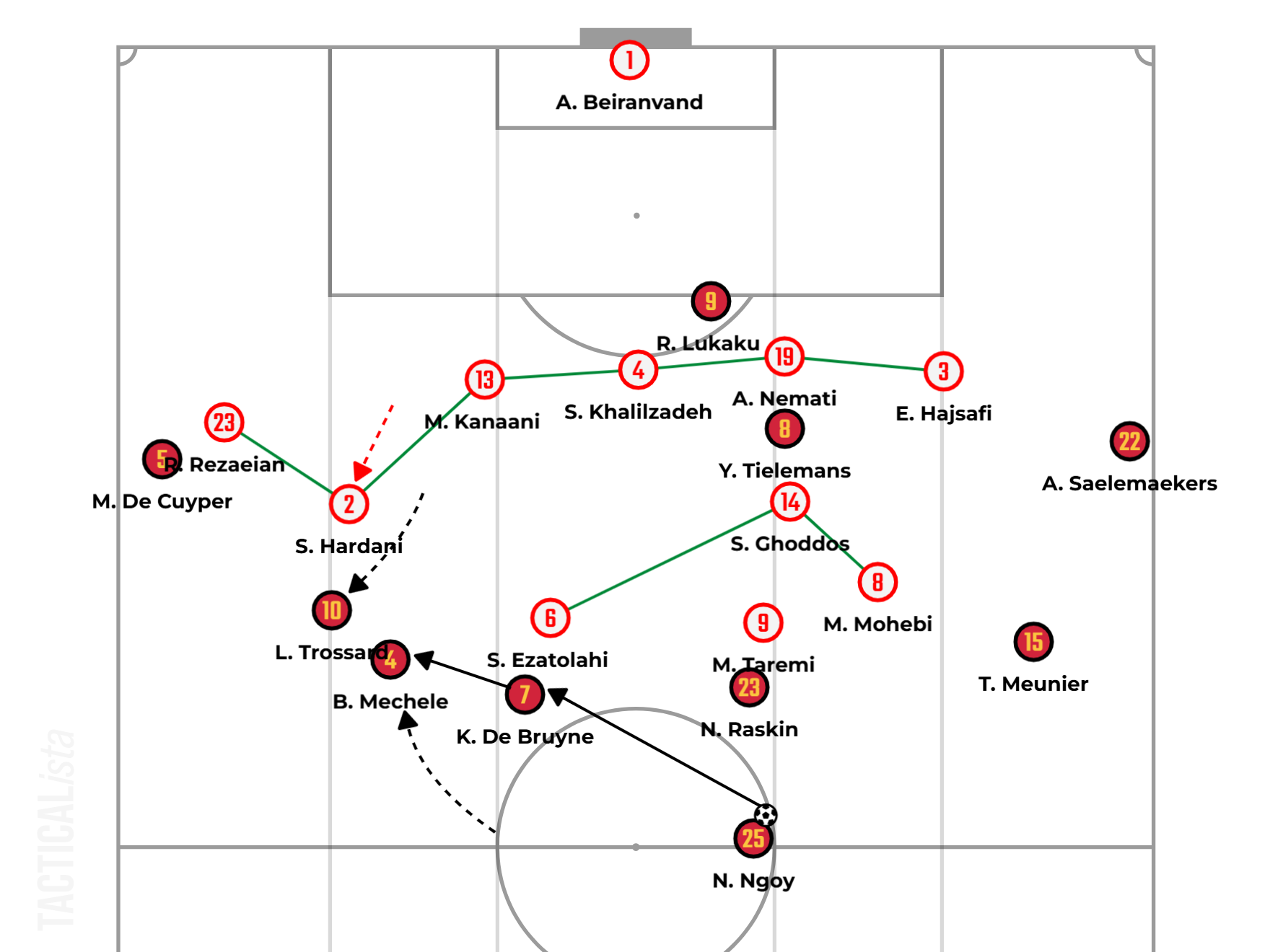
16th minute: Belgium’s buildup versus Iran’s 6-3-1 low block. Kevin de Bruyne had dropped into the pivot position and Mechele pushed forward to provide the quick lateral option. In the process, Leandro Trossard had dropped out and both players met De Bruyne’s pass at the same time. Hardani had jumped, but did not overcommit and the Iranian defense remained intact.
On the left side, Maxim De Cuyper moved into the left halfspace, which kept Trossard isolated with Rezaeian. His dribbles provided the best access around the block and Belgium attacks hit the same notes repeatedly. Runs were made from Trossard and pockets would open for De Bruyne to have high access, but the chance creation would only come from low crosses into a crowded box or cutbacks, with a full Iranian team behind the ball. All of Belgium’s shots would cluster to the left side of the box, five shots from De Cuyper and De Bruyne, but just one for Romelu Lukaku throughout his time on the pitch.
Nevertheless, Belgium’s issues in possession extended beyond what the Iranian block was doing. The structure centered around Alexis Saelemaekers and Trossard cutting in on their stronger feet, whilst De Bruyne and Youri Tielemans floated into the spaces around the final third, with few interactions between each other and Iran’s midfield three had quite a comfortable job in keeping their positions close towards the defensive line. From the base, Raskin offered little progression, and the frequent carries from the center-backs did nothing to attract the Iran block out. Much like the first half against Egypt, no synergy or countermovements that could offer a real threat.
Once again, Belgium started to lose their width, which was detrimental to the quality of the buildup. The Belgian players rotated their positions without any conviction into pulling the space apart, so it was easy for Iran to switch occupiers. Not maintaining width, especially on the right side of the field, meant that the switch was not available, whilst Thomas Meunier was not always in a position for passes to zip across the first line. As a result, the tempo was slow and Ehsan Hajsafi could jump onto the right fullback, without the fear of Saelemakers being free behind him, as the defensive block had time to shift over from one flank to the other.
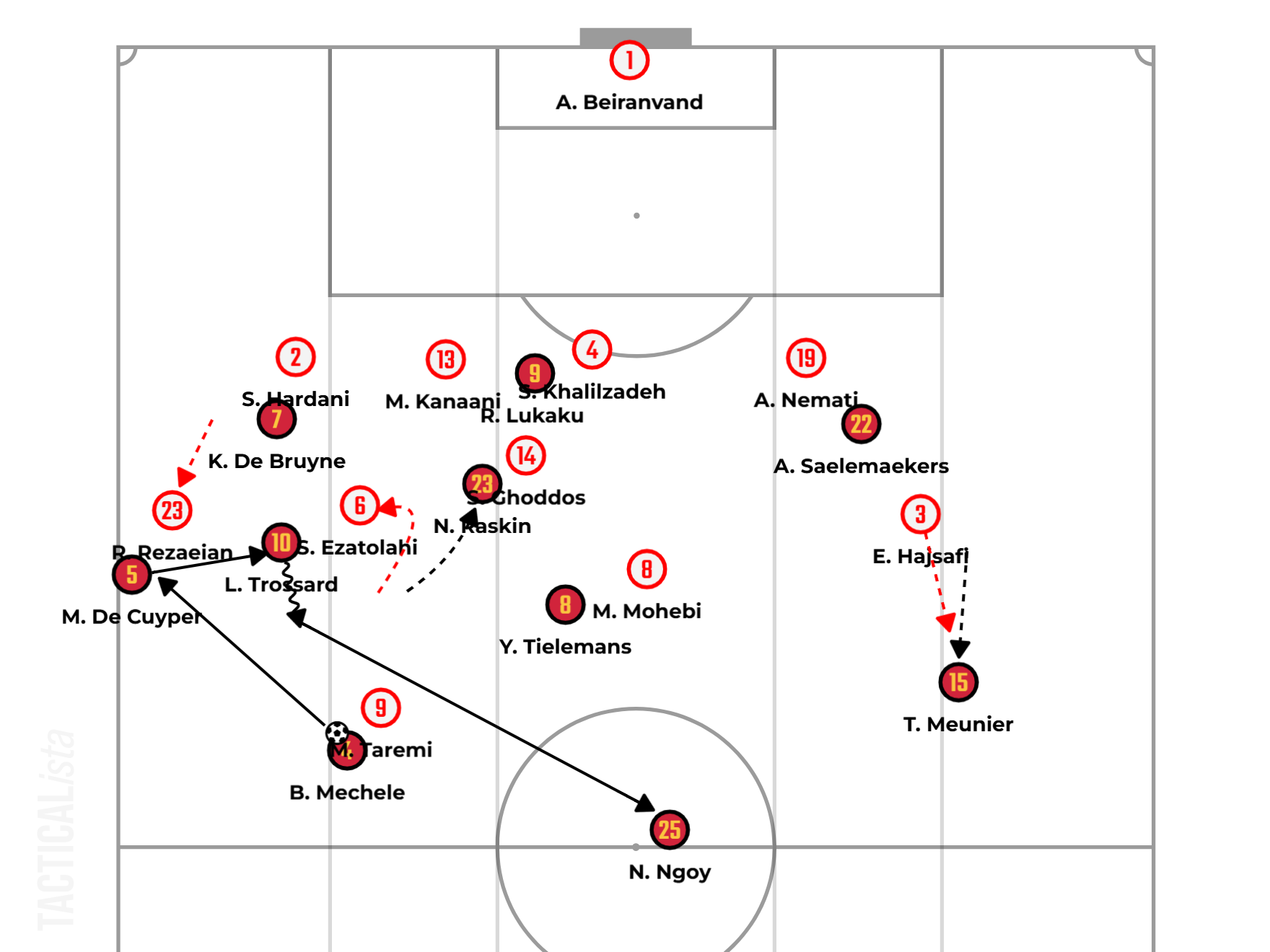
34th minute: Positional rotation from Belgium on the left, but slow circulation was still in place outside of the Iranian defensive block. Iran could switch their occupiers, Ezatolahi followed Raskin’s run, but had the time to move onto Trossard as Saman Ghoddos picked up Raskin as Tielemans dropped. Trossard carried and passed to Ngoy, but Meunier was in no place to offer the short pass for Ngoy or to place more tension further up the field. As he dropped, Hajsafi followed and the passes remained on the outside of the block.
Issues continue, red card relieves pressure
And much like the game against Egypt, Belgium came out for the second period holding more width, but with no more conviction in the process. Trossard and Saelemaekers were the players holding this width, only slaloming inside when the fullbacks were inside and ahead of the ball. In this process, Belgium started to appear in variations of a 2-3-5/3-2-5 structure, with plenty of the in-possession problems still intact.
Iran nearly broke the deadlock again at the start of the half. A throw-in was won from Beiranvand’s big boot and the subsequent headed exchanges that followed. Substitute Alireza Jahanbakhsh, who had replaced Hardani and offered more of an offensive outlet down the right, next to Rezaeian, launched the ball into the box, and Taremi’s shot forced great reactions out of Courtois.
On the left side of the Belgium attack, Jahanbakhsh was still tasked with dropping into the defensive line depending on the situation. As a result, the discipline in tracking De Cuyper on the inside was lost, but Belgium started to threaten more when a third man run was added to this channel, and Trossard went more direct from the outside channel to the left halfspace. Fifty-four minutes in, he found Lukaku in the box, only to lose control after initial control. Fifty-eight minutes in, and Belgium produced their best chance of the game.
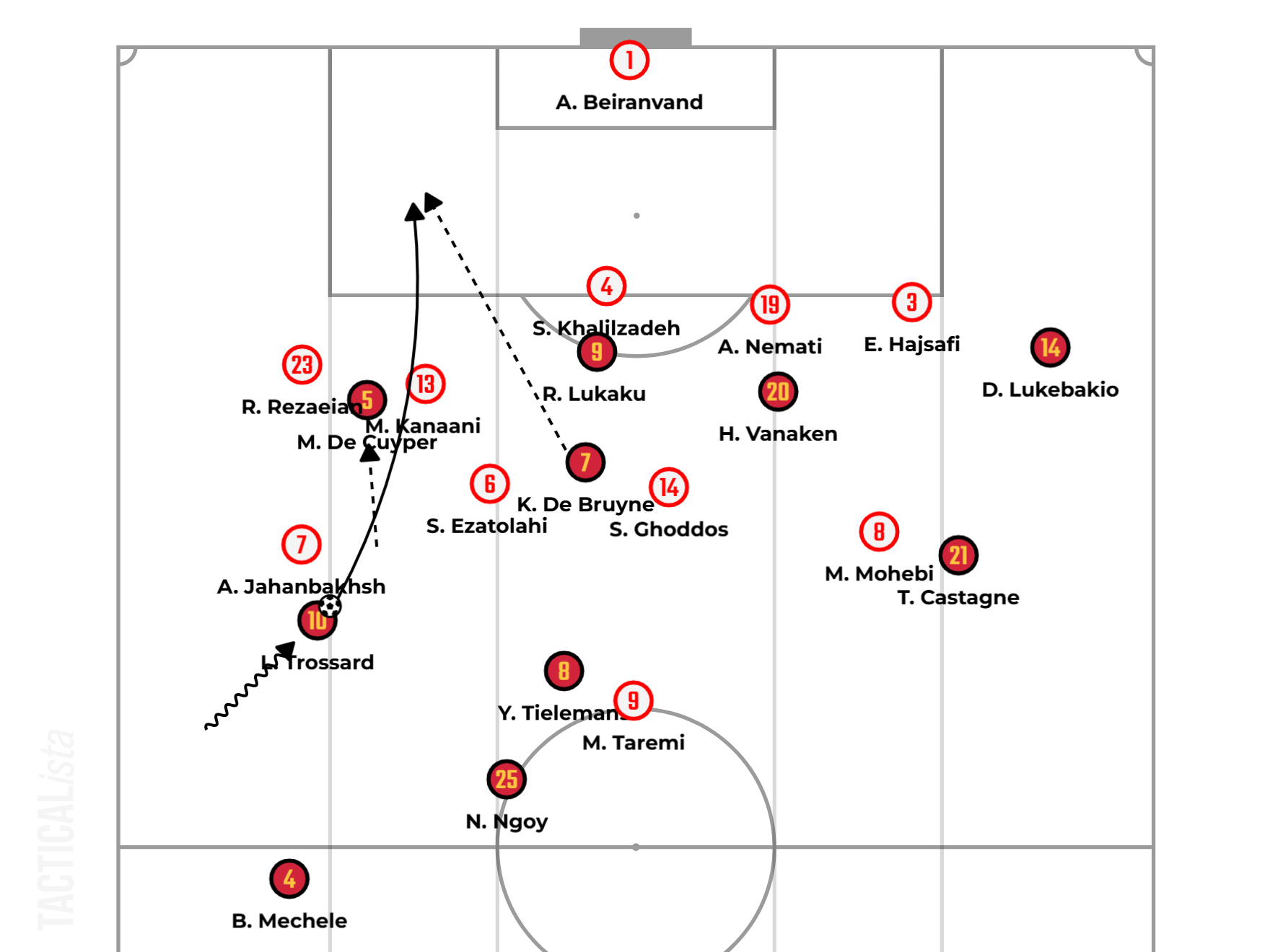
58th minute: Buildup to Belgium’s best chance. In this phase, Iran was still in their 5-4-1 formation and De Cuyper pinned both Rezaeian and Kanaani. De Bruyne made the third man run and controlled the high ball from Trossard. His low ball across the goal could not find Lukaku, but the pass bounced off Ali Nemati and landed to De Cuyper, only to be denied by Beiranvand with an excellent save. The ball bounced off Nemati again, and Beiranvand gathered the loose ball.
Despite some crosses teasing around Lukaku, the Belgium attack was still very limited in what they could produce. The quality of shots did not improve outside of a fortunate De Cuyper opportunity, although the tempo did improve and interactions around the midfield were better with Hans Vanaken added to the mix. However, Iran was relieving more pressure with more connections up the field and had fewer situations where they dropped into the 6-3-1 defensive block.
Approaching the final twenty-five minutes, Meunier put Ngoy under a lot of pressure with a back pass, as Iran started to jump out from their block. A pass with no power, aimed back towards Courtois from the middle third, would have seen Taremi charge through on goal. Ngoy fouled him as the last man and Belgium went down to ten men. In the process, Iran started to get a lot more of the ball.
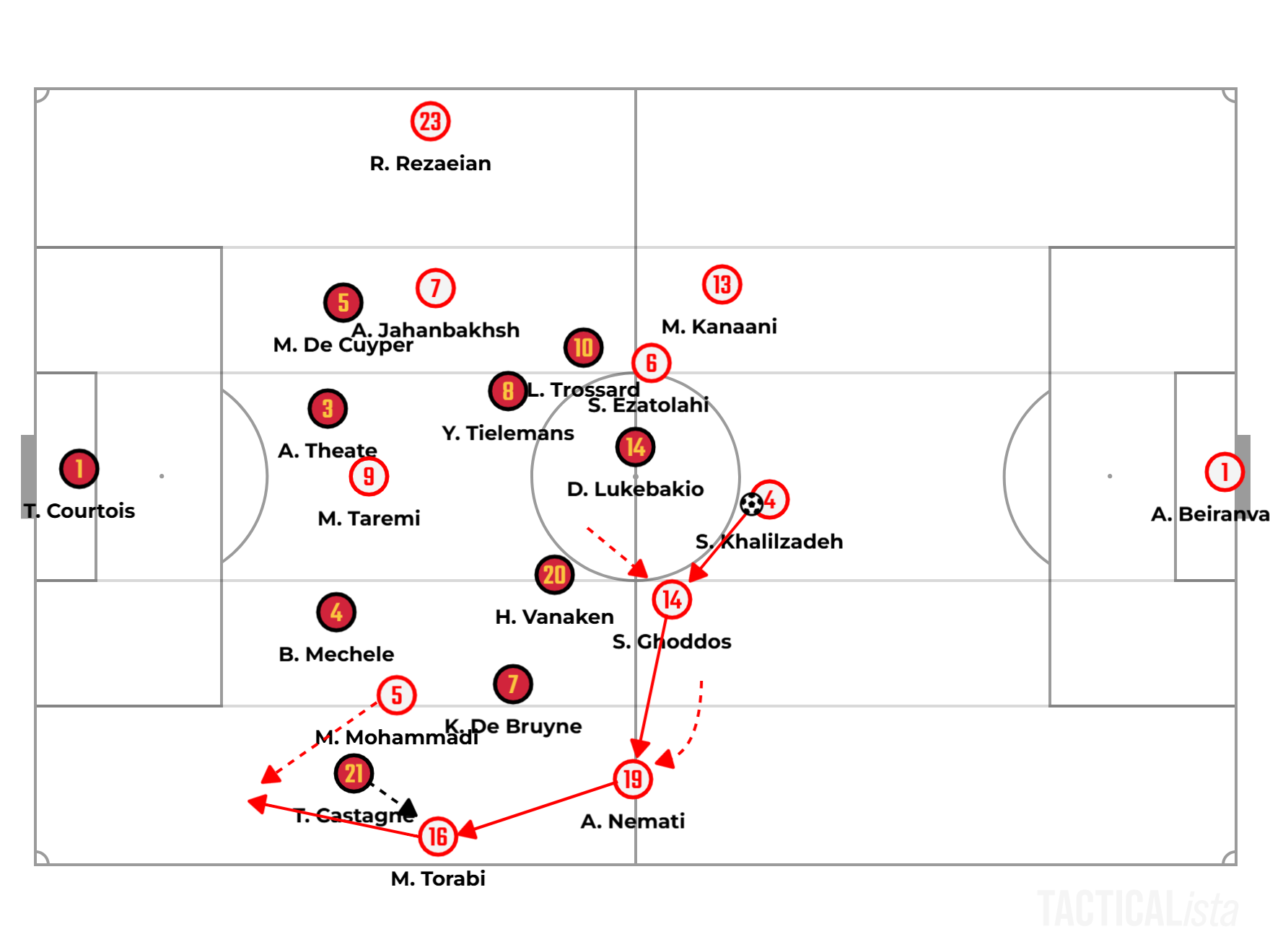
75th minute: Cautious movements from Iran’s 3-4-3 buildup against Belgium’s 4-4-1 formation. Ghoddos dropped between the center-backs, to move the ball out wide. Mahdi Torabi showed for the ball, whilst Milad Mohammadi made the halfspace run, after switching positions with Torabi on the left side.
Ghalenoei made two changes to the left side of the attack, with Mohammadi at left wing-back and Mohebi replaced by Torabi. After Tielemans plugged the gap in the defense for a few phases, Lukaku would be sacrificed for Arthur Theate and Belgium remained in the 4-4-1 medium block. Despite the introduction of new attackers, Iran’s 3-4-3 formation stayed very cautious in its off-ball movements, when they had possession.
Both center-midfielders kept close to the three center-backs, whilst positional rotations were made between the wing-back and winger. With the new additions on the left, all their phases would be produced down this channel and Iran could not produce the quality of opportunities that they had made earlier on in the game. Towards the final minutes, it was Belgium that nearly produced the dagger. Dodi Lukebakio cut in on his left foot, and his bending shot from range nearly dropped in at the far post.
Takeaways
After a dismal start, Belgium’s World Cup gets even worse. Without Doku, they were unimaginative, and all the same issues were not ironed out by Rudi Garcia. Despite reaching the World Cup in decent form, the option to hire a coach like Rudi Garcia, whose expertise lies in passive blocks and not buildup arrangements, is a curious one, but not an uncommon one when you look at Belgium’s previous employees to manage some of their best-ever players. They need a big performance against New Zealand to save their campaign.
Iran will go into the game against Egypt on the same points as Belgium, and with a very good opportunity of making the knockout phase. It is a remarkable achievement, considering this team is placed under a massive disadvantage. A well-organized performance that could have been so much more if a couple of Taremi’s attempts had landed in the right direction.
Match plots will be added as soon as possible.

Comments