

England – Ghana: Queiroz’s Low Block Frustrates England (0-0)
England faced a well-organized 4-5-1 low block here, a trademark of Ghana coach Carlos Queiroz. The focus on wide triangles in England’s 4-3-3 system did not quite provide the creativity needed to break down the Ghanaian backline. Second half substitutes led to improvements for Thomas Tuchel’s side, but in the end they could not find the decisive goal.
Tactical analysis and match report by Josh Manley.
We decided to make this article free to read. If you want to support our work, consider taking a subscription.
England were relatively impressive in their first-round win over Croatia, especially in the second half where they looked dangerous in attack. Ghana meanwhile had been able to secure three points with a 1-0 victory against Panama.
Lining his side up in their 4-3-3 shape, Thomas Tuchel made two changes to the starting eleven from the Croatia game as Djed Spence and Marc Guéhi came into the backline in place of Nico O’Reilly and John Stones. Ezri Konsa and Reece James completed the backline, while Elliot Anderson, Declan Rice, and Jude Bellingham formed the midfield trio. Noni Madueke, Harry Kane, and Anthony Gordon were the frontline.
Ghana, under the leadership of the experienced Carlos Queiroz, also lined up nominally in a 4-3-3 formation. The backline was formed by Marvin Senaya, Jonas Adjetey, Jerome Opoku, and Gideon Mensah while Thomas Partey was the deepest midfielder. Ahead of him were Caleb Yirenkyi and Kwasi Sibo behind a front three of Iñaki Williams, Jordan Ayew, and Antoine Semenyo.
Attack versus defense
The strategic pattern of this game remained the same throughout. It was essentially a duel of the Ghanaian low block against England’s organized attack as they sought to solve the problems posed by Queiroz’s well-drilled defense.
Much of England’s success in the Croatia game was in moments where they were able to attack depth. Croatia defended much more aggressively than Ghana did, and therefore their shape was more stretched and there were spaces to attack into.
With the deep 4-5-1 shape of Ghana, there was little space to play in behind. Ghana left England’s center-backs relatively unpressured apart from a few moments where the front three would try to jump. Anderson usually stayed close or dropped between them, and if he pushed forward into the second line, Ayew would usually screen passes into him.
Ghana’s setup was a zonal one with a flat midfield five, although Partey was sometimes slightly deeper, making it resemble a 4-1-4-1 shape. England’s main approach was to try to move the ball from side to side to force the Ghana block to shift, and to try and create synergies between the fullback-central midfielder-winger triangles on each side of the pitch.
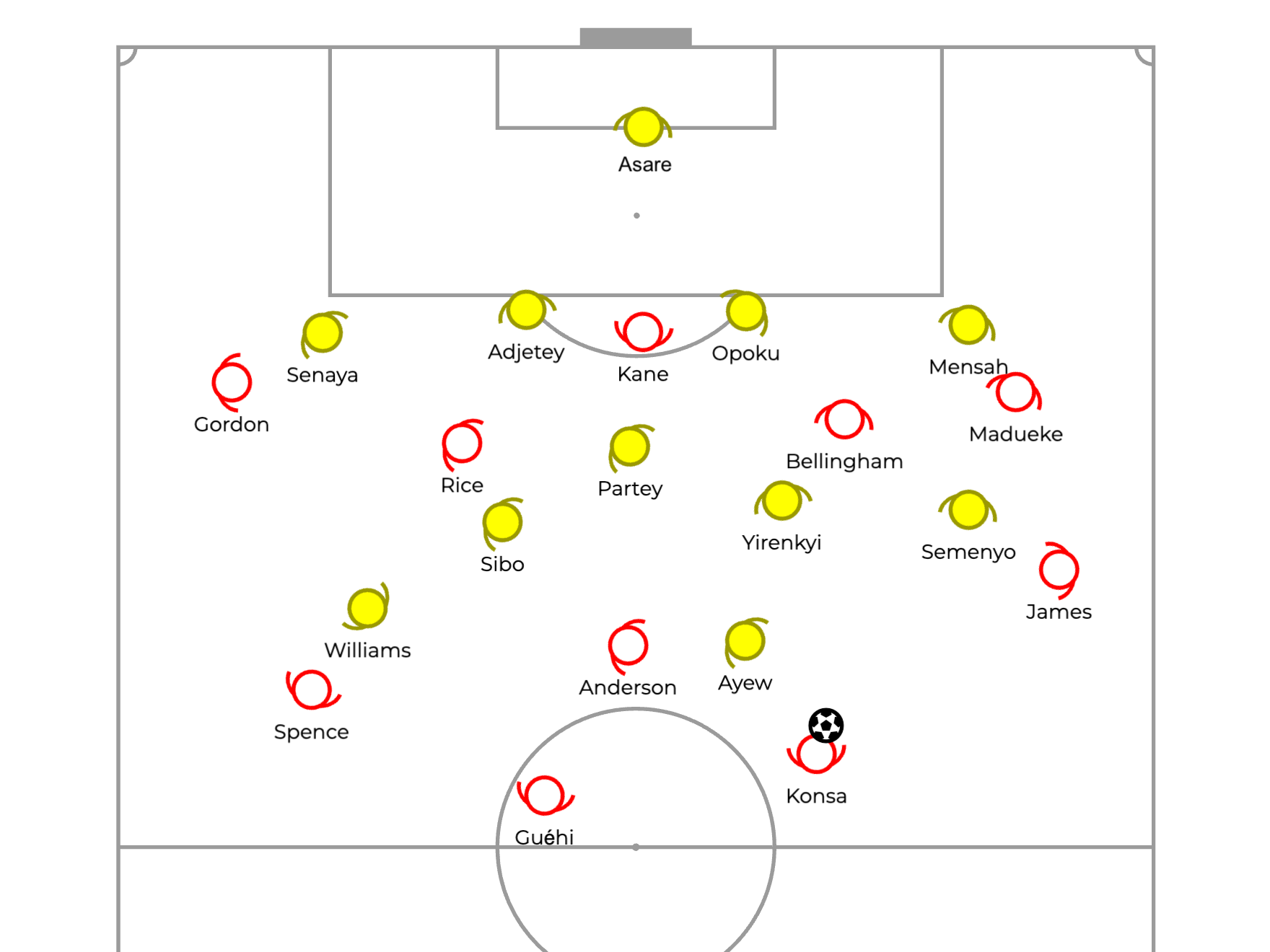
The initial shapes in England’s attacking phase.
Whereas Rice had started deeper in the Croatia game, he tended to be higher here, only dropping close to Anderson on rare occasions. Spence was usually the deepest member of the triangle, while Gordon tried to offer width and depth.
On the right side, the base of the triangle was usually higher than on the left. James was often the lowest player of the three, but still usually higher than Spence on the left. He would also push into high and wide positions when Madueke indented, while Bellingham had the role of occupying the right halfspace as well as attacking the box for crosses.
It was Bellingham who offered some of England’s more promising moments in terms of penetrating the Ghanaian block through his positioning off-the-ball. He picked up some excellent positions in the right halfspace pocket between Ghana’s midfield and defensive lines, able to receive line breaking passes as a result, although the follow-up actions never quite succeeded.
England’s main other plan was to try and get around the outside of Ghana’s defensive block. This would be achieved through underlaps once the ball had been moved wide, which could then lead to crosses with Bellingham, Rice, and Kane providing presence in the box. The wingers could also go one-versus-one in such situations.
Late flourish, no goal
The early stages of the second half saw a few forays from Ghana out of their low block thanks to their fast wingers, but the overall trend of the game continued to be one of attack versus defense. England continued to struggle to break down the defense, and the left-sided dynamic between Spence and Gordon came under scrutiny as it was clearly not working as intended.
After the hour mark, Tuchel changed things down this side. O’Reilly and Bukayo Saka replaced Spence and Gordon, with Madueke moving to the left wing for Saka to play on the right.
The original inclusion of Spence over O’Reilly seemed questionable in the first place in a game where England were almost certain to face a low block. O’Reilly has already shown his usefulness against low blocks for City this season, including his ability to arrive into the box. This later led to England’s best chance of the game, where O’Reilly’s header hit the bar and Kane skied the rebound.
Spence meanwhile had struggled to integrate himself well into this setup, and his presence had also meant that England had no natural left footer on this side of the pitch.
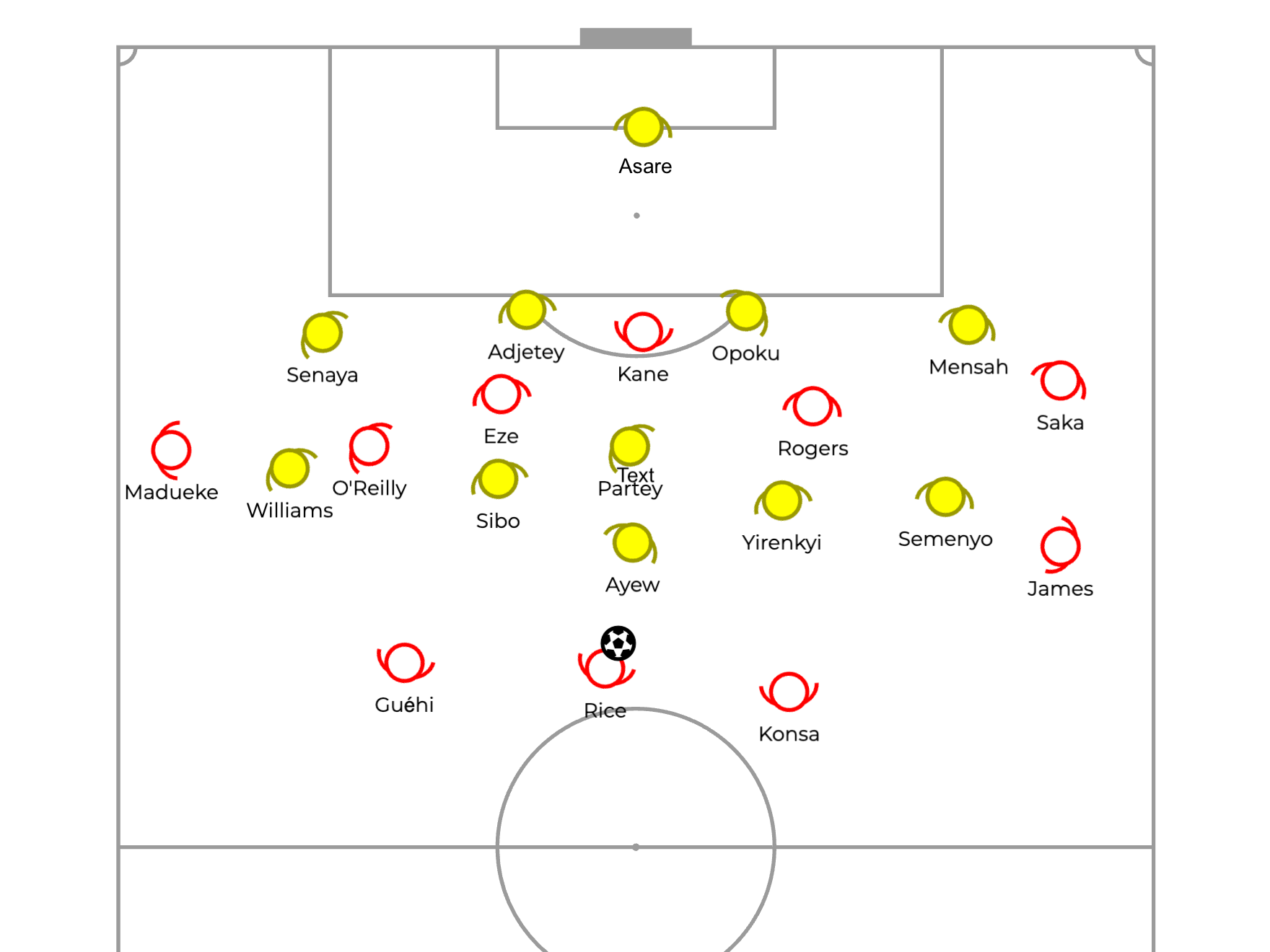
England after second-half changes.
O’Reilly’s introduction added extra dynamism to the left side with better underlapping runs. He played higher than Spence had, leaving the rest-defense to Anderson and the center-backs.
Madueke also provided more threat, able to go on the outside of the defender onto his left foot. With this improved dynamic plus Saka (another player with proven ability against low blocks) on the right, England started to improve slightly.
More changes followed, with Eberechi Eze and Morgan Rogers replacing Anderson and Bellingham. Anderson had struggled slightly with the lack of space against the low block. Rice now played in the deeper midfield role, with Rogers and Eze ahead of him, looking to add extra creativity.
Tuchel’s final roll of the dice was to replace Madueke with Marcus Rashford. The Mancunian winger’s right-footed presence from the left saw him looking for inswinging crosses as well as diagonals across to Saka, as England pressed for a goal.
However, the goal was not forthcoming. In the end, Ghana’s 4-5-1 low block continued to frustrate England, who were forced to leave Boston with just a point.
Takeaways
England will always be disappointed with anything other than a win in matches such as this, but they are not the first or last team to fall victim to a well-organized low block. This was already known as a potential weakness before the tournament. Although England’s system is excellently coherent, it can lack a little improvisation or creativity at times.
That aspect, as well as the focus on stability in possession, physical dominance, and set pieces, has drawn comparisons with Mikel Arteta’s Arsenal that are not far from the mark.
Ghana will be proud of their efforts here. They required a little luck with the Kane miss, but overall their low block was well executed, with a coach in Queiroz who is known for such exploits.
Match plots to be added shortly.


Comments