Spain – Belgium: Olmo In The Middle, Final Four Official (2-1)
The final ride for Belgium’s golden generation has been ridden. Spain marches on into the semi-finals. A late winner was required, but the story of the game was the effectiveness of the Spanish buildup, which dominated in the middle third but could not consistently find the formula in the final actions.
Tactical analysis and match report by Joel Parker.
We decided to make this article free to read. If you want to support our work, consider taking a subscription.
Spanish and Belgian football coincides by having its best eras in the modern age, yet this World Cup quarter-final pitted two teams not hitting their peaks. Nevertheless, these two have rarely made an acquaintance; the last meeting was a friendly ten years ago, competitively at Italia ‘90.
National teams yearn for the club-like fluency that Spain can engineer. The proof is in the pudding; the European champions are yet to concede in this tournament, with four wins on the bounce. Luis de la Fuente has relied on the same structure, capable of breaking lines and influenced by excellent countermovements/rotations to open space, but without the dual threat down the left channel, the Spanish can be prone to stale possession spells.
The Belgians were destined for an exit; Rudi Garcia took off his two best attackers whilst 2-0 down to Senegal, before on-field arguments clouded the final hydration break. Then they galvanised; an extra-time comeback was followed by dominating the United States, by far their best performance of the tournament after the political fiasco over Balogun’s suspended suspension. A fiery response for the Belgians, their tournament saved after a dismal group stage.
The one and only change from the win over Portugal was a significant one. Pedri was replaced by Fabián Ruiz, a return to the midfield base, alongside Rodri and Dani Olmo, that saw them through against France and England at EURO 2024.
Garcia also made significant changes. Two were enforced: in the warm-up, Youri Tielemans was lost due to injury, so Hans Vanaken was a last-minute solution. Amadou Onana suffered a crucial ligament injury that saw his tournament finished. Kevin de Bruyne, who did not feature against the USA, was back in the team. The other change came on the wing, as Dodi Lukebakio was replaced by Jérémy Doku.
The switch and evasion
Belgium started this game with more pressing intensity than what we have usually seen from them so far in this tournament. Pressing in the 4-4-2 formation, Vanaken and Raskin went man-to-man on Rodri and Ruiz, whilst Doku and Leandro Trossard (who had switched wings for this match, without the mix of positions that Garcia’s team partook in earlier matches) kept a deeper and zonal stance, so the distance increased on the Spanish fullbacks. Furthermore, Unai Simón could be utilized as a plus one and Spain could circulate around, whilst Belgium was quick to drop into the 4-4-2 medium block once the ball reached the middle third.
Despite some brave positions being taken on the jump, Spain could easily access the switch, as there were wide spaces between the lines of the Belgian defense. Spain progressed with different rotations but the same principle: direct pass made into the right halfspace and Marc Cucurella/Alex Baena attacked the space on the far side as Trossard/Timothy Castagne kept a narrow position. As Brandon Mechele jumped high towards Dani Olmo, this created more space for Mikel Oyarzabal to receive. Olmo could make the switch himself as he could constantly bypass on the half-turn, a position he has excelled in throughout his time in the Spanish national team. Yamal could make these switches too as Belgium’s vulnerabilities out-of-possession were on display.
From there, Baena constantly sought to cut back on his right foot or slow the game down. Such was the positional discipline of Ruiz and Rodri, the double pivot was quick to support the channel, whilst encouraging Vanaken to stay high, Trossard to move into a narrow position and Cucurella could become free on the third-man move. As phases continued, Olmo exposed a flaw in Belgium’s deeper block and that was both center-backs could be pinned by Oyarzabal, so Nicolas Raskin had to drop into the defensive line to defend the halfspace. With Vanaken high and Raskin deep, space opened for Olmo to drift from right to left and evade detection between the lines.
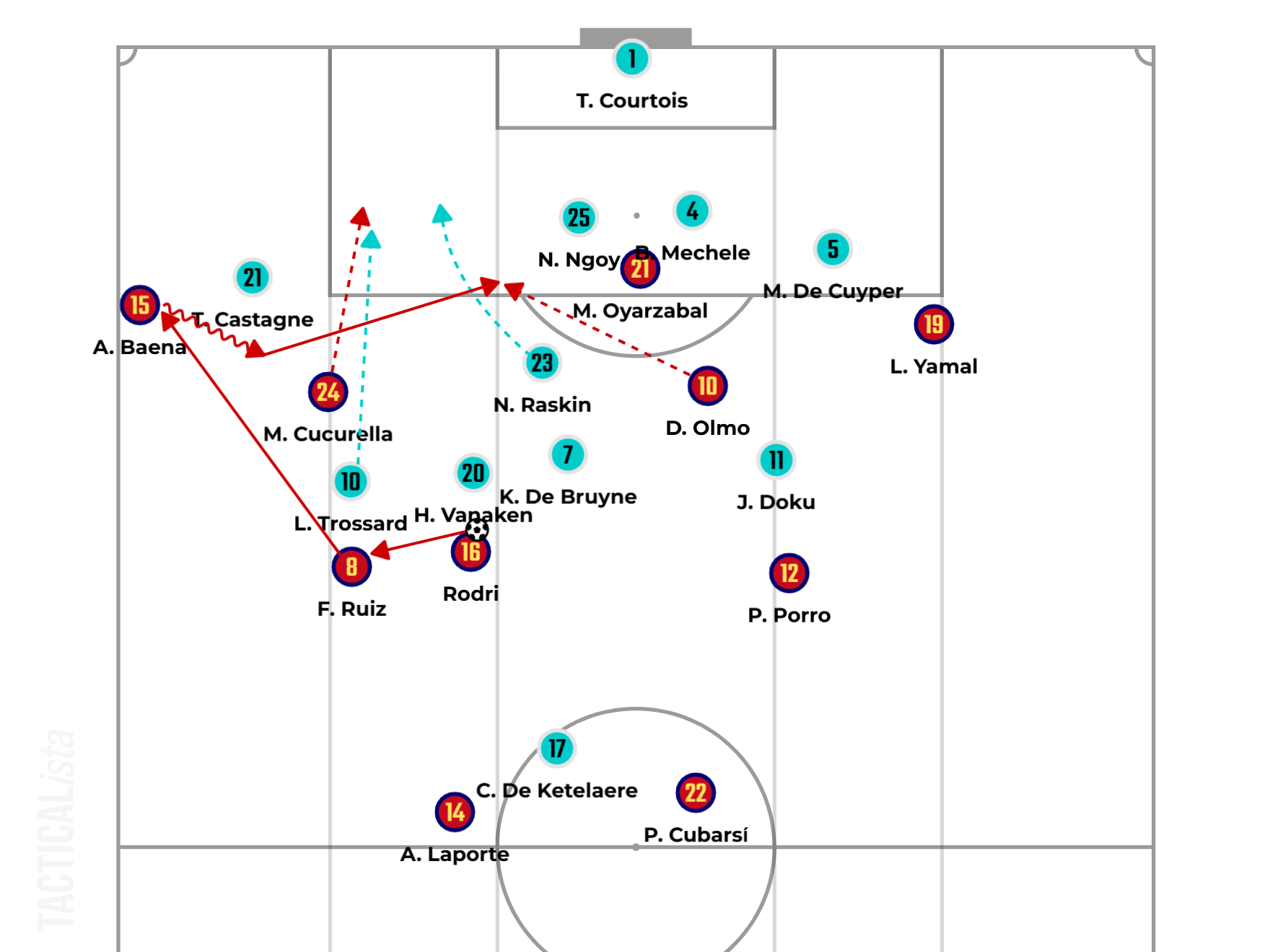
15th minute: Buildup down the left side for Spain. As Rodri passed back to Ruiz, Cucurella made his run into the left halfspace and dragged Trossard and Raskin towards his zone. Castagne showed Baena to his stronger right foot and Olmo evaded Belgian bodies in the center of the block. Baena’s pass found Olmo, but the Barça midfielder could not control to get a shot off.
It was easy for Spain to launch more vertical attacks. Rodri and Ruiz were flexible at the base of the buildup, which placed a tension on the Belgian block: left the double pivot to dictate freely or follow and risk space opening behind you. The result was the latter more than the former, whilst Pau Cubarsí and Aymeric Laporte were reliable in carrying outwards, to step away from the forwards’ pressing angle and play a pass into the channel or halfspace.
Why Ruiz over Pedri?
Pedri has had effective games in this tournament, where he would make these kinds of line-breaking passes and float around the midfield, providing the connective tissue to the Spanish structure. His exclusion was a surprise, but not a loss, as Ruiz is both reliable in the deeper parts of the buildup, whilst also being a flexible off-ball runner to support the left channel and crash the box.
As the sequences continued, Spain showed more rotations. Situationally, Olmo dropped to collect from Rodri/Cubarsí and Ruiz would push higher to encourage the same split to form between the Belgian center-midfielders. When Spain wanted more vertical attacks, Laporte, Cubarsí and Rodri were all effective in baiting jumps from Vanaken, whilst spaces appeared inside of the Belgian wingers. Ruiz could delay the response from Trossard and Baena drifted into a central spot to connect the dots.
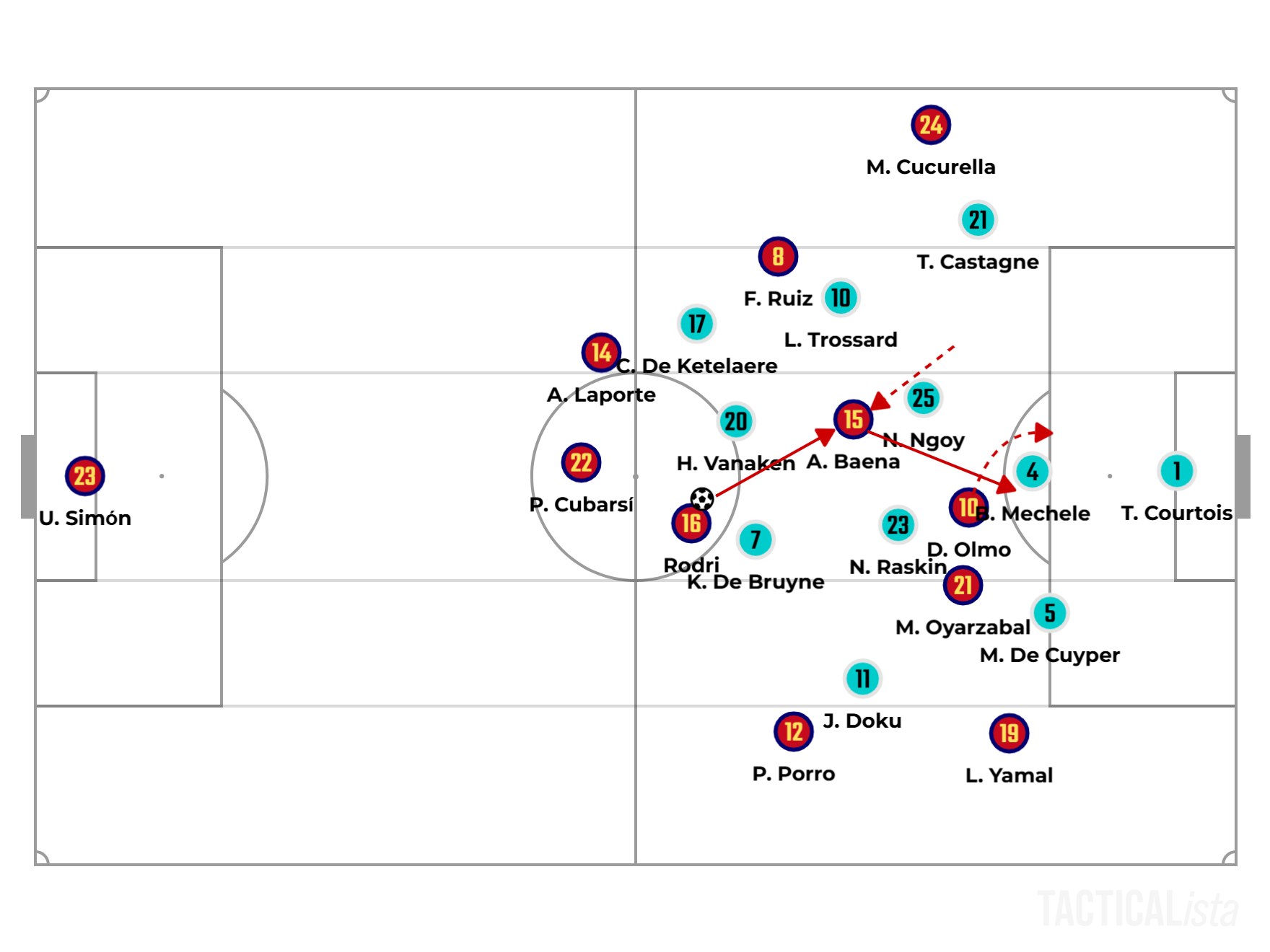
20th minute: Spain looking to attack the spaces between the defensive line. Ruiz’s wider position encouraged a delayed response from Trossard to the line-breaking pass; Rodri found Baena and Baena attempted the pass around the shoulder towards Olmo, who moved into the vacant space left by Ngoy and goal side of Mechele. This move nearly paid off; the pass just behind Olmo and Mechele awkwardly intercepted.
In terms of quality chances, Spain had not created a great deal by this point, despite the clear advantages established. However, the break in play did not sway any momentum and Spain could quickly force pressure against Belgium, who had become more passive as the game continued. The opening goal was a good representation of what had been working well for Spain up to this point: against a passive 4-4-2 shape, it does not take much to push your fullback into the attack. In this regard, Yamal and Pedro Porro complement one another, so Yamal slid the Tottenham fullback through behind Doku, with Maxim De Cuyper out of the equation. On the cutback, Olmo was free as Mechel dropped way too deep. Thibaut Courtois saved, only for Ruiz to be placed perfectly for the rebound and Spain took the lead, despite the shot deflecting off Castagne in the process.
After the goal, Spain appeared to have found their mojo, specifically Yamal, whose dribbles on the inside started to pay off. When possession circulated back, Rodri was at the center at building moves back up and the base constantly adapted so that the wider rotations were accessible. Ruiz was a part of these moves, as he could support Baena when he moved inside after passing, and Olmo continued to target the wide split between the Belgian midfielders.
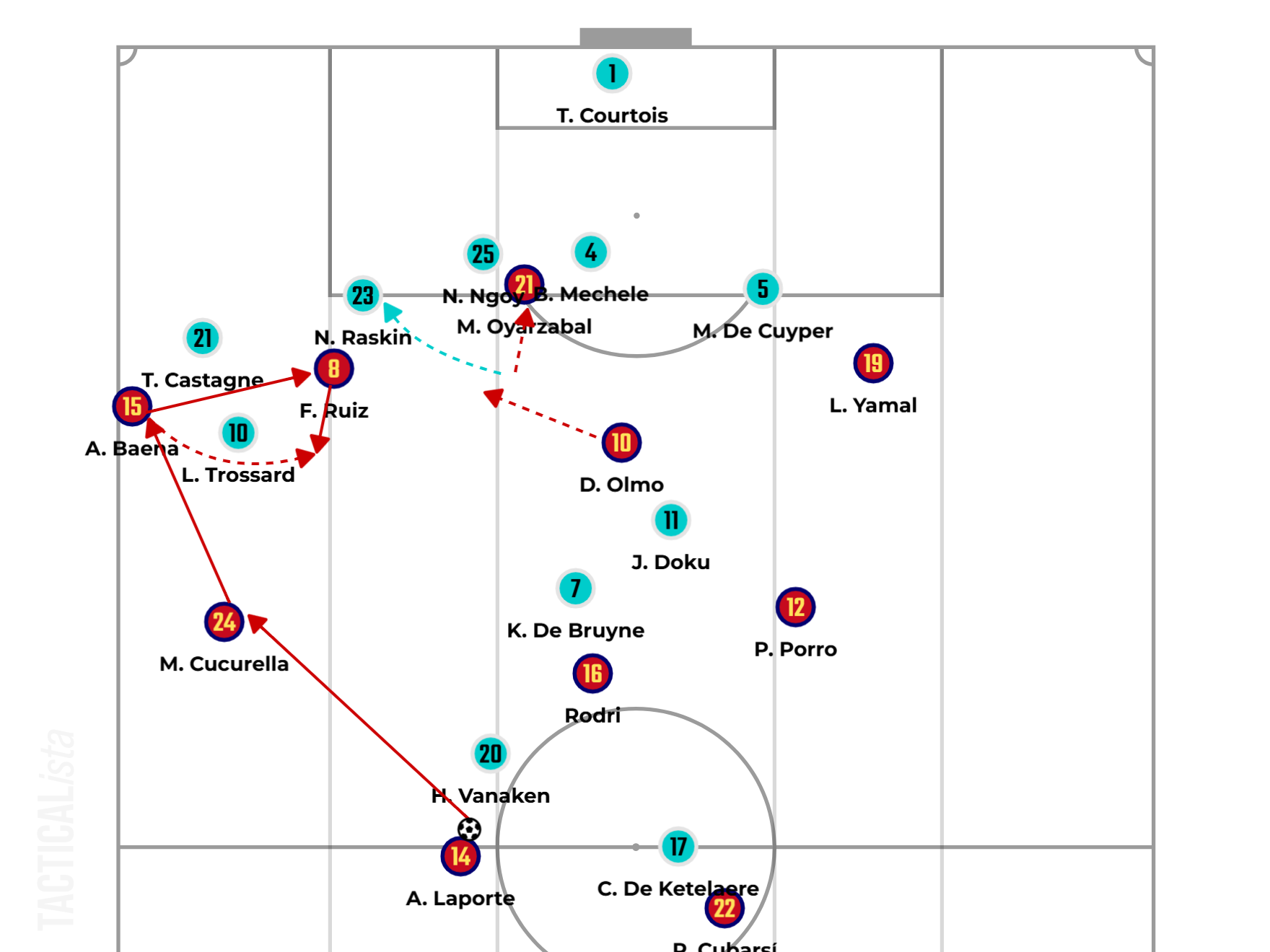
37th minute: An excellent combination nearly paid off for Spain. As the ball moved up the left chain, Ruiz made a diagonal run behind Trossard and Castagne. He received and backheeled to Baena, who moved on the inside. He fired a fast pass to Oyarzabal, who knocked it back to a completely free Olmo between the lines. Olmo and Oyarzabal tried to connect once more on the one-two, but a crucial intervention from Ngoy denied a fantastic move from pulling a shot off.
Spain had dominated up to this point. Belgium’s only saving grace was that Doku was back to his dribbling best, which could relieve pressure against a rest defense that was well organized to counterpress, but not many players can jump through hoops quite like Doku.
Five minutes before half-time, a goal-kick was launched from Courtois and Spain failed to deal with the second ball. Doku retained the territory and the Belgian team soon followed for a rare attack. Initial crosses into the box were cleared, only for Trossard to pass back to De Bruyne, who played the slide rule pass straight back into danger, one of the moves he is still capable of pulling off. Castagne’s cross was ideal for Charles De Ketelaere, who had curved his run ahead of Cubarsí. After a quiet tournament, the Atalanta forward had burst into life to score another header. Spain’s first goal that they had conceded in the tournament and Belgium were back in the game.
More strange decisions from Garcia
The second half continued as the first half had intended, Spain as the protagonist in possession. Quick attacks could still be launched; Ruiz was able to make the diagonal run wide if Baena was involved earlier in the buildup, whilst Cubarsí nearly played Yamal through on goal with a low pass in the halfspace, only for the winger to slightly mistime his run behind De Cuyper. Yamal was not at his scintillating best, yet he is still able to produce a lot of output, and Olmo continued to be a threat on the half-turn.
De La Fuente was the first to make changes: Ruiz for Pedri and Baena for Ferran Torres, who was moving into even narrower positions out from the left than his Atlético de Madrid counterpart. At the hour mark, Garcia made a triple substitution, which saw his team’s technical level decline. Trossard was off, replaced by Romelu Lukaku and De Ketelaere shifted onto the right wing. Axel Witsel (yes, still a part of this squad at thirty-seven) replaced Vanaken and Joaquin Seys on for De Cuyper.
From this point, Garcia tried to hunker down as De Ketelaere tracked Cucurella’s run on the outside more consistently than Trossard. However, with Torres, Olmo and Oyarzabal all positioned between the halfspaces and center, Witsel and Raskin continued to be outnumbered, and Belgium solved none of their out-of-possession issues, despite the block dropping deeper. Vertical, line-breaking passes continued to find the central attackers; all that was missing was an effective way to finish off moves upon entering the final third.
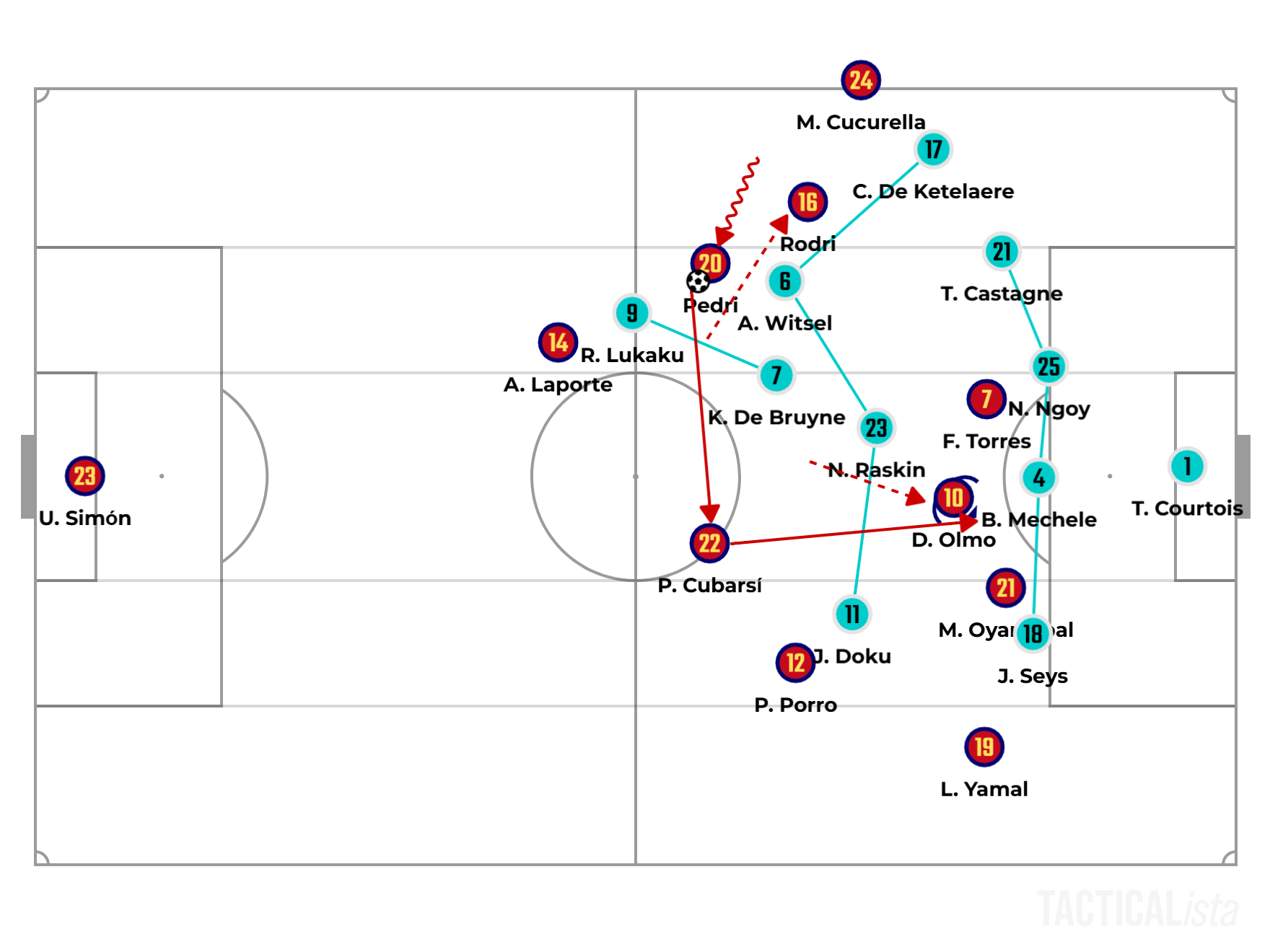
60th minute: The same issues were in place, despite Garcia’s changes. Pedri carried inside, Rodri pushed outward and Witsel had stepped up towards the midfielder. As a result, Belgian lines were distorted as a simple lateral pass towards Cubarsí put them under pressure as Olmo could face play, whilst making a run between the lines, and with both Torres and Oyarzabal in proximity. In this phase, Ngoy would scramble the ball away and Belgium would lead a counter, that resulted in a tame effort towards Unai Simón.
Merino call, veterans fall
Spain dominated three-quarters of the possession in the last half-hour, but their actions to get them into the final third did not have a finishing sequence. Dribbles from Yamal struggled to make the same impact, and most of these attacks had turned to him by this point in the game. Though passes into Olmo, Torres and Oyarzabal were accessible, these players were often bunched and required an extra pass going ahead to try and meet another run, rather than one of these players teeing up the other on the underside. Additionally, the cutbacks had dried up, with enough Belgian players behind the ball to deal with these situations.
Another quiet offensive spell of the game, but Garcia’s team could not capitalize on Spanish frustration. First was an injury to Courtois, who was replaced by Manchester United’s Senne Lammens with twenty minutes left. Then it was De Bruyne, who had briefly soldiered on before being replaced by Alexis Saelemaekers with four minutes left.
Nico Williams was deployed on the left, in place of Oyarzabal, but surely, the call for Mikel Merino was going to come. He entered at the same juncture as he had entered the game against Portugal, only it would take him less time for his effect to be felt. After possession circulated, Pedri played another lateral pass to Cubarsí, with the center of the defensive block still shifted to one side. A low shot from range saw Lammens spill and Merino was quick to pounce. He smashed in the rebound and Spain took the lead.
A late scare saw a neatly threaded through ball from Doku lead to Saelemaekers rounding Simón on the corner of the box. However, his cross towards Lukaku was cleared in the process as Spain entered the final four. Belgium had made a bang in Seattle but left California with a whimper.
Takeaways
If Spain wants to replicate its achievements in 2010, they may have to go down the same route as they had done in 2024. France possesses the same basic structure, but an attack that has somehow found more improvements. In Spain’s own 4-4-2 high press, it too had situations where the opposition could add a central third man, not appropriately utilized by the Belgians, but picture Michael Olise in the same pockets and France may not be so forgiving.
Spain still possesses one of the best buildup units in international football, but is prone to more periods of inactivity, and it is in such environments that France can relish such opportunities. Nevertheless, it is another fun matchup between two national teams that feel opposed to one another in their tactical format.
Use the arrows to scroll through all available match plots. Click to enlarge.
Check the match plots page for plots of other matches.