USA – Belgium: Belgium shatter USA’s World Cup dream (1–4)
Co-hosts United States saw their historic 2026 FIFA World Cup campaign come to an abrupt and painful end as an efficient, tactically superior Belgium side secured a commanding 4-1 victory in their Round of 16 clash at Seattle Stadium. Rudi Garcia’s surprising tactical blueprint paid off exquisitely, engineered around an incredible first-half brace from Charles De Ketelaere. Mauricio Pochettino’s side struggled to replicate their group-stage fluid positional dominance, finding themselves completely undone by early passivity, severe structural vulnerability, and Belgium’s elite transitional execution.
Tactical analysis and match report by Aderemi Qoyum.
We decided to make this article free to read. If you want to support our work, consider taking a subscription.
The match showcased a fascinating tactical battle between the USA’s possession-oriented approach and Belgium’s emphasis on rapid attacks through direct long balls and switches. While the Americans aimed to control the game through pressing and expansive positioning, their structure often left spaces defensivly. Belgium recognized these vulnerabilities, bypassing the initial pressure with direct passes into good areas before exploiting the gaps.
The USA operated with a flexible 4-1-2-3 system designed to create overloads across the pitch and maintain numerical superiority in midfield. Matt Freese played behind a back four of Alex Freeman, Chris Richards, Tim Ream, and Antonee Robinson while Sergiño Dest and Christian Pulisic provided attacking width. Tyler Adams anchored the midfield, supported by Weston McKennie and Malik Tillman, with both given freedom to rotate around Folarin Balogun in attack.
Belgium responded with a 4-2-3-1 setup built around defensive discipline and quick attacking transitions. Courtois marshalled a back four consisting of Timothy Castagne, Nathan Ngoy, Brandon Mechele, and Maxim De Cuyper, while Amadou Onana and Nicolas Raskin initially provided midfield stability before an injury forced a midfield change. The attacking trio of Dodi Lukébakio, Youri Tielemans and Leandro Trossard supported Charles De Ketelaere, whose movement, strength, and ability to link play made him a constant threat against the USA’s defensive structure.
Belgium’s deep build-up bypasses passive USA press
Belgium established a fluid 4-2-4 deep build-up structure, with Youri Tielemans initially pushed much higher up the pitch to occupy the advanced playmaker role like De Bruyne did in previous games. Garcia’s wingers and fullbacks occupied different lines to pull the American defensive shape apart.
The USA met this setup with passivity, failing to initially apply meaningful pressure when out of possession. This played directly into Belgium’s hands; the Red Devils patiently held on to the ball or rotated possession in their own area just long enough to provoke the American forwards into breaking their compact 4-4-2 block and committing to an aggressive, desperate man-to-man press.
The moment the USA stepped up, Belgium bypassed them entirely by launching direct long balls over the high defensive line, targetting De Ketelaere to contest aerial duels and others can cleanly claim the second balls. At times, Courtois or the defenders played long behind the high defensive line of USA—which later led to the third goal.
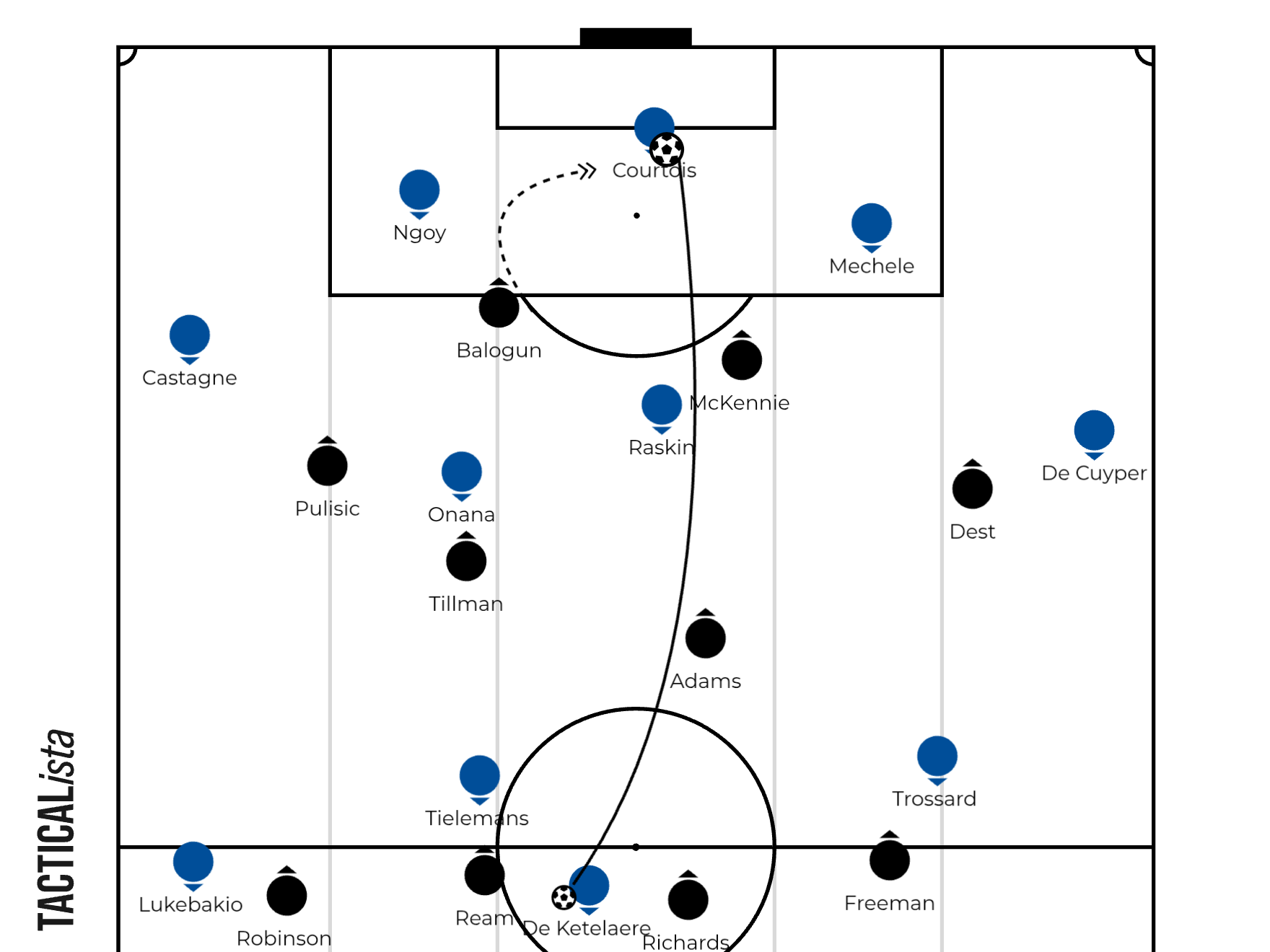
Minute 7′: Belgium’s 4-2-4 deep build-up pulls apart the USA’s passive pressing structure.
This long-ball mechanism allowed Belgium to progress play directly into the middle and final thirds with less risks against USA’s press that has gotten them goals in previous games. In response, the USA tried to retreat into a narrow, compact 4-4-2 block designed to block the central lanes. However, this defensive narrowness left massive amounts of space vacant in the wide channels.
Recognizing this flaw, Belgium completely abandoned slow central progressions—which would risk turning the ball over to the American counter-attack—and instead utilized rapid, sweeping diagonal switches to isolate their wingers in 1v1 situations on the flanks.
This exact pattern manufactured the opening goal in the 9th minute. Lukébakio executed a sharp switch over to Leandro Trossard on the left wing. Trossard delivered a teasing ball deep into the penalty box that threw the disorganized USA defensive line into complete disarray. Latching onto the second ball, Nicolas Raskin calmly drove a hard pass across the face of the six-yard box, allowing De Ketelaere to comfortably tap home from close range and put the Red Devils ahead.
3-1-6 overload against the touchline trap
When the USA managed to sustain possession, their shape evolved into their familiar 3-1-6 structure to confront Belgium’s 4-2-3-1 out-of-possession block. As they had done throughout the group stage, Pochettino pushed both Sergiño Dest and Antonee Robinson extremely high to pin Belgium’s fullbacks along the touchlines. Inside them, Christian Pulisic, Malik Tillman, and Weston McKennie roamed dynamically between the lines and across the halfspaces.
Following an early injury to Amadou Onana, Belgium introduced Hans Vanaken, who was immediately tasked with man-marking Tyler Adams like Tielemans initially did. To escape this shadow, Adams frequently dropped deep between center-backs Ream and Richards which gave right-back Alex Freeman the license to slightly advance into the middle third, generating heavy overloads on the right flank alongside Dest and McKennie to overwhelm Belgium’s left side.
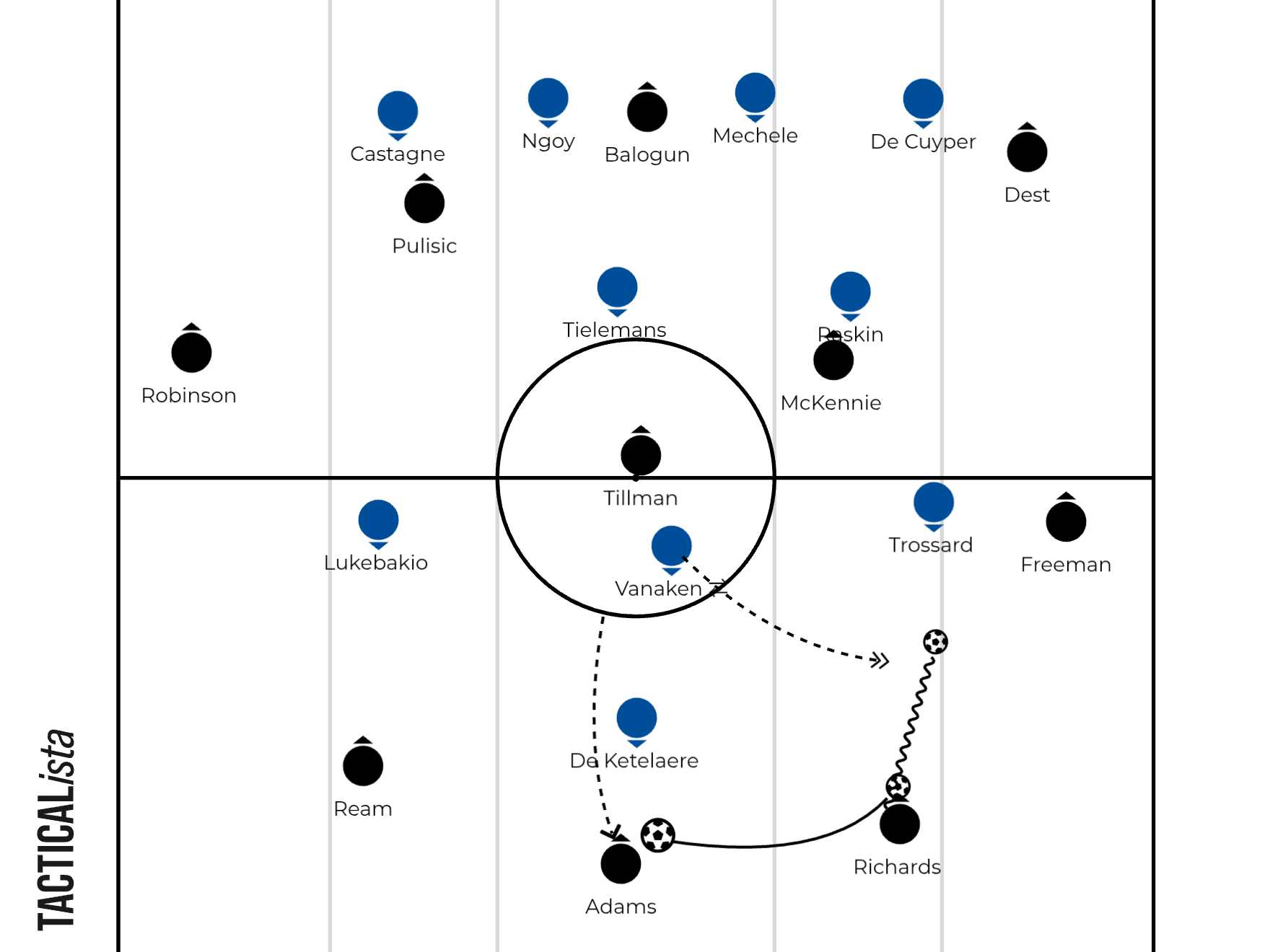
Minute 17′: Here, Adams drops in between the CBs, which frees Freeman to push higher while Richards carries the ball forward. The USA’s 3-1-6 in-possession structure attempts to stretch Belgium’s compact 4-2-3-1 defensive block.
USA looked most dangerous when threading quick combinations into these areas, trying to unleash Balogun’s runs into the channels or finding the midfielders bursting through the halfspaces. Belgium countered the USA’s wide overloads by forcing them toward the flanks and applying coordinated pressing traps, limiting American creativity.
De Ketelaere with the double
Despite their central sluggishness, the home side temporarily dragged themselves back into the tie through sheer individual quality. In the 31st minute, Balogun won a free-kick on the left flank and Tillman stepped up to unleash a vicious, curling effort. The ball took a wicked deflection off the Belgian wall, completely wrong-footing Thibaut Courtois and hitting the back of the net to equalize.
Yet, the tactical frailties of the American wide defense were exposed once more just two minutes later. Belgium executed another direct long switch, this time via Tielemans—who had dropped deeper alongside Raskin following Onana’s injury—finding the ever-dangerous Trossard out wide. Though quickly closed down by two recovering USA players, Trossard managed to manipulate the space and dig out a phenomenal cross. De Ketelaere read the flight perfectly, soaring cleanly over the veteran Tim Ream to power a clinical header past Matt Freese, instantly making it 2-1.
Catastrophic errors cost USA
Seeking to inject dynamic central creativity and restore balance, Pochettino made a major structural alteration at halftime, withdrawing winger Dest for Giovanni Reyna. This forced fullback Freeman to act as the primary source of width high on the right wing, while Reyna drifted inside to operate close to Flo Balogun. Things went from bad to worse in the 59th minute when Pulisic went down with an injury, forcing a premature substitution for Sebastian Berhalter.
Seconds before the substitution, during a buildup situation against a more aggressive USA press, Brandon Mechele launched a hopeful, direct long ball over the top of the high USA backline. Goalkeeper Matt Freese rushed well outside his penalty box to intercept, but he hesitated fatally, frozen by indecision on whether to clear or pass.
The hyper-alert De Ketelaere closed him down, stripped the ball away to Hans Vanaken. From long distance, Vanaken kept his composure and guided a precise right-footed shot into the entirely vacant net, completely bypassing Ream’s desperate, retreating goal-line slide to extend the cushion to 3-1.
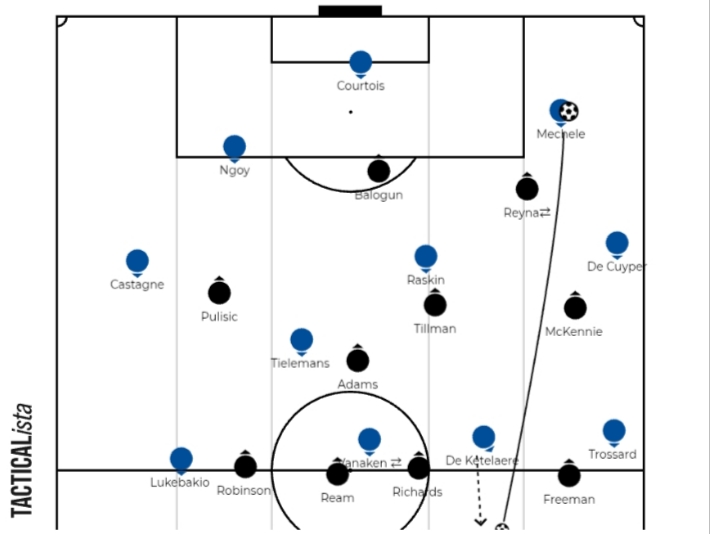
Minute 57′: Third goal sequence. Build-up from Belgium as Mechele plays a long ball into the space behind the high-line of USA.
Belgium choke the space to seal the win
With a comfortable two-goal cushion secured, Belgium intentionally lowered their defensive line and adopted a passive, highly disciplined compact defensive block. Trossard and Lukébakio put in an exhausting defensive shift, dropping deep to diligently assist their respective fullbacks and neutralize the American wide overloads.
Centrally, Vanaken dropped back from his attacking midfield station to sit directly between Tielemans and Raskin, forming a temporary midfield three that prevented the USA from establishing any central numeric superiority. Upfront, the lone striker worked intelligently, utilizing his cover shadow to completely cut off the passing lanes to Tyler Adams. The moment the striker jumps to press the center-backs due to a trigger, Vanaken would aggressively push on Adams.
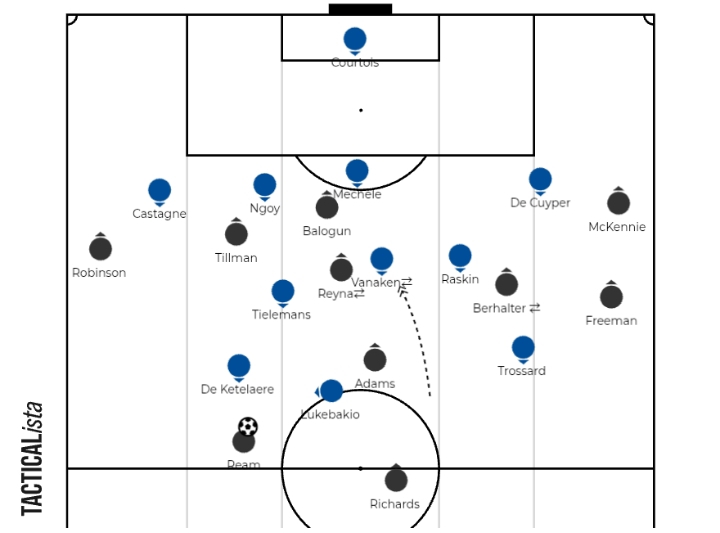
Minute 65′: Hans Vanaken’s defensive triggers and positional shifting within Belgium’s compact block.
Garcia’s substitutions further strengthened Belgium’s control of the match, with Doku and Lukaku adding fresh energy and a new dimension to the attack. Doku became a key outlet on counter-attacks, using his pace, physicality, and dribbling ability to escape pressure, draw multiple defenders, and win valuable fouls that helped Belgium regain control during difficult moments.
As the USA committed more players forward in search of a comeback, the spaces behind their defensive line became increasingly vulnerable. Belgium also pressed with ruthless efficiency, and in stoppage time, Vanaken capitalized on a loose ball from Richards before releasing Lukaku into the open space. The striker showed his experience and composure, finishing clinically to complete a dominant 4-1 victory.
Takeaways
Belgium’s use of direct long balls, switches and clinical transition play carries immense momentum into their upcoming quarter-final showdown against Spain, whereas the United States suffers a bitterly disappointing Round of 16 exit on home soil—punished for an overly passive tactical approach, glaring defensive instability on the flanks, and fatal individual blunders that ultimately seal a clean sweep of early tournament exits for all three 2026 World Cup co-hosts.