Portugal – Spain: Ronaldo’s Race Has Run Its Course (0-1)
The last meeting of these Iberian nations marked the only major blot on the record of Spain’s head coach in his three-year tenure. La Roja might not have stoked the fires of their fans with a pulsating performance on this occasion, but they managed to avenge that blow on the biggest international stage with a late strike that signaled a sad exit for one of football’s modern icons.
Tactical analysis and match report by Emmanuel Adeyemi-Abere.
We decided to make this article free to read. If you want to support our work, consider taking a subscription.
Spain showed something closer to their best form in the Round of 32, comfortably dispatching of Austria. From the first signs in their World Cup campaign, their approach appears far less threatening without the dynamic duo fit and firing on the flanks. But the team continue to command respect as a ball-dominant, technically gifted outfit, and the stability of their style has still yielded positive results. The Spaniards still have not conceded a single goal in the tournament, topped the table in their group, and have extended the 90-minute match unbeaten run that spans most of Luis de la Fuente’s reign.
On the other hand, Portugal have not put all the pieces together since their triumph in the Nations League final last June. Roberto Martínez moved from the Belgium dugout with a second chance to succeed with the Golden Generation of a European country, but he has struggled with the same brief in his present role. The Seleção drew twice in the group stage of this tournament, finishing in second spot to Colombia, then found a way past Croatia in controversial circumstances to set up this contest.
Martínez made a singular change to the lineup that kicked off the previous round. Though Rafael Leão had impressed against the Croatians, João Félix would feature with Cristiano Ronaldo and Pedro Neto in the frontline. The talented trio of Vitinha, João Neves and Bruno Fernandes filled the three slots in the middle of the park. João Cancelo continued at right back and Nuno Mendes is a mainstay on the left of the backline. Renato Veiga was trusted to partner with Rúben Dias in central defense.
Spanish manager de la Fuente fielded the same starting eleven that he used against Austria, having stabilized his selection through the group phase. Pedro Porro persisted as the right back instead of Marcos Llorente, and Dani Olmo operated as the attacking midfielder over Mikel Merino. Álex Baena has nailed down the role of the left winger in the attack, and Mikel Oyarzabal aimed to extend his stellar streak of output, having registered 24 goal involvements in his last 16 games for his nation.
Seleção’s stilted attack
Portugal’s desire for higher quality football is not unfounded. Vitinha and Neves are two thirds of the engine room for the back-to-back Champions League winners, Fernandes has just registered the most assists for a player in a single Premier League season, while Cancelo and Mendes have excelled as playmaking fullbacks for top tier teams at club level. The individual class is present to expect more.
The Seleção started more brightly out of the two teams during this match. Not unlike Austria, they concentrated many of their attacks on their left side, advancing into the areas left behind by Yamal. This focus also allowed Portugal to play through Mendes, whose expansive passing and carrying cut holes through Spanish attempts to recover the ball high up the field before freeing the right side.
However, Portugal could not turn their possession into real tangible opportunities. Ronaldo did not help matters: the 41-year-old cannot give the same explosiveness from his prime, needing time to return from deep positions to the box, and he was not well serviced with deliveries into the penalty area. At the same time, his teammates did not excel of their own accord. It was another quiet evening for Fernandes, while Neto is not blessed with much variation in his craft on the flank.
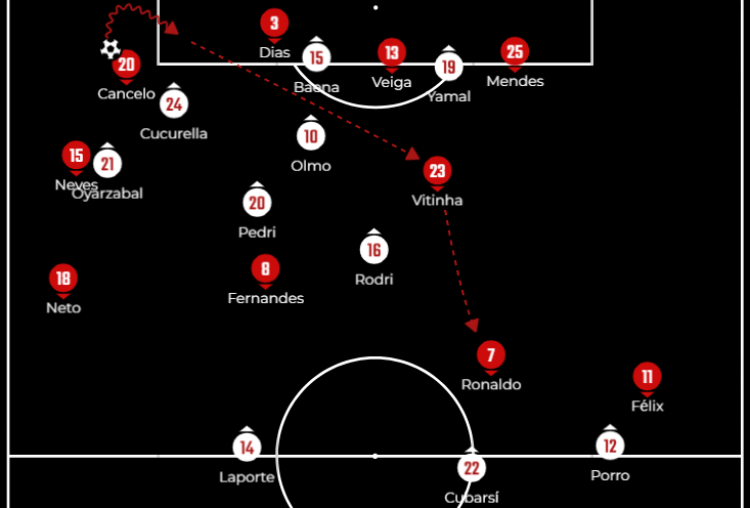
37th minute: offensive transition from Portugal. Cancelo collected the ball from Neves after a Spain turnover, and he swiveled away from Cucurella before clipping a weak footed pass over Olmo into the path of Vitinha. The opportunity to transition into open space is present: Ronaldo chose a back pass to Veiga, then when he received the ball back from the central defender, he fed Félix and demanded the ball underneath him. The lack of depth meant Portugal had to switch sides and Spain recovered.
A standard Spanish showing
Ronaldo’s relative lack of involvement was most clearly visible when Portugal were without the ball. He limited his activity to loitering around Laporte so that it was harder for the Spaniards to construct attacks through the distribution of the central defender. Fernandes would most frequently step forward to press Cubarsí, but Seleção stuck primarily to frustrating the opposition with a deeper-lying block.
Especially in the early stages of the contest, La Roja were guilty of sloppily giving away the possession and allowing their opponents promising positions to transition. However, their ability to dominate proceedings against a block with nine men outfield was not greatly thwarted. The typical patterns with the partnerships of Cucurella and Baena, Porro and Yamal and Oyarzabal and Olmo emerged, while Rodri put in an impressive performance to set the tone in the middle of the park.
For the Spaniards, the key question remains the extent of their offensive quality when Yamal cannot take them over the edge. The winger was again frustrated at points against Mendes as the pair renewed their battle from last summer. Meanwhile, Oyarzabal, who missed a presentable opening early in the first half, was found missing in the danger zone from several cutbacks across the game.
Merino moves decisively
Both managers attempted to respond to the struggle in the second half for a breakthrough. A hamstring injury forced Mendes to make way for Nélson Semedo in the 56th minute, then came a double change that involved Cancelo coming off for Diogo Dalot at right back and Leão replacing Félix in the attack.
In the 85th minute, de la Fuente made a double substitution: Olmo stepped aside for Merino and Fabián Ruiz replaced Pedri. Spain’s proven twelfth man would make the difference at the death.
Bernardo bundled into the back of Merino, who ran off the back of the midfielder after he attracted the foul. Fabián and Rodri drew Bernardo and Fernandes towards the ball before Rodri split the lines to find Ferran. A cleverly angled pass released Merino behind the backline, and the substitute slotted a strike to the right of Diogo Costa as the clock ticked into injury time. The Spaniards stole the lead.
Takeaways
Spain shall be happier than not with the win in this match, mimicking the scoreline from their triumph at the same stage of the tournament in 2010 against the Portuguese. While the offensive did not kick on from the signs against Austria, it appears that defensive stability will underpin any success that stands to be gained in the coming fortnight for La Roja. They have now kept clean sheets in all their five fixtures, extending their 90-minute game unbeaten run to a record-equaling 35 encounters.
Meanwhile, it is a case of more frustration for Portugal. Their performance produced flashes to indicate what could be possible with the group of talent that Martínez had selected, and ultimately the Seleção were not an easy opponent for their opponents to dispatch. However, the overwhelming feeling will be one of disappointment: another major competition has passed by Portugal without making a major mark, and the manager has paid the price for this outcome with his position.
Use the arrows to scroll through all available match plots. Click to enlarge.
Check the match plots page for plots of other matches.