
Portugal – Croatia: Portugal survive, but Martínez’s tactical flaws remain exposed (2-1)
Portugal reached the World Cup quarterfinals after a dramatic 2-1 victory over Croatia, yet the scoreline did little to hide the structural issues that have followed Roberto Martínez’s side throughout the tournament. Croatia controlled long stretches after halftime and were only denied by a combination of Portuguese efficiency, late tactical corrections, and the narrowest of margins after a heartbreaking disallowed equalizer.
Tactical analysis and match report by Sebastián Parreño.
We decided to make this article free to read. If you want to support our work, consider taking a subscription.
Portugal began the match in a 4-3-3, with Vitinha and João Neves alternating as deep playmakers during the buildup. Their movements allowed the center-backs to circulate possession comfortably while creating numerical superiority in the first phase. Ahead of them, the fullbacks interpreted their roles asymmetrically but according to the same positional principle. Nuno Mendes regularly drifted into the left half-space, leaving the entire flank for Rafael Leão to stretch Croatia horizontally. On the opposite side, João Cancelo inverted into midfield while Pedro Neto held the width, occasionally dropping deeper to participate in quick combinations before accelerating forward.
The concept behind these rotations was sound. Portugal consistently created direct passing lanes towards their wingers while simultaneously positioning another player inside the adjacent half-space. This gave them several clean progression sequences during the opening stages and allowed them to move Croatia’s defensive block from side to side.
Croatia, however, defended with remarkable flexibility. Although officially organized in a 4-4-2, their shape constantly evolved depending on Portugal’s circulation. Luka Modrić frequently dropped alongside the center-backs to create what resembled a 4-1-4-1, while Petar Sučić occasionally joined the midfield line to transform the block into a compact 4-5-1. Rather than pressing high, Croatia deliberately allowed Portugal to build from deep before collapsing aggressively inside their own half, shifting collectively toward the ball and denying central progression.
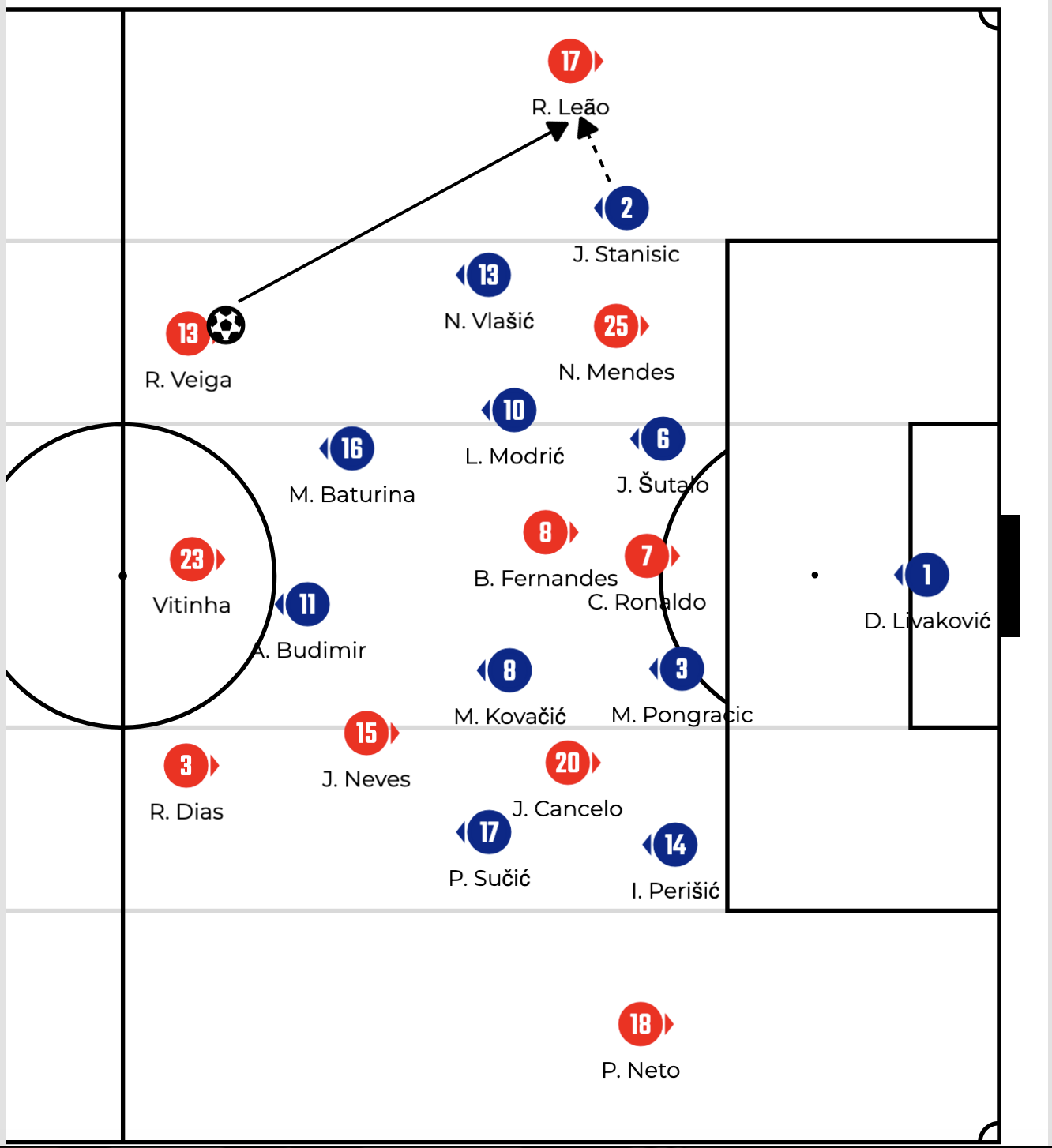
Portugal’s first half set-up against Croatia, playing almost exclusively down the flanks
Portugal’s biggest attacking problem was not Croatia’s defensive shape alone but their own occupation of space. Despite occasional openings between Croatia’s midfielders, Portugal rarely positioned enough players to exploit them. Cancelo’s inverted positioning illustrated the issue perfectly. Although he initially moved inside, he naturally drifted back toward the wing instead of occupying central pockets between Croatia’s lines. Instead of providing an additional interior passing option, he frequently duplicated Neto’s position on the outside, leaving Portugal short of central connections.
Ironically, Croatia themselves offered opportunities. The distance between Modrić and Mateo Kovačić often opened a passing lane directly into Bruno Fernandes, but Portugal repeatedly preferred to attack through the flanks instead of exploiting those central spaces. Considering the technical quality of Fernandes, Vitinha and João Neves, those central combinations could have become the primary source of progression instead of an underused alternative.
Portugal’s wide attacks punished Croatia’s aggressive fullbacks
Although Portugal’s insistence on attacking through the wings reflected their inability to play centrally, it still created genuine danger. Croatia instructed their fullbacks to jump aggressively toward Portugal’s wingers whenever possible, but those anticipatory movements occasionally exposed the channel between fullback and center-back.
One such situation nearly produced the opening goal. Josip Stanišić stepped early to engage Leão, leaving a sizeable gap inside him. Leão immediately attacked the space, reaching the byline before cutting the ball back into the second line of the penalty area. Bruno Fernandes arrived completely unmarked and generated Portugal’s clearest opportunities of the first half, exposing Croatia’s vulnerability whenever their defensive timing failed.
Ronaldo’s false nine experiment failed to stretch Croatia
Perhaps the biggest tactical surprise came through Cristiano Ronaldo’s role. Rather than operating as a traditional striker, Ronaldo constantly vacated the center-forward position, dropping between Croatia’s midfield and defensive lines in an attempt to function as a false nine. Meanwhile, Bruno Fernandes frequently occupied the highest line, effectively becoming Portugal’s striker during sustained possession.
In theory, the movement resembled the classic false-nine concept. In practice, however, it failed to achieve its primary objective. Croatia’s center-backs simply refused to follow Ronaldo into midfield because he no longer represents the same dribbling or progression threat between the lines. By remaining in position, Croatia denied Portugal the space that a successful false nine is designed to create for wide runners attacking beyond the defensive line.
The statistical evidence perfectly reflected the tactical problem. Ronaldo registered only a single touch inside Croatia’s penalty area, the penalty he eventually converted. Croatia were perfectly comfortable allowing him to receive possession deeper because every touch outside the box reduced his presence where he remains genuinely dangerous, the box. If Martínez intended to use a false nine, profiles such as João Félix or Bernardo Silva would have offered considerably greater effectiveness due to their ability to receive under pressure, turn, and eliminate defenders between the lines.
Portugal’s aggressive man-oriented press controlled the first half
Out of possession, Portugal adopted an uncompromising man-to-man pressing system. Every defender stepped high to follow direct opponents, while the midfield matched Croatia player for player across the pitch. The structure prevented Croatia from constructing attacks through short buildup and repeatedly forced long balls toward isolated forwards. Since Portugal wanted to dominate possession, denying Croatia controlled buildup became one of the game’s defining features during the opening forty-five minutes.
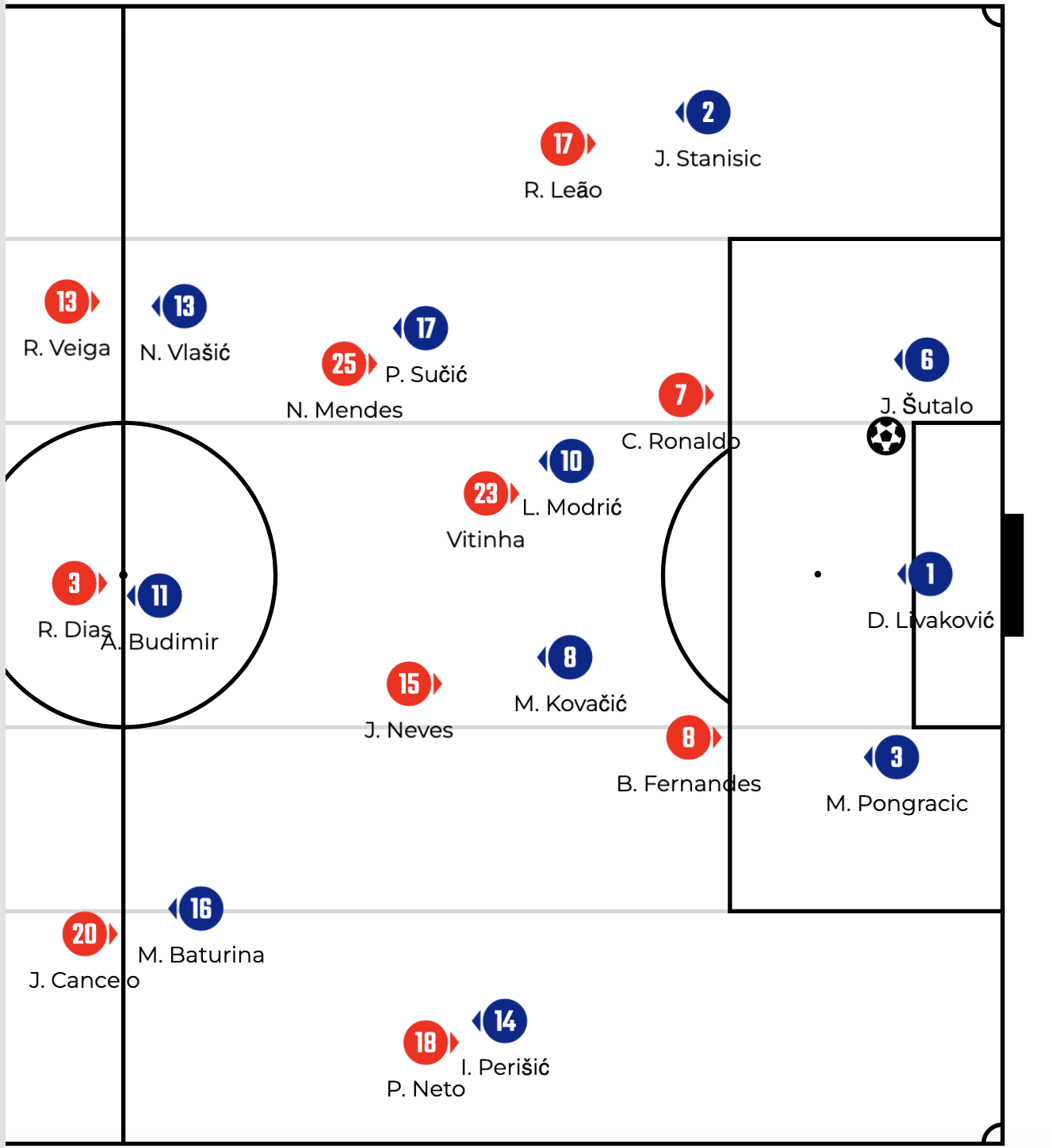
The man-to-man matchups that Portugal created to force Croatia to play long all game long.
The system demanded enormous sacrifice from the wingers. Both Leão and Neto spent long periods tracking the attacking runs of Ivan Perišić and Stanišić, meaning Portugal frequently defended in a temporary 5-4-1 with Neto effectively becoming a wing-back. The organization itself worked well because every player understood his direct marking assignment, allowing Portugal to maintain defensive compactness despite the aggressive individual responsibilities.
Yet the intensity that makes man-oriented pressing successful gradually disappeared before halftime. Ronaldo, responsible for initiating the first wave of pressure, increasingly jogged rather than sprinted toward Croatia’s defenders. Those extra seconds allowed Croatia’s back line to lift their heads and select longer, more accurate passes. Within such an aggressive pressing system, every fraction of a second matters, and Portugal’s front line slowly stopped providing the urgency required to sustain the collective structure.
Croatia’s halftime adjustments shifted the momentum
Croatia emerged after halftime with subtle but highly effective tactical adjustments. Whenever one fullback stepped out aggressively toward Portugal’s winger, the Croatian winger immediately dropped into the defensive line to protect the vacated space. Simultaneously, the far-side winger remained significantly higher, preparing immediate counterattacks once possession was regained as he was an outlet to play to after regaining possession.
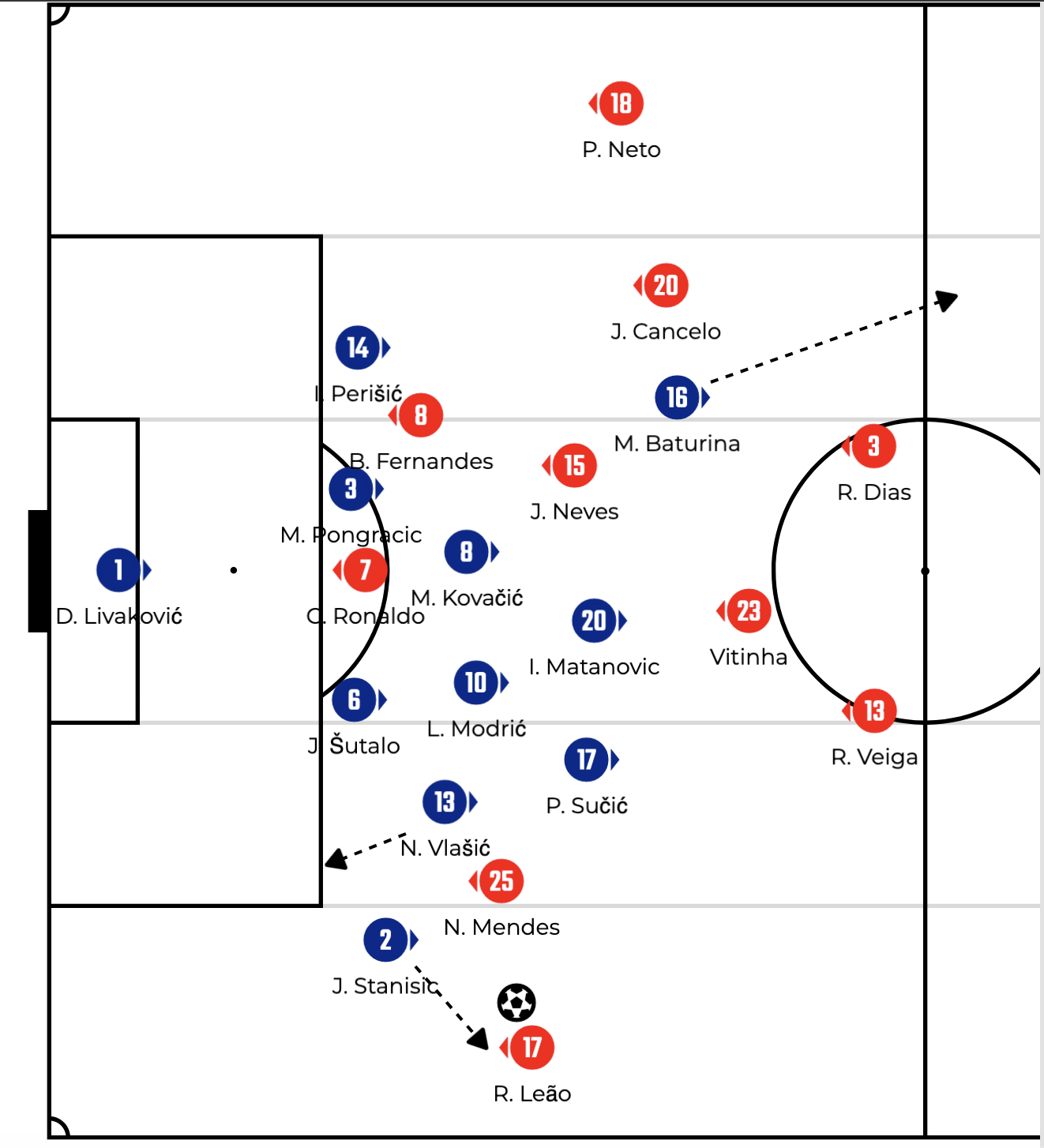
The adjustment that allowed Croatia to defend better and counter attack more effectively, with the weakside winger staying higher and exploiting the advanced position from Portugal’s fullbacks.
The changes immediately transformed the game. Croatia opened the scoring following a sequence that perfectly combined Portugal’s tactical weakness with a costly lapse in concentration. A quickly restarted throw-in caught several Portuguese players arguing with the assistant referee rather than defending. Croatia advanced possession toward the far post, where Cancelo lost both his positioning and the flight of the ball, leaving Perišić completely unmarked to finish.
From that point onward Croatia became significantly more threatening. Portugal’s wingers, exhausted by their defensive workload, gradually stopped tracking the continuous overlapping runs of Croatia’s fullbacks. Those moments repeatedly created two-versus-one situations on the flanks, particularly through switches toward the back post, exposing the weaknesses inherent in Portugal’s man-oriented defensive approach.
Martínez’s substitutions rescued the result before restoring balance
Recognizing the momentum shift, Roberto Martínez responded with four simultaneous substitutions, introducing Gonçalo Ramos, Bernardo Silva, Nélson Semedo and Francisco Conceição while removing, among others, Vitinha and Bruno Fernandes. The changes dramatically altered Portugal’s attacking structure, increasing their presence inside the penalty area through a strike partnership but simultaneously sacrificing midfield control.
Initially, the gamble worked. Portugal’s renewed energy in the high press immediately forced a corner, from which they eventually won the penalty that Ronaldo converted to equalize. The sequence illustrated how much their pressing intensity had dropped before the substitutions and how quickly refreshed legs could restore it.
However, the balance once again shifted. Portugal relaxed after the equalizer, allowing Croatia to continue attacking dangerous transition spaces. Croatia consistently targeted the far post, exploiting the numerical superiority created by their advanced fullbacks and Portugal’s increasingly passive wide defenders.
Martínez then made arguably his boldest decision of the tournament. He removed Cristiano Ronaldo for Rúben Neves, accepting the emotional significance of substituting his captain in what could have been his final international appearance. Tactically, however, the logic proved sound. Portugal regained an additional midfielder, improved their defensive balance, and significantly reduced Croatia’s ability to counterattack through central areas.
Portugal’s winning goal ultimately arrived from another wide delivery. Leão produced an inswinging cross toward the far post despite Croatia holding numerical superiority inside the box. The superiority became meaningless because Croatia defended the situation exceptionally poorly. One defender failed to attack the ball, another lost his positioning entirely, while Joško Gvardiol remained passive behind his direct opponent instead of challenging aerially. Gonçalo Ramos attacked the cross decisively and headed home the winner, punishing Croatia’s poor box defending rather than any sophisticated attacking mechanism.
Takeaways
Portugal advanced, but the performance raised almost as many concerns as it provided positives. Their positional play generated controlled progression but lacked enough occupation between Croatia’s lines, forcing excessive reliance on wide attacks. The experiment of using Cristiano Ronaldo as a false nine produced little tactical benefit, while Bruno Fernandes spent long periods occupying areas that limited his creative influence.
Without the ball, Martínez’s commitment to an aggressive man-oriented defensive system initially disrupted Croatia’s buildup but eventually became a liability. The enormous defensive demands placed upon Leão and Neto inevitably produced fatigue, allowing Croatia’s fullbacks to dominate wide areas after halftime. Portugal also committed too many players to the last line in possession, leaving only the center-backs and Vitinha protecting defensive transitions, a structural weakness Croatia repeatedly exploited through counters and far-post overloads.
Ultimately, Portugal survived through superior individual quality, decisive substitutions, and Croatia’s defensive errors inside their own penalty area rather than sustained tactical superiority. Against Spain in the quarterfinals, where positional discipline and transitional control will be tested far more severely, Martínez’s side will almost certainly require significant structural improvements if they hope to continue their World Cup journey.


Comments