
River Plate – Independiente Rivadavia: River Plate Edge Closer to Playoff Places with back-to-back Wins Under New Coach, Leonardo Ponzio (3-1).
River’s persistence paid off to seal the win against Rivadavia. After a hard fought end to end first half, River’s advantage helped them to sustain pressure in the second half. This gave them the room to score the third goal, however, Rivadavia’s poor defending gave room for River’s players to enjoy a bit too much in the final third.
Tactical analysis and match report by Ebuka Ogoegbunam.
Leonardo Ponzio started off with a win in his first game in charge of River Plate, beating Banfield away from home by three goals to two. His next game in front of the home fans proved to be a huge game against a tough opposition. Rivadavia are unbeaten in their last three games, with back to back wins in previous games.
With expectancy high from the River fans, Ponzio had to bring excitement in this game. At the same time, he also had the chance to bring River closer to playoff places and shoot them right up the table.
River Plate had Santiago Beltrán in goal with a center back pairing of Martínez Quarta and Nicolás Otamendi. The fullbacks were Gonzalo Montiel and Marcos Acuña. Fausto Vera played alone in midfield as the single pivot with Tobias Andrada, Thiago Almada and Tomás Galvan ahead of him. Sebastián Driussi and Angel Correa led the line as the front two in a 4-1-3-2 shape.
For Independiente Rivadavia, the starting lineup was a 4-3-1-2: Nicolás Bolcato in goal, with Alejo Osella, Iván Villalba, Leonard Costa and Juan Elordi forming the back four. Gonzalo Ríos, Tomás Bottari and José Florentín played in midfield, with Matías Fernández ahead of them as the attacking midfielder. Fabrizio Sartori and Álex Arce led the line as the front two.
Structural differences
River Plate set up in a 4-1-3-2 shape, with Ponzio aiming to implement his style early enough between his players. Andrada and Galvan were used as the wingers but operated inside in the pockets. This allowed the fullbacks to occupy wide areas and push forward in the final third. The three midfielders in Galvan, Almada and Andrada, all acted as box to box midfielders.
In possession, they dropped deep during the build up. Andrada did this more than others, joining Fausto in the midfield to form a double pivot. They also occupied spaces between the lines and made runs into half- spaces.
Rivadavia without the ball, set up in a 4-3-1-2 shape. They two strikers with the attacking midfielder all pressed from the front when they wanted to put pressure. The three midfielders were responsible for covering the central spaces.
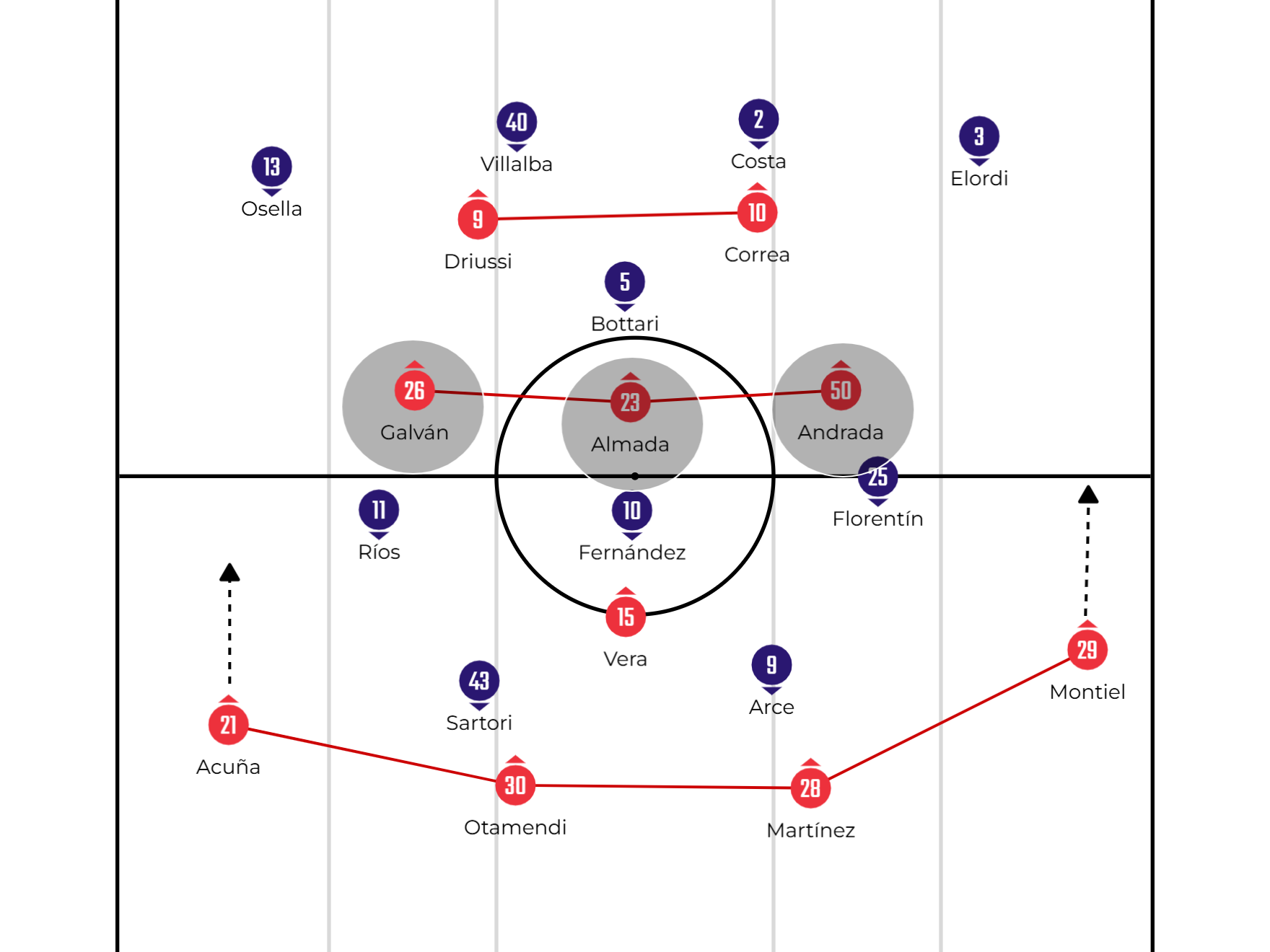
River’s shape in possession. Fullbacks are to push high up with the three midfielders being crucial in the connecting the midfield and attack.
In the early moments of the game, Rivadavia had problems dealing with River’s setup in possession. When Andrada dropped into midfield, there were situations when the opposition fullback didn’t follow his movements. River’s wide midfielders’ attracted the Rivadavia midfielders’ attention and this left the River fullbacks free. When the Rivadavia midfielders put pressure on the River fullbacks, this left River’s wide players, Andrada and Galvan free.
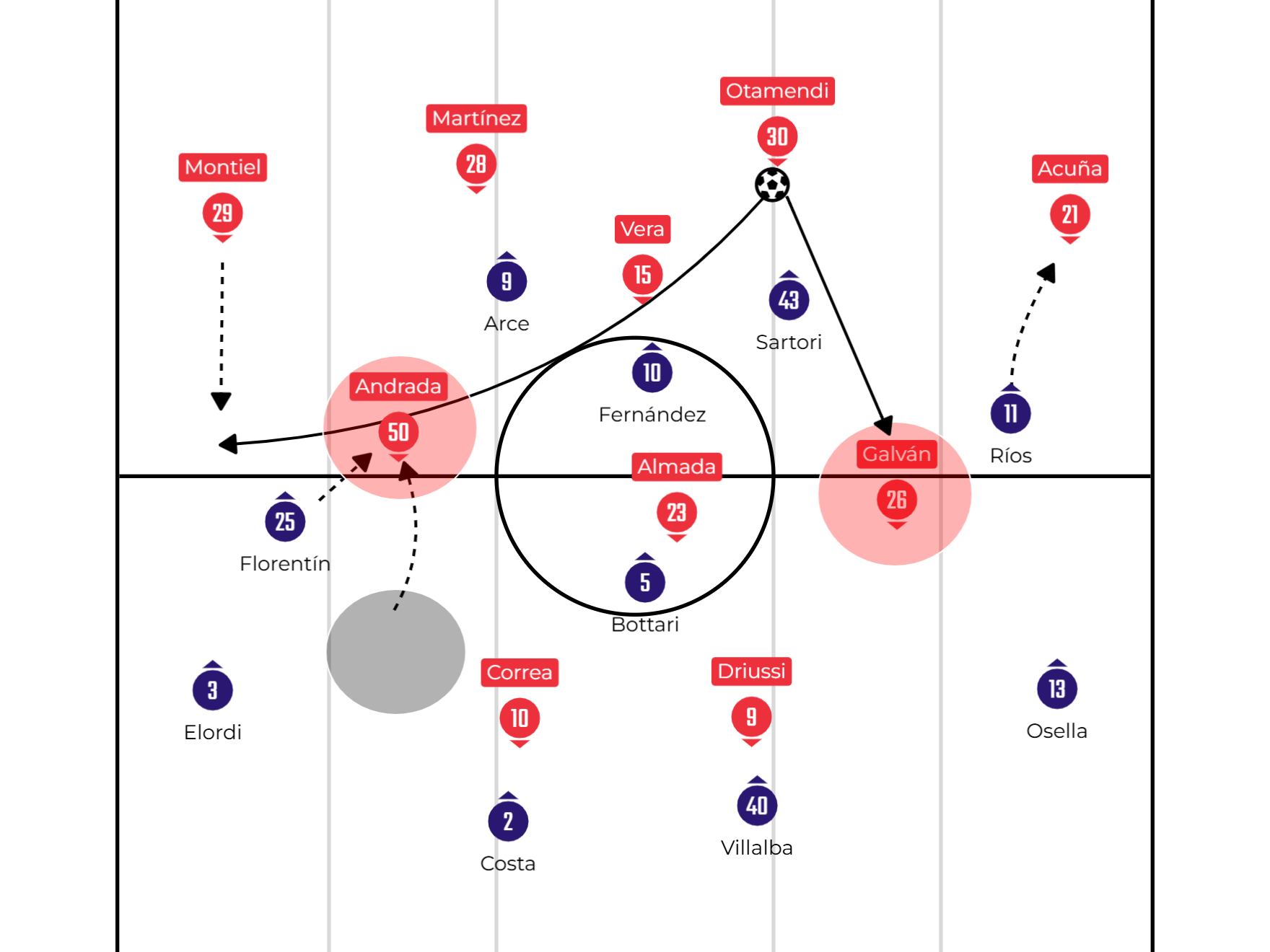
River’s two wide midfielders caused chaos with their movements. When Andrada dropped to cause an overload in the build up, Montiel was often found with a long switch to the wide areas.
Rivadavia in possession, set up in a 4-1-3-2 shape with the wide midfielders acting like wingers. Fernández was the mobile player for his team. As the #10, he was always roaming around to link up play and overload areas. The fullbacks were also allowed to push forward when the team were attacking.
River pressed in their 4-1-3-2 shape with the narrow wingers always applying pressure to the opposition fullbacks.
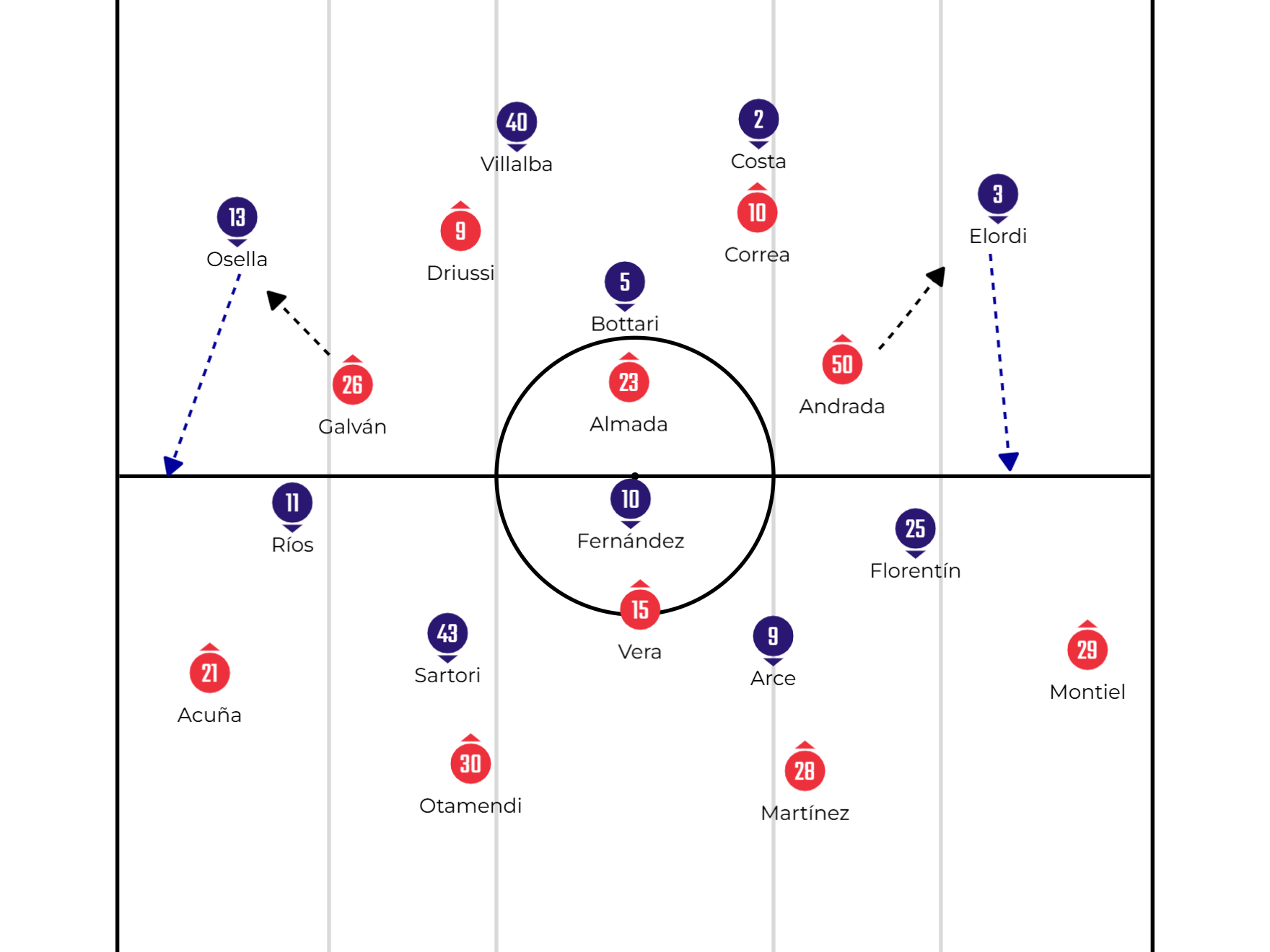
Rivadavia’s 4-1-3-2 shape with the wide midfielders acting as wingers. River pressed in a 4-1-3-2 shape with their wide midfielders putting pressure against Rivadavia’s fullbacks.
Correa and Galván’s impact
Correa caused chaos with his movements. He played like the second striker but his positioning between the lines as always accessible to his teammates. In transitions, he was an outlet alongside his partner Driussi. This was evident in the first goal, as his solo run was crucial to win a penalty for River. Montiel was able to convert the penalty to give River the lead in the first half.
The first half was very aggressive from both sides. Quick and direct play was the motive and when loads of turnovers and fouls were added to these sequence, it gave the game more spice in intensity. Amidst the chaos, River still found spaces to attack the Rivadavia mid-block and this was down to the numbers they had in the central areas of the pitch.
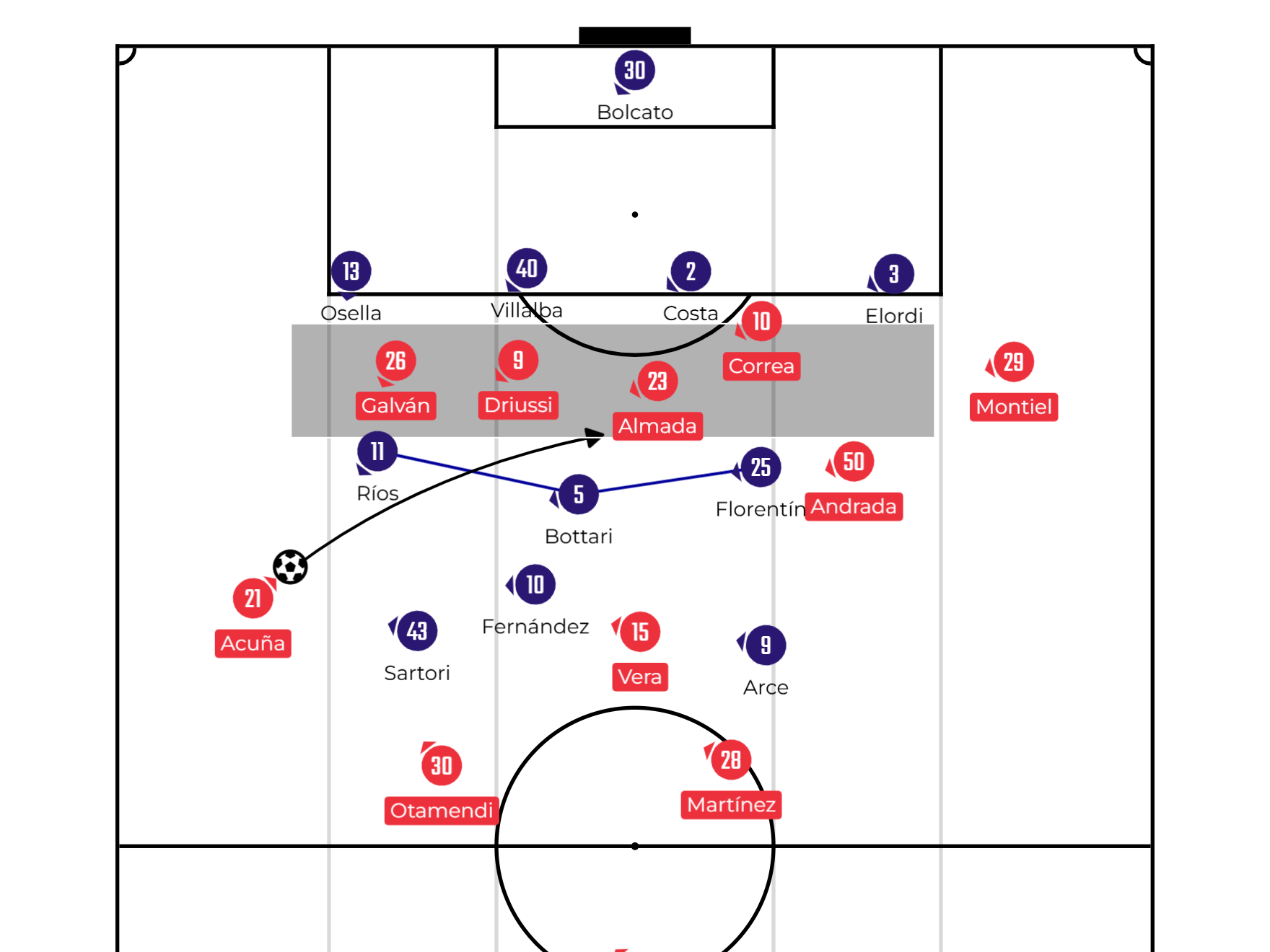
Rivadavia’s midfield three failed to limit the spaces in between the lines. River often used these opportunities to combine with one-two passes in behind. Driussi, Correa, Almada, and Galvan loved to occupy these areas.
River accessed the spaces between the lines to attack Rivadavia.
River generated multiple chances from combining with one another but failed to convert these opportunities past the goalkeeper. River scored a second goal and it came from the combinations between the lines. Correa and Almada combined between the lines before Almada’s shot was saved by the goalie. Galván’s put-back gave River a two goal advantage.
After River’s second goal, Rivadavia generated momentum through crosses into the box. With the physical presence of Arce, Satori and Fernández, River couldn’t cope with the short term pressure. Beltrán’s saves were able to keep the margin at two goals for a period of time, but it wasn’t long before Rivadavia punished their opponents with these same crosses.
Arce was able to head the ball into the back of the net after Florentin’s header from the backpost. Rivadavia’s goal brought them back to life and with River slowly fading out of the game, Rivadavia got confident.
River Plate needed to hold on to the result with the way the game swung heavily away from them. Galvan added another to his tally in the game, scoring a curler from the edge of the box. This goal highlighted the importance of Galván’s positioning between the lines showing his quality to execute in those moments.
The third goal sealed the game for River Plate and ensured the three points before the referee blew for the full time whistle.
Takeaways
River Plate’s 3-1 victory over Independiente Rivadavia was built around their ability to exploit spaces between the lines and use positional rotations to unsettle the opposition. Leonardo Ponzio’s 4-1-3-2 structure gave River a strong presence through the centre, with Tobias Andrada and Tomás Galvan moving inside while the fullbacks pushed forward to provide width. Their movements repeatedly created difficult decisions for Rivadavia’s defenders and midfielders.
Andrada’s tendency to drop alongside Fausto Vera was particularly effective in the build-up, creating a temporary double pivot and allowing River to progress possession. Meanwhile, Galvan and the other attacking players occupied spaces between the lines and in the half-spaces. Rivadavia’s midfield three struggled to control these areas, allowing River to combine through quick one-two passes and generate several opportunities.
Angel Correa was another important factor. His movement between the lines made him difficult to track, while his pace in transition provided River with a direct outlet alongside Sebastián Driussi. His individual run that won the penalty for River’s opening goal highlighted his influence on the match.
Rivadavia responded strongly after the second goal, using crosses to exploit River’s difficulties defending aerial situations. Arce’s header reduced the deficit and shifted momentum towards the visitors. However, River remained composed enough to withstand the pressure before Galván’s excellent curling finish from the edge of the box restored their two-goal advantage and sealed the victory.
For River, the result provides valuable momentum under Ponzio, giving him back-to-back victories in his opening two matches and moving the team closer to the playoff positions. For Rivadavia, the defeat ends their three-game unbeaten run and exposes defensive weaknesses that must be addressed, particularly their inability to control spaces between the lines and deal with River’s positional rotations.

Comments