

Botafogo – Palmeiras: Another poor performance and dropped points finally cost Palmeiras the lead (0-0)
After several rounds and spending almost the entire year at the top of the Brasileirão, Palmeiras finally paid the price for their negative run of results and performances by drawing with Botafogo, who are also going through a difficult spell, on Matchday 26. In a very physical match, it was possible to see the weaknesses that caused Palmeiras to lose their advantage, as well as some new ideas from a Botafogo side led by an interim coach.
Tactical analysis and match report by Marcus Arboés.
Botafogo have recently dismissed two coaches and are now under interim coach Rodrigo Bellão, known for being an excellent developer of young players, who had been coaching Botafogo’s U20 team. Under him, the team have been experimenting and making changes, finally trying to find a path forward for a group that has struggled to win matches in the Brasileirão. He lined Botafogo up in a 4-4-2 outline: Gabriel Batista in goal; Vitinho (former Burnley), Ferraresi, Monzon and Marçal (former Wolves) in the back line; Danilo Santos (Brazil National Team) and youth player Huguinho as the holding midfielders; Montoro as the left midfielder, Villalba on the right wing and a front two of Arthur Cabral (former Benfica) and Danilo Pereira (former Rangers).
Palmeiras had built a considerable advantage at the top of the Brasileirão standings, but had been playing poorly and losing some matches. After recovering with a big win over Vasco and advancing in the cup competitions, Abel Ferreira still had adjustments to make. In this match, he focused more on controlling the midfield with a 4-3-3 formation, lining up with goalkeeper Carlos Miguel (former Nottingham Forest); center backs Gustavo Gómez (Paraguay National Team) and Barboza (former Botafogo); fullbacks Giay and Piquerez (Uruguay); Marlon Freitas (former Botafogo), Andreas Pereira (former Fulham) and Lucas Evangelista in midfield; Felipe Anderson (former Lazio) and Maurício (Paraguay) on the wings, with Flaco López as the target man.
Have Botafogo found a way forward?
Since taking interim charge of Botafogo, young coach Rodrigo Bellão had only lost in the Brasileirão, but he finally managed to earn a point, even though his team did not score, against one of the toughest opponents on the continent. Apparently, Bellão has found a way to organize his team that allows them to progress in a simple manner. It’s not flashy and is very direct, but it created good attacking situations for a team whose confidence is currently very low.
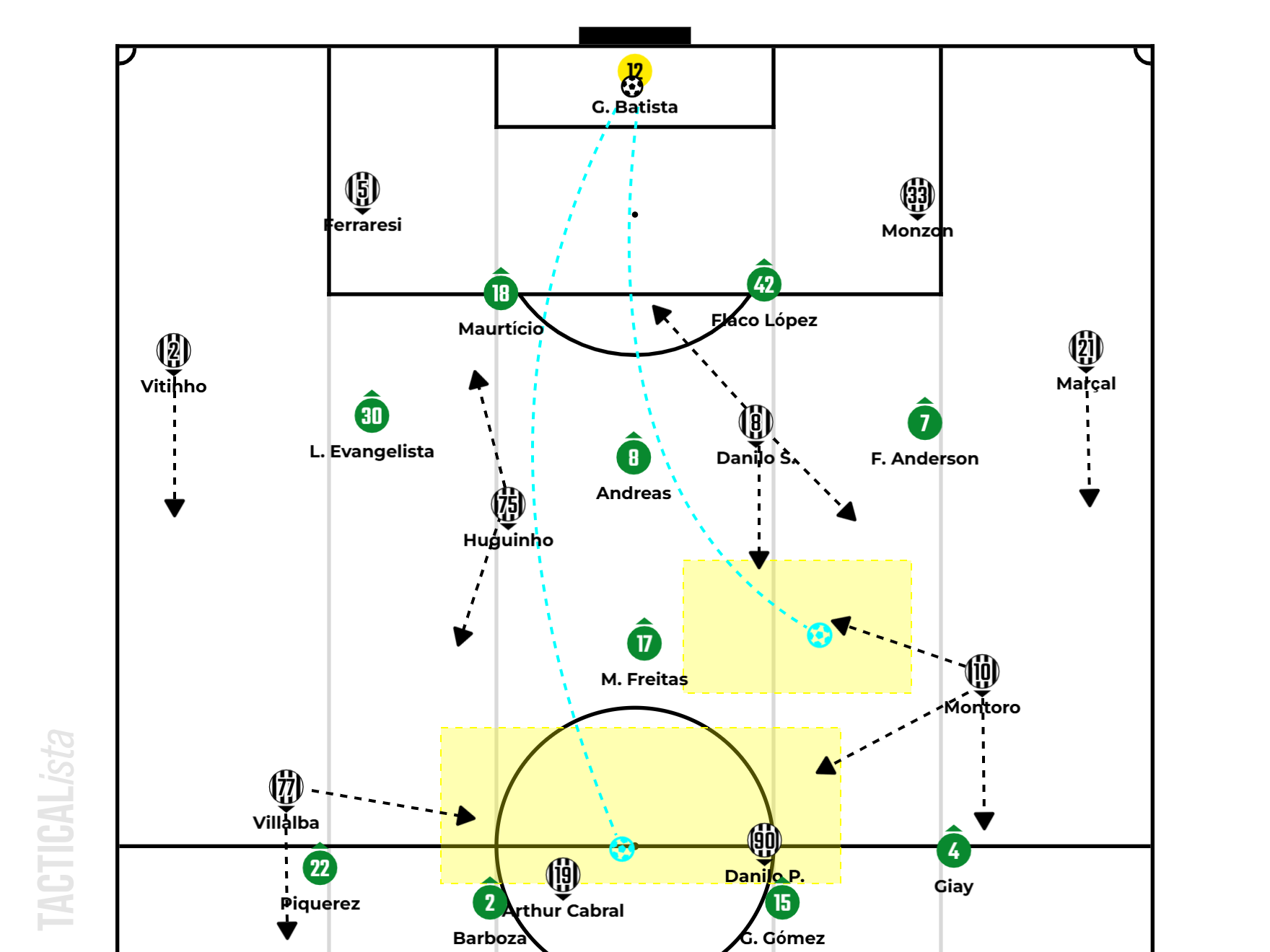
Botafogo’s build-up in an asymmetrical 4-4-2 formation, playing long balls behind Palmeiras’ midfielders in a 4-1-3-2 shape.
At home and in possession, Botafogo seemed to have a very clear game plan: exploit the space behind Palmeiras’ defense. This had become a considerable weakness for Abel Ferreira’s side in recent matches. When building short, which was rare, goalkeeper Gabriel Batista and the center backs looked for the fullbacks as supporting options to free the holding midfielders. Danilo Santos and Huguinho, a major surprise from the youth academy, varied their positions and heights, always looking to create an advantage for one another.
However, this movement was designed to attract Palmeiras’ high press. In a 4-1-3-2 shape, the visitors looked to press the build-up through man-oriented marking. When you choose this system to press high, it’s important to consider how the holding midfielder, positioned behind the second line, will protect the space, because any defensive shift forces him to move horizontally.
So, on several occasions, Botafogo started their build-up down the right, Palmeiras shifted across, forcing Marlon Freitas to protect the second line against a possible forward movement from Huguinho. Botafogo then played the return pass to Gabriel Batista, who sent a long ball toward the opposite side, where Montoro dropped precisely into the blind side of Andreas, Marlon Freitas and Felipe Anderson, creating confusion for Giay.
To put Montoro in a favorable situation, Arthur Cabral, Danilo Pereira and Villalba pinned and dragged the last line. The target man duo was chosen precisely because of their ability to win aerial duels while also attacking depth and holding up the ball for players arriving from behind, either Montoro or the holding midfielders. Giay did not step out to press Montoro, probably because Palmeiras would have been left three against three in the last line in a potential aerial duel. This allowed Botafogo’s young number ten to become heavily involved.
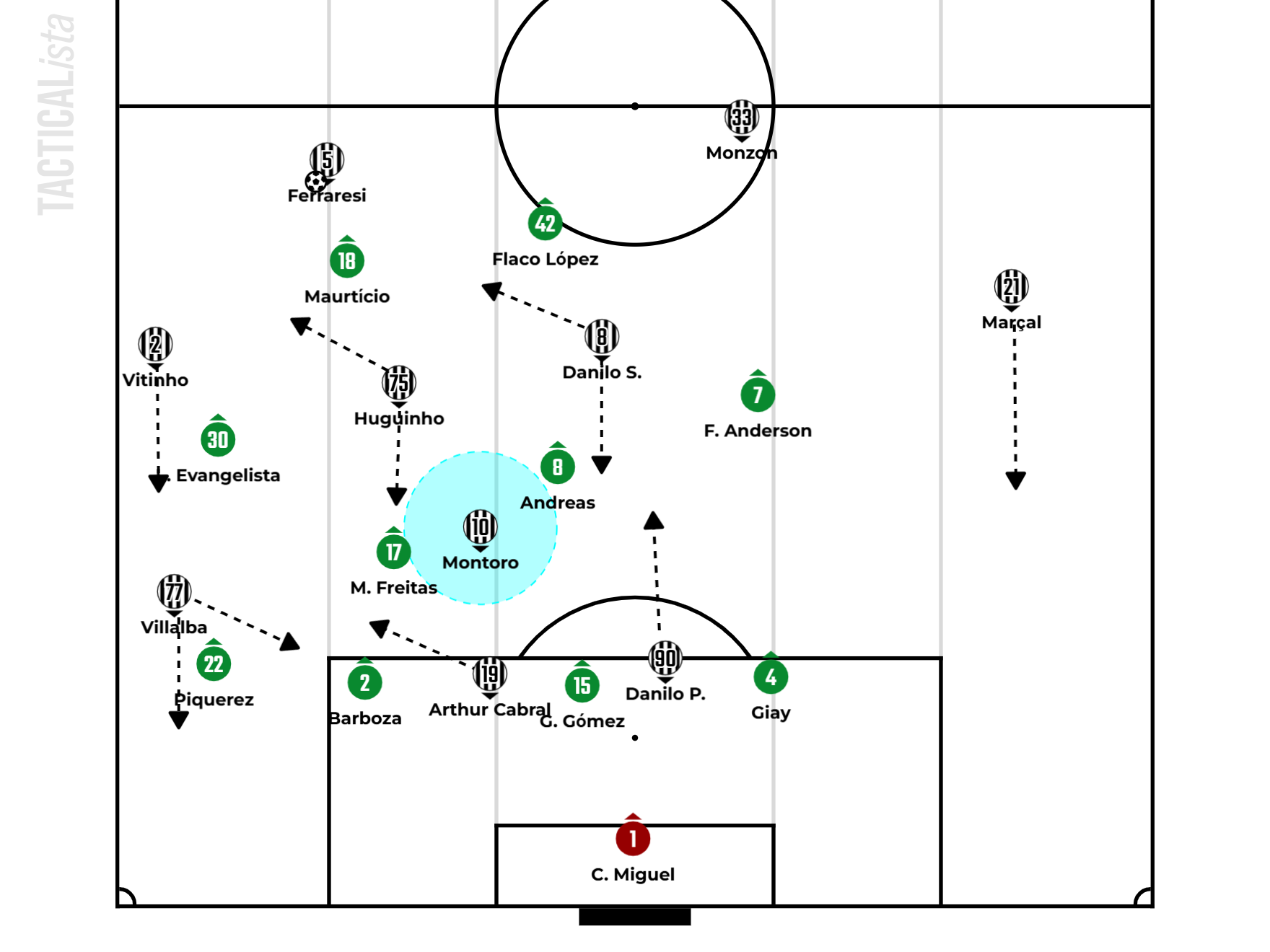
Botafogo attacking in an asymmetrical 4-4-2 shape against Palmeiras’ man-oriented defense in a 4-4-2 formation.
Most of Botafogo’s attacks came from offensive transitions, quick attacks starting from the build-up through Danilo, Huguinho and Montoro, or long balls looking for the forwards. However, at certain moments of the match, it was possible to see some of the team’s new ideas within a slightly more functional/relational asymmetrical 4-4-2 shape.
If I am not mistaken, every sustained attack in the opposition half started down the right. Villalba remained wide as a right winger, the center forwards alternated between dropping to provide support and occupying the box, while the fullbacks did not advance much, except when an opportunity appeared. In contrast, both holding midfielders were involved in the final third, alternating between carrying the ball, making forward runs and contributing to the build-up and quick circulation of possession.
The key to giving Botafogo’s build-up this asymmetrical profile was Montoro, who started as the left midfielder but became a free playmaker inside, moving around and influencing the game wherever he wanted, creating some confusion in Palmeiras’ defensive matchups through quick passing combinations. Unlike in the match against Fluminense, Botafogo did not use quick switches of play after gathering players on one side of the pitch, which could have exposed a weakness in Palmeiras’ defensive shifting when defending in a low block.
While Palmeiras were better defensively than in some of their other recent matches, offensively they still left a lot to be desired. It’s no coincidence that they lost the Brasileirão lead.
There’s no sauce in Palmeiras’ attack
Over the past few years, Palmeiras have been extremely successful under Abel Ferreira, which is undeniable and unquestionable, but there have been several periods in which the team fluctuated and produced highly questionable performances. That is happening again, this time accompanied by dropped points both at home and away. Almost every time, Palmeiras look like a repetitive team, overly reliant on their own attacking patterns, but Abel is trying to find solutions.
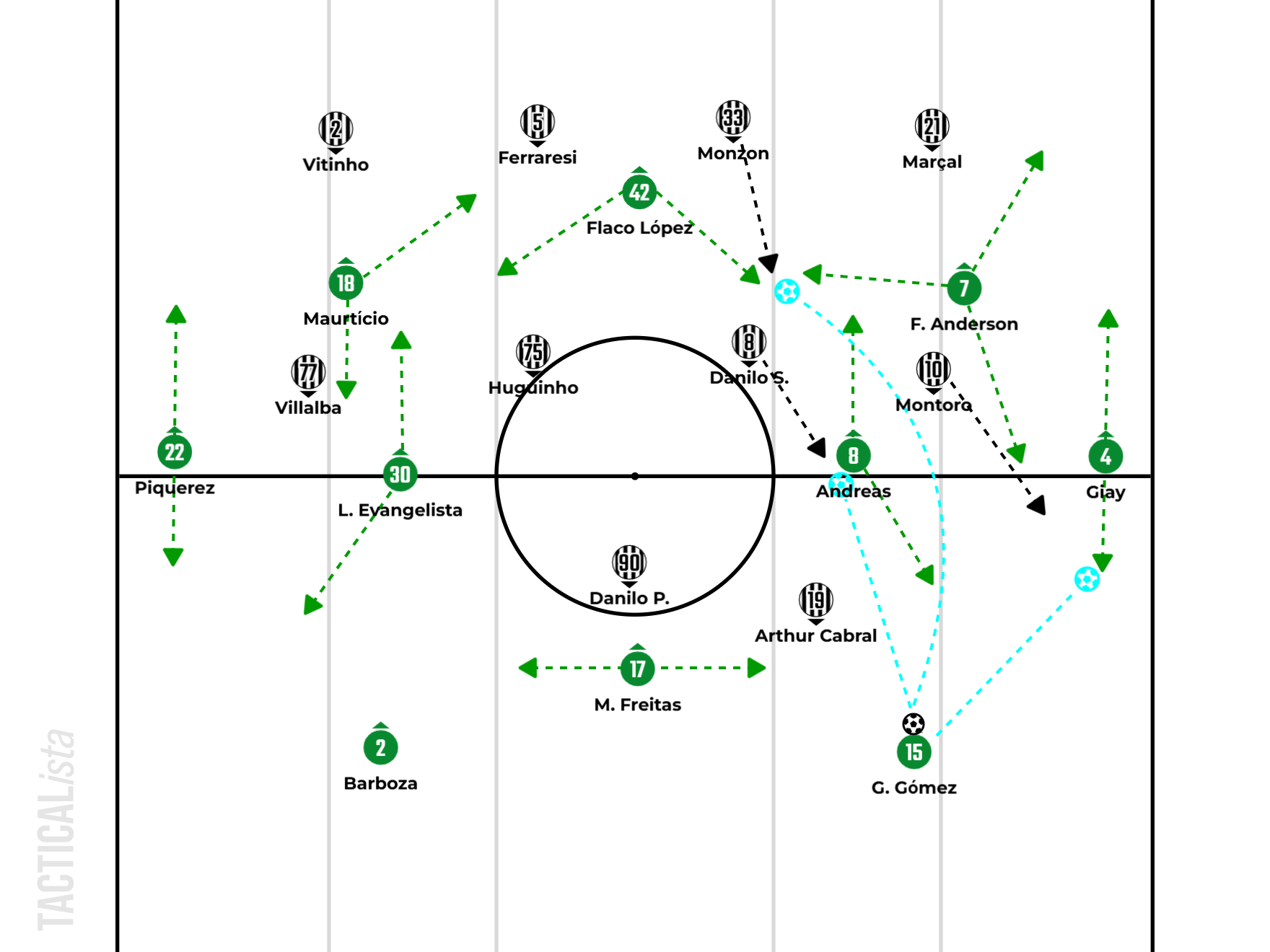
Palmeiras attacking in a 4-3-3 outline against Botafogo’s pressing zonal defense in a 4-4-2 formation.
For most of the match, Palmeiras had more possession than Botafogo, but couldn’t be effective. The team organized themselves in a positional 4-3-3 outline. Marlon Freitas was the holding midfielder closest to the center backs, always drifting toward the side from which the team was building up while providing defensive cover. Andreas Pereira and Lucas Evangelista alternated between dropping into wider positions to create an advantage in the build-up, providing support for the wide players or attacking space inside.
The wide channels belonged to the fullbacks, who made forward runs into space to receive conditioned long balls and cross into the box. The three forwards had plenty of freedom to interchange positions and provide support in available spaces, especially Flaco López, who appeared across every channel. Felipe Anderson was very active, dropping to receive during the early stages of the build-up so that Giay could push forward as a winger.
However, most of their attacks were well neutralized. In a 4-4-2 shape, Botafogo did not press the ball carrier, instead moving as a compact and well-coordinated block, closing down the receiver of the pass and creating discomfort, particularly for the center backs and the two holding midfielders. In practice, despite all the movement and close combinations, Palmeiras created very little until the first third of the second half.
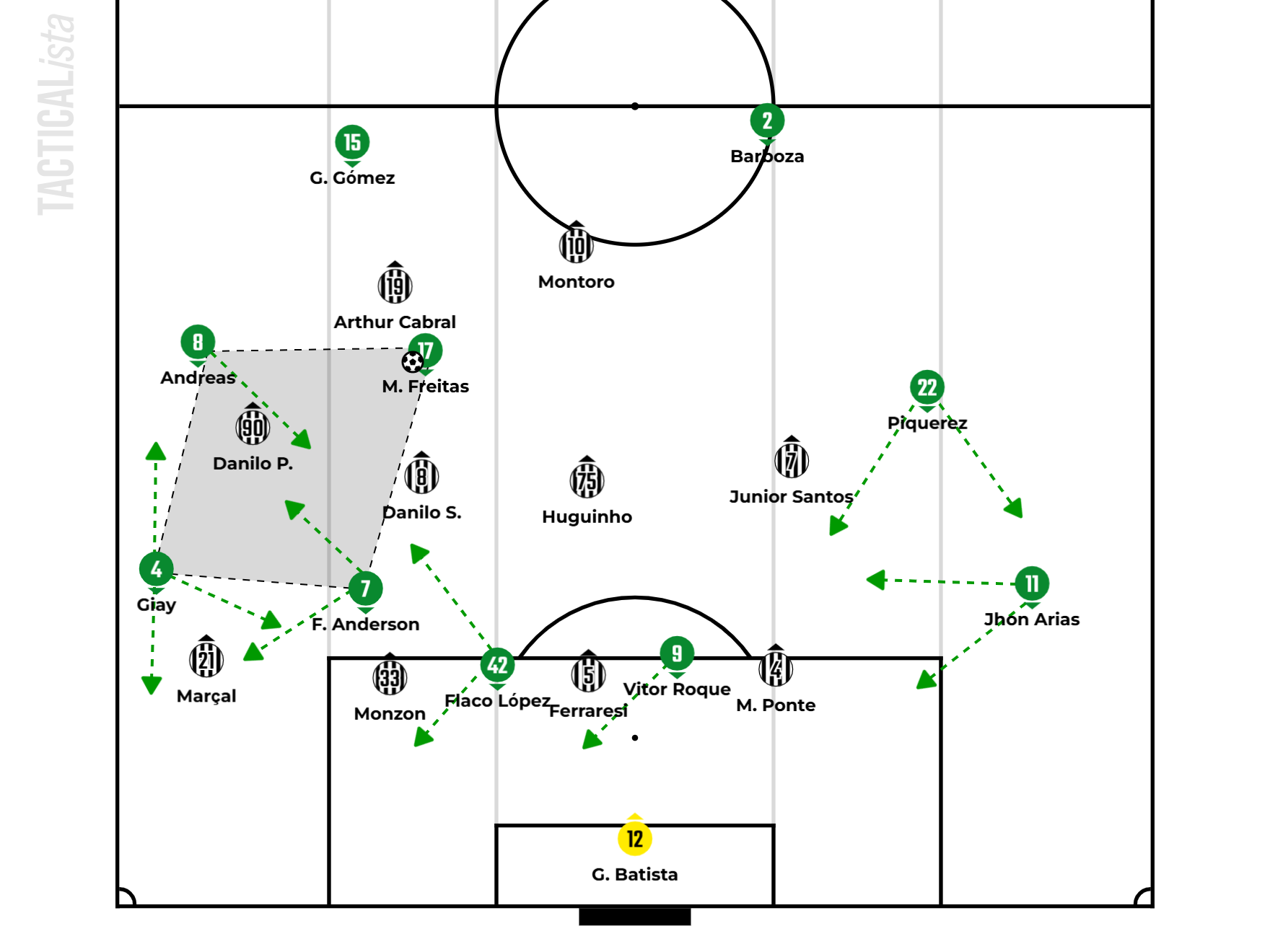
Abel Ferreira changes Palmeiras into a 4-2-4 formation to focus on crosses.
The second half started at an extremely high tempo, but not in a good way. Both teams forced transitions and long balls, a lot was happening, but there was very little effectiveness from box to box. At one point in the second half, Palmeiras were managing to create advantages out wide through close combinations, freeing Giay and Felipe Anderson, in particular, to cross into the box, but they did not have enough attacking presence to take advantage of those opportunities.
So, the coach abandoned the three-midfielder structure, taking off Lucas Evangelista and bringing on Vitor Roque as another striker. He also replaced Maurício, who is a player better suited to operating inside, with Jhon Árias, who is more versatile, incisive and capable in one against one situations to deliver crosses when attacking from the left wing.
As a result, the team switched to a positional 4-2-4 that tried to attack by combining four players out wide. Usually, these were Giay, Felipe Anderson and at least one of the holding midfielders or one of the forwards. Positional rotations, movements to drag defenders away and triangular combinations created spaces for someone to cross into the box. Bellão responded with individual rather than structural changes. He removed Montoro from the second defensive line and changed the entire right side.
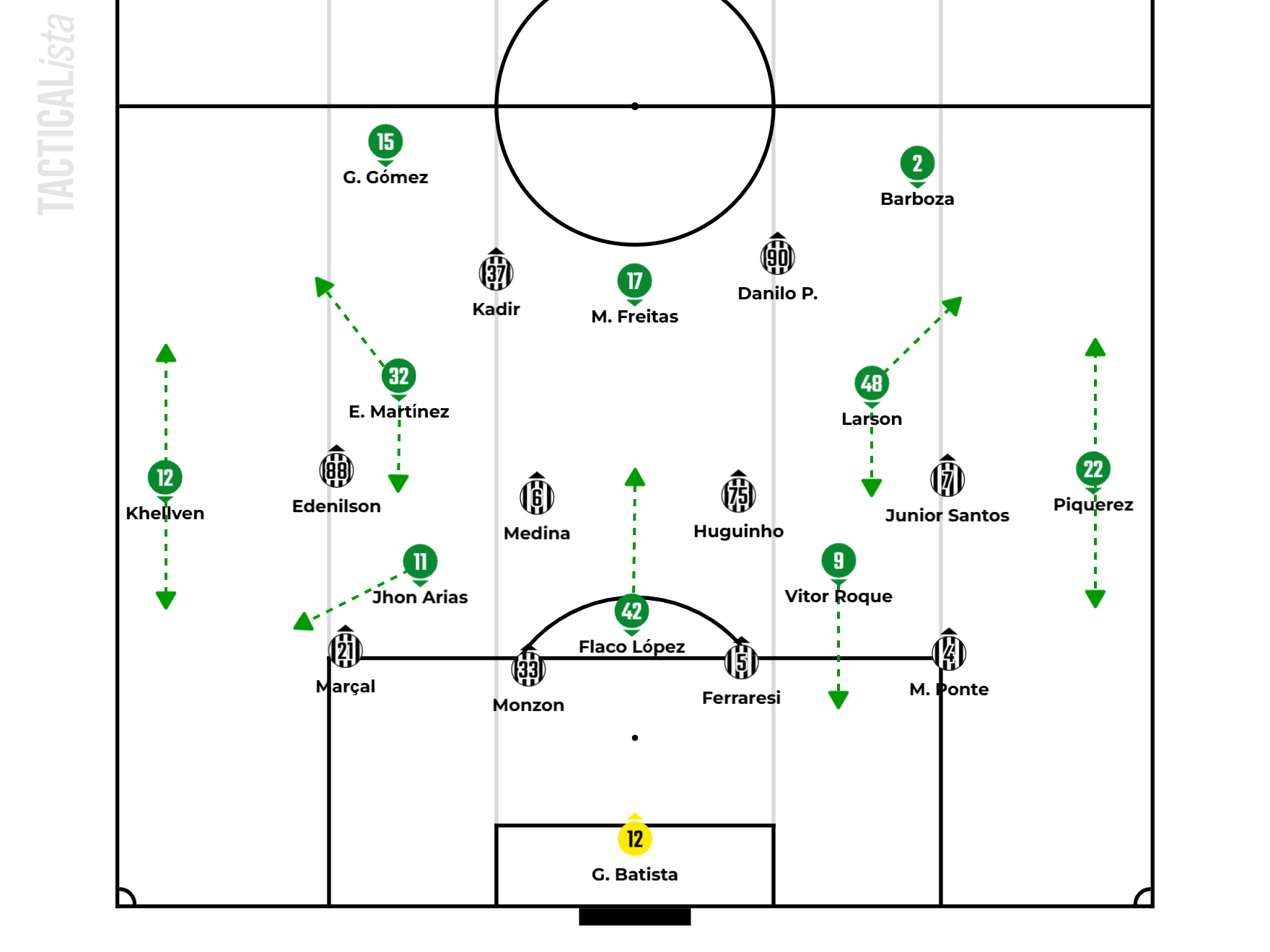
The tactical scenario late in the second half, with Palmeiras returning to their initial system.
In the closing stages of the match, still without success, Abel Ferreira brought on Khellven, a more attack-minded fullback, to have the fullbacks providing width and Jhon Arias operating inside alongside the two forwards. The major question, and something that must have caused some frustration, was that he sacrificed Felipe Anderson to bring on Martínez, who sometimes even plays as a center back, to reinforce the midfield, win more second balls and help with connections through longer passes. The attacking system returned to a 4-3-3 formation.
Botafogo, on the other hand, only made personnel substitutions without changing their defensive tactical structure, although they did change the players’ characteristics, now having three holding midfielders and a right winger on the pitch. Junior Santos became the playmaker for their counterattacks, with Kadir and Danilo Pereira looking to make runs in behind. Medina, who replaced Montoro in attack, became the player with the greatest freedom of movement and influence on their attacks.
Takeaways
Nothing worked for either side, but Botafogo showed more signs of progress, even though they continue to drop points and lose positions in the standings, with their winless run only getting longer. Now in 14th place, they will face Bragantino in the next round.
Palmeiras watched Flamengo gradually close the points gap and finally, after chipping away at it round by round, take first place in the Brasileirão. Their run of two consecutive draws proved costly. Now, they will need to beat São Paulo, one of their biggest rivals, on Matchday 27. Before that, however, they face Ecuador’s LDU in the Copa Libertadores.


Comments