

Real Madrid – Inter: Pressing Moments Shape Mourinho’s Champions League Return With Madrid (2-1)
José Mourinho’s Real Madrid opened their Champions League campaign against an Inter side that enjoyed greater possession and midfield control. Madrid’s compact structure closed the central spaces before using selective pressing triggers and quick transitions to exploit weaknesses in Inter’s build-up, producing two early goals. Inter responded through wide overloads and sustained pressure, while Madrid increasingly relied on defensive organisation and counter-attacks to protect their lead. The 2-1 victory offered an early glimpse of Mourinho’s influence, with pressing moments, compactness and transition play defining Madrid’s approach.
Tactical analysis and match report by Mustafa Hassan.
Real Madrid began José Mourinho’s Champions League campaign with his 4-2-3-1 system, using a double pivot to provide structure in midfield and support their defensive organisation. Thibaut Courtois started in goal behind Denzel Dumfries, Ibrahima Konaté, Dean Huijsen and Marc Cucurella, who formed the defensive line. Trent Alexander-Arnold and Federico Valverde operated as the midfield double pivot, while Brahim Díaz, Jude Bellingham and Vinícius Júnior supported Kylian Mbappé, who led the attack.
The structure allowed Madrid to maintain a compact shape without the ball, with Trent and Valverde protecting the central areas while Bellingham could move higher to support the press. Brahim and Vinícius provided width and transition outlets, while Mbappé offered a direct threat against Inter’s defensive line. This structure became particularly effective when Madrid triggered pressure around Inter’s build-up, turning defensive recoveries into rapid attacking transitions.
Inter, meanwhile, lined up in a 3-5-2 formation under Cristian Chivu. Josep Martínez started in goal behind Benjamin Pavard, Yann Bisseck and Alessandro Bastoni, who formed the back three. Andy Diouf and Carlos Augusto operated as the wing-backs, while Nicolò Barella, Hakan Çalhanoğlu and Curtis Jones formed the midfield three. Lautaro Martínez and Marcus Thuram led the attack.
Chivu’s structure provided Inter with numerical superiority through midfield and allowed the wing-backs to advance high, creating overloads in wide areas. Barella, Çalhanoğlu and Jones helped Inter circulate possession centrally before progressing towards the flanks, while Bisseck could step forward from the back three to support attacks. However, the structure also left spaces behind the advancing wing-backs and exposed weaknesses during Madrid’s pressing moments and quick transitions.
Madrid’s Pressing Trap Targeted Inter’s Build-Up
Real Madrid’s opening goal wasn’t simply the result of an individual mistake from Yann Bisseck, but the product of a carefully constructed pressing trap designed to direct Inter’s build-up towards the German centre-back.
Madrid appeared to recognise that Bisseck was less comfortable when receiving under pressure, particularly when required to control the ball and make his next decision quickly. His first touch could become loose when pressed aggressively, while he often needed an extra moment on the ball before finding his next pass. Madrid used these tendencies to determine where their pressure would eventually arrive.
The initial structure was particularly clever. Vinícius Júnior positioned himself close to Pavard in the left half-space, while Bellingham occupied the central channel alongside Çalhanoğlu. On the opposite side, Brahim Díaz remained close to Bastoni in the right half-space. Meanwhile, Valverde initially appeared to run towards Barella in the central channel, creating the impression that he was simply following the nearest midfield option. Instead, Valverde suddenly continued his run towards Josep Martínez, creating a much more aggressive pressing angle.
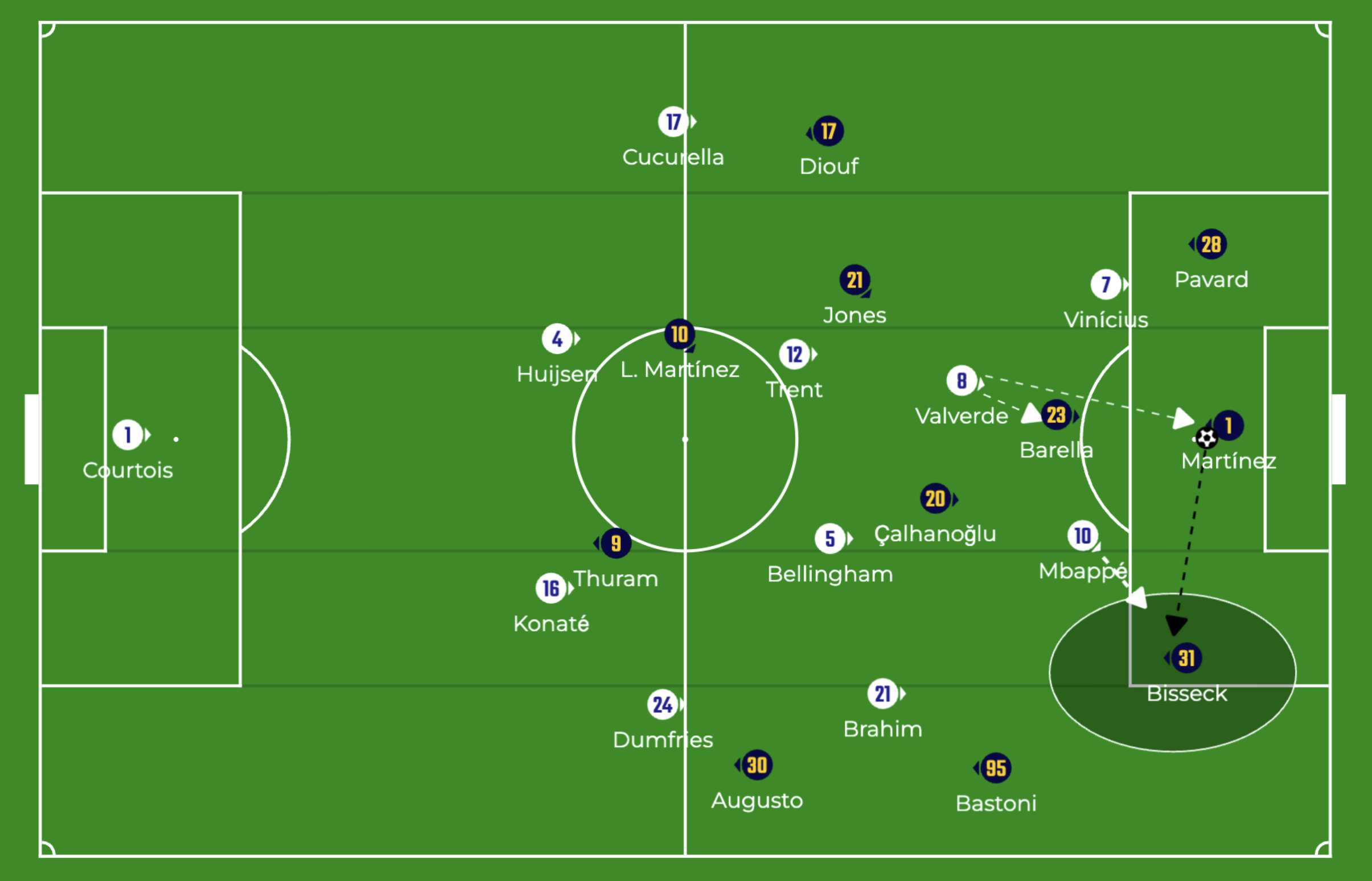
Real Madrid’s pressing structure was designed to steer Inter’s build-up towards Bisseck, with Valverde disguising his initial pressure before jumping onto the goalkeeper.
This movement was important because it disrupted the goalkeeper’s decision-making. Valverde’s sudden acceleration made the pass to Barella less attractive, while Mbappé deliberately moved slightly away from Bisseck.
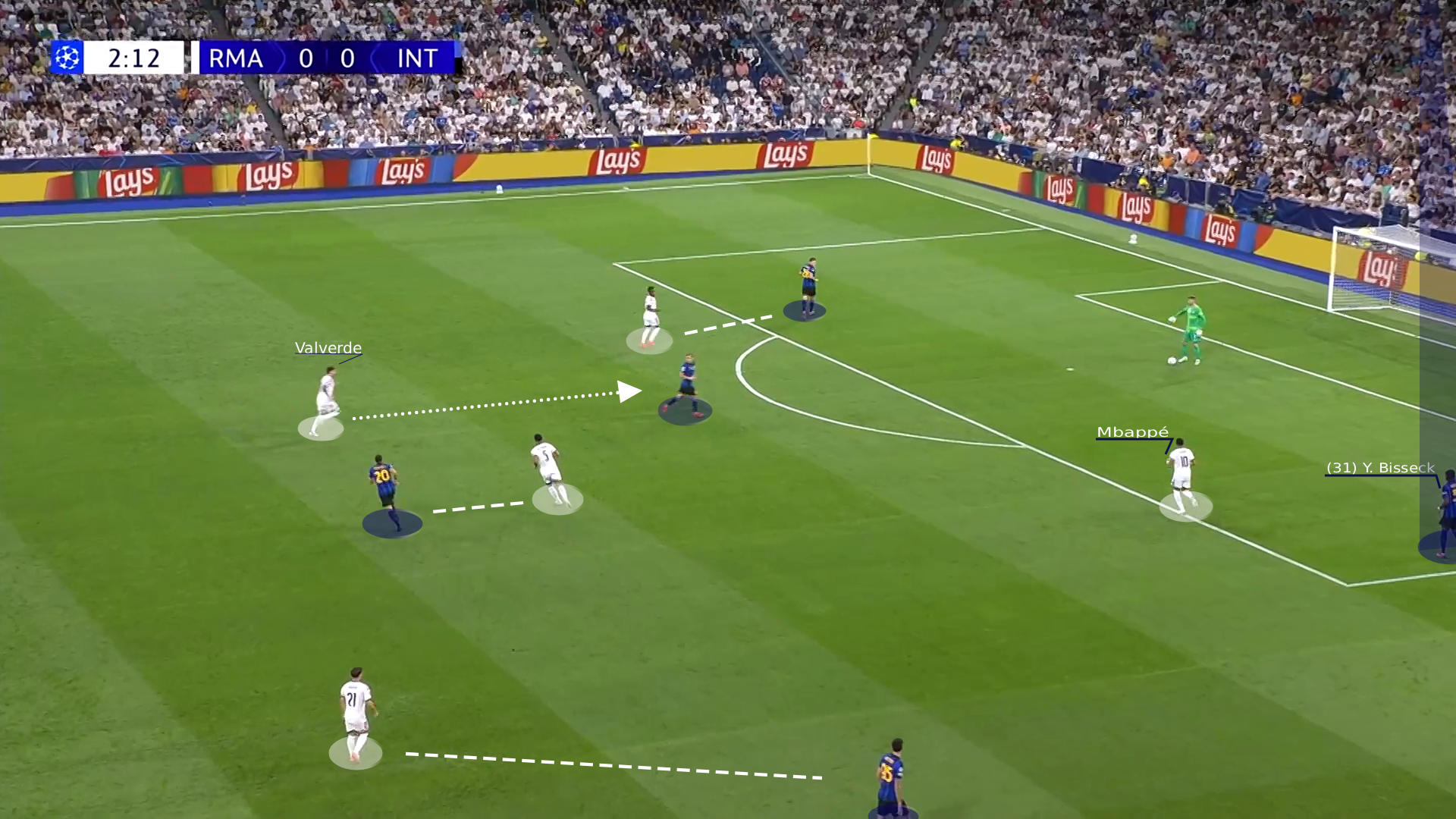
Valverde’s sudden acceleration towards Martínez disrupted Inter’s passing options, while Mbappé’s movement away from Bisseck helped make the centre-back appear available.
By doing so, the Frenchman appeared to leave Bisseck as a potential passing option, effectively inviting Martínez to play towards him. Once the goalkeeper committed to that route, Mbappé could immediately accelerate towards the receiver and turn the apparently available pass into the pressing trigger. The target was therefore not necessarily the player who initially appeared most vulnerable, but the player Madrid wanted Inter to find.
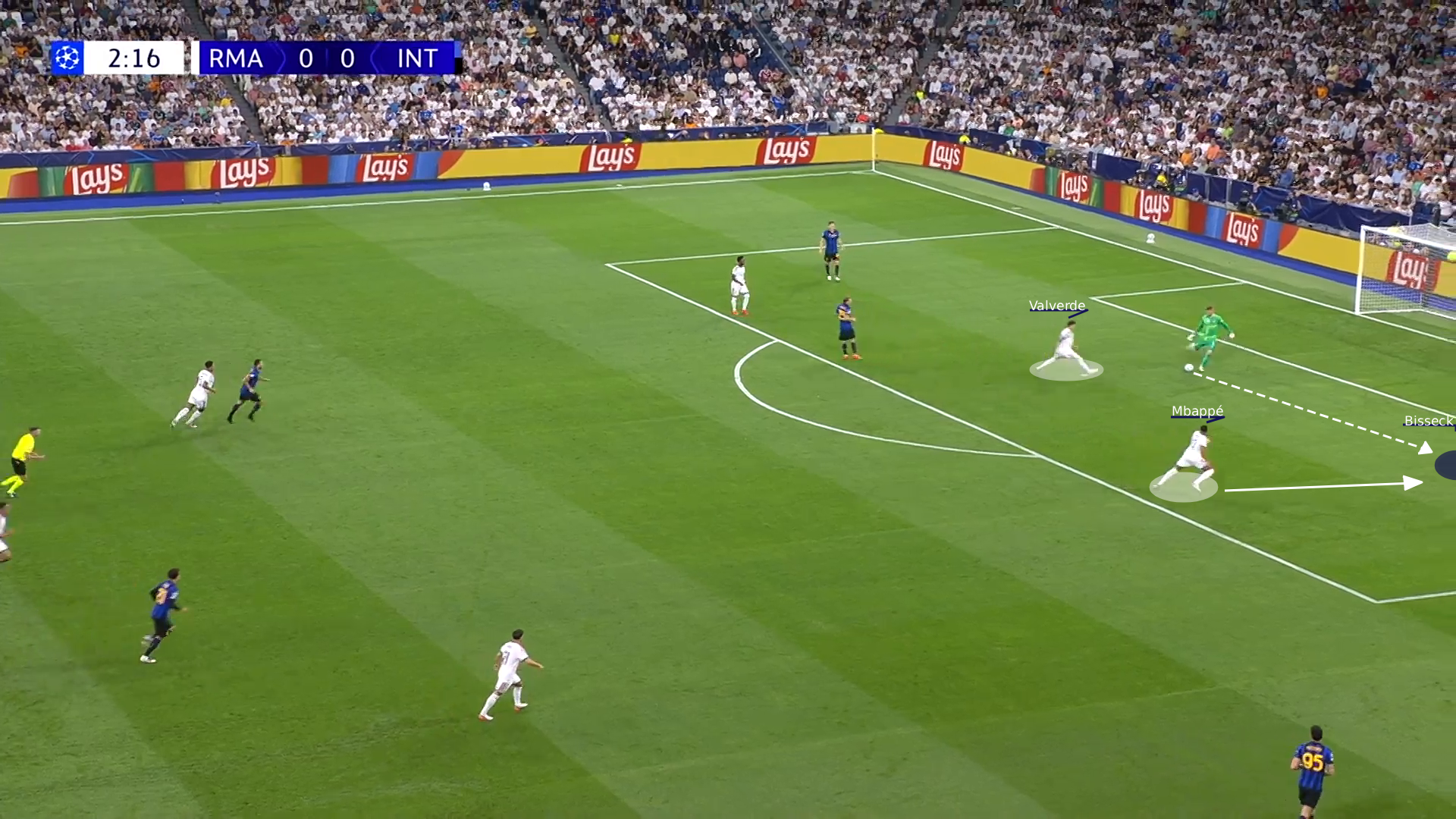
Mbappé deliberately left the passing lane to Bisseck open, allowing Madrid to turn Inter’s preferred escape route into the trigger for their next pressing action.
The same principle produced the opening goal. As Curtis Jones received possession in the left pocket, Trent Alexander-Arnold stepped forward to press his former Liverpool teammate, with Vinícius moving closer to reinforce the pressure. Mbappé positioned himself so that the passing lane towards Bisseck remained available. Once the ball was played, Mbappé immediately accelerated towards Bisseck, forcing him to deal with the ball under pressure.
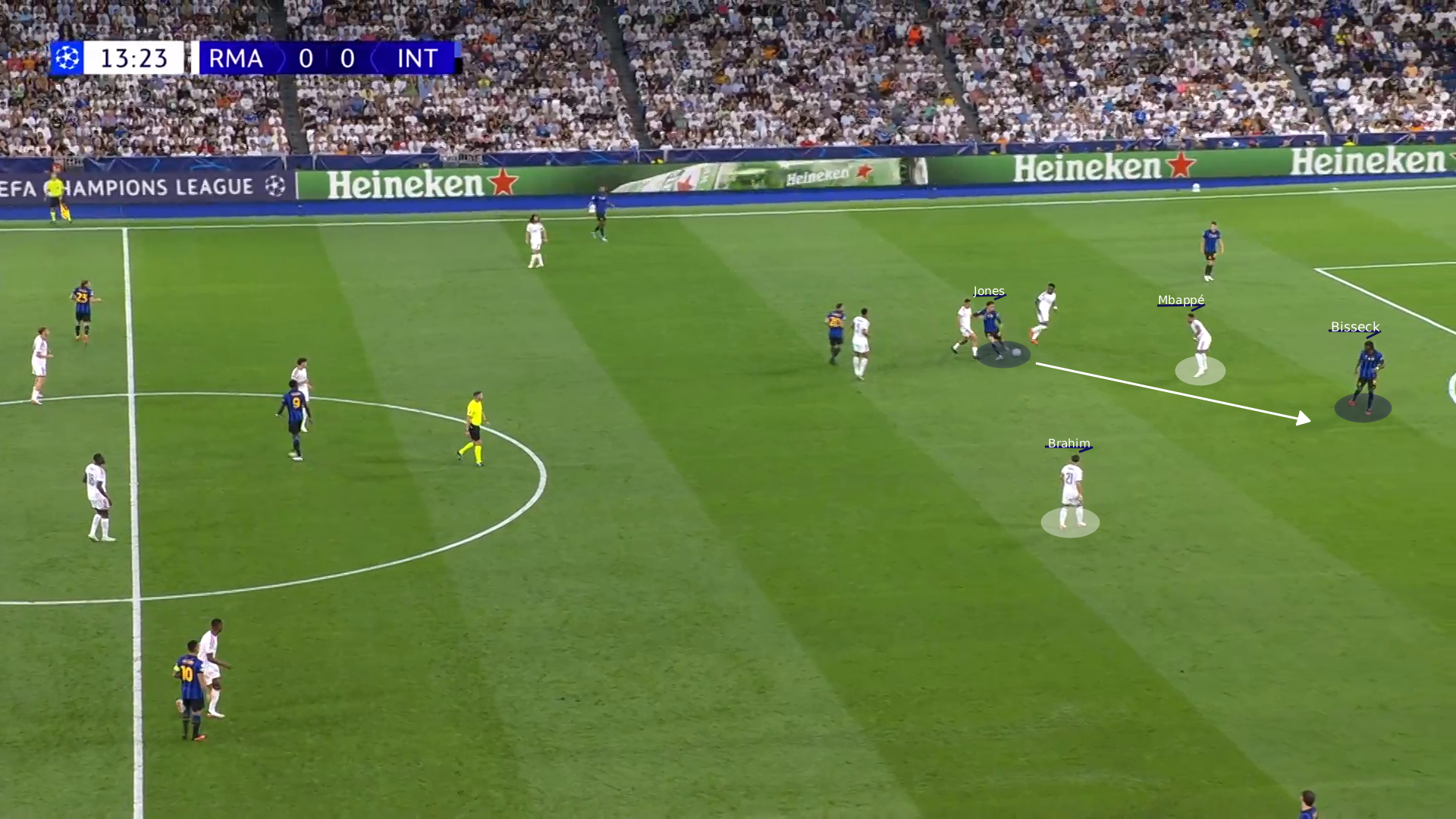
As Jones received in the left pocket, Alexander-Arnold and Vinícius intensified the pressure, while Mbappé positioned himself to attack Bisseck as soon as the pass was played.
The German’s poor touch and attempted clearance allowed Brahim Díaz to recover possession, before he quickly released Mbappé into the space behind the defensive line. Mbappé finished first time to give Madrid the lead, turning a deliberately engineered pressing situation into a goal.
This was the first clear indication that Mourinho’s side weren’t simply defending deep, but actively manipulating Inter’s build-up to create specific moments for pressure and transition.
Madrid’s Compactness Forced Inter Towards The Flanks
While Madrid’s pressing traps created opportunities higher up the pitch, their defensive organisation was built around a different principle, protecting the central spaces. Alexander-Arnold and Valverde were instructed to remain positioned centrally, regardless of Inter’s movements towards the flanks. This allowed Madrid to maintain their compactness and prevented Inter from using rotations to pull the midfield double pivot away from the centre.
Inter repeatedly attempted to manipulate this structure by moving players towards the wide areas, hoping to attract Madrid’s midfielders and subsequently open passing lanes through the middle. Madrid’s players largely resisted these movements, maintaining their central positions. The intention was clear, allowing Inter to progress towards the wings was preferable to opening the central corridors.
In this sense, Madrid’s defensive shape effectively turned Inter’s attempts to stretch them into a trap, as the visitors could circulate possession towards the flanks without achieving the central access they were seeking.
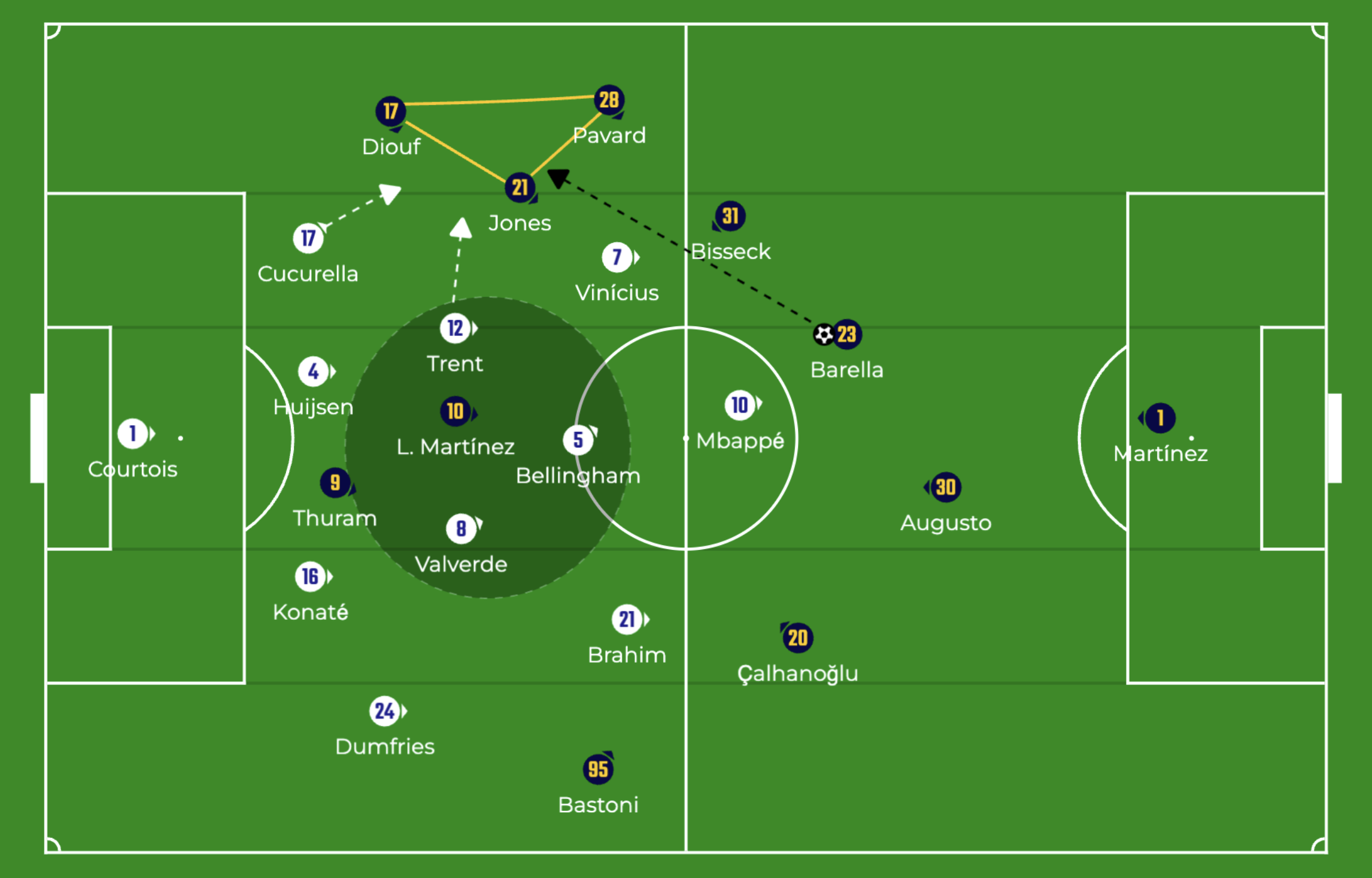
Alexander-Arnold and Valverde remained compact in the central spaces, refusing to follow Inter’s wide rotations and leaving the flanks as the visitors’ main route forward.
This compactness naturally encouraged Inter to increase the number of players involved in their wide attacks. With the central routes consistently blocked, the visitors needed to create their own numerical advantages closer to the touchline, particularly on the left.
Inter Wide Areas Overloading
As Madrid continued to protect the centre, Inter increasingly looked towards the left flank as their main route of progression. The pass map reflects this tendency, with a significant proportion of Inter’s passing activity developing through the left side. The visitors used rotations to progressively overload this area as the ball advanced.
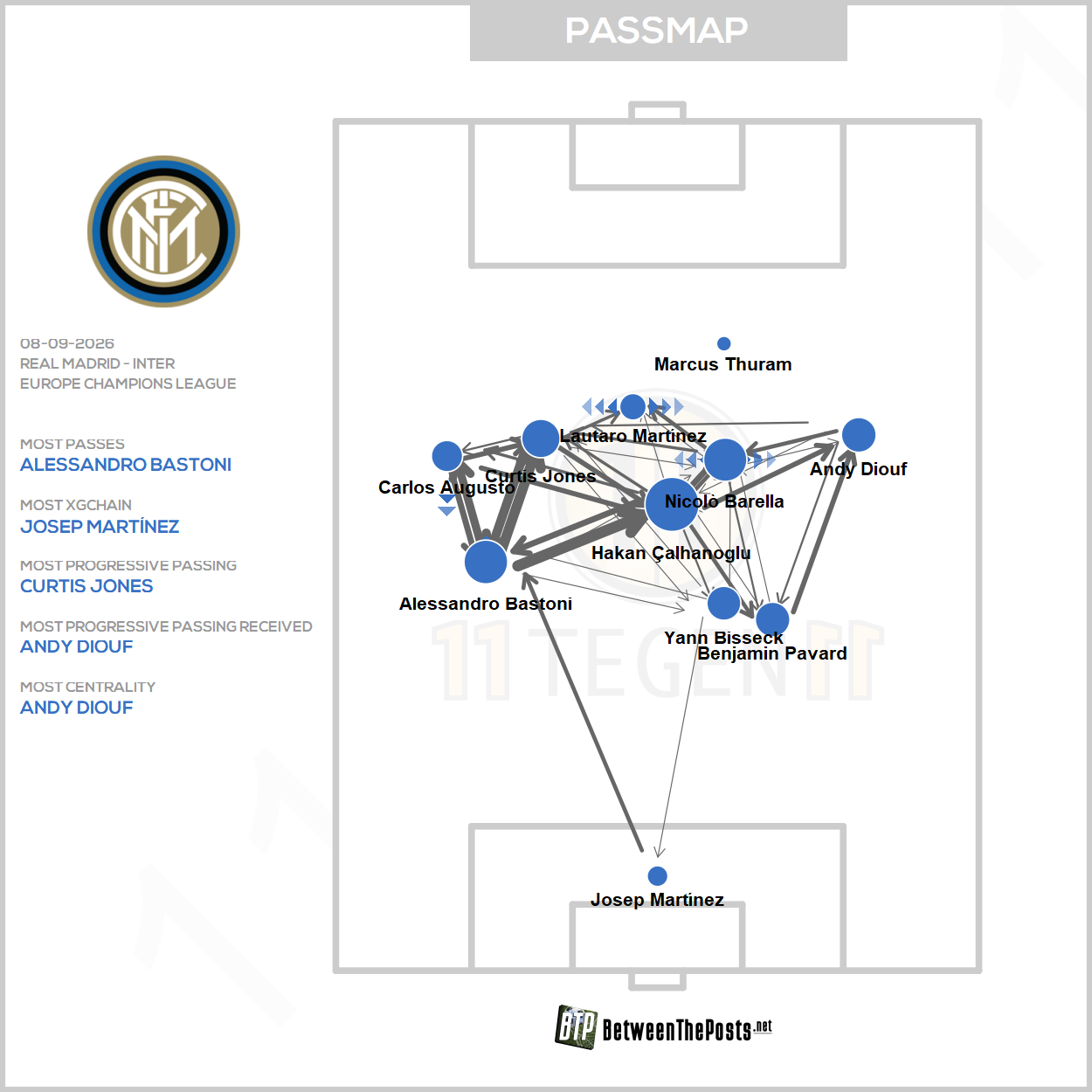
Inter’s pass map highlights the visitors’ preference for progressing through the left flank as Madrid consistently denied access through the centre.
Carlos Augusto and Curtis Jones could initially occupy the flank and half-space, while additional players joined as Inter moved into the final third. Çalhanoğlu would step across from the centre to provide another passing option, while Lautaro Martínez could drift towards the same side from the front line.
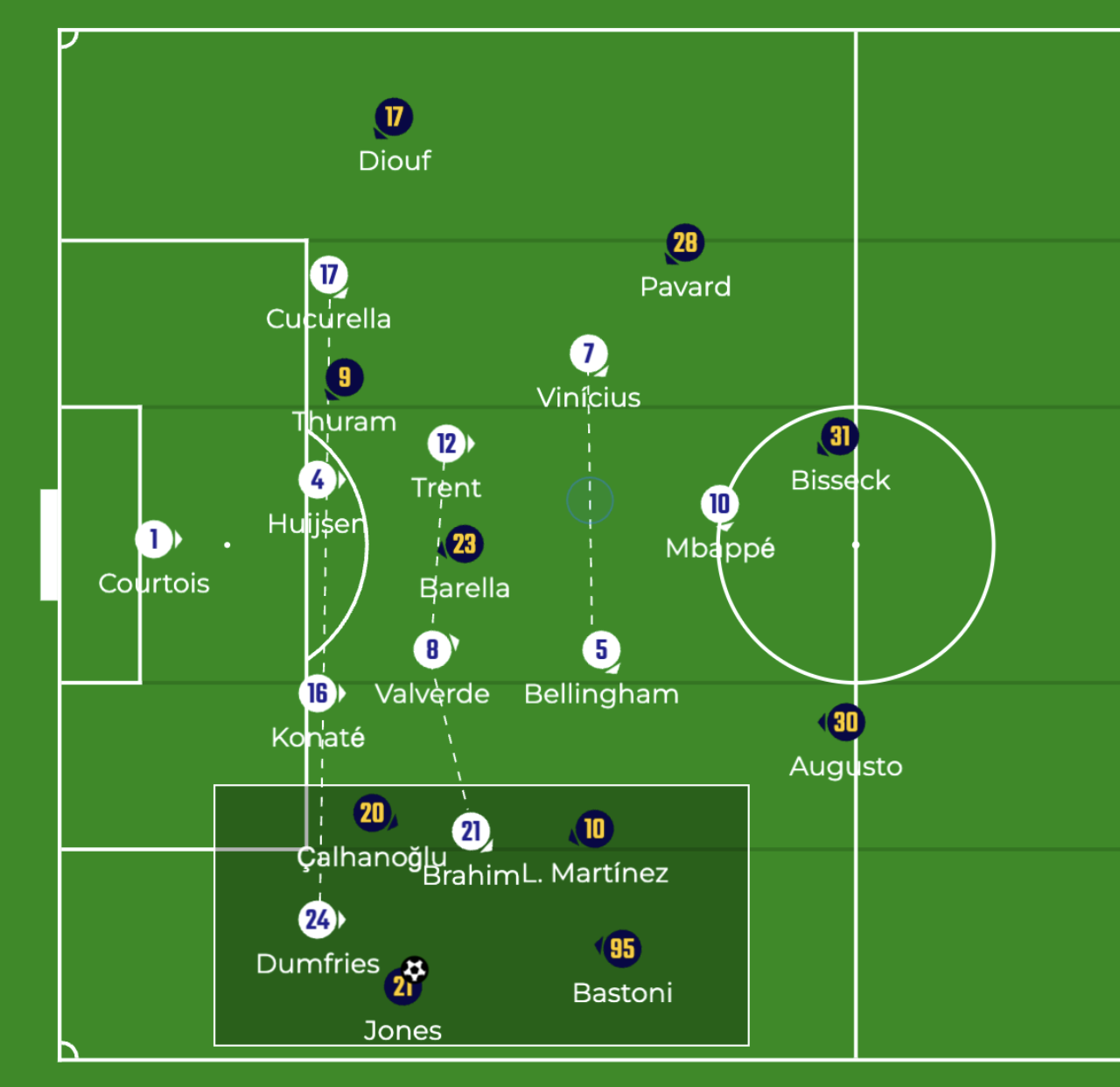
Çalhanoğlu and Lautaro joined Carlos Augusto and Curtis Jones on the left, creating rotating passing options and numerical advantages around the ball.
These movements allowed Inter to create temporary numerical superiority around the ball, repeatedly producing three-versus-two or four-versus-three situations against Madrid’s defenders.
The objective was to use these overloads to move the ball around Madrid’s compact block. Once the ball reached the final third, Inter’s rotations became particularly important, with players constantly exchanging positions to create an extra passing option and isolate Madrid’s defenders.
This approach generated most of Inter’s clearer attacking situations, as the visitors were able to use their numerical advantages on the flank to progress beyond Madrid’s first defensive line and deliver from more advanced positions.
Madrid’s Central Protection Backfired
The same defensive principle that had helped Madrid protect the centre eventually created the opening Inter needed, it was largely a consequence of Madrid becoming overly focused on protecting the central spaces as the ball progressed into the final third. With several Madrid players positioned tightly around the centre, the right side of Inter’s attack became increasingly open, leaving a large amount of space for the visitors to exploit.
As the ball moved towards this area, Bisseck recognised the available space and stepped forward from the back three to occupy it. His movement allowed Inter to progress into an advanced position without needing to break through Madrid’s compact central block.
Bisseck received the ball in space before finding Lautaro Martínez, who had moved towards the flank to support the attack. Lautaro’s positioning gave Inter another route forward and allowed the visitors to continue the move into the box.
From there, Lautaro played a cross into the penalty area. Carlos Augusto had attacked the available space inside the box and was able to meet the delivery and finish successfully.
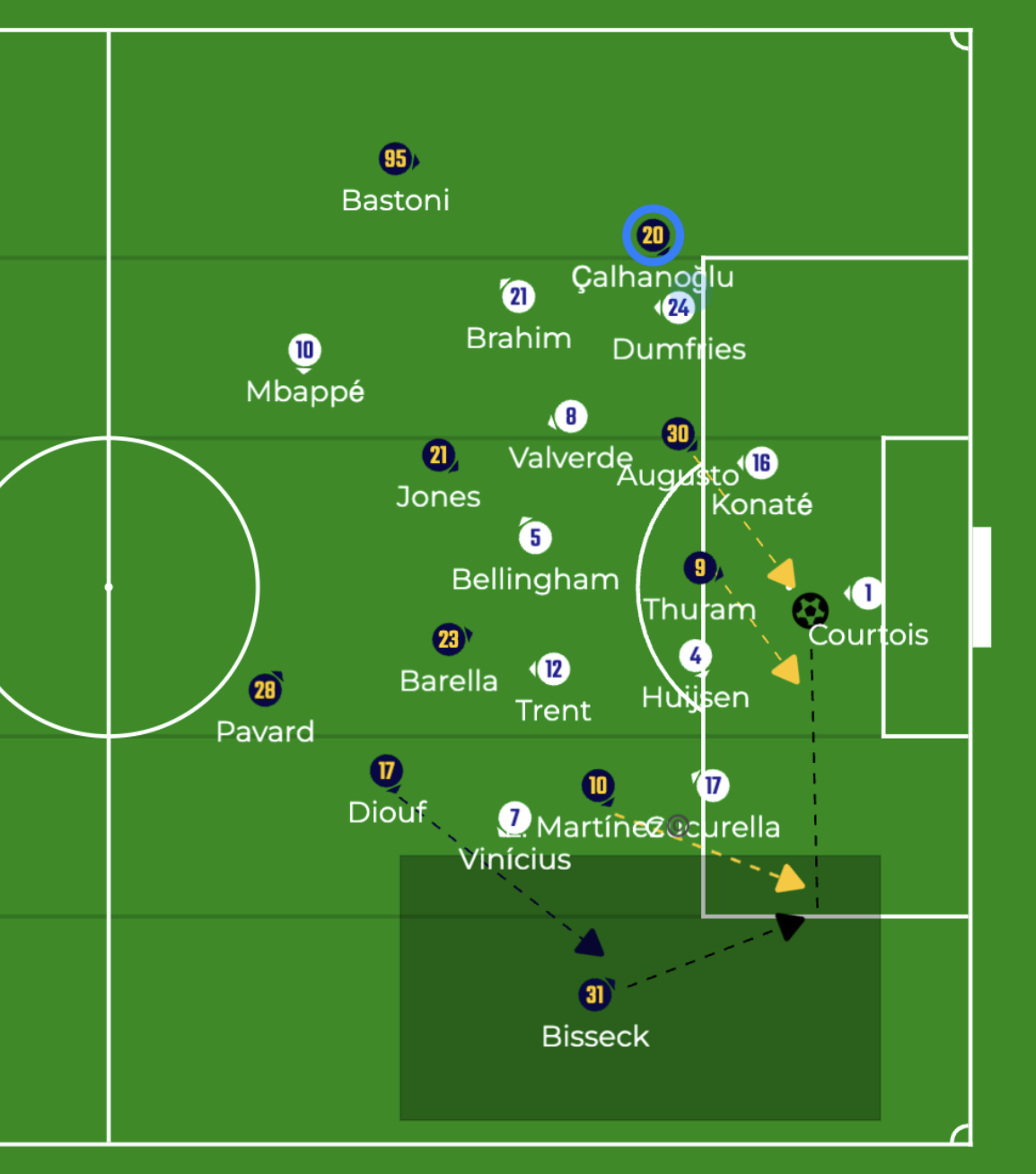
Bisseck exploited the space left on the flank, combining with Lautaro before the Argentine delivered the cross that Carlos Augusto converted.
The goal therefore highlighted the trade-off within Madrid’s defensive approach. Their aggressive protection of the central spaces had successfully denied Inter access through the middle for long periods, but it also left considerable space available on the outside.
Once Bisseck moved into that space and Lautaro joined the attack, Inter were able to exploit the gap created by Madrid’s excessive central focus and eventually produce the cross that led to their goal.
Madrid’s Left-Sided Transitions
During Inter’s sustained spells of possession, Real Madrid increasingly relied on rapid transitions after regaining the ball. When possession was recovered in deeper areas, Madrid immediately looked for direct vertical passes towards the right side, targeting the space behind Inter’s defensive structure. Mbappé and Bellingham would frequently move towards these areas, providing additional runners and increasing the attacking threat.
The primary objective was to consistently create one-versus-one situations for Vinícius on the left flank, where his pace and dribbling ability could be used against an exposed defence.
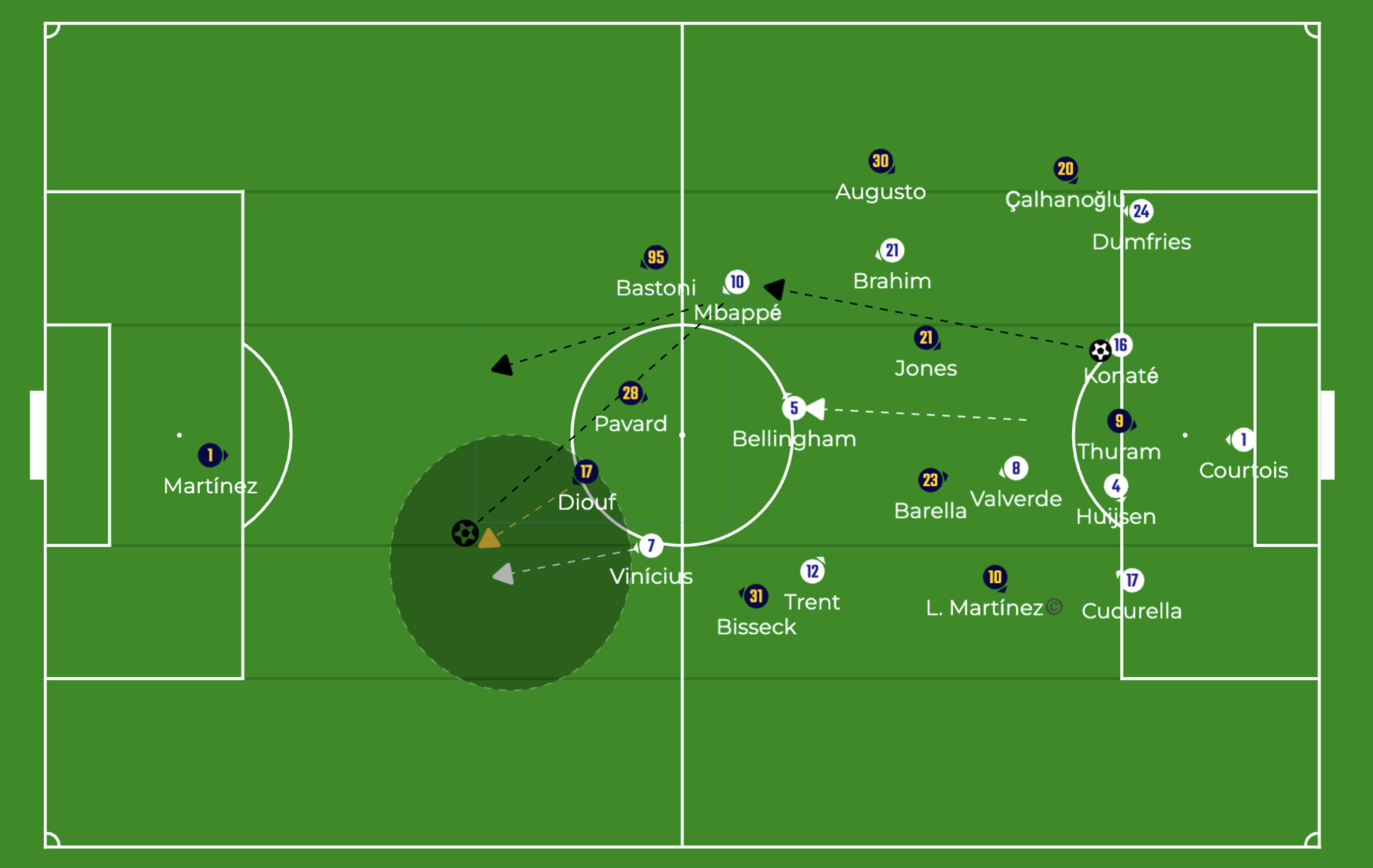
Madrid’s direct transitions targeted the space behind Inter’s structure, with Mbappé and Bellingham supporting Vinícius to create one-versus-one situations on the left.
Takeaways
Madrid’s pressing was highly deliberate, using disguised movements and specific triggers to steer Inter towards Bisseck and exploit his vulnerability under pressure. Valverde’s aggressive jump onto Martínez and Mbappé’s positioning helped manufacture the situations that produced Madrid’s early goals.
Madrid’s narrow defensive structure successfully protected the central corridors and forced Inter towards the flanks. Inter responded with rotations and wide overloads, particularly on the left, although Madrid’s excessive focus on the centre eventually created the space Bisseck and Lautaro exploited for the equaliser.
As Inter dominated possession, Madrid used their defensive recoveries to launch rapid transitions. They initially circulated the ball towards the right before switching quickly to the left, repeatedly seeking to isolate Vinícius in one-versus-one situations and exploit his pace against Inter’s exposed defensive structure.
Use the arrows to scroll through all available match plots. Click to enlarge.
Check the match plots page for plots of other matches.


Comments