
Manchester United – Manchester City: City Stay Stable With Ten Men (0-1)
After a competitive first twenty minutes, Phil Foden’s red card forced Manchester City to sit deep and reduced their attacking chances. Despite this, Manchester United were unable to capitalize due to their deficiencies against low blocks, meaning that Erling Haaland’s wrongly awarded goal was decisive in this Manchester Derby.
Tactical analysis and match report by Josh Manley.
We decided to make this article free to read. If you want to support our work, consider taking a subscription.
The last Manchester Derby saw Manchester United win a convincing 2-0 victory over Manchester City in Michael Carrick’s first game as manager. A lot has happened since for both clubs. Carrick has become permanent boss after returning United to the Champions League stage, while City saw the Pep Guardiola era come to an end, with Enzo Maresca as his replacement.
United lined up in a 4-2-3-1 shape here with Diogo Dalot, Harry Maguire, Lisandro Martínez, and Patrick Dorgu in the back four as Luke Shaw missed out through injury. Youri Tielemans and Kobbie Mainoo once again partnered in midfield, with Bruno Fernandes at number ten. Bryan Mbuemo and Marcus Rashford took the wide roles, while Matheus Cunha was the central attacker.
City also started in a nominal 4-2-3-1 formation with Matheus Nunes, Rúben Dias, Marc Guéhi, and Joško Gvardiol at the back. Elliot Anderson and Enzo Fernández played in central midfield with Phil Foden, Rayan Cherki, and Antoine Semenyo as the attacking midfield trio behind striker Erling Haaland.
Before Foden’s red
Both teams started the game with an intent to impose their own style, with United trying to combine centrally through City’s man-to-man press, and City attempting to establish stable possession against United’s own press.
City’s press resembled a 4-4-2 or 3-5-2 shape depending on the situation. Foden and Haaland would try to pressure United’s center-backs directly, while Cherki and Fernández would mark United’s double pivot.
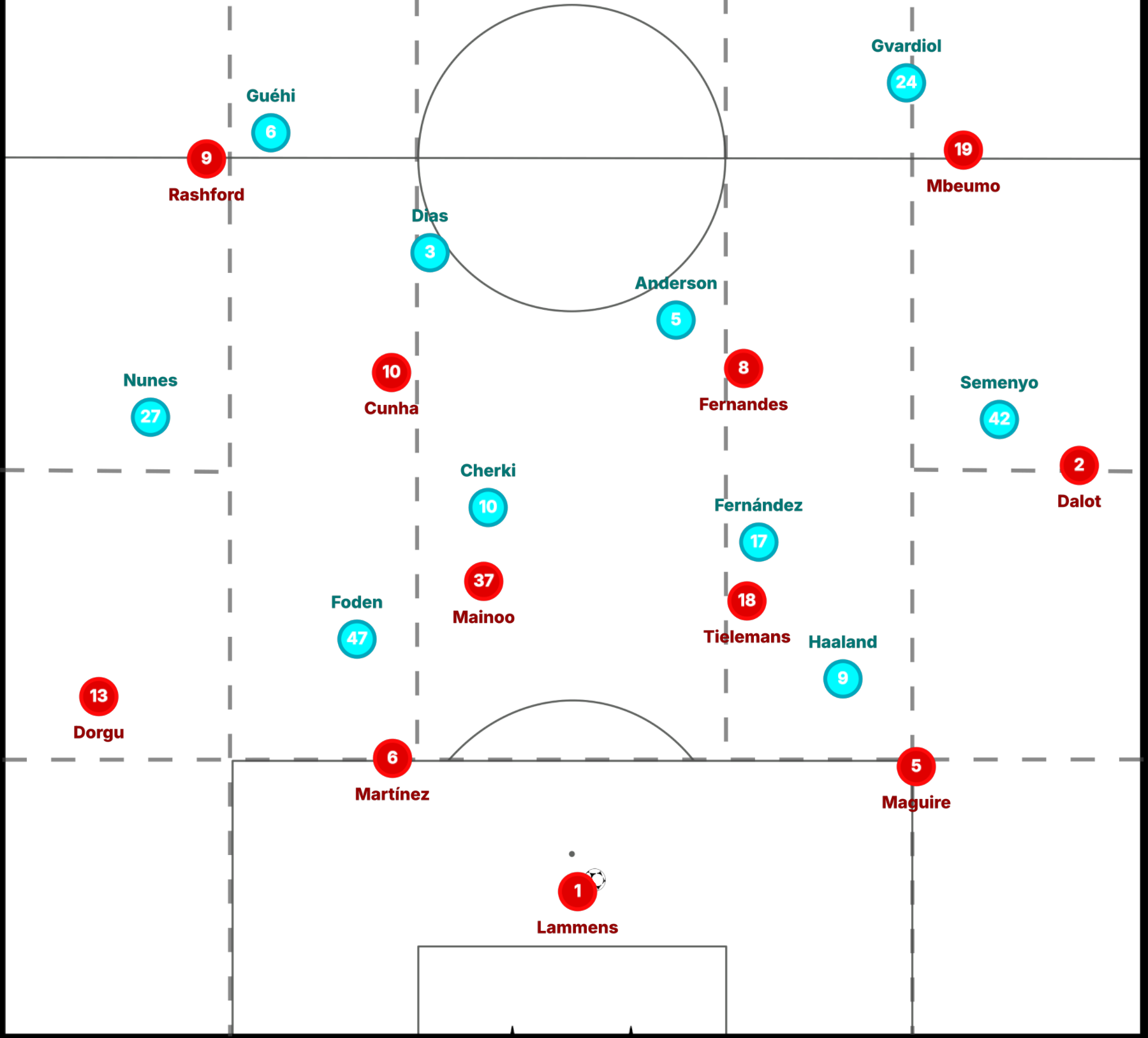
United’s buildup phase.
A slight issue that City had was that Cunha would drop alongside Fernandes to help form a box midfield, but Dias was not always quick to follow, not wanting to leave too much central space in certain situations since Guéhi and Gvardiol were already responsible for Mbuemo and Rashford.
This meant United could sometimes find superiorities in this area of the pitch through Cunha and Fernandes overloading Anderson in City’s defensive midfield area.
Another aspect was that Dorgu would often drop quite deep in United’s first phase buildup, too far for Nunes to jump in many situations, which meant that he could also be used in United’s buildup.
In United’s own pressing, they used a 4-4-2 formation against City’s 3-1-3-3 possession shape. The pressing here was better initially than it has been in recent games (although this did not necessarily last) as the midfield was able to get tighter and the frontline could establish pressure on the backline more quickly.
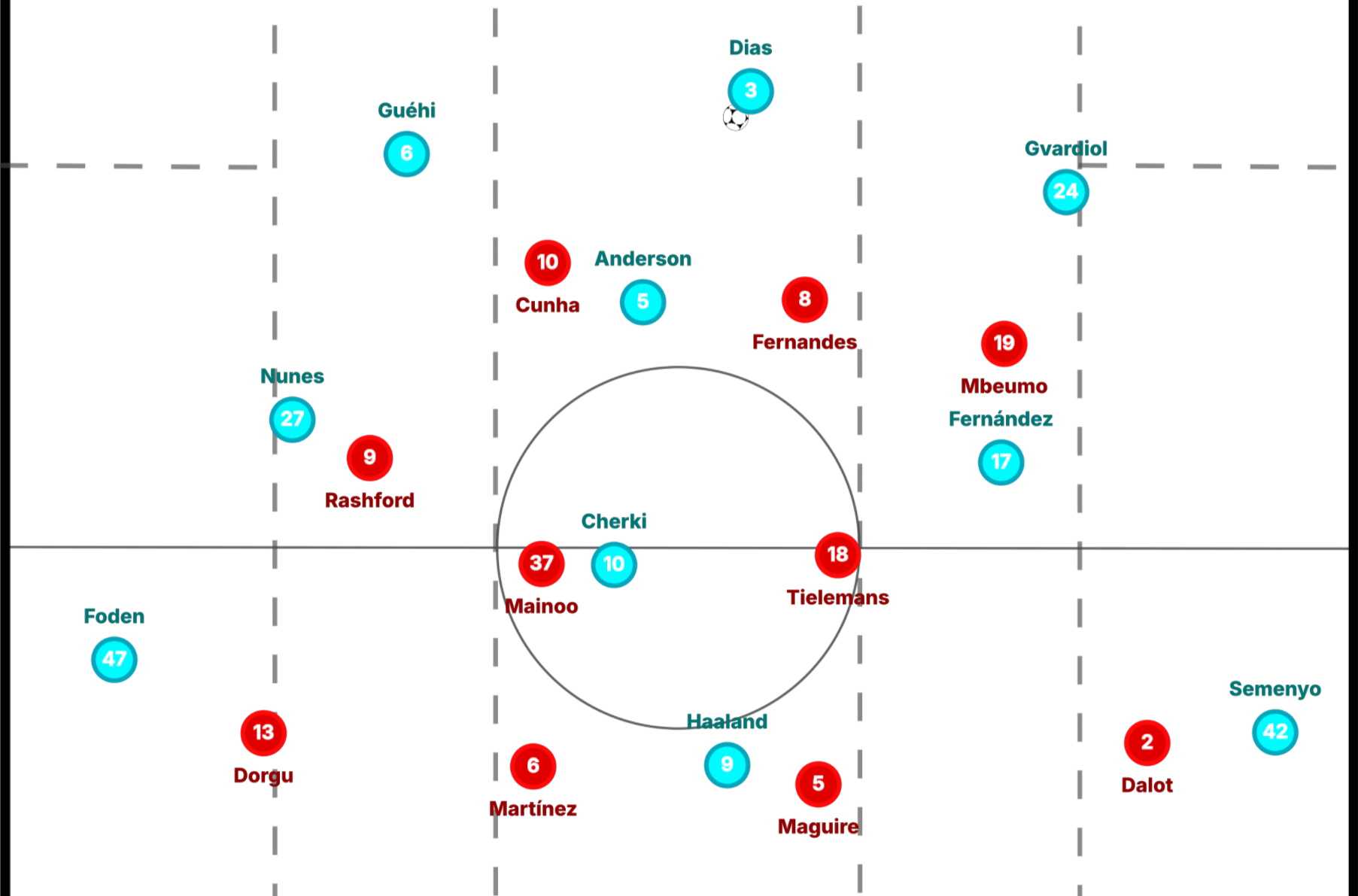
City’s possession structure with eleven men.
Mbuemo often stepped up to Gvardiol on City’s left, while this sometimes left space outside for Fernández to drift into, dragging Tielemans wide and stretching the gap between him and Mainoo, which did allow City to break United’s midfield press on one occasion.
Maresca’s adjustments with ten
After Foden’s red card midway through the first half, the shape of the game changed somewhat. City’s defense moved deeper, and they defended in a more zonal manner since they no longer had the numerical parity to go man-to-man.
City therefore moved into a 4-4-1 low block, which also became a 5-3-1 in some phases as Semenyo would track Dalot’s forward movements down United’s right side.
United had Mbuemo often indenting from the right side to offer depth, while Rashford held the width on the left side with Dorgu providing later runs to support him.
City’s move to a deeper defensive line did not necessarily suit United, despite their man advantage. There have been some improvements in some possession principles under Carrick, especially in the first two phases (deep buildup and middle third), but United still struggle when faced with the task of breaking down a stubborn low block.
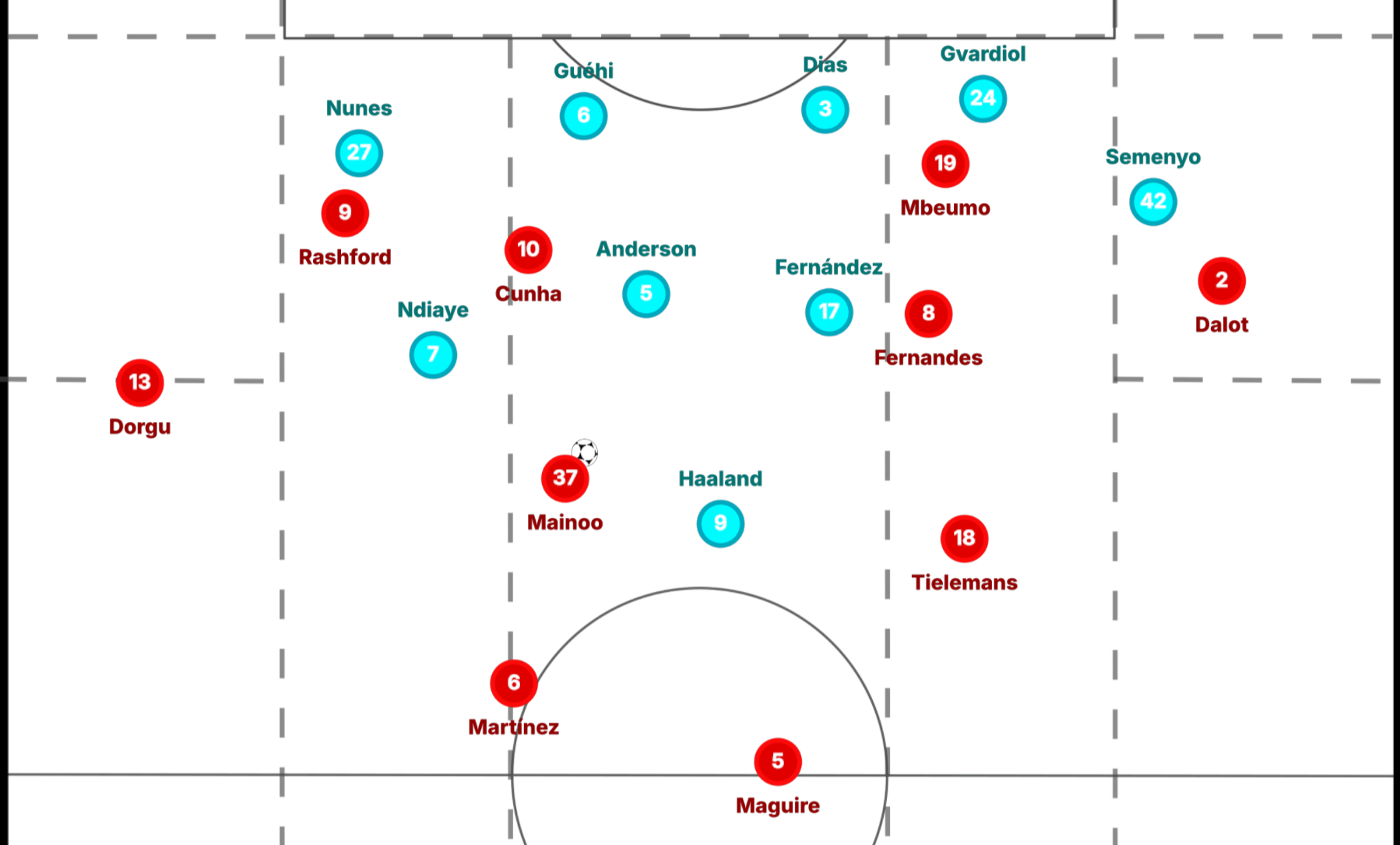
City’s low block after the red card.
Maresca made a further adjustment at half time, bringing on Iliman Ndiaye for Cherki. This change was well suited to the circumstances, as Ndiaye brought extra legs to the midfield while also providing the ability to dribble in transition and win fouls to help break the flow of the game.
City not only defended well but also started to put together some decent possession phases. This was mostly deep possession in their own half, using the backline and two central midfielders to circulate in deep areas against a United press which was not imposing or intense enough.
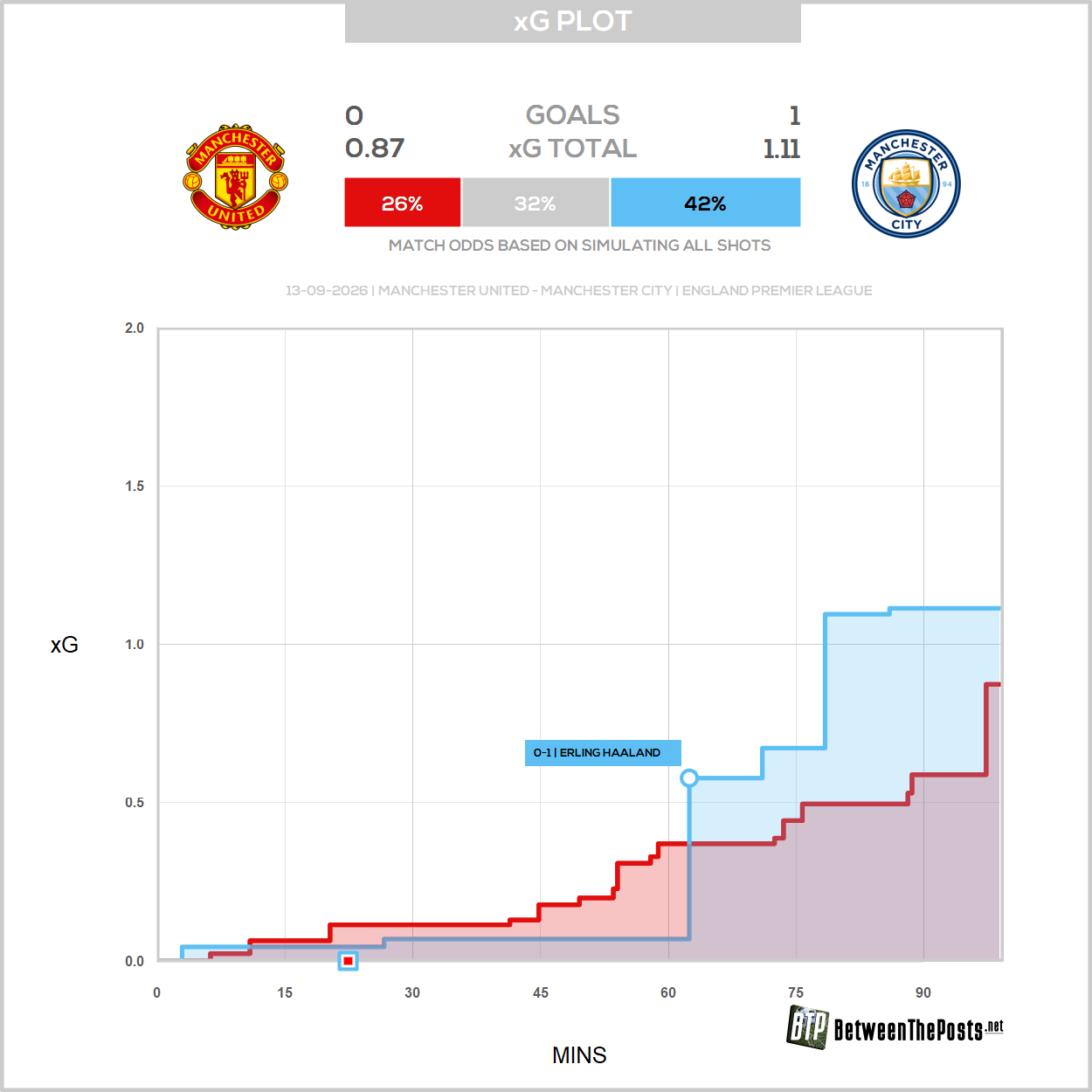
Things got even better for City on the hour mark as Haaland was able to put them ahead, albeit in controversial circumstances. The goal should not have stood, but it did, and City found themselves with a lead to defend.
A lack of ideas
As alluded to, Carrick’s coaching has certainly brought good ideas to United’s first two possession phases, as their box midfield helps them progress well against opposition pressing in United’s half.
However, the game in the final third still seems somewhat improvised, with a lack of clarity on how exactly United should create breakthroughs against low blocks.
In the second half, Rashford began to indent more, leaving the left flank for Dorgu. United then essentially attacked in a 2-2-6 arrangement, with the double pivot ahead of the centre-backs while the front four roamed within City’s shape.
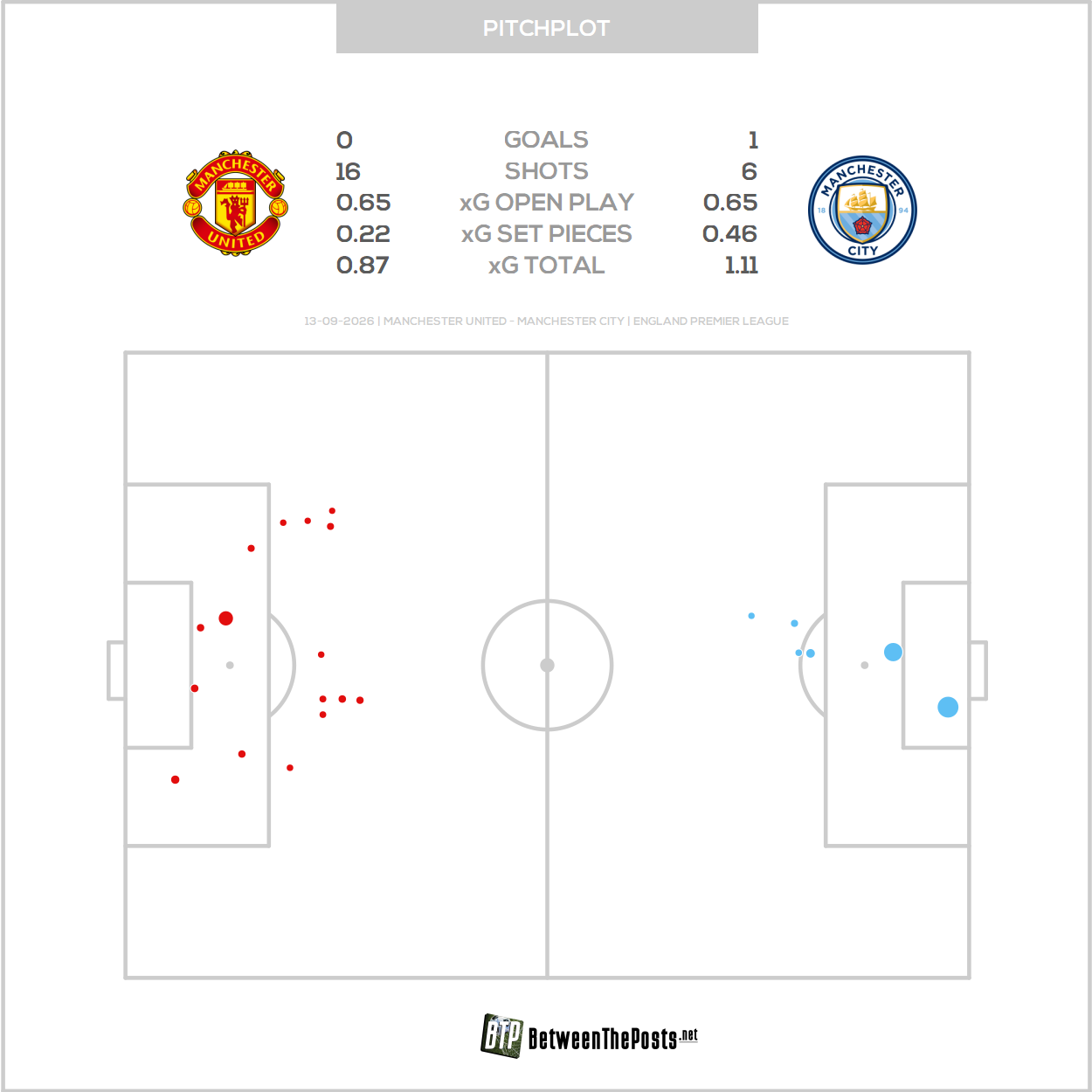
United’s shot locations tell a story of their struggle to generate shots in the box against a low block.
United’s problem, however, was less about the structure and more about the intentions with ball circulation, coordination with movement, and decision-making intentions against a low block.
Carrick brought Benjamin Šeško on after City’s goal, with Fernandes moving back into central midfield and Cunha at number ten, so that Šeško could play as the focal point. However, United were unable to make use of their target man.
Takeaways
United will feel aggrieved with the wrongly called offside, but most of the problems in this game were of their own making. Their inability to play productively in attack when there is no space to hit in transition will perpetually limit their ceiling if it is not addressed. Maresca himself mentioned after the game that the game became more difficult for United with ten men for this reason.
City managed this game excellently in the circumstances. They were able to generate stable possession phases to take the sting out of the game despite their man disadvantage. Maresca’s decision to bring Ndiaye in for Cherki perfectly suited the game circumstances.
Use the arrows to scroll through all available match plots. Click to enlarge.
Check the match plots page for plots of other matches.



Comments