
Flamengo – Corinthians: Corinthians’ reserves put up a fight, but cannot withstand the Brasileirão leaders’ dominance (2-1)
Flamengo had ten times more shots than Corinthians in a classic Brazilian football matchup on Matchday 27. This was, of course, partly because Fernando Diniz decided to physically preserve practically his entire starting lineup due to their still undecided Libertadores Cup tie in midweek. In an “attack versus defense” scenario, Flamengo were dominant with their starters, but still struggled to secure the win, eventually scoring in the final minutes.
Tactical analysis and match report by Marcus Arboés.
At home and after securing an excellent advantage in the first leg of their Libertadores tie, Flamengo decided not to rest players and field the best possible team available, aiming to maintain their lead after Palmeiras had beaten São Paulo on the matchday. Leonardo Jardim therefore lined up: Rossi in goal; Varela (Uruguay National Team) and Ayrton Lucas as the fullbacks, with Léo Ortiz and Danilo (former Brazil National Team) completing the defensive line; Pulgar and Paquetá (former West Ham) in midfield alongside De Arrascaeta (Uruguay); up front, forming a 4-2-3-1 outline, Gonzalo Plata (Ecuador) and Samuel Lino (former Atleti) played on the wings alongside target man Pedro (former Fiorentina). The latter two were recently called up by Ancelotti for Brazil National Team friendlies.
Without most of his key players, such as Breno Bidon and Matheuzinho, who were also called up by Ancelotti, as well as Memphis Depay, Fernando Diniz gave opportunities to several players, who managed to show good defensive qualities in the first half. Hugo Souza (Brazil National Team) was in goal; Milans and Angileri at fullback; João Pedro and Iago Machado, an excellent 17-year-old youngster, as the center back pairing; Charles, Raniele and Matheus Pereira (former Barcelona) in midfield; Dieguinho on the right wing, Lingard (yes, that one) on the left and Gui Negão as the striker.
How did Corinthians survive the first half?
Flamengo had 18 shots to Corinthians’ zero, with the visitors only getting close to the opposition box on two counterattacks. Of course, this goes far beyond simply being a starting lineup at 100% of its potential against an almost entirely reserve team, with the exception of one holding midfielder and the goalkeeper. Flamengo’s total dominance of the first half came from the way they attacked and neutralized the opposition’s build-up.
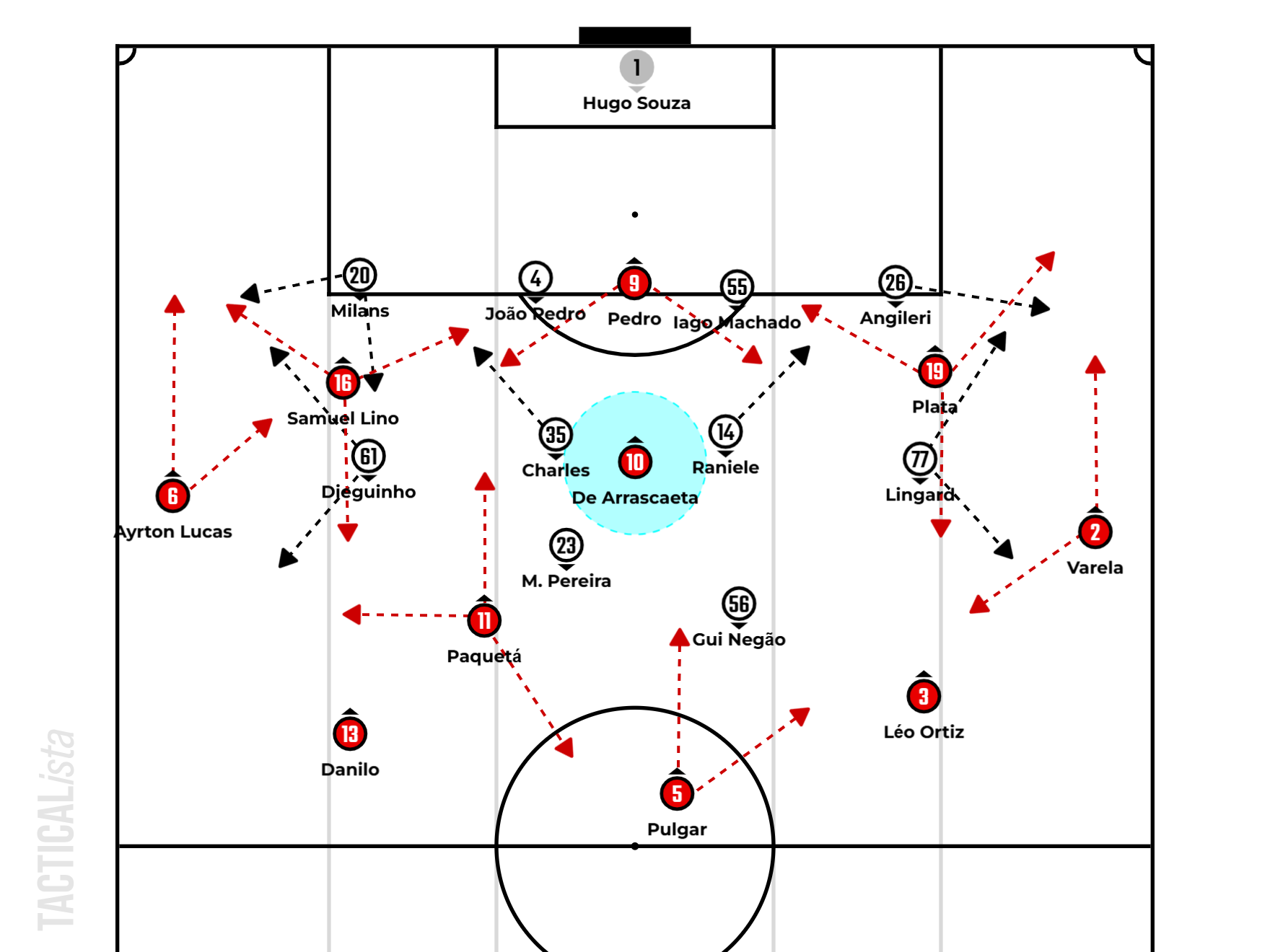
Flamengo attacking from a 4-2-3-1 outline against Corinthians’ defense in a 4-4-2 formation.
For most of the first half and the match, Flamengo occupied the attacking half with patient possession. The build-up always started with the two center backs and the two holding midfielders, Pulgar and Paquetá, forming a 3+1 structure, with one of the holding midfielders dropping between the center backs or moving into a wider position, while the other provided support for the build-up and then helped shift the construction toward the flank. Preferably, this involved three or more players combining on one side of the pitch.
Among the fullbacks, Varela had a build-up role, while Ayrton Lucas became almost a left winger, with both primarily using the wide channels. This allowed Samuel Lino and Plata, both natural wingers, to play with a certain freedom inside, either dropping to help in the build-up, moving wide or drifting across to provide an option on the other side of the pitch, creating overloads alongside Pedro’s supporting movements or Arrascaeta’s free movement.
Even with an almost entirely reserve lineup, Corinthians also defended in a 4-4-2 formation. The closer they were to their own goal, the more the wingers dropped into the last line to track the fullbacks, while the holding midfielders alternated between protecting the edge of the box and covering the fullbacks when they stepped out to press. This forced Flamengo to use their entire attacking repertoire, attacking down both sides and through the middle. At times, Corinthians were saved by their center backs or by saves from Hugo Souza, the goalkeeper recently called up by Ancelotti to the National Team.
Flamengo’s control through defensive factors
When Flamengo lost possession, almost every Corinthians counterattack was well neutralized by the post-loss reaction of one or two players, by the depth control of the first line of build-up players or by Flamengo’s defensive recovery. As a result, Leonardo Jardim’s team were able to maintain possession in the attacking half for long periods.
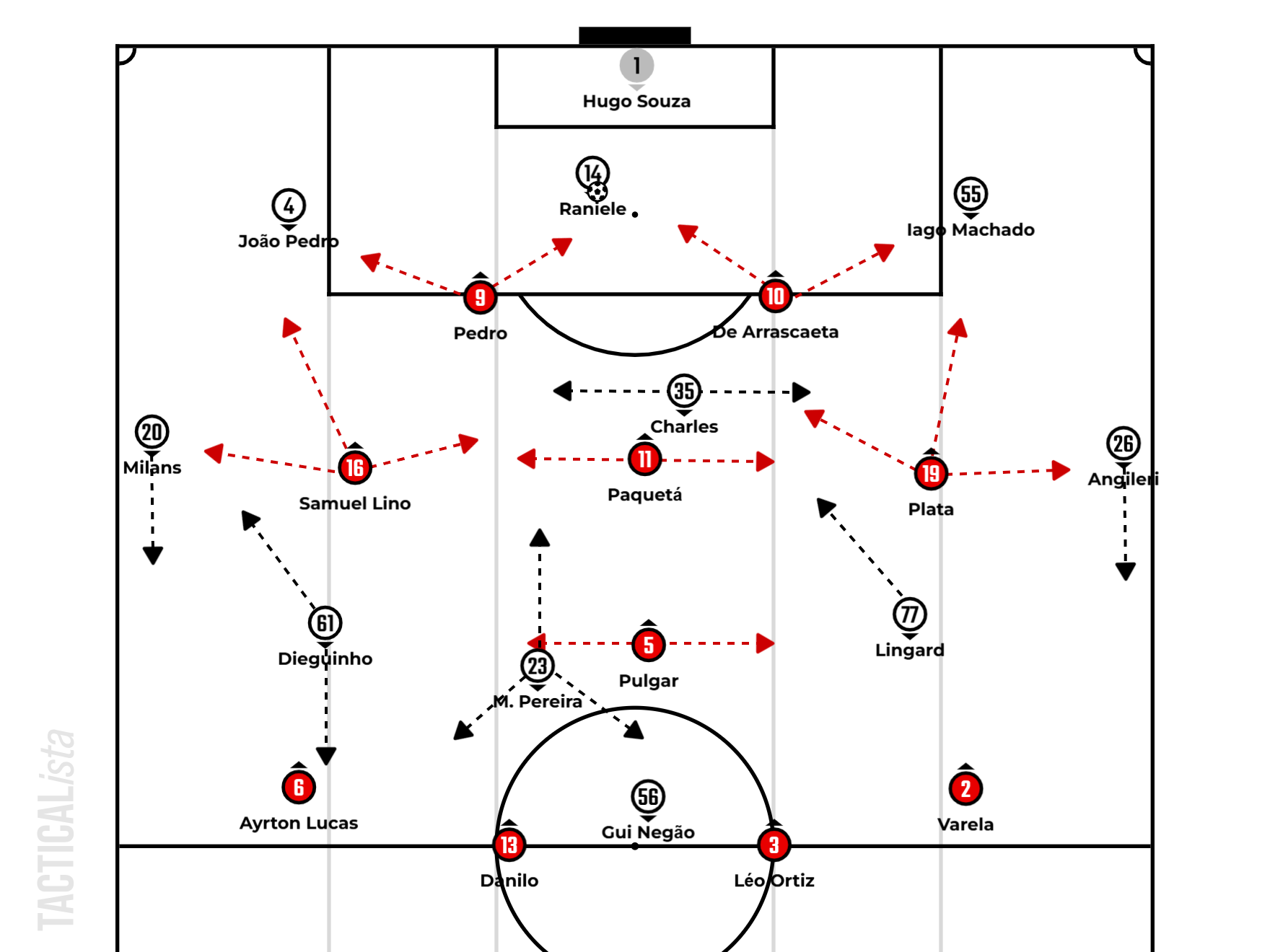
Corinthians’ build-up with Raniele between the center backs, against Flamengo’s high-block press in a 4-1-3-2 shape.
A determining factor in preventing Corinthians’ game from flowing was Flamengo’s high-block marking, pressing Fernando Diniz’s side during their build-up. Raniele dropped between the center backs, with Charles moving behind the first line of pressure, giving the two fullbacks, who are not particularly technically efficient, the freedom to advance through the wide channels behind the second line of pressure, but this was rarely and poorly exploited.
At the same time, Lingard and Dieguinho moved inside as midfielders on a second midfield line, but all of these spaces were very well neutralized. Pedro and Arrascaeta made the first contact, while the wingers alternated between pressing the wide center back to create a three against three, stepping out to press and track the fullback, or drifting inside to eliminate Paquetá’s numerical disadvantage as he tracked Charles in that space, with Pulgar also protecting the space behind him. The defensive matchups also allowed Flamengo to always maintain numerical superiority in the last defensive line.
In the first half, Flamengo were dominant through their defensive qualities, and Corinthians somehow survived. But at the start of the second half, everything collapsed when Paquetá capitalized on a mistake by goalkeeper Hugo Souza following a corner kick to make it 1-0.
Goals happen where eyes cannot reach
After conceding, following the first third of the second half, Corinthians began to come out and play more. Patiently or not, Diniz waited for the exact moment to introduce his starters and try to improve a team in which only the center backs and Raniele had managed to produce anything positive. After these changes, in particular, the visitors improved on the ball and managed to retain possession for longer periods. From one of their few opportunities, they managed to score.
Initially, Breno Bidon replaced Charles, adding greater creativity to the midfield; Kaio César replaced Dieguinho on the right wing and the two starting fullbacks, Matheus Bidu and Matheuzinho, who are considerably better, came onto the pitch. Minutes later, with the team still lacking presence in the final third because Matheus Pereira was frequently dropping as the third midfielder, the coach took him off and introduced Garro, improving the technical quality of the team’s passing near the box. These substitutions changed the result.
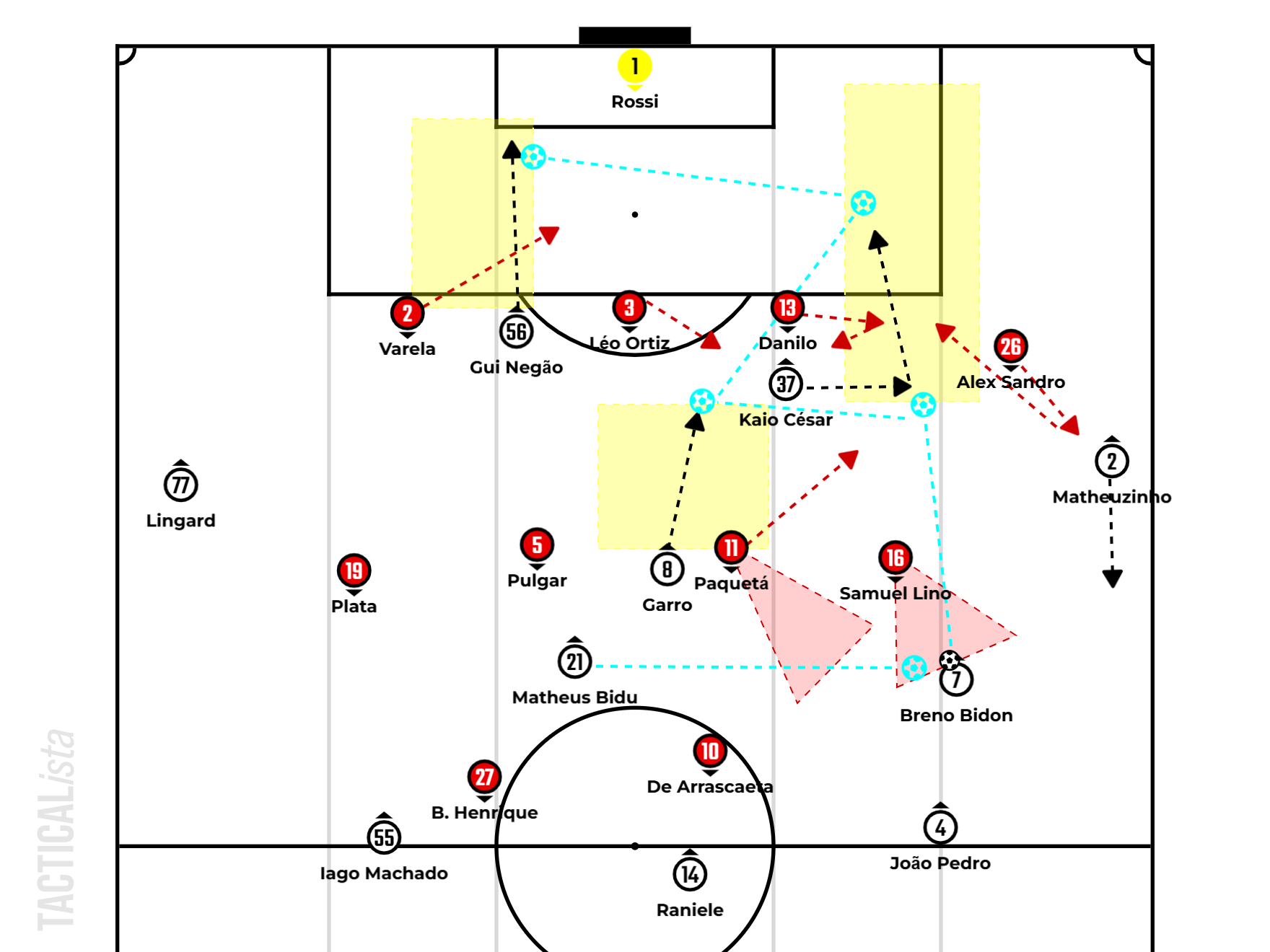
The situation leading to Corinthians’ goal after the substitutions, with Kaio César and Garro exploiting blind spots in Flamengo’s marking.
At the moment of the equalizer, Corinthians won a free kick near midfield and Matheus Bidu took it very quickly, finding Breno Bidon. At that point, Flamengo were not particularly disorganized, positioned in a 4-4-2 formation and quickly reorganizing to shift defensively toward the right side of the opposition’s attack, where Breno Bidon received the ball to create while facing forward. At that moment, a series of small events led to the goal.
During the defensive shift, Samuel Lino and Paquetá oriented themselves according to the position of the ball, while the left winger neither pressed nor blocked the Corinthians midfielder’s passing angle. Breno found a pass to Kaio César, who moved from the central channel into the half-space, drawing Danilo’s marking. Meanwhile, Matheuzinho, who was positioned wide on the right wing, dropped deeper, attracting Alex Sandro’s tracking. These two movements would prove extremely important.
Kaio César received in the half-space and paused on the ball, while Garro attacked space inside from the blind side of Paquetá’s field of vision, as Paquetá recovered to press Kaio César. The Corinthians attacker passed to Garro and advanced into the box, quickly enough that Alex Sandro couldn’t adjust in time. Garro brilliantly found space between Flamengo’s center backs and played a first-time pass into the overlapping run of Kaio César, behind Danilo, who opted to close the space inside.
As Léo Ortiz shifted inside, Varela recovered to protect the middle of the box, but Gui Negão attacked precisely behind him to receive a good pass from Kaio César and score. Can you see the key detail that allowed Corinthians to take advantage of one of Flamengo’s few defensive mistakes in the match?
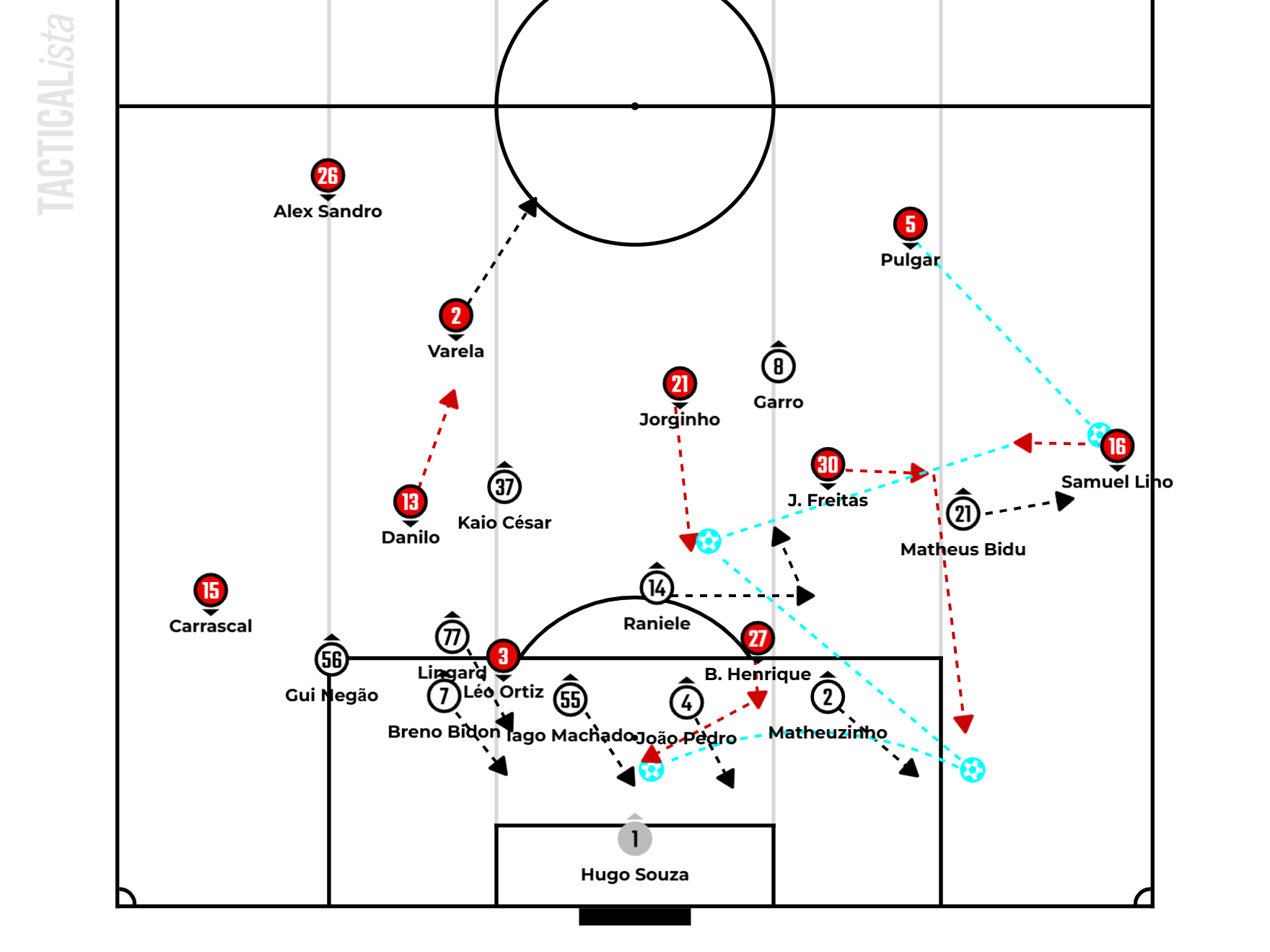
Flamengo’s winning goal after a second ball from a corner.
The answer for Flamengo’s goal, which secured the victory and kept them at the top of the table, is almost the same, and the basic structure of the two goals is even similar: someone receives the ball on the edge of the box and plays a first-time pass into the path of a player making an overlapping run out wide, looking for the striker in the defense’s blind spot.
For the goal, Pulgar received from Alex Sandro and reorganized the attack by passing to Samuel Lino. He attracted Matheus Bidu’s marking and carried the ball inside. At that moment, new signing Joaquín Freitas initially moved closer to provide support before quickly attacking the space out wide. Raniele moved to protect the edge of the box, which seemed like the most logical decision, but his task became much more difficult when Garro failed to track Jorginho’s overlapping run. The Italian-Brazilian midfielder received from Samuel Lino and played a first-time through pass to Freitas, at a distance Matheuzinho couldn’t cover.
During the defense’s counter-movement, Bruno Henrique, who had been positioned at the edge of the penalty arc, moved behind center back João Pedro, exploiting the defender’s blind spot to attack the box and head the ball into the net, scoring yet another decisive goal for Flamengo.
Takeaways
Even though they went through difficulties in the match, Flamengo celebrated the kind of victory that builds champions, against an opponent that did not attack much but fought hard. The result kept the team in first place in the Brasileirão standings, even though Palmeiras won their match in the same round. Now, in midweek, Flamengo have a second leg against Independiente del Valle in the Libertadores and, next weekend, they will defend their lead against Bragantino, also at home.
Corinthians, on the other hand, paid the price for choosing to rest their key players and suffered their fifth consecutive defeat in the Brasileirão, continuing to drop points and fall rapidly down the table after a strong recovery following Fernando Diniz’s arrival. Despite everything, their priority match comes on Wednesday against Estudiantes, with whom they drew in the first leg of their Libertadores tie. In the Brasileirão, they will try to move away from the crisis when they face Fluminense, who will also have a midweek Libertadores match.
Use the arrows to scroll through all available match plots. Click to enlarge. Check the match plots page for plots of other matches.


Comments