
Manchester United – Roma: Cunha Cooks A Dramatic Clutch Comeback (3-2)
Roma deepened Manchester United’s misery in the first half by taking an early 2-0 lead. However, the half-time break changed fortunes as an energetic United side forced their way back into the game before a stunning winning goal by Matheus Cunha in the final minutes completed an emphatic comeback victory.
Tactical analysis and match report by Fahd Ahmed.
The mood remains bleak at Manchester United, as they have not yet picked up a victory since defeating Sabah in early September. Since then, United have endured a nine-game winless run, with off-field issues taking centre stage. Their latest loss was against Chelsea at Stamford Bridge, despite looking like the better team in the first half, when they also had many opportunities to take the lead. Despite the result, there was at least some positivity to take away from United’s performance ahead of a UEFA Champions League clash with Roma.
In almost stark contrast, Gian Piero Gasperini’s team enjoyed a strong start to the campaign. They lost just one match, a 4-3 defeat to Real Madrid, despite being in the driving seat for most of the ninety minutes, but imploded in the final ten minutes as they let go of a two-goal cushion. Such results have the potential to demoralise a squad. However, it did not affect Roma, who quickly regained form and were undefeated in their next three games, where they faced Napoli, Cagliari, and Udinese.
United were thereby hosting one of the most in-form teams from Italy whilst suffering from their own on- and off-pitch troubles. It was set to be a fascinating match-up, with different storylines clashing against each other in an important Tuesday night Champions League fixture.
Crumbling early under Roma’s man-to-man pressure
Gasperini’s teams are famous for applying intense and frequent man-oriented pressure. Thus, when receiving possession, it is important for players to get their individual technical details spot on. Primarily, the receiving player’s objective must be to either shield the ball with his body or move against the flow of the arriving defender to break the press. If this is not achieved, the defending team can generate a turnover, which could potentially lead to a dangerous counter-attack depending on the area of the field.
In the opening minutes, especially during deep build-up, United showcased their intention to play long and direct when Roma locked on man-to-man. They still had players from the front line, such as Bruno Fernandes and Matheus Cunha, dropping below to receive a short pass in midfield. If the player generated enough separation, United’s goalkeeper, who was the spare man, was willing to fire a pass to their feet. However, Michael Carrick’s pre-match instructions clearly seemed to indicate a risk-averse tendency in their possession play.
In the middle third, when United organised into their settled in-possession structure, Roma constantly searched for the right moment to trigger a man-oriented press from a rough 5-2-3 off-ball shape. In these circumstances, it was crucial for United to get their individual technical details and decision-making spot on, especially when receiving in the centre.
In the 11th minute, once United had structured themselves in their desired possession shape and midfielder Carlos Baleba played a pass backwards towards Harry Maguire, the Roma players began finding their man-marking references. However, United had temporarily created a central overload, with Kobbie Mainoo emerging as the free man. This was because Roma’s central midfielder, Bryan Cristante, had sunk low to mark Fernandes. Thus, once Leny Yoro received the ball on the right, his intention was understandably to find Mainoo with a diagonal pass.
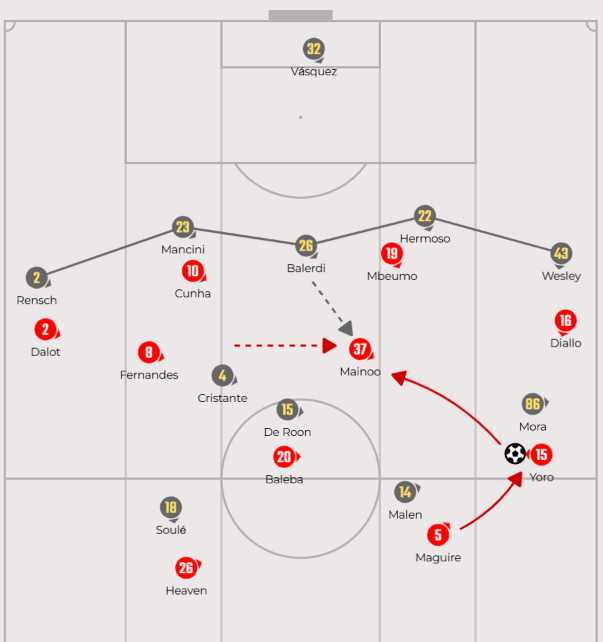
Image 1: Mainoo temporarily receives freely in midfield but is immediately under pressure from the Roma centre-back.
The following defensive actions from Roma’s centre-back highlight their collective understanding of Gasperini’s principles. Instead of hesitating or trying to shift responsibility to a teammate, Leonardo Balerdi proactively and courageously stepped out of the back line to apply pressure on Mainoo, who was receiving with a closed-body orientation. Although he did well to initially shield the ball by keeping his body between it and the defender, his subsequent decision to try and find Baleba was delayed for too long.
Consequently, Marten de Roon generated a central turnover in midfield, initiating a 4v4 counter-attack. Rodrigo Mora showed excellent awareness and technical quality to find a diagonal switch to Matías Soulé, who was completely free in the right half-space since Ayden Heaven was occupied in the centre whilst Diogo Dalot was higher up the field. Soulé brought the ball under control before tucking it away past Senne Lammens.
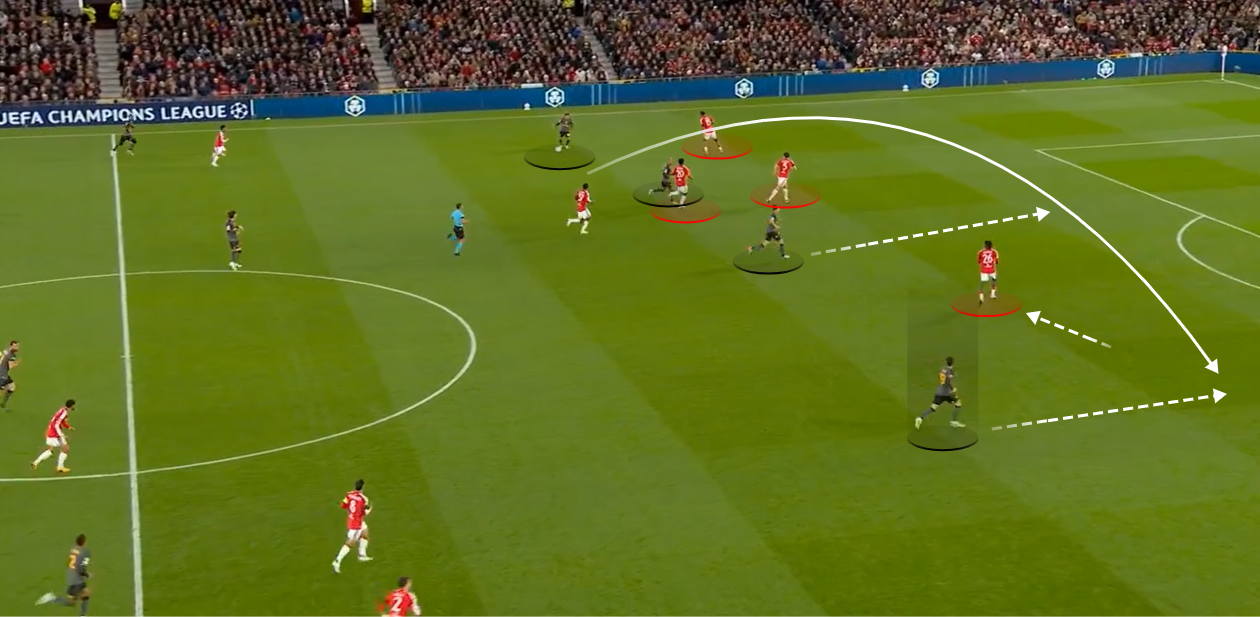
Image 2: Mora’s diagonal switch found Soulé, who was free to receive in the space vacated by Dalot since he occupied a high and wide position during United’s possession phase. Soulé then converted the chance to give Roma the lead.
Targeting the space behind Dalot again
During Roma’s counter-attacks, the diagonal switch that directly paid off for the opening goal was constantly available and posed a threat. With Donyell Malen regularly running below to receive, he would drag Maguire, who constantly followed him.
Consequently, it was often the case that Heaven was isolated in the centre and had to briefly cover large spaces. With United’s midfielders also attracted towards the ball side, Soulé always had the opportunity to attack beyond in the right channel as Dalot was positioned high and wide, making it almost impossible for him to track back. As seen in Image 2, in the sequence leading to a handball in United’s box, Heaven is isolated centrally, Mainoo is alone protecting the midfield, Baleba is caught high, and Dalot is not even in the frame. Further, you will notice the large gaps between United’s centre-backs and midfielders.
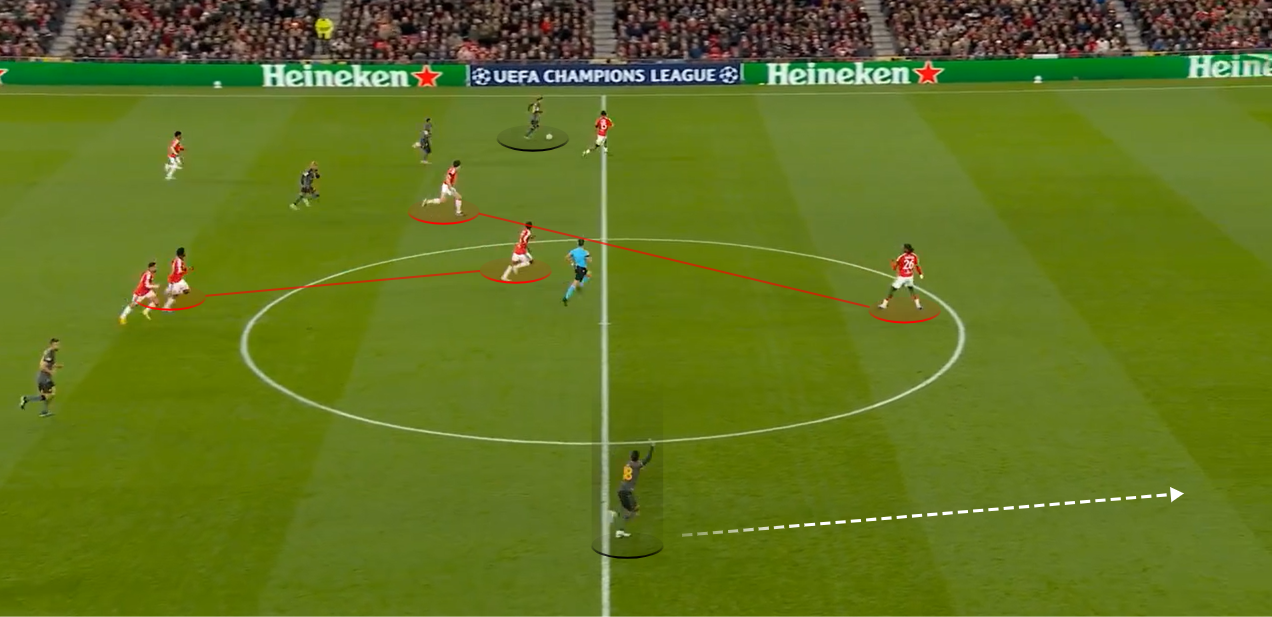
Image 3: Soulé regularly had the chance to attack unprotected spaces in the right channel due to United’s rest-defence structure.
Later in the first half, Carrick responded by instructing Dalot to sink low rather than position himself high up the left wing. This obviously had the intended benefit of having Dalot mark Soulé, which was United’s core performance problem at the start since the Argentinian forward was Roma’s main threat during counter-attacks. Thus, Dalot was arriving in the space on the left flank rather than always being high and doing so as soon as possible, instead picking his moments.
Although one might think that United would have theoretically decreased their quality going forward, this was not exactly true on the field. Dalot’s high position did not really help United during settled possession phases since he was not found in that area. Instead, the home side often retained possession on the right, where Cunha, Fernandes, and Bryan Mbeumo would drift, whilst not frequently searching for a switch to Dalot on the left. Nevertheless, for the remainder of the first half, United did not create much from open play, whilst Roma had a few glimpses on the counter-attack.
Intensity in the counter-press during second-ball phases
As briefly mentioned earlier, in United’s deep build-up phases, Lammens was often the free man to receive after Roma locked on man-to-man across the pitch. Since the visitors were unwilling to press the goalkeeper, Lammens had the time and space to pick a pass, which was generally a long ball due to their risk-averse preference.
In these moments, it is crucial for United to be aggressive in the second-ball phase with their counter-press, which will better facilitate their intention to regain possession. When United did win the ball back, they could immediately initiate a transitional attack that suited the forwards who preferred such conditions. In the sequence leading to United’s penalty kick, it is clear how well the second-ball structure was organised to regain possession, with Mbeumo and Cunha not only in close proximity but also positioned at a distance that allowed them to pounce on the Roma defender’s clearance.
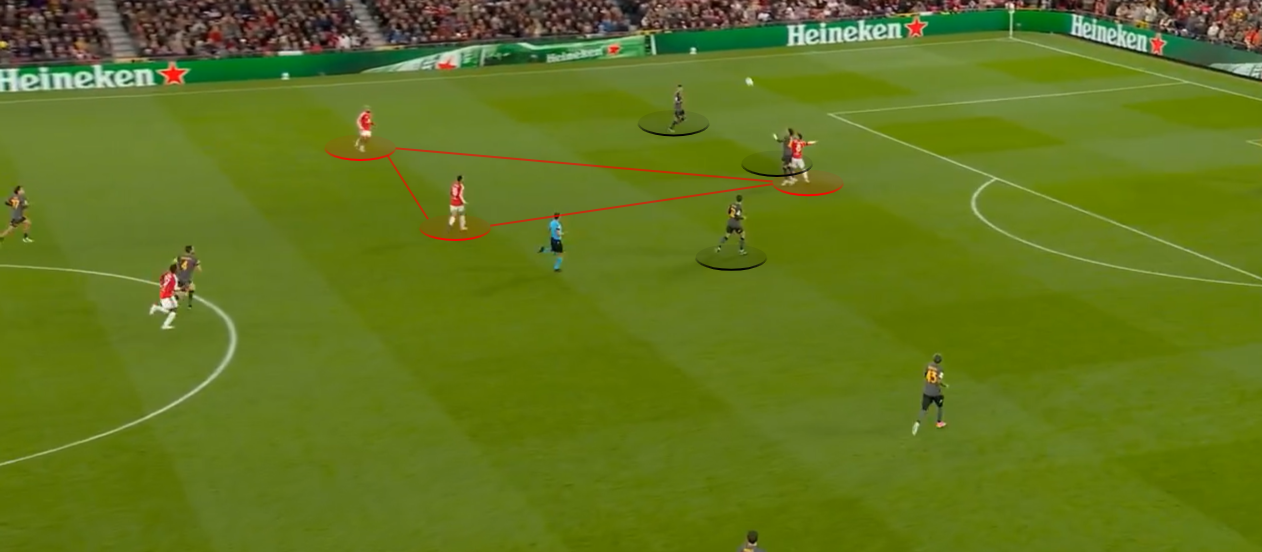
Image 4: United’s second-ball structure, which facilitated their counter-press and contributed to the penalty that Cunha won.
The aggressiveness that United showcased was not only during second balls but, more broadly, in their offensive and defensive phases. The half-time talk from Carrick evidently energised the team, which had been missing the same intensity levels in the first half. Further, after Fernandes converted the penalty re-take, there was enough momentum behind United to proactively search for an equaliser. Subsequently, the game opened up more, with both teams constantly having space to transition quickly.
Utilising the five channels to have multiple threats
Another tactical change from Carrick seemed to be during settled possession phases. Instead of having numerous forwards cluster on the right side, which was generally the case in the first half, United’s attackers seemed to be more spread out. Although it hindered the quality of United’s close-proximity associative attacks, it enabled them to occupy the five channels more often and, more importantly, have multiple sides from which to probe Roma’s defence. This does not suggest that United did not have any attacks in the first half where the players were spread wide, as they did, but such instances were comparatively fewer.
Further, as the second half wore on, Roma’s defensive line gradually dropped deeper and deeper to protect their narrow lead. This thereby allowed United to camp higher up in the final third whilst constantly shifting possession from side to side and testing Roma’s ability to shuffle across compactly. There was also noticeably a higher volume of dangerous crosses into the box and runs into the space beyond, with both United full-backs supporting the winger.
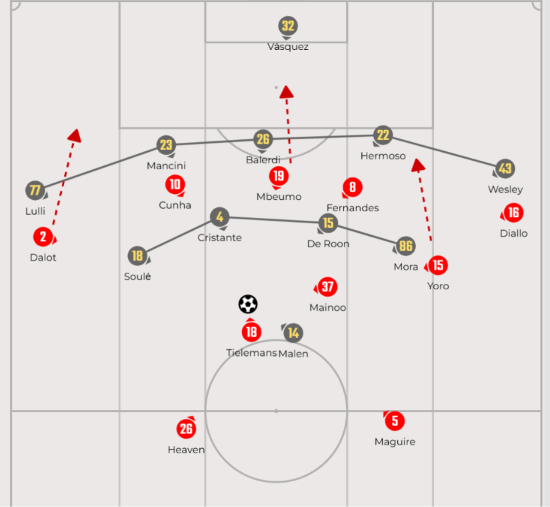
Image 5: In the second half, United’s attackers were more spread apart across the five channels rather than positioning themselves in close proximity to each other.
These details were apparent in the 83rd minute. It starts with United trying to piece their way through Roma’s block on the right side, with the winger and full-back attempting to combine. However, they cannot break through and so decide to recycle possession. When the substitute Youri Tielemans receives the ball in midfield, it is noticeable how all five channels are occupied. Thus, Tielemans can play a diagonal switch to the opposite wing, where Fernandes can collect and start another attack.
Fernandes shapes to deliver a cross, which he does with precision to find Cunha. Admittedly, Balerdi should have done much better to clear the ball. However, with United’s pressure, energy, and persistence in the second half, another goal seemed inevitable.
Further, ‘depth’ was a key facet of United’s attacks, with the forwards trying to exploit the space beyond. For Cunha’s winning goal, this was the central theme as he received an excellent diagonal pass from Shea Lacey behind Roma’s defence. He still had a lot to do from that position because it is extremely difficult to find the net from such a tight angle. Cunha’s technical quality and precision were simply brilliant and made for a very worthy winner.
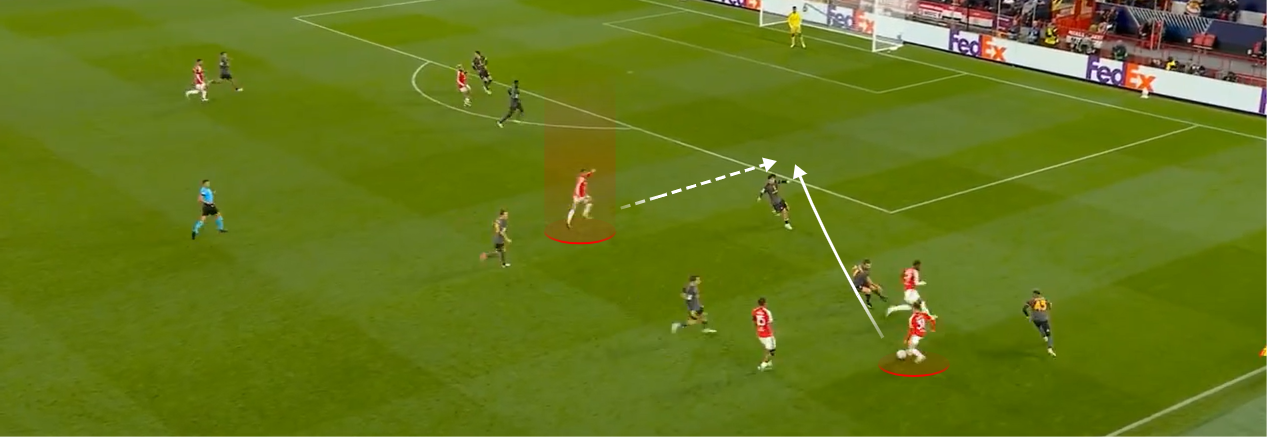
Image 6: Cunha’s run in behind to attack the space behind Roma’s defence, where he receives and finishes to hand United the victory.
Takeaways
Fernandes’ passionate post-match interview with CBS Sport underscored the emotional rollercoaster that the players, staff, and most importantly, the United supporters have endured not just in the game but in the opening few months of the season. Although Carrick’s future at the club remains uncertain, an emphatic victory such as this and in the way the team achieved it has the potential of redirecting their season’s momentum. That said, it needs to be supplemented with on-field tactical changes along with better individual performances to ensure that they can sustainably produce victories. Thus, there will be newfound optimism behind United but one which will have cautious undertone.
For Gasperini, that is two Champions League matches where his team have conceded a defeat after leading the match with a two-goal advantage. They performed well offensively and defensively in the first half which were rewarded. However, it is important to be able to defend these leads. Roma conceded the penalty with a careless and needless foul in the box. Likewise, a failed clearance from Balerdi was the primary reason for Cunha to receive and score. The only goal that was excusable was the winner which was a sheer display of quality from Lacey and Cunha. Defeats are a part of the game and so Roma will have to take it on the chin and move on, but it clearly highlights a key area of improvement that Gasperini must work on the in the coming weeks and months.
Use the arrows to scroll through all available match plots. Click to enlarge.
Check the match plots page for plots of other matches.