
Cruzeiro – Palmeiras: Cruzeiro’s set-piece comeback complicates Palmeiras’ title race (2-1)
The Brasileirão is nearing its conclusion, and Palmeiras are among the title contenders, trying to recover from the advantage Flamengo have built at the top of the table. However, Abel Ferreira had not counted on Cruzeiro’s significant improvement under fellow Portuguese coach Artur Jorge. On Matchday 35, Cruzeiro were clearly superior but needed two set pieces to turn the game around, although the tactical changes also had an impact.
Tactical analysis and match report by Marcus Arboés.
To secure their place in the 2026 Copa Libertadores (South America’s continental tournament), Cruzeiro needed a comeback victory. To achieve that, they relied on an almost entirely first-choice lineup and another experiment from Artur Jorge: Otávio in goal; Fabrício Bruno and Villalba as the center back pairing; William at right fullback and Rojas on the left; Zé Lucas (Brazil Youth National Team) and Romero as the double pivot; Gerson (former Fiorentina) and Matheus Pereira (former West Brom) as attacking midfielders; Kaio Jorge (former Juventus) and Marquinhos as the striking partnership.
Palmeiras, meanwhile, are still competing for titles in three different competitions, including the Brasileirão. As a result, they have needed to manage their players’ minutes and physical workload. Against Cruzeiro away from home, the coaching staff strategically opted to rest most of the regular starters. The team therefore took the field with Carlos Miguel in goal; Barboza, Bruno Fuchs and Benedetti as the center back trio; Khellven and Arthur Gabriel as the fullbacks; Marlon Freitas, Andreas Pereira (former Fulham) and Lucas Evangelista in midfield; Sosa and Vitor Roque (former Barcelona) up front, forming a 3-5-2 outline.
An attack-versus-defense game
Cruzeiro showed how to impose themselves at home, but Palmeiras are a team that, whether using their first-choice players or reserves, feel comfortable defending and attacking longer spaces. The first half was not particularly interesting, with few chances and no goals, but Cruzeiro clearly had a more connected and cohesive game structure, concentrating their attacks through the central channels.
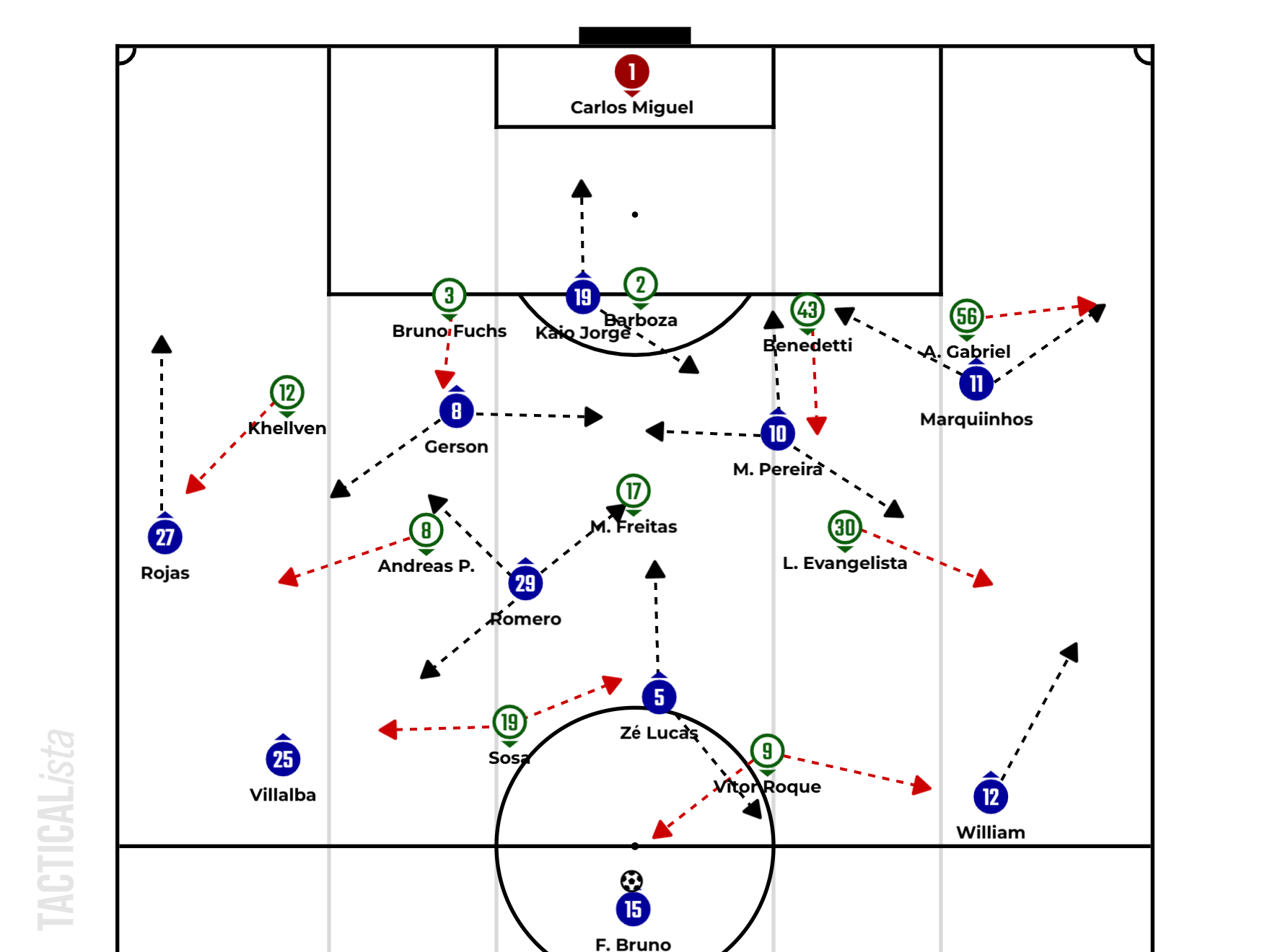
Cruzeiro’s first-half attack, with several players concentrated in the central channel, against Palmeiras’ man-oriented marking in a 5-3-2 formation.
During the first half, Palmeiras only had possession for brief periods. When they did, on no more than three occasions, the team used quick attacks, drawing Cruzeiro’s effective pressing structure toward them. However, the main focus of the first-half scenario was how Cruzeiro attacked, building up in a 3+1 structure, with the more advanced players switching positions and moving around in a slightly more functional/relational attacking style.
Within this three-player build-up structure, William dropped into the right side of the defensive line, or Zé Lucas moved into that position, with Romero acting as the holding midfielder. If William stayed in the build-up line, Zé Lucas became the first reference point in the second line of positioning, while Romero advanced into the available spaces inside. Gerson and Matheus Pereira operated inside as playmakers and connectors, constantly looking to combine and progress the play. Kaio Jorge was the target man, while Marquinhos alternated between staying wide on the right and moving inside as a second striker. On the opposite side, left fullback Rojas always provided width.
Palmeiras defended in a 5-3-2 shape, using man-oriented marking with medium-to-long tracking movements, while the midfield line shifted toward the side of the attack. When Cruzeiro concentrated players on one flank, the midfield line shifted across and the outside midfielder stepped out to engage. The three center backs were responsible for protecting the space between the two last lines, stepping out aggressively to apply individual pressure.
After winning the ball, Palmeiras tried to launch immediate counterattacks. Almost all of these attempts, however, were harmless. But the situation changed dramatically in the first minute of the second half.
Change the players’ profiles, not the structure
Nobody in the stadium should have expected what happened next. In the first minute of the second half, Lucas Evangelista played a long ball for Ramón Sosa to attack the space behind Cruzeiro’s defense and score the opening goal. Artur Jorge’s reaction was clear: he needed to change his plans, but he waited a little longer. Over the following ten minutes, Palmeiras did not face many attacks and even managed to retain possession in the attacking half, unlike what had happened in the first half.
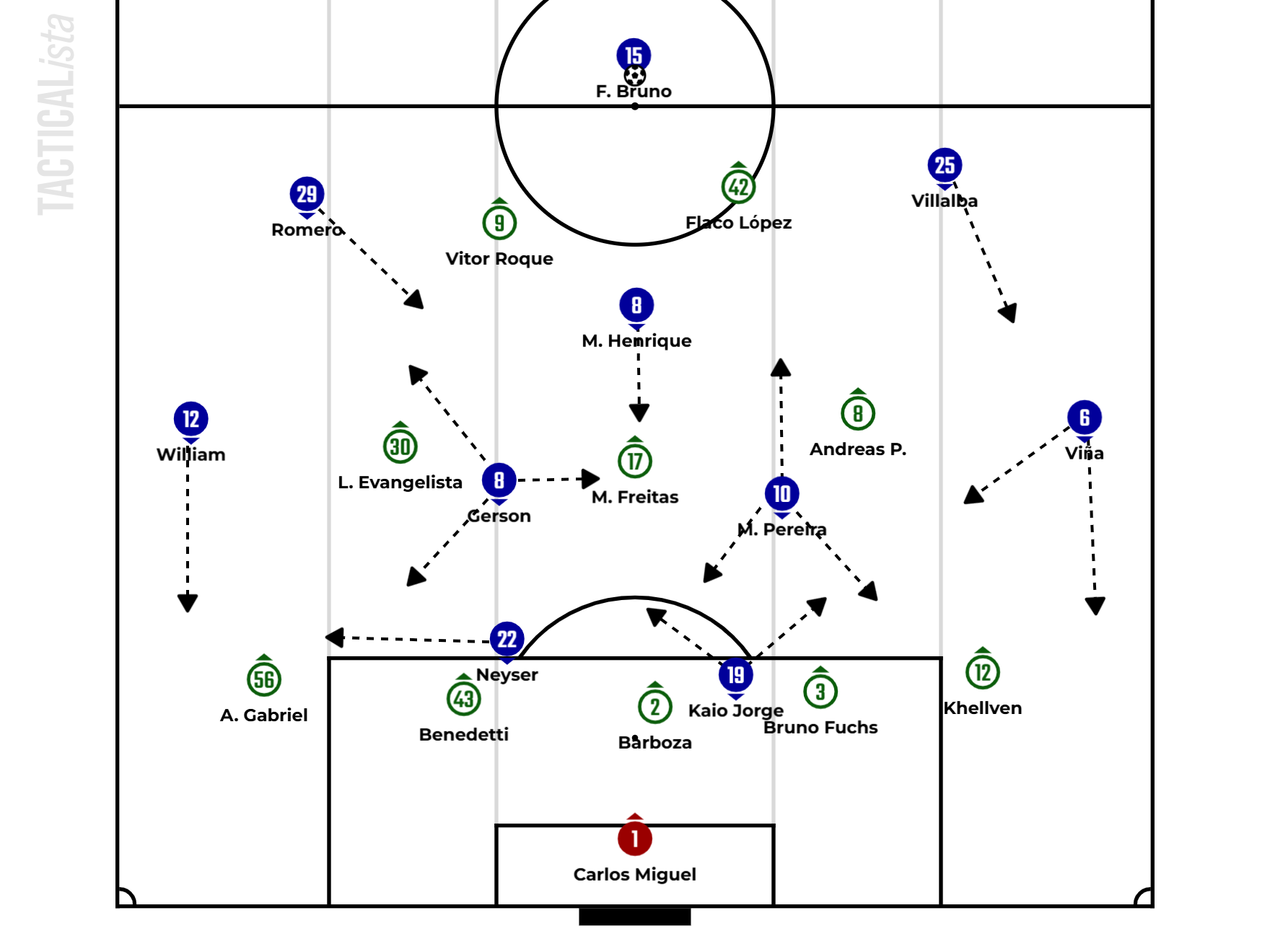
Cruzeiro’s attack in a 3-1-4-2 formation, with the fullbacks operating out wide and a striking partnership up front.
Cruzeiro made two rounds of substitutions. In the first, they replaced winger Marquinhos with striker Neyser Villarreal, who is taller, stronger and has a greater presence in the box. They also brought on ball-playing midfielder Matheus Henrique (former Sassuolo) for the young Zé Lucas. In the second change, left fullback Viña (former Roma and Palmeiras) replaced Rojas. Palmeiras, meanwhile, only replaced Ramón Sosa with Flaco López (Argentina National Team).
As a result, Cruzeiro gained a greater presence in the box when attacking. The profiles of the players operating out wide also changed: Marquinhos and Rojas are faster and more skillful, while William and Viña are more focused on build-up play and have good crossing ability from different distances. Matheus Henrique brought a more balanced profile as a positional holding midfielder, while Romero took on the responsibility of building up from the right. The final crucial adjustment that improved the team was switching Matheus Pereira and Gerson’s sides, creating a better fit between the players’ profiles and the roles in each channel.
The attacks continued through the middle, but with greater intensity. Palmeiras were under pressure, although they were still holding on. Then Matheus Pereira scored a beautiful long-range free kick. Minutes later, from a corner, Cruzeiro capitalized on the momentum from the equalizer and benefited from a mistake by Khellven, who scored an own goal.
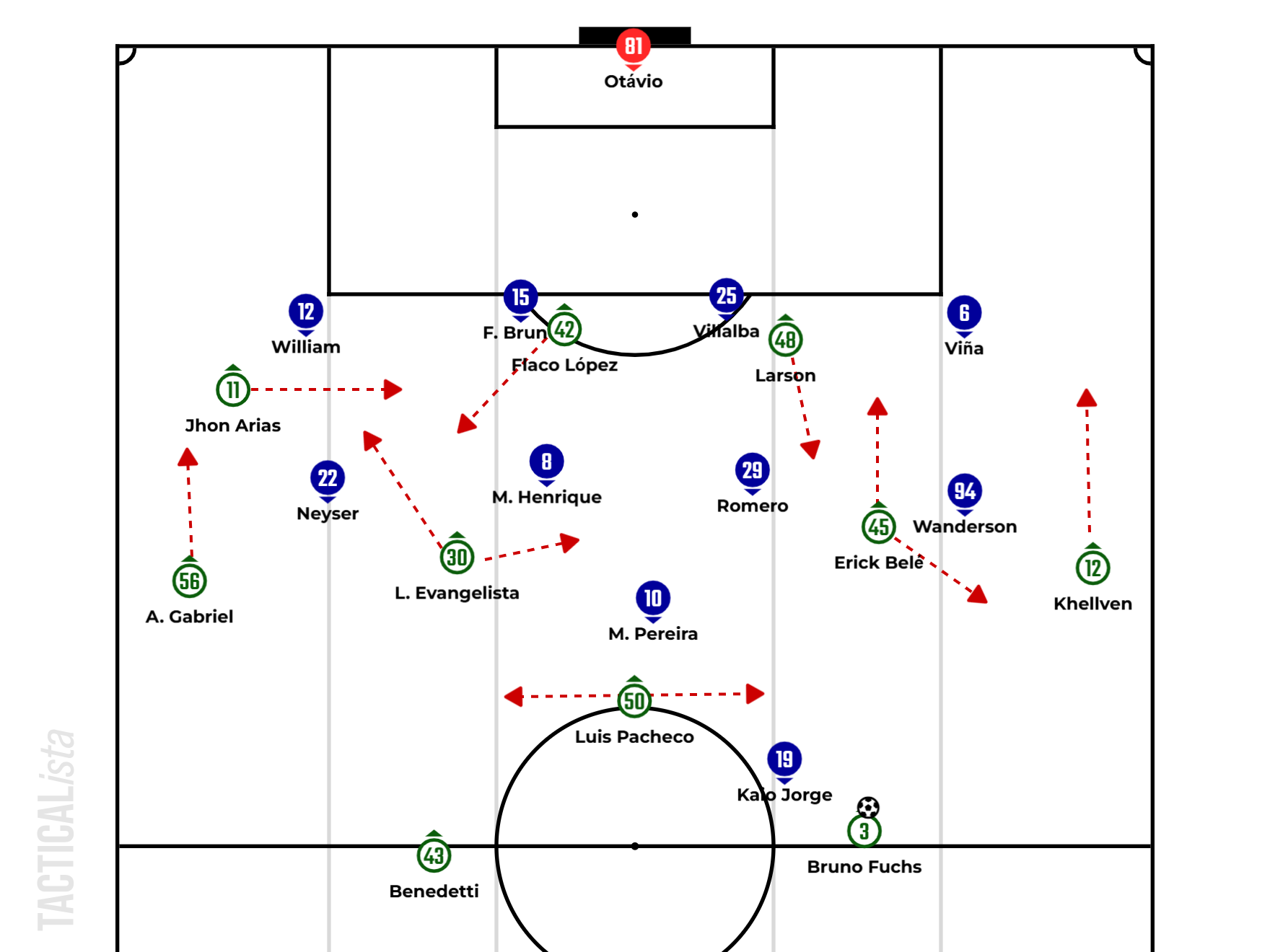
The final game scenario, with Palmeiras’ attacking structure completely disfigured and filled with young players.
The final score was 2-1, but Palmeiras did not give up, even if their supporters may have been left with that impression, since the substitutions ultimately made no difference whatsoever. Arias came on for Vitor Roque, which improved the attack, but all the other changes involved young players: Luís Pacheco, Larson and Erick Belé, who replaced starters being rested for physical reasons (Andreas, Marlon Freitas and Barboza).
The final three substitutions, alongside Wanderson replacing Gerson to improve Cruzeiro’s defensive marking out wide, came around the 40th minute of the second half, during the closing stages. Before and after that, Palmeiras failed to make any real progress in attack. With several technically dominant players controlling the game through possession, Artur Jorge’s team had no trouble dealing with the inexperience of the young players who had come on to make up the opposition’s midfield.
Takeaways
Cruzeiro have not yet confirmed their final league position, but they’re already certain to play in the 2027 Libertadores, having secured a victory against one of the continent’s leading teams. In the next round, they face Chapecoense, who have already been mathematically relegated. Cruzeiro will probably collect another three points, giving the coach a good opportunity to try new ideas and give some players more playing time.
Palmeiras, on the other hand, have found themselves in a much more complicated position. There are now only three rounds remaining in the Brasileirão. Flamengo won their Matchday fixture and opened up a six-point lead. In the next game, the two sides will face each other in what could be an early title decider. Palmeiras will play at home and need to win to keep their title hopes alive, while they still have two other finals to play this season. If they lose this decisive encounter, Flamengo will be mathematically crowned Brasileirão champions.
Use the arrows to scroll through all available match plots. Click to enlarge. Check the match plots page for plots of other matches.