
Liverpool – Manchester United: Pochettino’s United In A Sorry State (4-0)
Any intrigue around Mauricio Pochettino’s tactical approach in his first game at Manchester United was quickly overshadowed by defensive calamities and an early red card. Although a formation change for United stabilized things temporarily, Liverpool upped the intensity in the second half.
Tactical analysis and match report by Josh Manley.
We decided to make this article free to read. If you want to support our work, consider taking a subscription.
Mauricio Pochettino was handed a tough assignment in his first game as Manchester United manager as he led his team to Anfield having only had a short time to prepare his team after the international break.
Liverpool meanwhile have been relatively steady under Andoni Iraola so far, with the exception of defeats against Arsenal and Fenerbahçe earlier this month. They were favorites coming into this game against a United side currently in the relegation zone.
Iraola’s side lined up in a 4-2-3-1 shape here with a back four of Ronald Araújo, Jérémy Jacquet, Virgil van Dijk, and Milos Kerkez. Dominik Szoboszlai and Alexis Mac Allister partnered in central midfield, while Florian Wirtz acted as the number ten. Bradley Barcola and Rio Ngumoha then flanked striker Alexander Isak.
Pochettino lined United up in a 3-4-3 shape with a back three of Leny Yoro, Matthijs de Ligt, and Lisandro Martínez while Diogo Dalot and Patrick Dorgu played as wing backs. Youri Tielemans and Kobbie Mainoo partnered in central midfield behind a front three of Bryan Mbeumo, Matheus Cunha, and Bruno Fernandes.
United’s defensive calamity
Defending has been a problem for United on an individual and collective level this season, and this continued to be a decisive theme in this game.
United were using a hybrid system whereby they formed a 3-4-3 in possession and fell into a back four without the ball as Dalot became the right back and Martínez the left back, with Dorgu part of the midfield line.
From the earliest stages though, it was clear that there would be defensive worries for United. For example, the matchup between right winger Barcola and Martínez became relevant almost immediately.
There were two early scenes where Barcola was able to beat Martínez with his speed in dangerous transition situations for United.
On the other side, Dalot also struggled in his one-versus-one duels against Ngumoha, including in the lead up to Liverpool’s second goal.
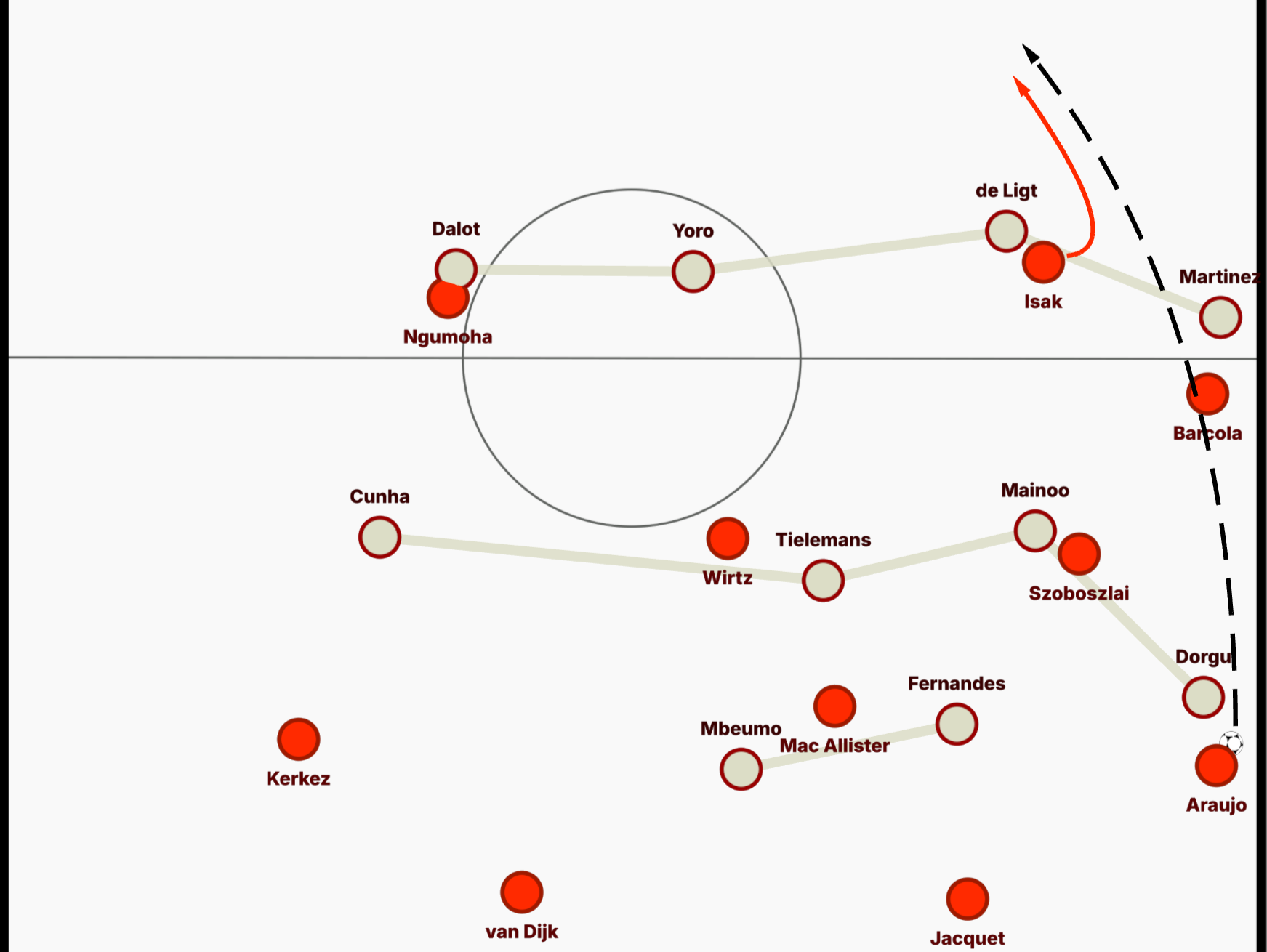
The scene leading to Yoro’s red card.
Before that though, the decisive moment in the game happened within the first ten minutes, where United’s lack of coordination in their defensive line allowed Isak to get in behind from a simple long ball.
De Ligt had horribly misjudged the ball as it went over his head, and Yoro had failed to recognize the potential danger of the ball in behind. The Frenchman ended up fouling Isak as the last defender, resulting in a red card.
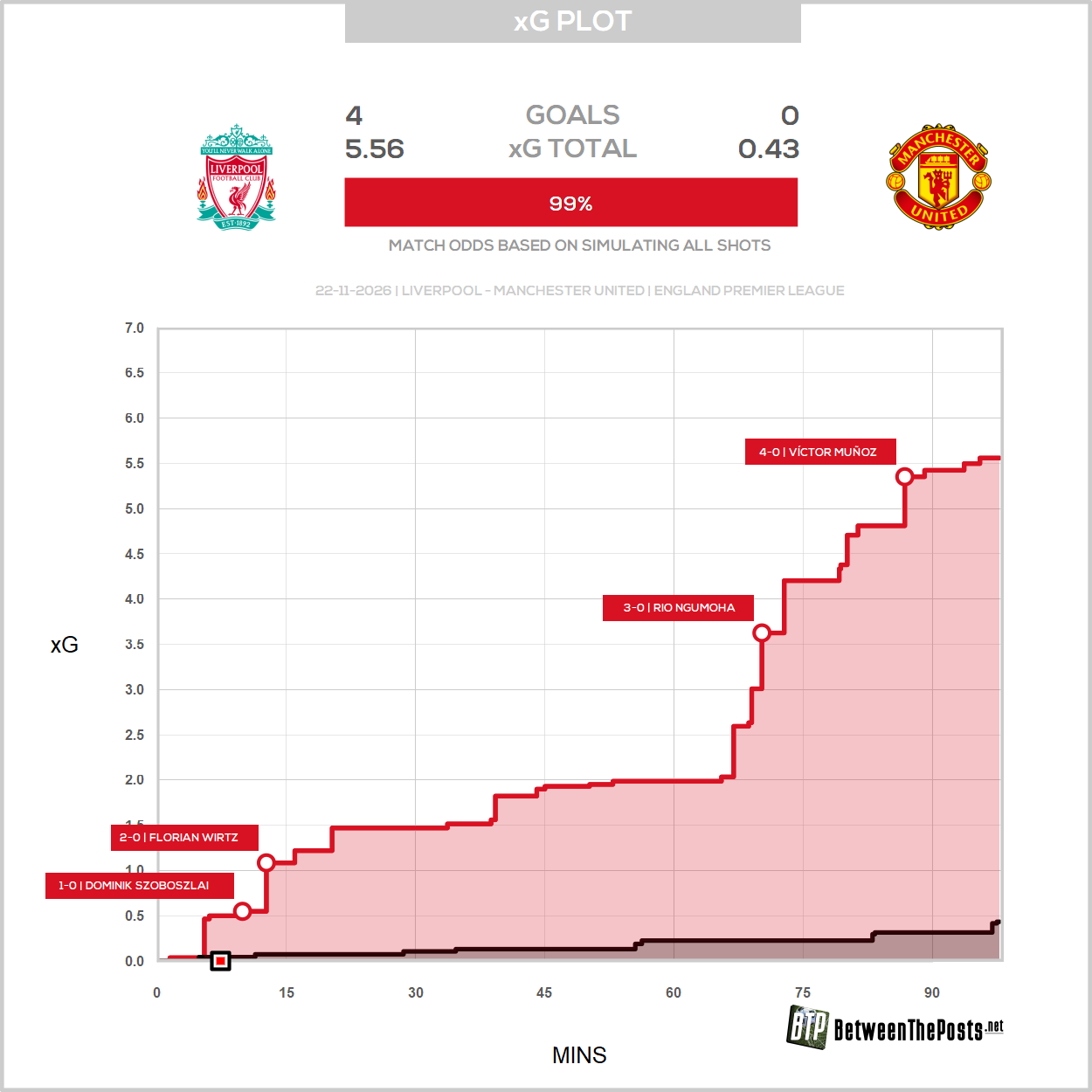
Szoboszlai scored from the subsequent free-kick, and Wirtz followed up shortly afterwards, assisted by the aforementioned Ngumoha beating of Dalot.
Damage limitation
After fifteen minutes, United were 2-0 down with ten men. Pochettino decided that damage limitation was a necessity at this point and therefore brought on Harry Maguire for Mbeumo.
United now played in a 5-3-1 shape with Fernandes dropping back into central midfield and Cunha operating as the lone forward.
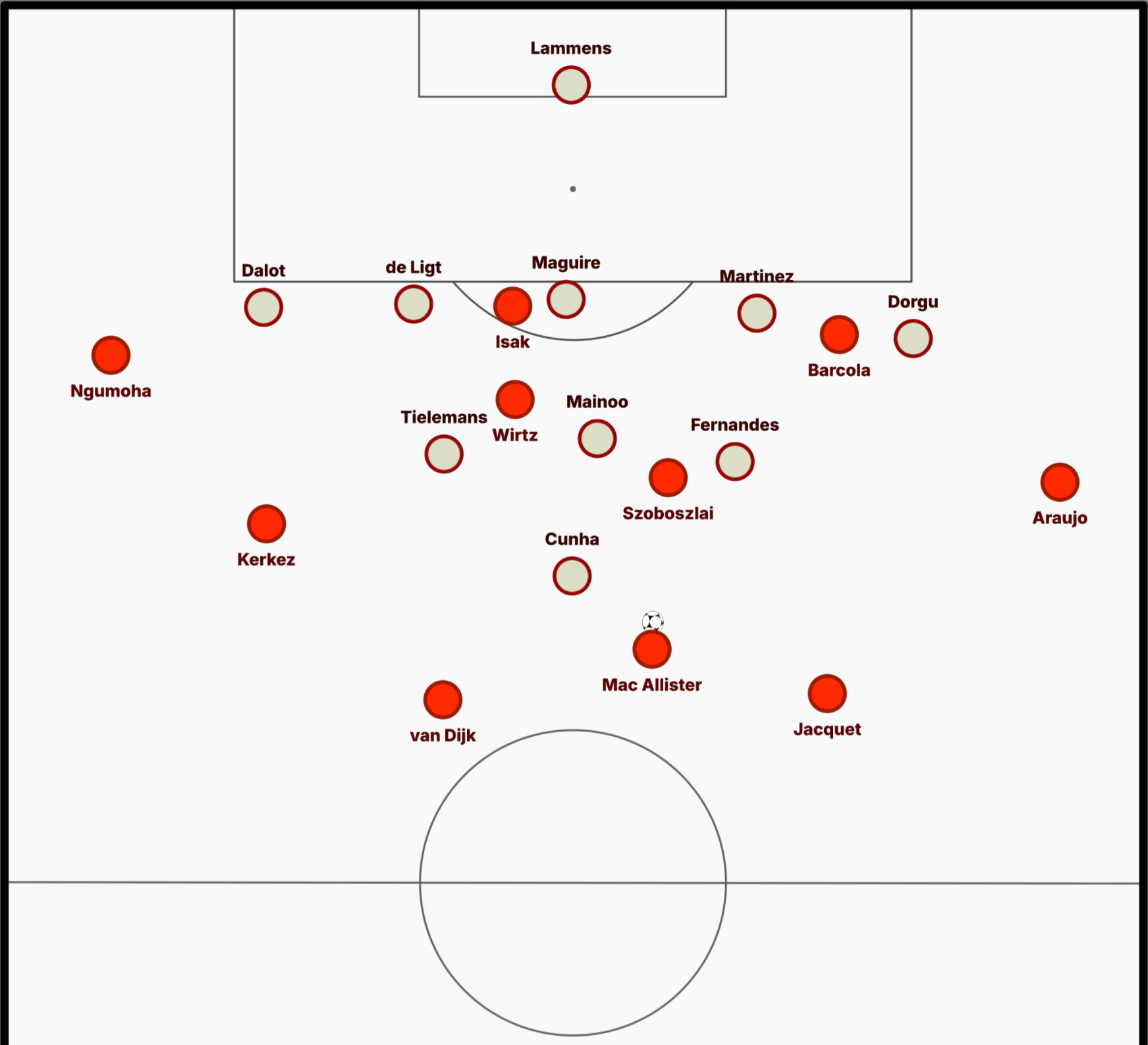
United’s 5-3-1 shape.
This move by Pochettino was actually successful in stabilizing United with and without the ball. For the following twenty minutes or so, Liverpool did not create much against the back five, and United were able to string together some possession phases of their own.
Their 3-5-1 shape in attack with Cunha as false nine helped them knit together central combinations against the 4-4-2 pressing shape of Liverpool, with switches of play out to Dorgu their preferred way to attempt progression.
Naturally though, United with ten men did not create anything of substance from these moves.
Attacking through Ngumoha
In Liverpool’s possession phases, they usually played from a 2-4-4 shape initially. The fullbacks started on the second line. Araújo tended to be wider while Kerkez played a narrower role on the left.
This was in coordination with the roles of the wingers. Barcola from the right side often indented, moving onto the last line around the right halfspace, constantly threatening runs in behind the United defense.
Ngumoha meanwhile stayed wide on the left, looking for isolation situations against Dalot. This turned out to be Liverpool’s primary route of attack, with many passes and switches of play finding their way to Ngumoha.
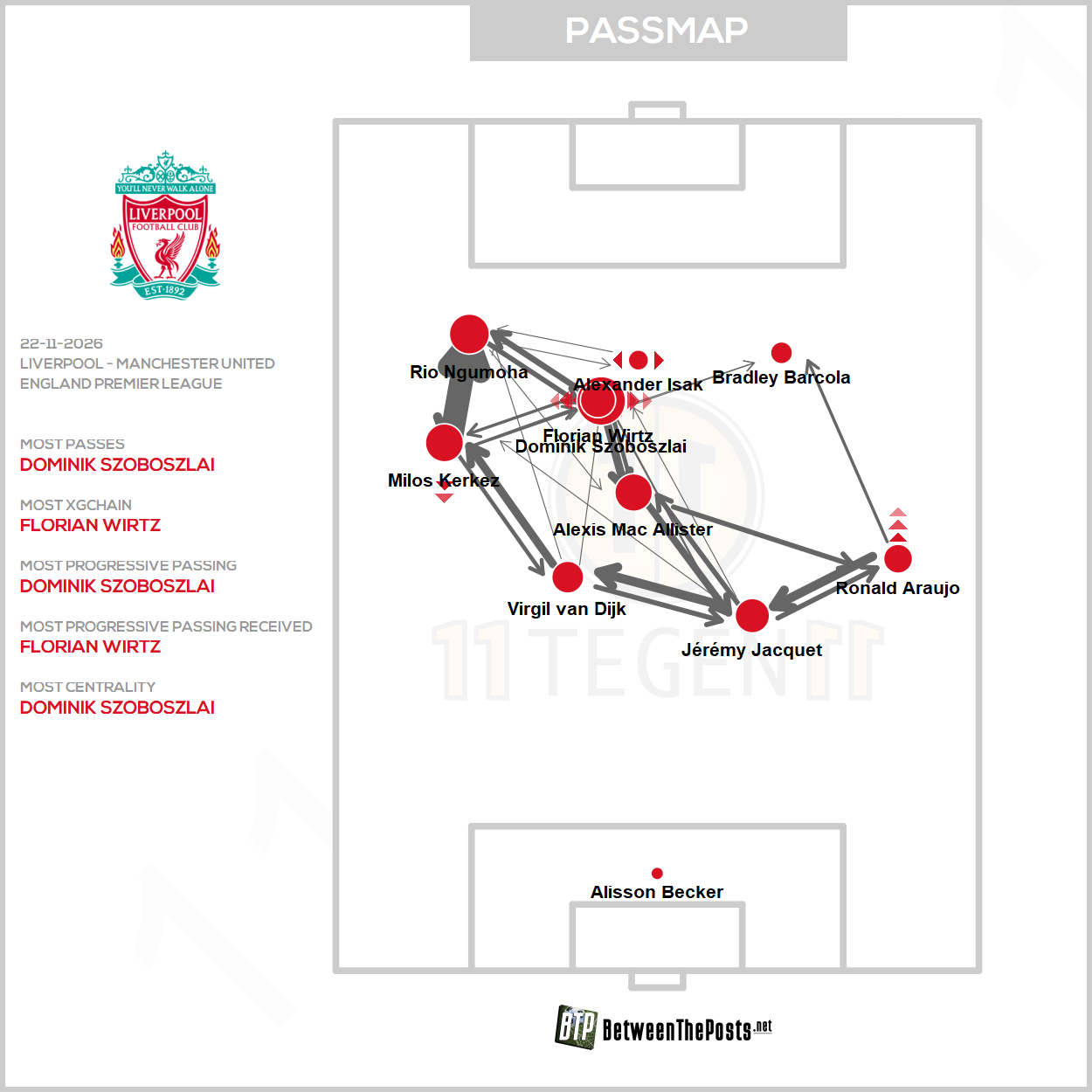
Liverpool’s left-sided attacking focus is clear in their passmap.
With United defending in a 5-3-1 shape, there was plenty of space at the corners of the defensive shape for Liverpool to stage attacks from. United’s midfield three could not cover the width of the halfspaces.
Mac Allister tended to be the deepest midfielder for Liverpool, while Szoboszlai had freedom to move further ahead, level with United’s midfield line or behind it. Liverpool could then move into 4-3-3 variations when attacking.
The lack of coordination in United’s defensive line became evident again in the second half as failed offside traps and individual errors were shown.
As the second half progressed, Liverpool were now racking up the chances. This included transition phases since United did commit players forward when attacking, including an aggressive role for Martínez from left center-back.
This gave Liverpool’s attackers plenty of space to run into. It was unsurprising when Ngumoha added Liverpool’s third from a counter-attack, assisted by Barcola.
Pochettino had tried to add fresh legs to United, bringing on Joshua Zirkzee at half time and then Mason Mount and Noussair Mazraoui after the hour. Iraola meanwhile replaced Mac Allister and Barcola with Trey Nyoni and Víctor Muñoz.
It was Muñoz who would eventually add the final goal for Liverpool, made from a counterpressing situation on the edge of United’s own box.
Takeaways
Liverpool took advantage of the situation presented to them here. The frontline looked quick and sharp, with United being unable to cope with Barcola and Ngumoha. Iraola is in the process of stamping his identity onto this team, as shown through their high-tempo style.
For United it’s another defensive calamity. Anyone who was hoping to learn something substantive about how Pochettino will approach things at United will have been disappointed by the early red card. Instead, the game was largely defined by basic defensive deficiencies from United on an individual and group level.
Use the arrows to scroll through all available match plots. Click to enlarge.
Check the match plots page for plots of other matches.