
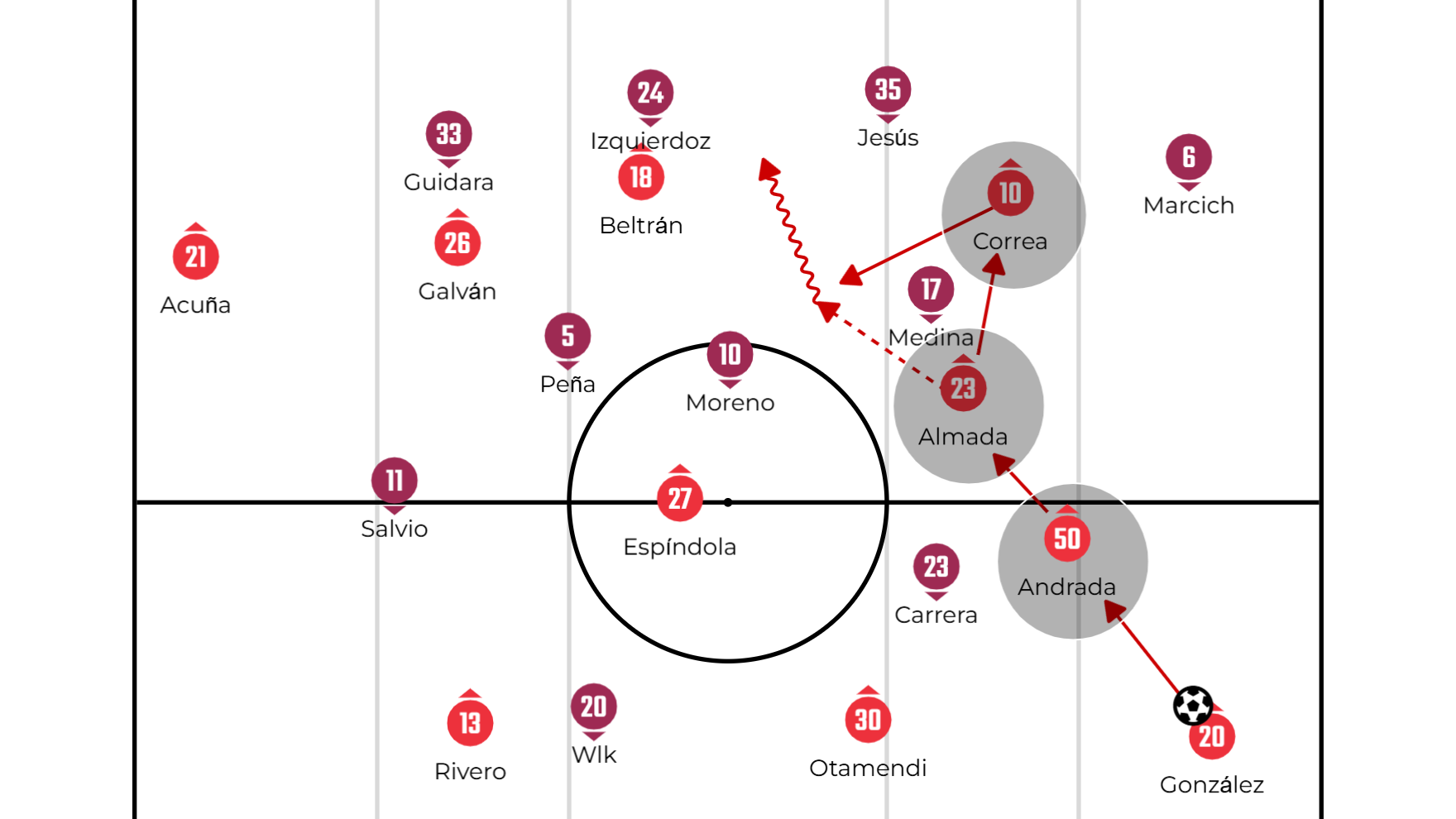
River Plate – Lanús: The Andrada and Almada Show as River Plate Advance to the quarter-finals of the Playoffs (3-1)
River Plate controlled this game with and without the ball, but Lanús needed only a little momentum to get back into it. In the end, Thiago Almada and Tobías Andrada made the difference. One scored twice, the other had a goal and an assist.
Tactical analysis and match report by Ebuka Ogoegbunam.
River Plate came into this round of 16 tie after a Clausura of two very different parts. Having lost the Apertura final 3-2 to Belgrano in May, they opened the new tournament with four straight defeats. Eduardo Coudet resigned in late August and Leonardo Ponzio took over as interim coach. His first game was a 3-2 win over Banfield, and from there things started to turn.
Under Ponzio, River Plate took seven wins, one draw and two defeats from their last ten games of the regular phase. They beat Belgrano 3-0 and Racing 1-0 in October before a 1-0 defeat to Boca Juniors in the Superclásico at La Bombonera. They responded with a 2-0 win over Aldosivi. That recovery took them from that start to fourth in Zone B, with 26 points, 21 goals scored and 14 conceded in 16 games.
Lanús arrived in a different way. They were harder to beat than exciting, finishing fifth in Zone A with the same 26 points from seven wins, five draws and four defeats. They conceded only 12 goals in those 16 games and had gone nine games unbeaten. Mauricio Pellegrino’s side ended Vélez’s unbeaten record with a 2-0 win and then won 1-0 at Platense. After that they drew their last three games 1-1, against Banfield, Gimnasia de Mendoza and Central Córdoba, so the run was still alive but the wins had dried up.
River Plate set up in a 4-1-2-3, with Santiago Beltrán in goal and a back four of Giovanni González, Nicolás Otamendi, Lautaro Rivero and Marcos Acuña. Santiago Espíndola was the single pivot, with Andrada and Almada ahead of him. Ángel Correa and Tomás Galván played either side of Lucas Beltrán. Ponzio was without Gonzalo Montiel through suspension, while Fausto Vera and Aníbal Moreno were also unavailable.
It was a lineup with a lot of technical players close together. Almada and Andrada could both receive deep and arrive forward, while Correa and Galván preferred to play inside rather than stay on the touchline. That meant River Plate’s width would have to come from the fullbacks, and this shaped much of how they attacked.
Pellegrino’s Lanús set up in a 4-2-3-1 shape. Nahuel Losada was in goal behind Tomás Guidara, Carlos Izquierdoz, Ronaldo De Jesús and Sasha Marcich. Eduardo Salvio and Ramiro Carrera were the wide players, with Agustín Medina and Felipe Peña Biafore in the middle. Marcelino Moreno joined Alan Wlk up front.
River Plate’s Wide Overloads
In possession, River Plate’s 4-1-2-3 was very fluid. Acuña and González pushed high, and that let the wingers come inside. Galván and Correa occupied the spaces between the Lanús defenders and midfielders, while Almada and Andrada dropped deep and came ball side to help the team play through.
This gave River Plate plenty of numbers close to the ball, especially on the left. Almada dropped out towards the touchline, Acuña stayed high and wide, Galván moved inside and Espíndola supported from the middle. The wide players for Lanús were left dealing with multiple River players around them. Correa also drifted from his position on the right to come across centrally, which made River Plate even harder to pick up.
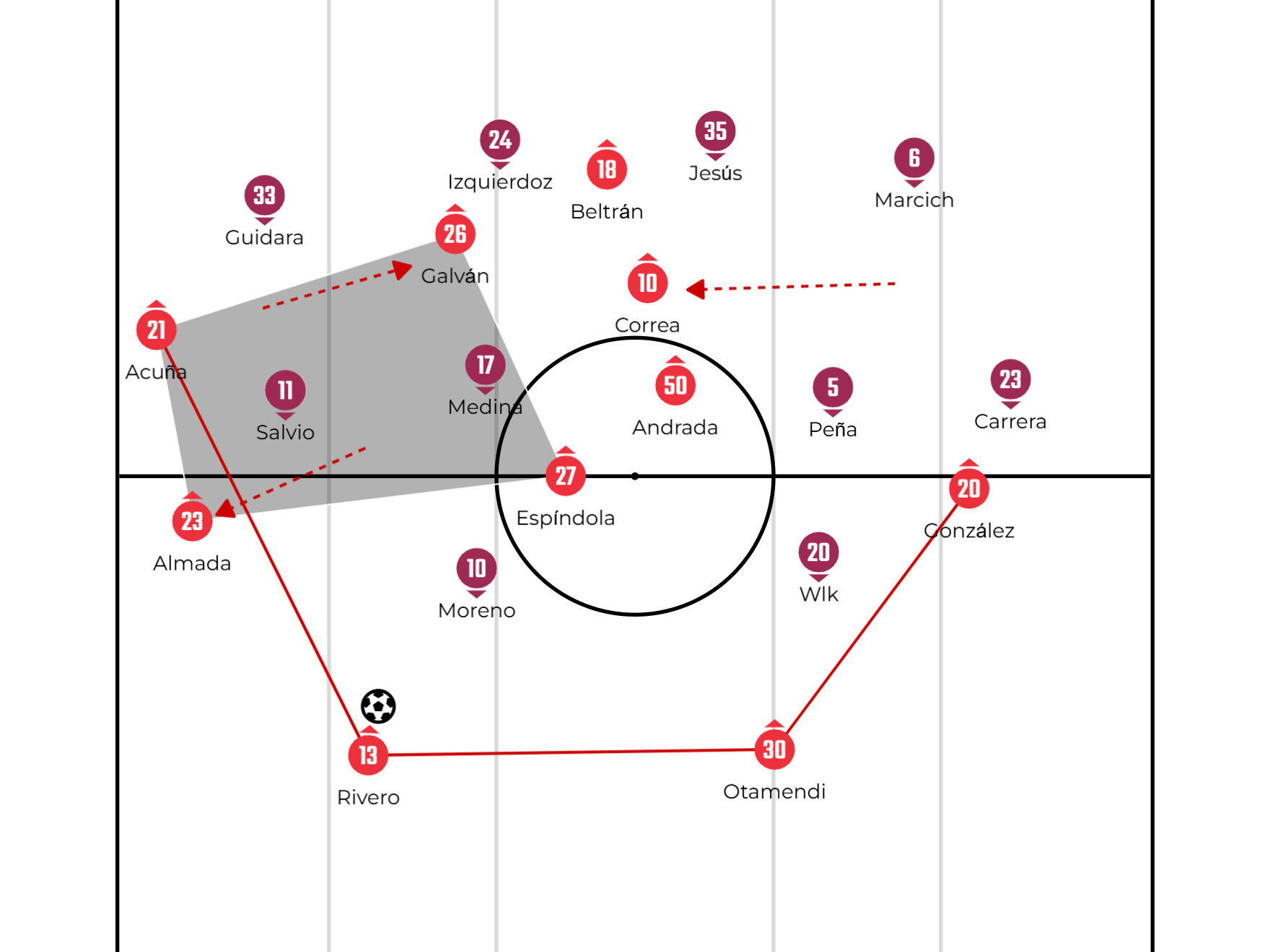
River Plate’s left-sided overload, with Almada dropping, Acuña high and Galván and Correa coming inside.
It was not only on the left. Andrada and Almada constantly moved to wherever the ball was to overload the wide areas. When the ball was with González on the right, Andrada came across to receive from him and Almada was there ahead of him. Almada, Andrada and Correa were able to combine in these central areas and use third man movements to beat Lanús’ pressure. River Plate controlled possession with plenty of players around the ball and combined very well in tight areas.
River Plate always had another player to play with and another one ready to move.
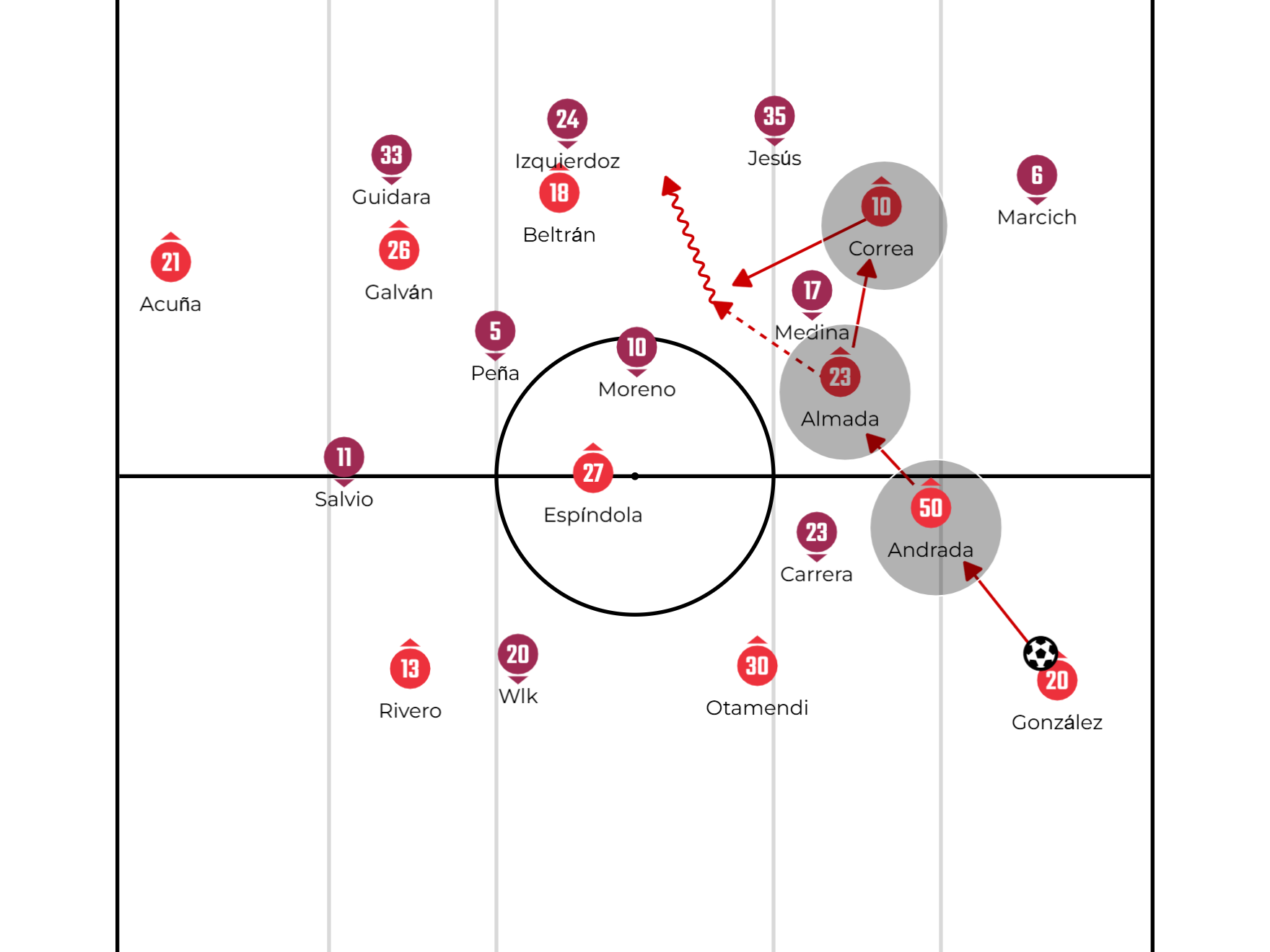
Andrada, Almada and Correa combining on the right, with Almada running beyond Medina for the return pass.
The wide areas were River Plate’s main outlets in the final third. They looked to put in crosses and used overlapping and underlapping runs to confuse the Lanús defenders. They arrived on the last line a lot, and Lanús had to respond. In the mid and low block, Salvio at times dropped into the back line to contain Acuña, who was always going forward. This gave Lanús a back five in those moments while allowing River more control in the build-up.
River Plate got their reward in the 14th minute. Izquierdoz fouled Otamendi in the box and Almada converted the penalty.
A Zonal Press for Control
River Plate also controlled the game without the ball. They pressed in a 4-1-3-2, with Correa moving up next to Beltrán to lead the press against Izquierdoz and De Jesús. Galván, Almada and Andrada formed the line of three behind them, screening the space in front of Espíndola.
Galván and Andrada were the wide players of that three, and they helped to put pressure on the Lanús fullbacks. Galván went out to Guidara and Andrada to Marcich. Espíndola then shifted ball side to cover the central spaces whenever the ball moved to one side. It was a very good zonal approach early on and it forced turnovers.
Almada’s role in the middle of that line was just as important. He stayed between Peña Biafore and Medina, so Lanús did not have an easy pass into the center. The natural way out was through the fullbacks, and that was where Galván and Andrada were ready to jump out to them in those moments. Behind them, Acuña stayed close to Salvio and González to Carrera, with Rivero and Otamendi dealing with Wlk. The risk was the space on either side of Espíndola, especially with Moreno around him, so his movement across was key to keeping the press together.
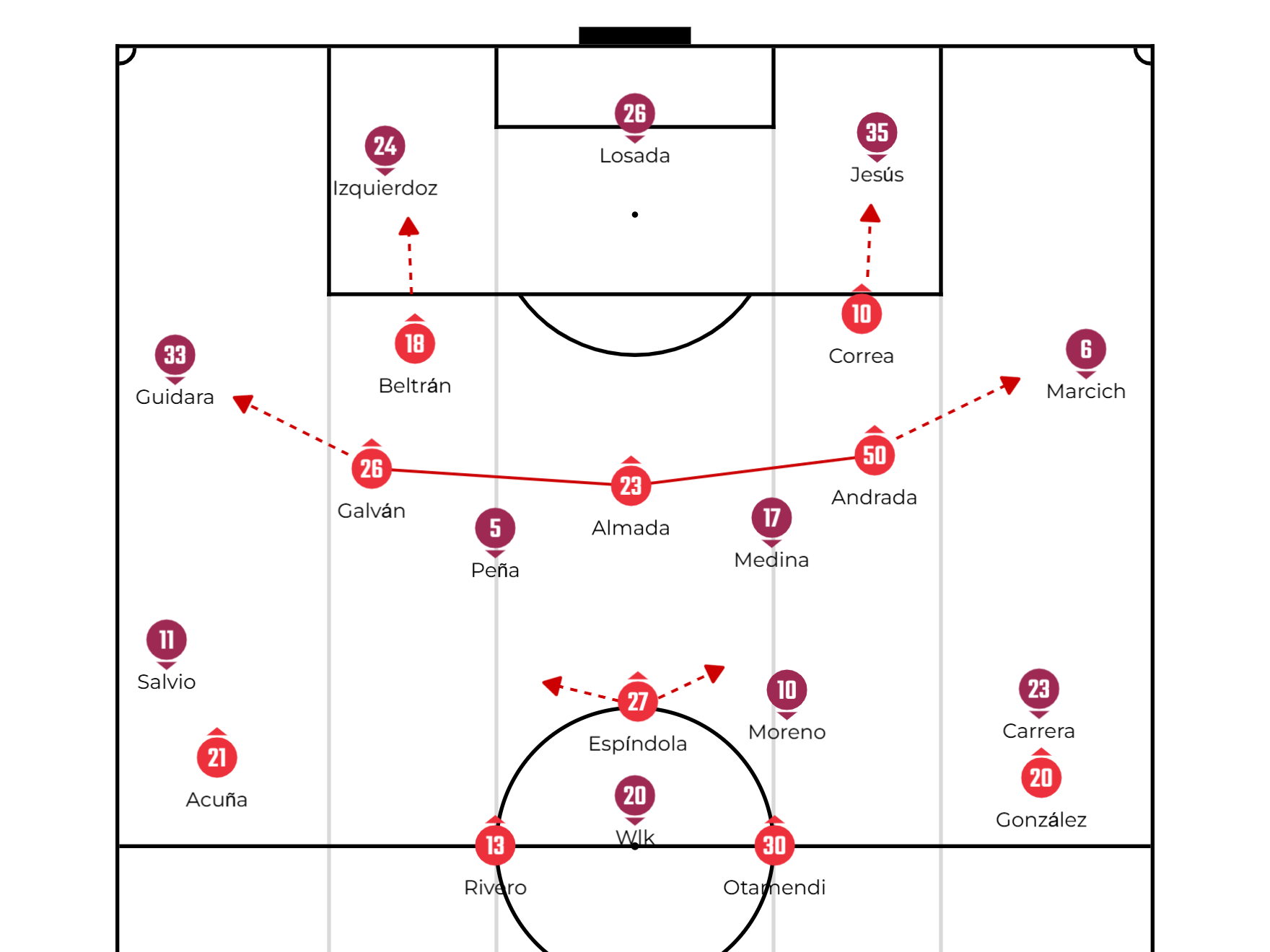
River Plate’s 4-1-3-2 press, with Galván and Andrada jumping to the fullbacks and Espíndola shifting ball side.
Lanús Choose Their Moment
River Plate dominated the first 25 minutes and Lanús had to concede control. On one or two occasions, River lost the ball in deep areas and allowed Lanús to transition. They did well to defend these situations and did not let Lanús build much momentum.
However, Lanús made the most of the little momentum they gained later on. In the 31st minute, they combined on the right to get back into the game. Guidara, Salvio and Moreno were all on that side with Medina nearby. Moreno played the ball into the space behind Acuña and Medina ran from midfield to reach it. He cut the ball back for Carrera, who had come inside from the opposite wing to finish past Santiago Beltrán. It was 1-1 at the break in a half that River Plate had largely controlled.
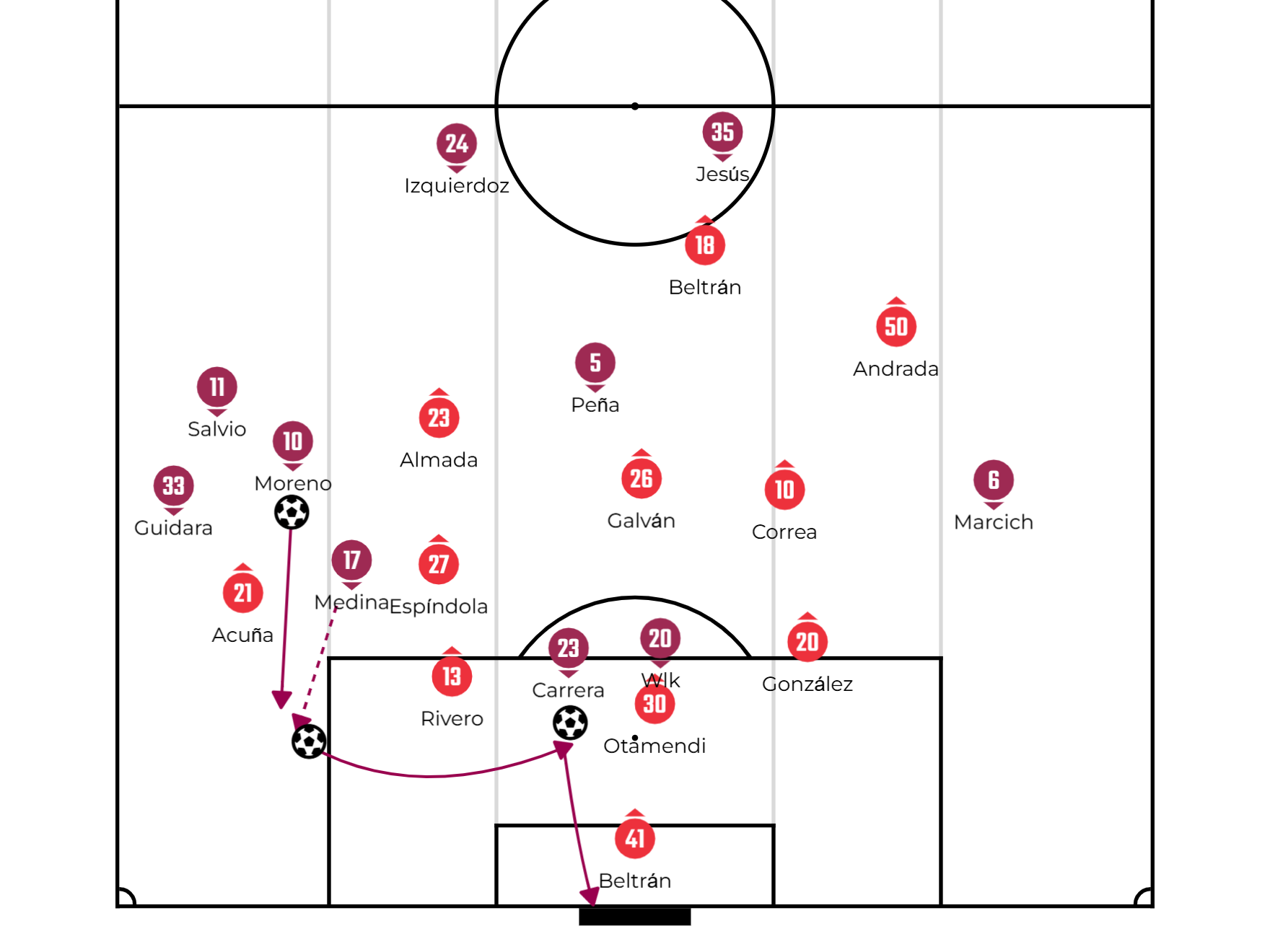
Lanús’ equaliser, with Medina running in behind Acuña to set up Carrera.
The Andrada and Almada Show
River Plate went back in front in the 68th minute, and the two midfielders were involved again. Almada’s free kick came back off the bar and Andrada was there to put in the rebound.
Ponzio had already changed things before that goal, with Ortega replacing Acuña in the 57th minute and Sebastián Driussi coming on for Lucas Beltrán four minutes later.
They finished the game off in the 89th minute. Lanús lost the ball up the pitch and Andrada carried it from deep, covering a huge distance before finding Almada. He finished past Losada to make it 3-1.
Almada ended the night with two goals and hit the free kick that led to the other one. Andrada had a goal and an assist. The same two players who helped River Plate control the ball were also the ones who decided the game.
Takeaways
River Plate were the better side in the first half. Their movement gave them numbers in wide areas, their fullbacks kept arriving high up the pitch and their zonal press stopped Lanús from building any sort of momentum.
Lanús deserve credit for their efficiency. They did not have many good spells, but they were precise when one came and found the space River Plate’s high fullbacks can leave behind.
Their unbeaten run ends at nine games, and the way they conceded will hurt. A penalty, a rebound and a late transition are all moments a side that had conceded only 12 goals in 16 games would expect to manage better.
For all that control, River Plate’s first two goals came from a penalty and a free kick. They will want more from their wide overloads in open play, but having Andrada and Almada in this kind of form made up for it.
Ponzio’s side have now won eight of their 11 games under him, which is a long way from the four straight defeats they started with. They travel to face Instituto, who beat Huracán 2-1, for a place in the semi-finals.
Match plots will be added as soon as possible