
Paris Saint-Germain – AS Roma: All Square In Battle Between Ideologues (2-2)
Paris Saint-Germain and AS Roma’s first-ever meeting would end with the points shared between them. Roma would strike early and then set about frustrating their hosts with a hard-to-break-down system. PSG would have to rely on set-pieces to find the back of the net, before being stung by one, as their twelve-game winning streak was brought to an end.
Tactical analysis and match report by Nick Hartland.
We decided to make this article free to read. If you want to support our work, consider taking a subscription.
The hunger in Paris for Champions League glory has not been sated by winning the past two editions of the competition. Instead, it seems to have only fuelled the relentlessness within Luis Enrique’s all-conquering Paris Saint-Germain. However, the prospect of a three-peat looks somewhat diminished, with season-ending injuries to Khvicha Kvaratskhelia and Désiré Doué leaving the side notably lighter in attack, regardless of their significant summer recruitment efforts.
AS Roma’s expectations coming into this game were damaged by their results in the competition, even if domestically Gian Piero Gasperini has his side humming along nicely as current runners-up to rivals SS Lazio. The Italian side had thrown away winning positions in losses to Manchester United and Real Madrid, and also in the draw with Fenerbahçe SK. Their one win in Europe had come against underdogs ŠK Slovan Bratislava.
Enrique went with a 4-3-3 shape. In goal, Matvey Safonov, with a defense consisting of Nuno Mendes, Willian Pacho, Illia Zabarnyi, and Achraf Hakimi. In midfield, it was Fabián Ruiz, Vitinha, and João Neves. Up front, nominally, Senny Mayulu and Maghnes Akliouche were on the wings, while Ferran Torres played through the middle.
Gasperini deployed a 3-4-2-1 formation. Mile Svilar was between the posts, with a backline made up of Mario Hermoso, Evan Ndicka, and Gianluca Mancini. Wesley and Nahuel Molina were the wing-backs, with Manu Koné and Marten de Roon as the double pivot. In attack, Matías Soulé and Niccolò Pisilli supported Santiago Castro.
Game, set…
Enrique’s PSG over the past two seasons have become an enigmatic question for elite coaches to solve. If you sit back, you allow them to control the ball and pick you apart with patient passing and excellent one-versus-one dribblers. If you press them, you open yourself up to their eagerness to stretch the game and to attack the space behind your backline. For an ideologue like Gasperini, who has dogmatically instilled man-to-man pressing throughout his time in management. The question around PSG was reframed: how will PSG respond to us and our out-of-possession system?
From the first whistle, Roma set out to impose themselves on their hosts. Gasperini wanted his side to defend high up the pitch in a hybrid system. Roma pressed man-to-man when PSG looked to build from the back. Gasperini gave his charges license to be dragged away from their starting position, in order to prevent Les Parisiens from having time and space on the ball. However, if PSG passed the half-way line, Roma dropped into a more zonal structure, putting their players behind the ball to congest the center of the pitch.
Both elements of Roma’s off-ball approach were – as expected – designed around making life as difficult as possible for PSG to play through them. Albeit in different ways, when defending higher up the pitch, Roma aimed to force PSG into a high turnover, where they could then create a dangerous transitional attack. In deeper areas, In deeper areas, ball recovery was less important as risk mitigation became a more pressing concern than… pressing. Albeit Roma were conscious to look for triggers to move out of their zonal shape when PSG recycled the ball backwards so as not to get trapped into a deep shape.
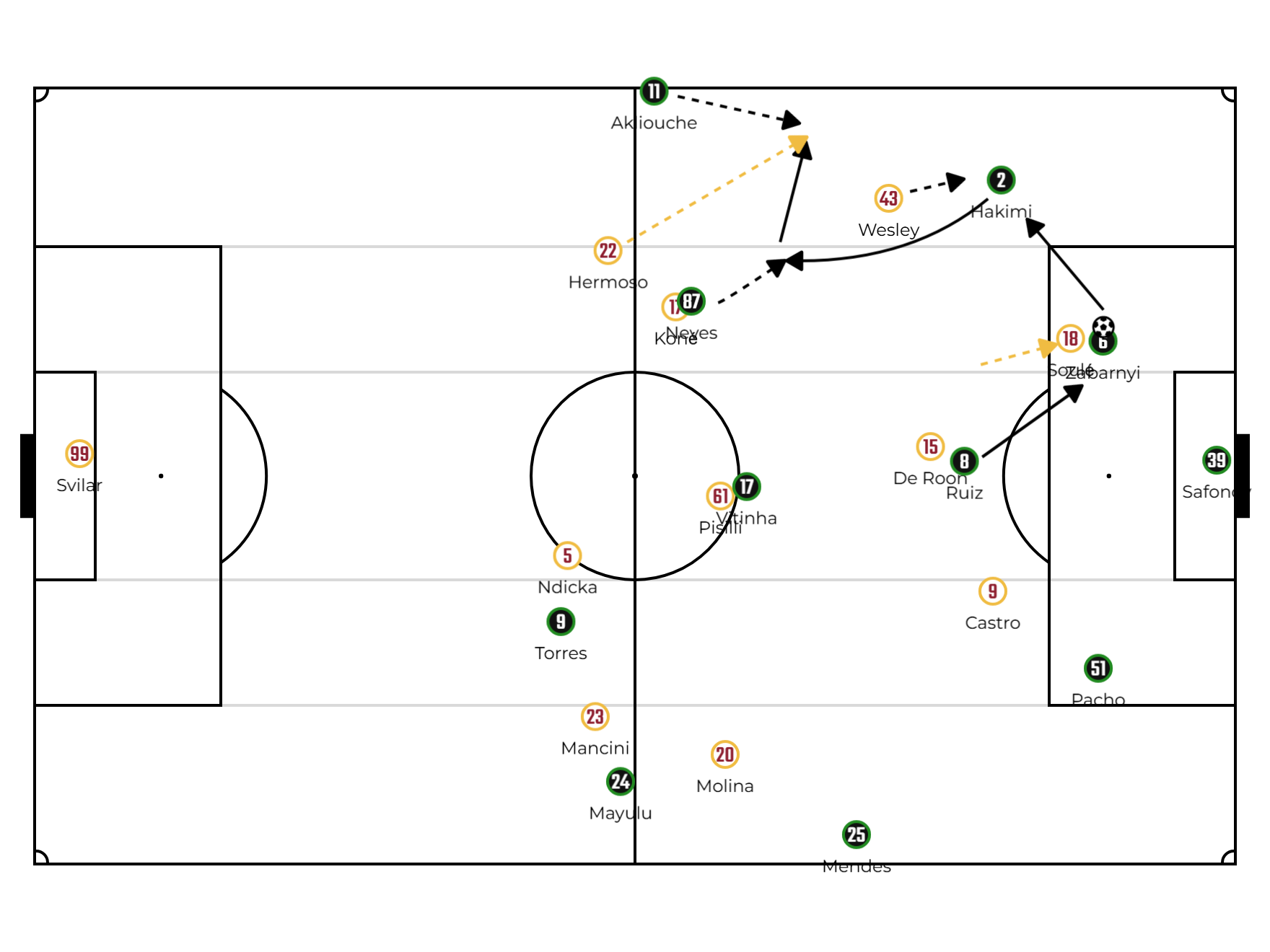
PSG responded to the pressure on their build-up phase by leaning into Roma’s willingness to follow their man. Les Parisiens looked to use rotations across the pitch to attempt to distort their visitors’ shape and open pockets of space for third and fourth man runs and passing lanes into the forward line. However, it was Roma’s system that would come out on top in the opening exchanges, when their pressing forced a high turnover in the fifth minute. Hermoso dispossessed Akliouche high up the pitch, kickstarting Roma’s counter. The center-back carried on his run, crashing the box, where he was in position to receive Soulé’s pass and fire Roma ahead.
5th minute: Lead-up to Roma’s goal. You can see Roma’s man-t0-man pressing across the pitch. They suffocate passing options and create these individual duels. Hermoso is dragged far out from the backline. The risk leaves space behind him, but the reward is the goal.
Despite the goal, the game state didn’t change. PSG were not the kind of side to throw out their game plan just because the other team had scored, while Roma had hard evidence that they could create openings against the reigning European champions. As the half progressed, PSG were largely left frustrated, with Roma limiting them to no real notable chances from open play. Instead, Les Parisiens would have to find their leveller off a set-piece. Zabarnyi’s flicked header found the back of the net from a corner delivery towards the near post.
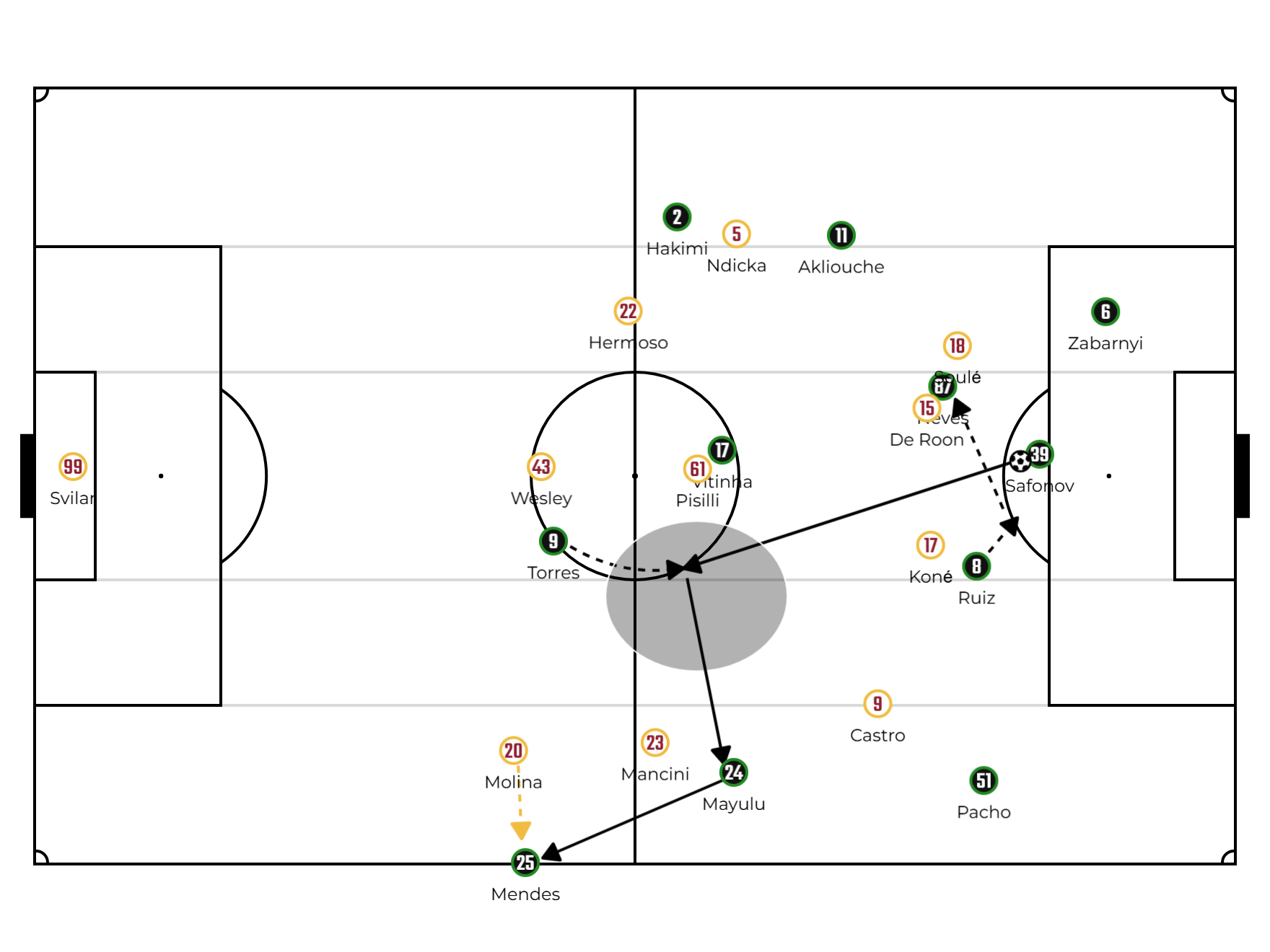
28th minute: PSG rotations. You can see Roma’s players have been pulled away from their natural starting positions as PSG rotate. Near Safonov Ruiz and Neves work to create a clear channel in the center. Neves pulls wide to the right, dragging De Roon, Ruiz drops into where Neves was, bringing Koné with him. This movement works to open the center for Safonov to find Torres in space.
And match
The second half looked to chart a similar course ot the first when Hermoso almost scored within the two minutes of the restart. The center-back once again marauded forward and perched inside the PSG box. He wasn’t the target of Wesley’s cross, but he did become the inadvertent recipient when Safonov palmed the ball in his direction. Hermoso volleyed the ball, but couldn’t keep his shot and watched it safely rise over the bar for a goal kick.
PSG maintained their rhythm; they often found they could get past the first line of pressure from Roma, but their play would break down or be delayed as they looked to attack the space behind their visitors’ backline, with the forwards not quite clicking. You were left to wonder how different the match might have felt if Les Parisiens had one of either Doué or Kvaratskhelia at their disposal; Akliouche, Torres, and at times Mayulu would misplace their pass.
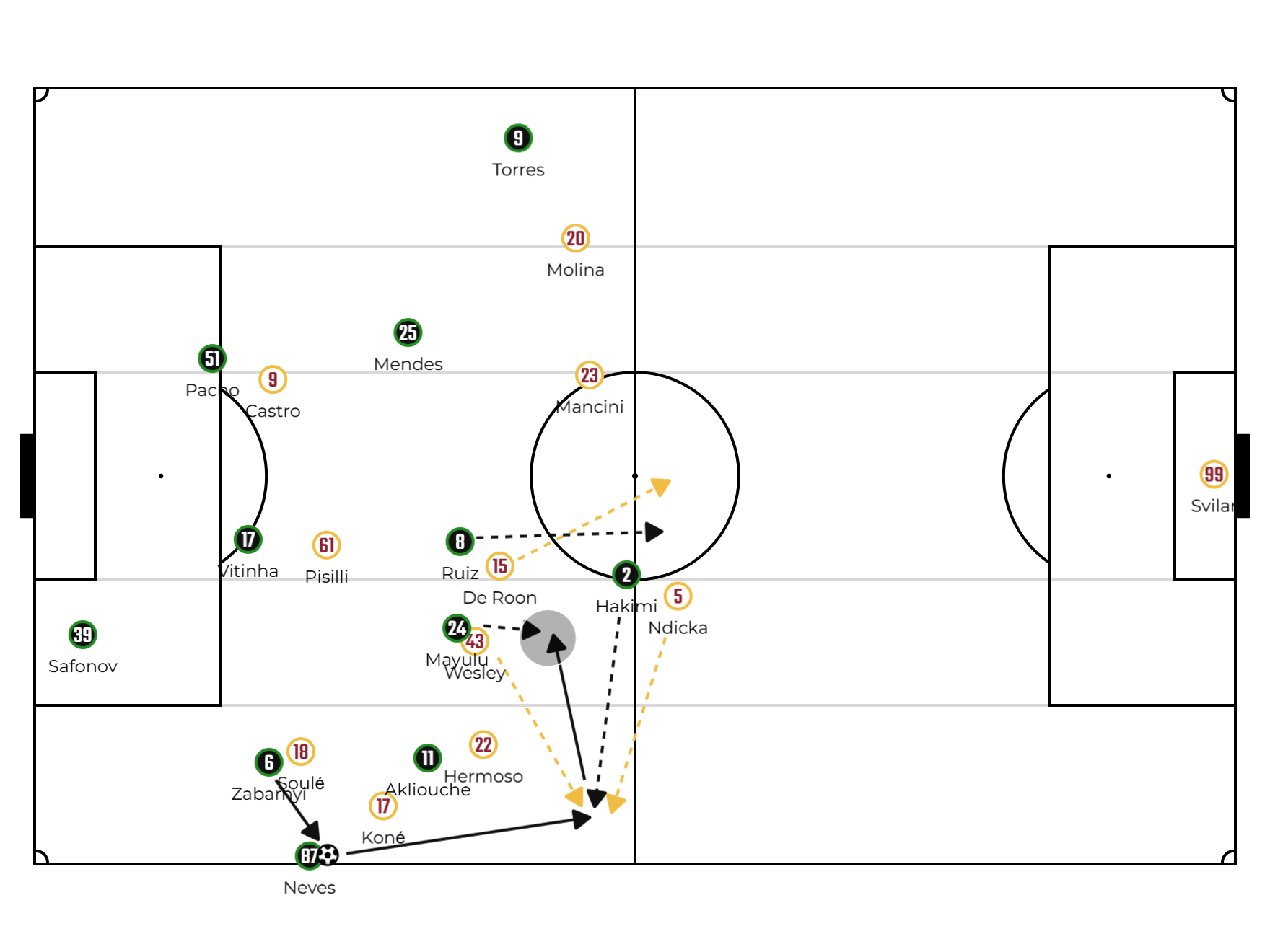
50th minute: PSG play through initial pressure. Hakimi’s rotated into the number nine role. He then makes the run wide to collect the ball. Ndicka follows him forcing De Roon to drop back. Ruiz offers a third man run, as does Mayulu. Wesley deserts Mayulu, who becomes a free receiver.
It gave the impression that the well-oiled machine that Enrique has created was beginning to become unstuck. In the 59th minute, the Spaniard had seen enough. Ousmane Dembélé was brought on for Torres, while Warren Zaïre-Emery replaced Mendes. A few minutes later, Gasperini would respond with Bryan Cristante and Paulo Dybala coming on for Koné and Castro, but not before PSG had pulled ahead.
PSG won the ball close to their own goal and sprang into a counter before Roma had a chance to counterpress. Hakimi was released behind the backline, sprinting into the box where he was tugged to the ground by Wesley. It was a clear penalty, but surprisingly only a yellow card for the Roma defender, who made no attempt to play the ball in denying the goal-scoring opportunity (and therefore was exempt from the double jeopardy rule). Dembélé stepped up to the spot and dispatched the spot kick.
Gasperini looked to roll the dice by bringing on Donyell Malen in the 67th minute. Alongside Dybala, the striker had been surprisingly benched before this game. The easy thought was that Roma had one eye on the title race in Italy and were resigned to defeat, but as James Horncastle wrote in The Athletic, that was not the case for a fierce competitor. Instead, it felt as if Roma wanted youthful legs to provide the running early on, while the more experienced stars would provide the finish. It was a game plan that seemingly worked, as Malen was on the pitch to finish from the penalty spot and rescue a point after VAR spotted that Vitinha had handled the ball in the box.
Takeaways
PSG’s twelve-game winning streak would be brought to an end. Enrique would say after the match that “It was the most difficult match of the season.” Roma provided a unique challenge that blunted PSG’s attacking efforts. It’s not often that Les Parisiens were forced into relying on set pieces. This match left a lot to be desired for the summer’s attacking recruits, and Enrique will hope that Ligue 1 can be used to find some consistency for Mika Godts, Akliouche, and Torres.
Roma will be frustrated that this was another Champions League game where they scored first, but ended up without the three points. They provided a consistent threat to PSG and unsettled their usually slick processes. They were the better team on the night, and on another occasion likely should have taken the victory. Albeit there was an element of luck that they ended the encounter with eleven players on the pitch.