

Bayern Munich – Real Madrid: Bayern Prevail In High-Quality Thriller (4-3)
Real Madrid took the lead three times in the first half of this game, determined to overcome their deficit with their counter-attacking strategy against Bayern Munich’s aggressive approach. The aggregate scoreline was deadlocked until late on when Madrid went down to ten men, and their low block was finally breached by the quality of Bayern’s wingers.
Tactical analysis and match report by Josh Manley.
We decided to make this article free to read. If you want to support our work, consider taking a subscription.
The first leg of this tie between two European heavyweights served up an entertaining game with both teams showing defensive vulnerability, leading to chances on both sides. On that occasion, Bayern Munich were able to take home a 2-1 victory from Madrid thanks to goals from Luis Díaz and Harry Kane.
Vincent Kompany again lined his side up in a 4-2-3-1 shape here, with a back four of Josip Stanišić, Dayot Upamecano, Jonathan Tah, and Konrad Laimer. Joshua Kimmich and Aleksandar Pavlović formed the double pivot behind a fluid front four of Michael Olise, Serge Gnabry, Luis Díaz, and Kane.
Real Madrid meanwhile lined up in a 4-4-2 formation. Trent Alexander-Arnold, Éder Militão, Antonio Rüdiger, and Ferland Mendy formed the backline, while Federico Valverde partnered Jude Bellingham in central midfield. Brahim Díaz and Arda Güler then started from wide positions behind a front two of Kylian Mbappé and Vinícius Júnior.
Bayern possession without control
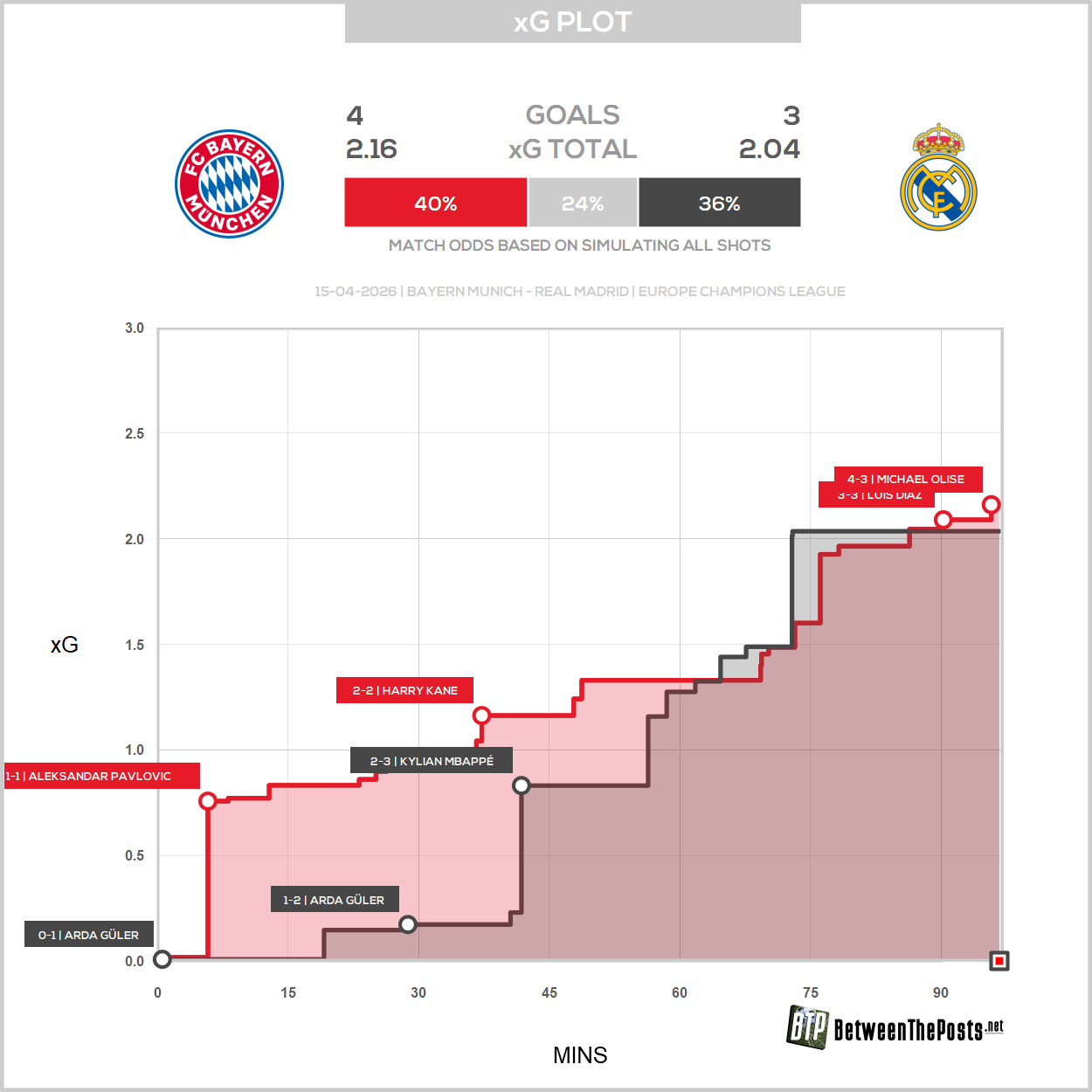
Things got off to the worst possible start for Bayern inside the first minute when Manuel Neuer’s loose pass while stationed outside his own area allowed Güler to guide the ball into an open net. It didn’t take long for Bayern to respond though, as Pavlović headed home Kimmich’s inswinging corner at the near post just five minutes later.
As one would expect, Bayern would play this game on the front foot, having most of the possession and territory, while Madrid would look for counter-attacking opportunities. Although Bayern were able to achieve these advantages in possession and territory, it did not necessarily translate to control of the game, as Madrid would threaten them with their speed in behind via Kylian Mbappé and Vinícius Júnior.
Without the ball, Bayern would try to press high in their man-marking system. They were prepared to embrace a high-risk approach in pressing, leaving their center-backs in a two-versus-two against Vinícius Júnior and Mbappé, often with large distances between them as the Madrid front duo often split into wider positions.
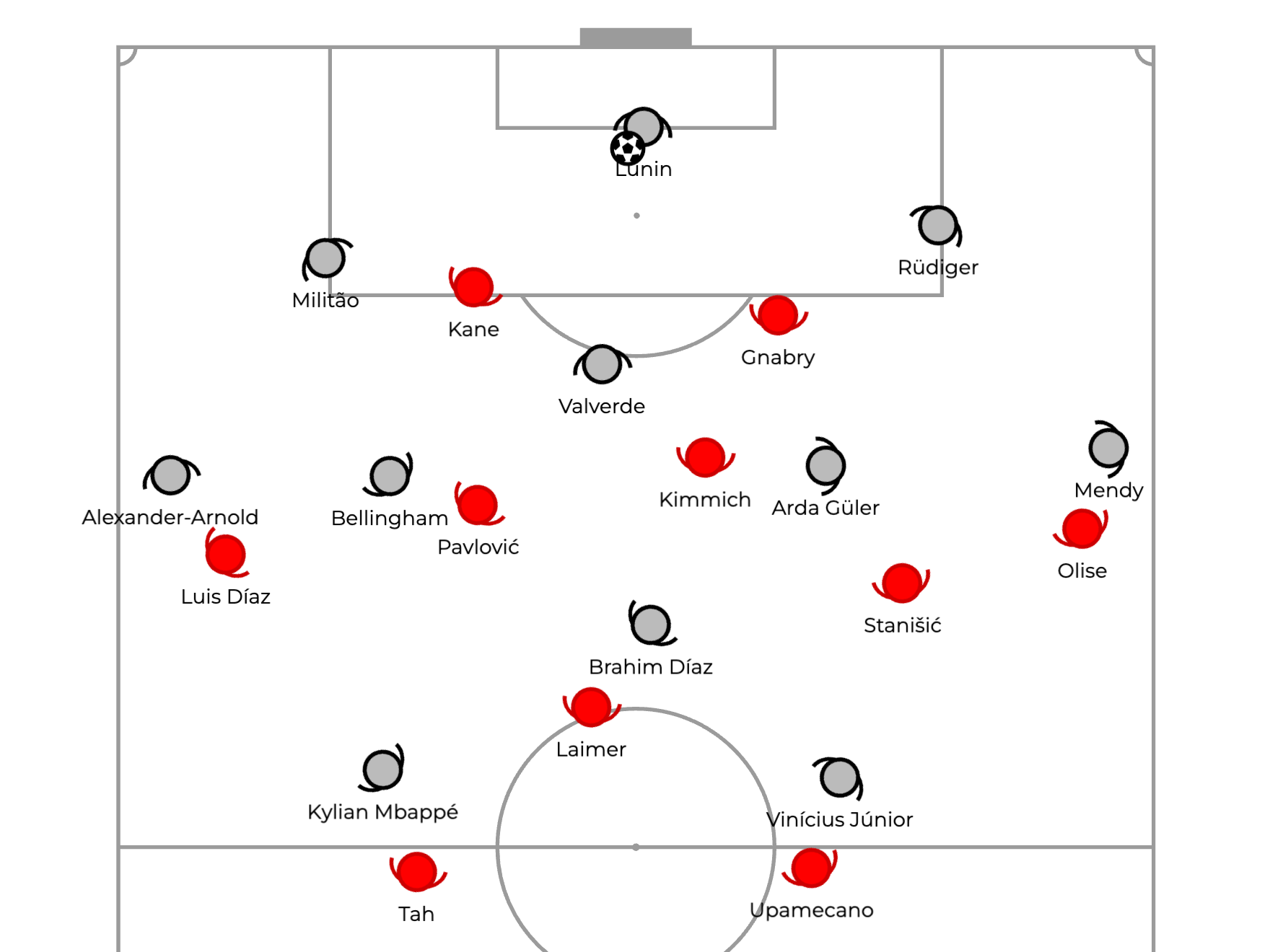
Bayern’s high press.
Bayern’s fullbacks would indent when pressing, to track Brahim Díaz and Arda Güler. When they had the ball, Madrid essentially moved into a 4-4-2 diamond shape. Valverde would become the number six, while Bellingham and Güler played on each side of the diamond, and Brahim Díaz was the number ten.
Although Bayern’s pressing exposed them to some risk, it did help them to dominate possession. When they had the ball, Pavlović often dropped off into the left halfspace alongside the center-backs, while Kimmich remained as the number six. This allowed them to form a diamond around the strikers in Madrid’s 4-4-2 defensive shape, providing better angles in buildup than a flat double-pivot.
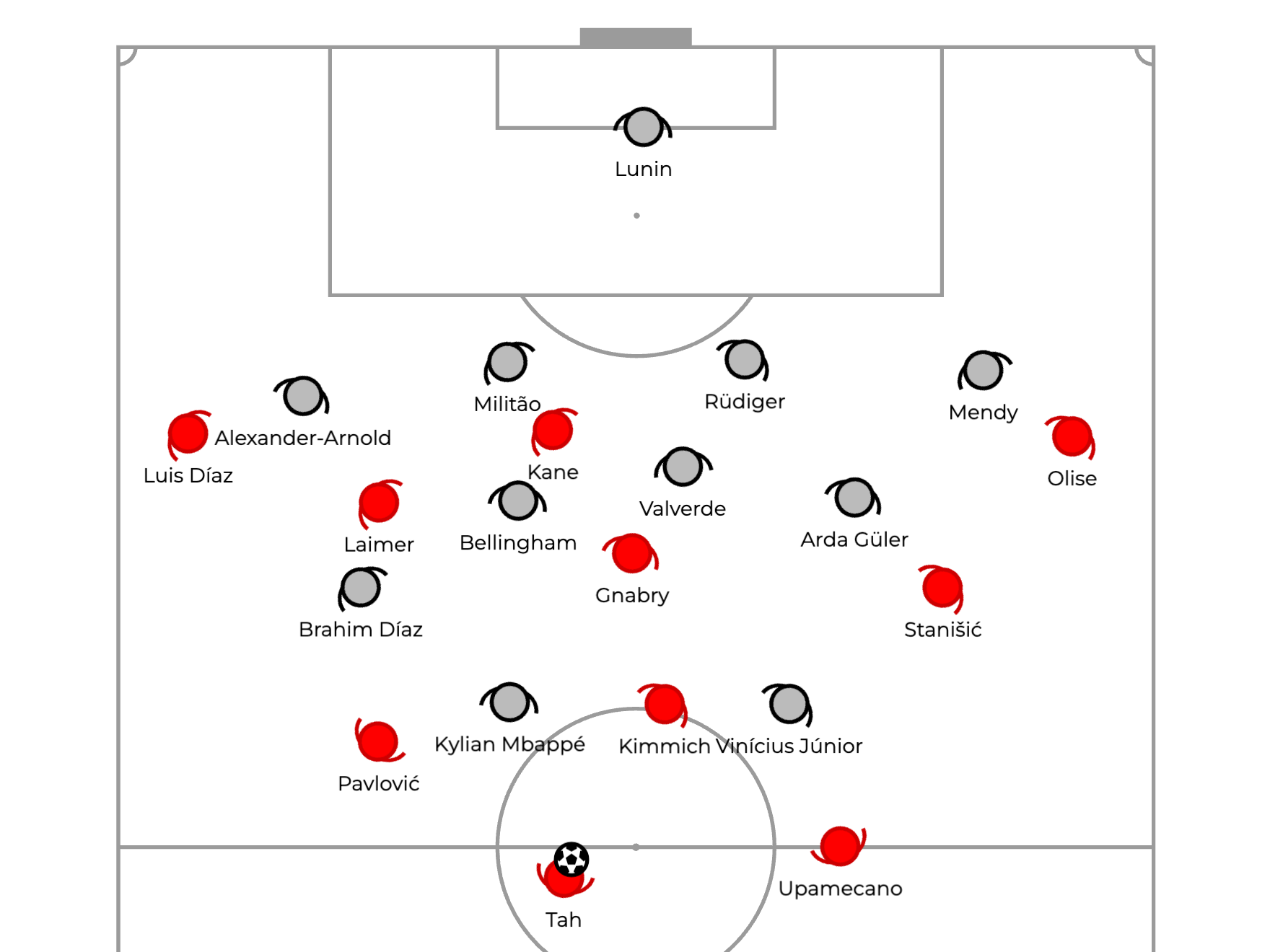
Bayern’s first-half possession shape.
Stanišić and Laimer played their usual inverting roles, pushing up in the halfspaces. Bayern’s intent was often to move the ball wide to Olise and Luis Díaz and create dynamics from wing attacks. Stanišić and Laimer would therefore provide plenty of underlaps and overlaps in order to support their wingers. Kane and Gnabry were then the main central presences in attack, with Gnabry as the number ten dropping closer to Kimmich often in buildup.
Despite all of this, Madrid would go in ahead at half time. Güler’s curled free-kick beat Neuer on the half-hour mark, before Kane replied for Bayern. Just before the break, Vinícius Júnior was released down the left side for Madrid, and his pass found Mbappé sprinting past Upamecano off the ball to finish from close range.
Madrid’s late implosion
Kompany made a change at half time, bringing Alphonso Davies on for Stanišić, meaning Laimer switched over to right back. The second half saw Bayern able to establish more control in their possession phases. There were still a few dangerous Madrid attacks, but the overall flow of the game was more stable from Bayern’s point of view, while the Germans also improved the speed and precision of their ball circulation.
The addition of Davies at left back gave an extra cutting edge for Bayern on the left. With his speed, the underlapping runs carried an extra threat, and forced Madrid’s defense to drop off slightly more.
With Davies being naturally left footed, as opposed to the right-footed Laimer, it also allowed Luis Díaz to take up more narrow positions, while the left-footed Davies could play on the outside.
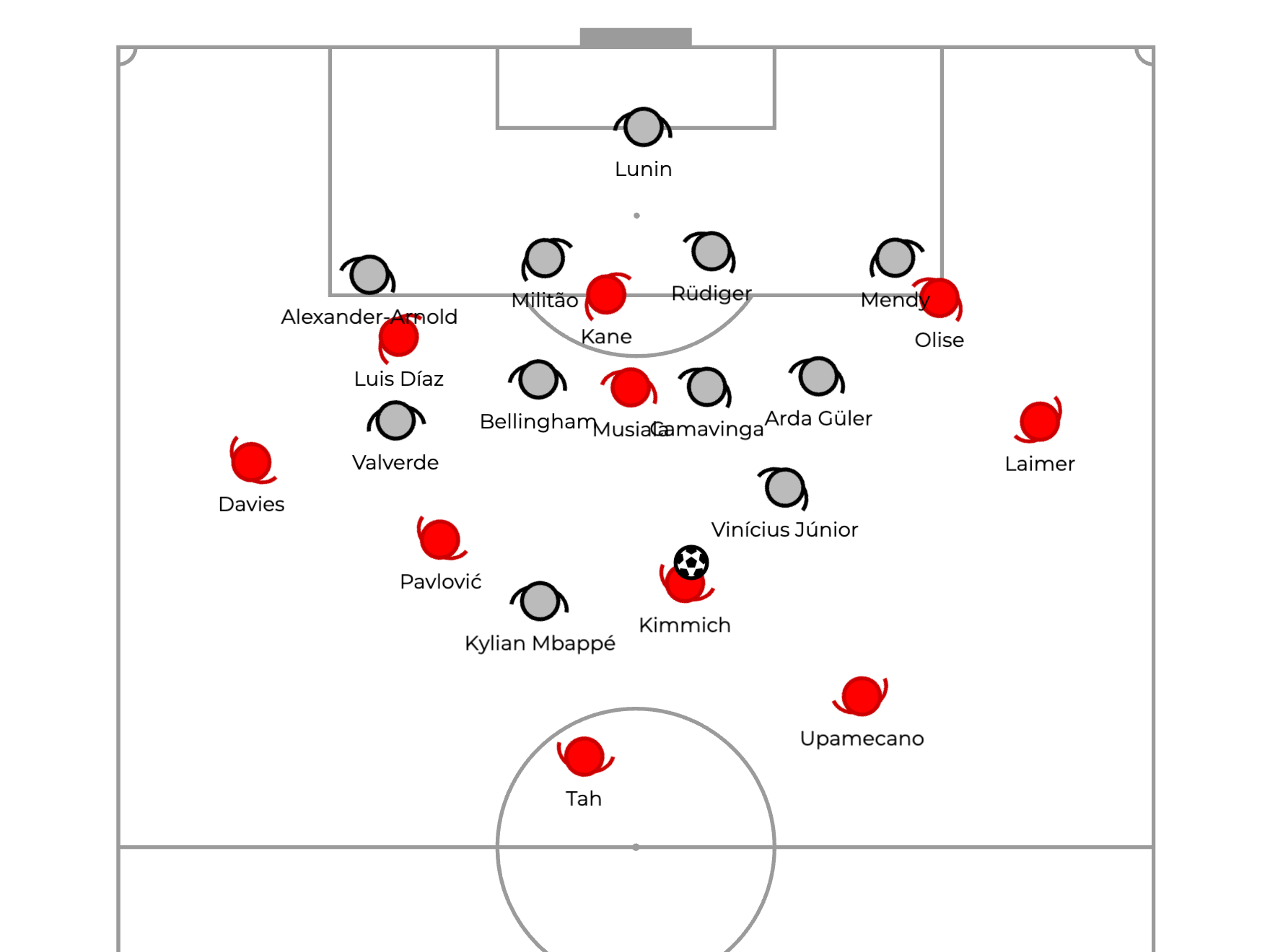
Bayern were able to force Madrid further back in the second half.
Olise from the right wing was also seen indenting on quite a few occasions in the second half, bringing his small-space abilities into the game to try and crack Madrid’s low block.
On the hour mark, another small space specialist was introduced for Bayern in the form of Jamal Musiala, who replaced Gnabry. With Musiala’s ability to dribble through tight spaces, Bayern now had another weapon against the low block.
Madrid also made their own change at this point, introducing Eduardo Camavinga in place of Brahim Díaz. This saw Valverde move out to the right side of midfield, while Camavinga became the deepest midfielder and Bellingham had license to go forward through the center.
It was Camavinga who would have a decisive role in Madrid’s eventual downfall though, as he was sent off with a second yellow card just over twenty minutes after coming on. Against Madrid’s ten men, Bayern swiftly broke through with emphatic strikes from Luis Díaz and Olise cutting in from their respective wings.
Takeaways
Bayern were not quite able to establish the control they desired in the first half, with their defense looking vulnerable at times against the pace of Madrid’s forwards. In the second half, they were able to improve their stability on the ball and pin Madrid back for longer periods, although they still showed some vulnerability at the back and did concede shots. In the end, it was no surprise that their quality from the wings helped deliver the decisive blow, as Olise and Luis Díaz are a key part of Kompany’s attacking setup.
Madrid came into this game with a deficit, but fought well and gave Bayern plenty of problems. With their dangerous front two, they are able to create danger out of seemingly nothing. Güler and Bellingham both put in good midfield performances and helped drive the team forward. After the red card though, the odds were always against them, and Bayern’s quality proved too much.
Use the arrows to scroll through all available match plots. Click to enlarge.
Check the match plots page for plots of other matches.



Comments