

Brighton & Hove Albion – Arsenal: High-Pressing Seagulls Stun Arsenal (3-0)
Arsenal came into this match with a perfect winning record but were unable to cope with Brighton’s high-pressing game as the hosts were able to prevent Arsenal gaining control with possession. Two goals from outside the box plus a set-piece were the eventual difference-makers.
Tactical analysis and match report by Josh Manley.
Brighton & Hove Albion came into this game on the back of a 3-2 EFL Cup win at Old Trafford in midweek, while Arsenal were looking to continue their perfect winning record in the season so far.
Fabian Hürzeler lined Brighton up in a 4-2-3-1 shape as Ferdi Kadıoğlu, Luka Vušković, Pascal Struijk, and Olivier Boscagli made up the backline. Chema Andrés and Pascal Groß partnered centrally with Yasin Ayari ahead of them. Diego Gómez and Maxim De Cuyper then flanked Charalampos Kostoulas up front.
For Arsenal, it was also a 4-2-3-1 shape. Jurriën Timber, Ezri Konsa, Gabriel Magalhães, and Riccardo Calafiori started in the backline with Declan Rice and Bruno Guimarães in central midfield. Bukayo Saka, Martin Ødegaard, and Christos Tzolis were the attacking midfield trio behind nominal striker Kai Havertz.
Brighton’s high press
The defining characteristic of this game was the success that Brighton achieved in their high pressing phases against Arsenal’s buildup. They were able to prevent Arteta’s side from establishing control in the game through their bold pressing approach.
The approach itself was relatively simple. Brighton played man-to-man, while Ayari would be responsible for trying to curve his run from Konsa to David Raya to keep the English centre-back in his cover shadow and force play to the other side.
Kostoulas would stand on Gabriel, while the central midfielders Chema and Groß would push aggressively onto Arsenal’s central midfielders. This was especially true of Groß who was responsible for marking Rice who often dropped deeper.
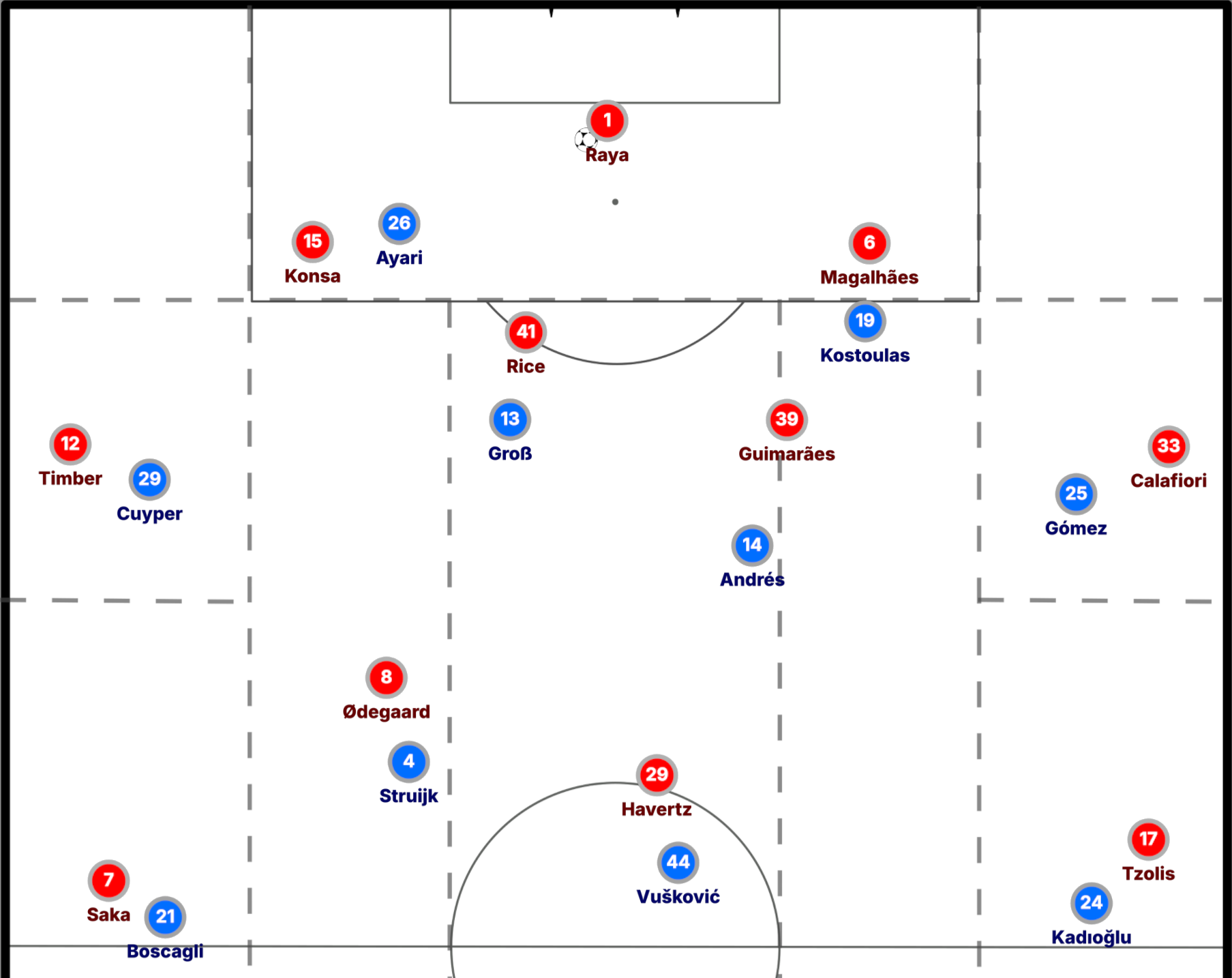
Brighton’s high press.
This meant Groß often found himself going into the first line of Brighton’s press as well as running through to Konsa at times, meaning another teammate had to be flexible enough to cover Rice.
With the aggression of the central midfielders, it was imperative that the center-backs also played in an aggressive manner in order to close the spaces between the lines. Vušković and Struijk executed this well, pushing onto Ødegaard and the deep-dropping Havertz at the right times to prevent Brighton from getting outnumbered in midfield.
A key issue for Arsenal was the lack of direct threat. Their attempts to play over the Brighton press were not effective enough, lacking speed from the frontline to get in behind and turn Brighton towards their own goal.
This led to a game in which Arsenal conceded a lot of transitions and were generally unable to suffocate their opponents with the ball in the opponent’s half as they usually prefer to do.
Seagulls in flight
Brighton’s own attacks attempted to be quick and incisive, especially after regaining the ball in their press, after which they would attempt one-touch combinations with the front players.
When they were in possession, the shape was something approximating a 4-3-3 formation. Chema generally played as the deepest midfielder, while Groß had more freedom to roam from the left central midfield position.
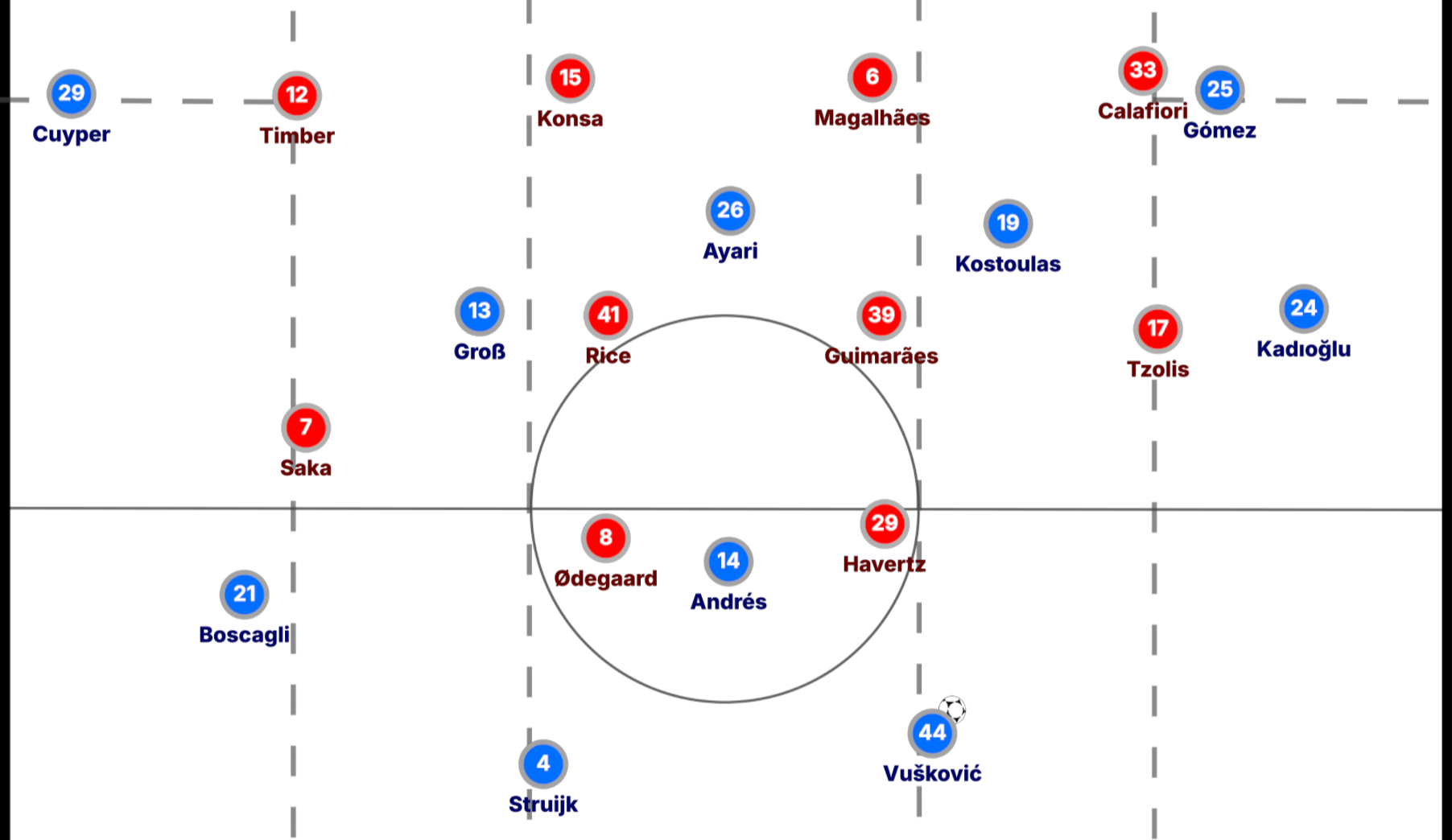
Brighton’s possession shape.
On the right side, Kadıoğlu was quick to push up in support of Gómez, while Boscagli on the left tended to start a little deeper before joining attacks. Rotations in wide areas were key to Brighton’s play, using dynamic movements to try to open gaps in Arsenal’s defense.
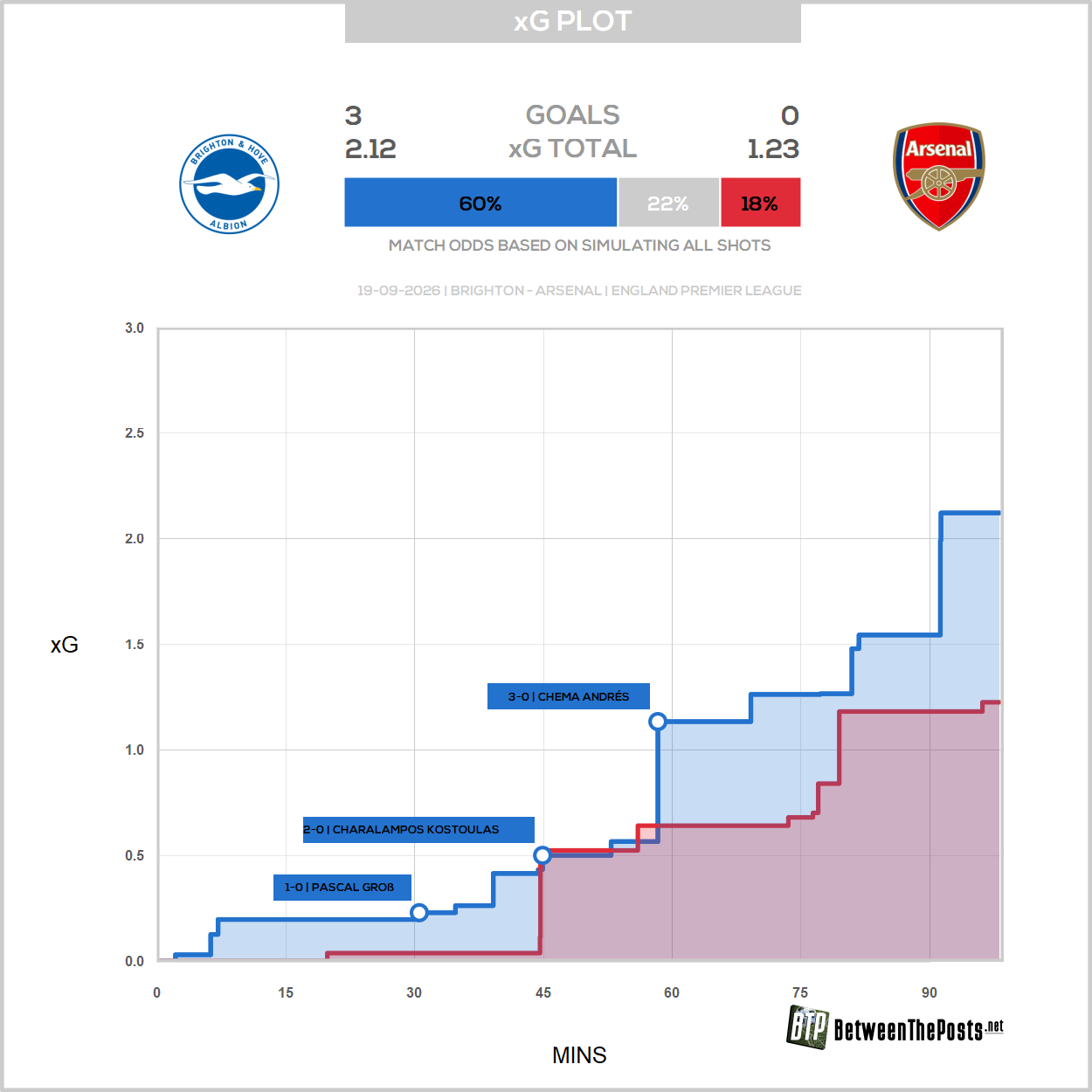
Brighton’s first two goals eventually came from strikes from outside the box. In the first, Groß was able to find space between the lines as Arsenal’s central midfield was slightly open after Brighton had just dragged Guimarães out to the left side with some rotations in that area.
The second was a goal in transition, finished by Kostoulas. In both cases, Arsenal’s center-backs were slightly slow to step out to get sufficient pressure on the player between lines.
Maintaining the intensity
Having established a 2-0 lead in the first half, many teams would be tempted to sit deeper and defend their lead. However, Brighton instead came out in the second half with renewed intent and vigor in their high press.
They were able to continue to prevent Arsenal from gaining any control in the game. Brighton’s high press was evidently well-coached, with players showing understanding to be able to swap man-to-man assignments in dynamic situations when necessary and adapt to any structural variations from Arsenal.
Brighton’s third goal arrived before the hour mark courtesy of Chema’s header, rising unmarked to meet a far-post corner delivery. There was no let-up from Hürzeler’s side after this though – they continued to play proactively and with intensity.
In the first half, Arsenal had been able to establish some settled possession phases in Brighton’s half, but this actually became even more difficult in the second.
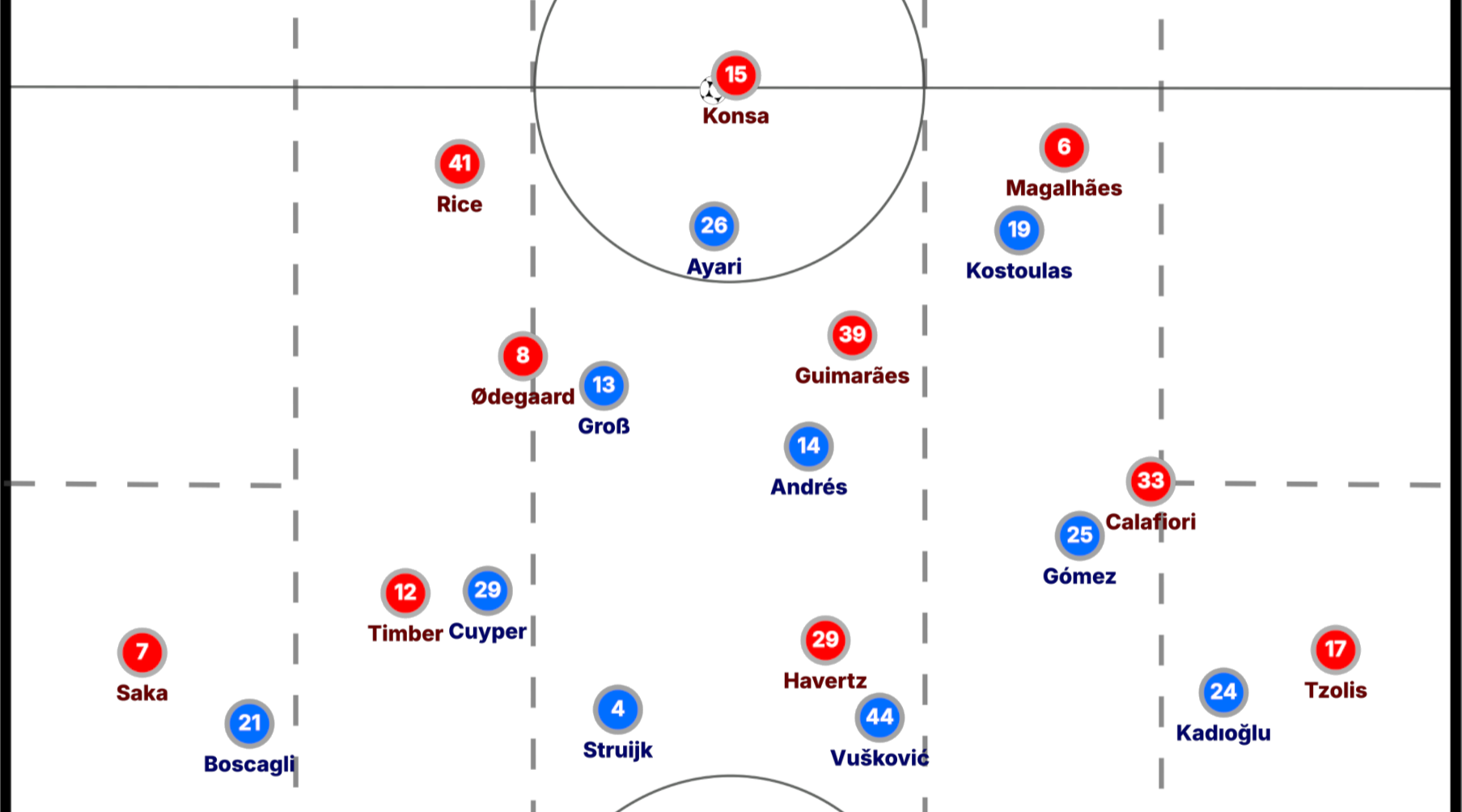
Arsenal’s shape in organized possession.
In those possession phases, Arsenal had been using a back three with Rice as third center-back, and Ødegaard then dropping alongside Guimarães in deeper midfield areas. The fullbacks for Arsenal attacked the halfspaces.
Arteta made changes on the hour mark, with Martín Zubimendi and Mikel Merino replacing Timber and Guimarães. This saw Rice moving to right back, with the two Spanish substitutes partnering centrally.
Viktor Gyökeres and Eberechi Eze also made entries soon afterwards, replacing Ødegaard and Tzolis.
There was not much positive effect for Arsenal though. Brighton continued to play at a high intensity, jumping into a high press where possible and looking dangerous with transition phases.
Takeaways
This was a very impressive performance by Brighton. It’s rare to see Arteta’s Arsenal team be genuinely outplayed, let alone in such a proactive and aggressive style. The high press had excellent intensity, and Brighton also showed glimpses of their fluidity in possession and transition phases.
For Arsenal there will be no panic, but Arteta will want to ensure that his team has better solutions against a high press in future. They were sometimes a little predictable, and the direct option to play over the press with speed in behind was not enough of a threat.
Use the arrows to scroll through all available match plots. Click to enlarge.
Check the match plots page for plots of other matches.


Comments