
Corinthians – São Paulo: Dinizismo dominates the derby and deepens São Paulo’s crisis (3-2)
Corinthians have definitely moved away from the relegation zone, showing quality in another derby against a fellow state giant. This time, they defeated São Paulo on Matchday 15 of the Brasileirão with authority, showing clear evolution within Fernando Diniz’s footballing ideas. The result further intensified São Paulo’s crisis.
Tactical analysis and match report by Marcus Arboés.
Since Fernando Diniz became Corinthians manager, the team still had not been able to count on all of its main players, but in this round they finally fielded an excellent starting eleven: Hugo Souza (Brazil National Team) in goal; Matheuzinho, Gabriel Paulista (former Valencia), Gustavo Henrique and Matheus Bidu in the defensive line; Carrillo (Peru), Raniele, Breno Bidon and Garro in midfield; Lingard (former Manchester United) on the left wing and Yuri Alberto as the target man. Even this strong lineup was still missing Memphis and Kayke through injury, plus André and Allan through suspension.
Roger Machado, who has faced criticism at São Paulo since arriving, was without Alan Franco, Marcos Antônio, Lucas Ramon, Maik and Lucas Moura. Even so, he set the team up in a 4-2-4 outline: Rafael in goal; Cedric Soares at right fullback and Enzo Díaz on the left; Dória and Sabino as the center back pairing; Danielzinho and Bobadilla (Paraguay) as pivots; Ferreirinha on the left wing, Artur on the right wing, Luciano as the second striker and Carelli as the striker completed the attacking quartet.
A first half built on physical duels
São Paulo and Corinthians are experiencing opposite moments in the Brasileirão. São Paulo sit near the top of the table, but live under internal political turmoil and growing pressure on Roger Machado for performances and results. Corinthians are still fighting to avoid relegation, but the managerial change has significantly improved the team, who had lost only once up to that point. The derby itself reflected the current state of both clubs.
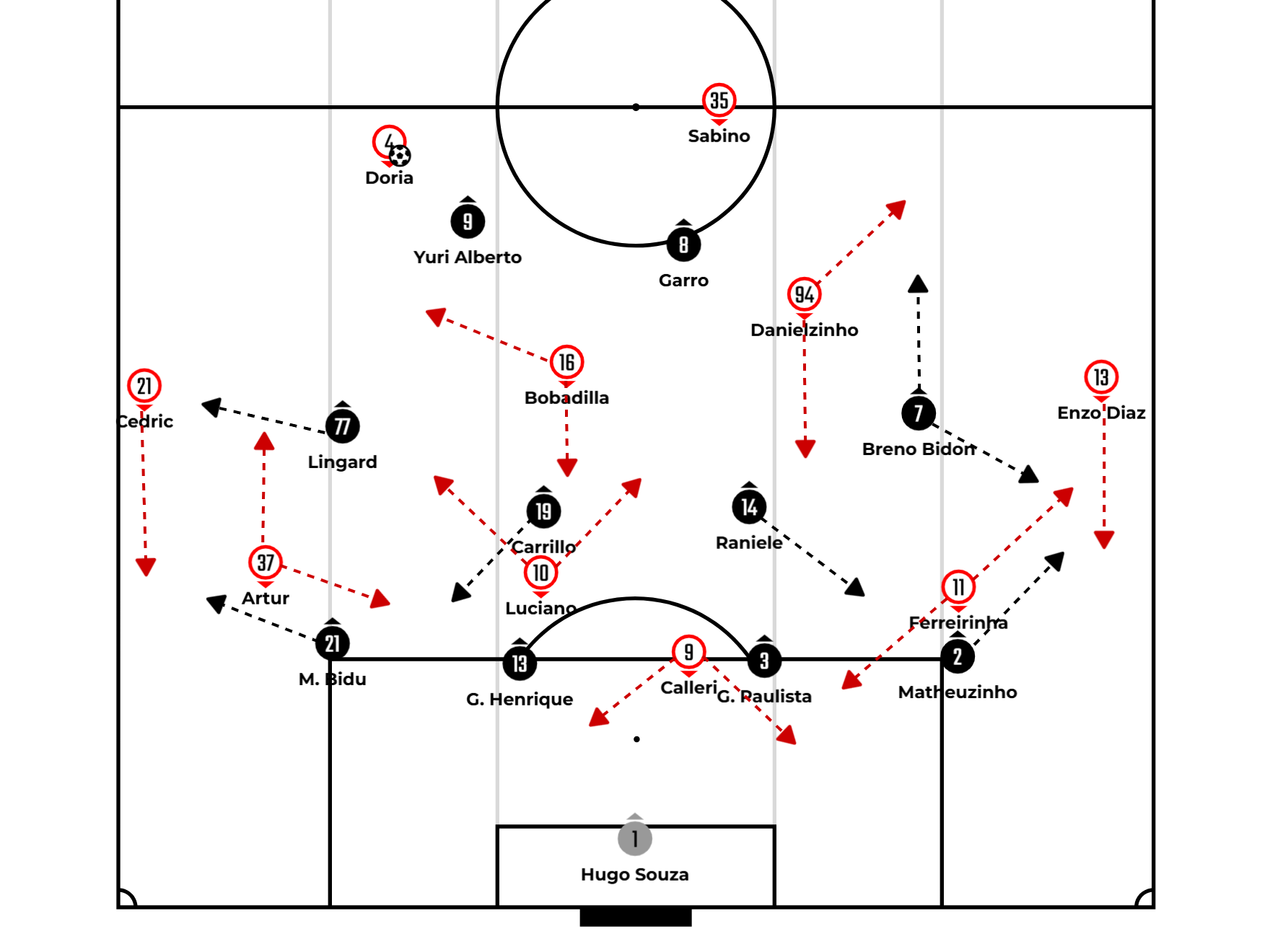
São Paulo attacking in a 4-2-4 shape, using pivot support out wide against Corinthians’ 4-4-2 defensive formation.
São Paulo actually looked sharper at the beginning of the match, which featured chances for both sides early on, but Corinthians quickly opened the scoring through Raniele, with another goal originating from offensive aerial play, something that has been decisive in the early stages of Fernando Diniz’s tenure. From then on, whenever São Paulo had possession, Roger Machado’s side looked extremely limited, relying mostly on repetitive patterns down the flanks or attempts to win physical battles.
In a 4-2-4 shape, build up started with the center backs, while one of the pivots, usually Danielzinho, dropped closer to the first line to create a three against two advantage. The main idea was always to use the pivots’ support to progress the play toward the flanks, where the fullbacks, Cedric and Díaz, provided width while coordinating space with the wingers, who could combine inside or attract defenders centrally.
Luciano tried to provide support between the lines, but remained trapped there, while Carelli also attempted to contribute through hold up play, though that is not his main strength. In practice, São Paulo created very few crossing situations and were heavily neutralized by Corinthians’ defense at every height of the pitch. Matheuzinho and Matheus Bidu tracked the wingers aggressively, while the pivots covered their advances whenever Luciano or one of São Paulo’s midfielders tried to exploit the gaps left by the pressing fullbacks. The wide players in Corinthians’ second defensive line, Breno and Lingard, could either jump forward to press build up or drop deeper to avoid numerical inferiority on the flanks. Whenever the ball reached the box, Gustavo Henrique and Gabriel Paulista were dominant.
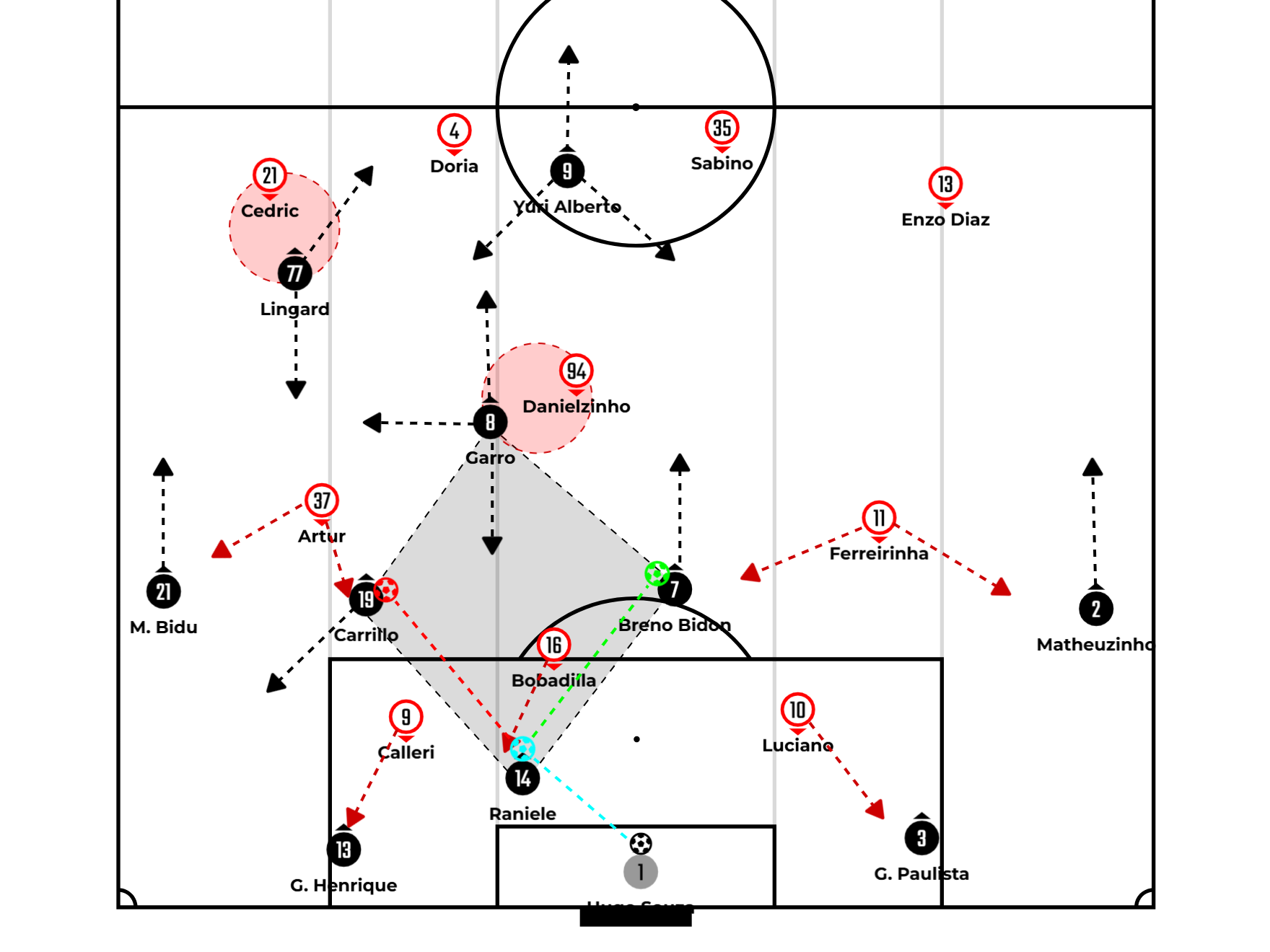
São Paulo’s aggressive high press against Corinthians’ asymmetric build up.
Even without playing especially well, São Paulo managed to equalize after forcing a turnover, making their physical intensity count and capitalizing on a Corinthians build up mistake. During and after the game in Brazil, much of the discussion centered around fans and even journalists blaming Diniz and his football philosophy, but tactically, the main responsibility clearly belonged to the player.
All of Fernando Diniz’s teams are known for building out asymmetrically and dynamically, with many players positioned close to the goalkeeper under the principle of attracting pressure and generating space. It’s a very risky approach that demands high confidence levels. Up to that point, Corinthians had done it sparingly, including in this match, preferring longer, more direct and vertical build up because they still lacked confidence in the famous “Diniz build up”.
In these situations, the fullbacks stay very wide, Raniele drops between the center backs and forms a mobile diamond with Carrillo, Breno Bidon and Garro, capable of creating an overload flank, a concept explained in the previous Corinthians analysis, or line breaking passes toward the support movements of Garro, Lingard or Yuri Alberto. São Paulo, meanwhile, pressed man to man in a 4-1-3-2 formation.
Since the center backs positioned themselves almost on the goal kick line to stretch the field, São Paulo’s forwards pressed them directly, while the wingers stayed narrower, able to mark either the pivots or the fullbacks depending on where Corinthians tried to build. Amid that uncertainty, Raniele received the ball from a goal kick and immediately controlled toward the left without properly scanning his options. Bobadilla pressed and stole the ball during the attempted pass to Carrillo, which was actually the worst possible option.
The tactical structure had created a much better option through the middle, with Breno Bidon completely free behind Bobadilla, which would have given Corinthians a huge advantage. After the game, Diniz highlighted that he does not condemn this kind of mistake because it is part of the learning process and because Raniele had not previously made such errors in training or matches under him, even if the player still carried responsibility for the decision.
Relational dynamics and Dinizismo’s domination
If the short build up is still not fully established, Corinthians delivered a footballing masterclass in the second half through dynamics rooted in Dinizismo’s relational/functional principles: “toco y me voy”, combinations, attraction of opponents and deception. Within a short period, the team went 3-1 up and effectively killed the game.
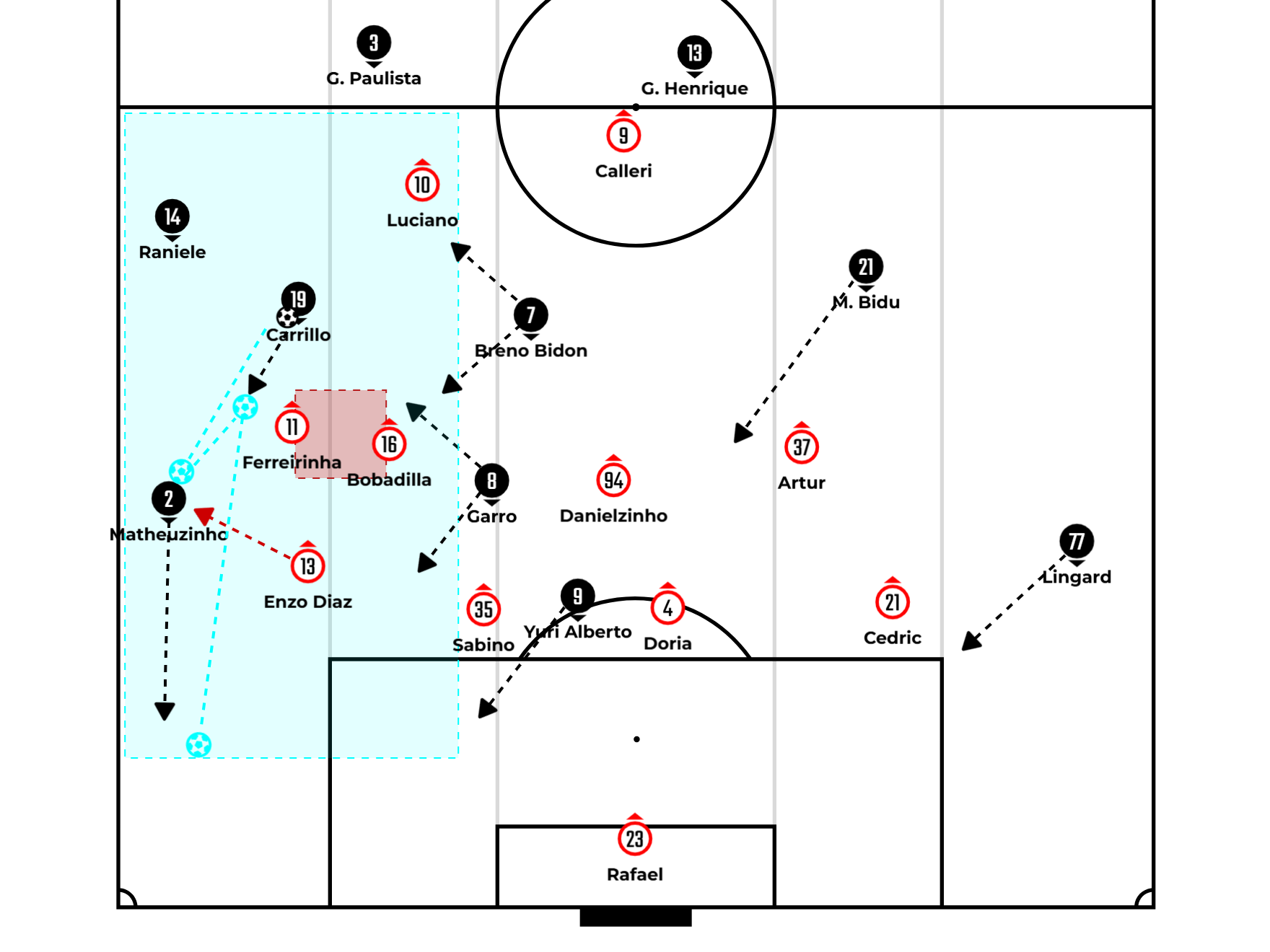
Corinthians’ first goal, with Matheuzinho and Carrillo combining down the right corridor.
As seen in previous analyses, Corinthians attack through a completely chaotic relational/functional structure regarding positional freedom. The idea is for the player on the ball to always have multiple passing options, although at times the dynamic depends only on two players. During the first goal sequence, Corinthians enjoyed a long spell of possession but struggled to create openings despite recovering every rebound from São Paulo’s defense.
At one point, Matheuzinho advanced as a right winger, Raniele drifted wide as a right fullback and Carrillo initiated the play, with Breno Bidon and Garro offering support in the half spaces. Carrillo passed to Matheuzinho out wide, attracting Enzo Díaz, but Matheuzinho immediately returned the ball first time. Bobadilla and Ferreirinha became confused about their defensive references and Carrillo, again first time, released Matheuzinho once more, now making a run behind the defender.
The overload created uncertainty in the defensive structure, but the key to the goal was the relational dynamic between Carrillo and Matheuzinho. The Corinthians fullback received, feinted past his marker and, despite having passing options available, drove forward himself and finished to restore the lead.
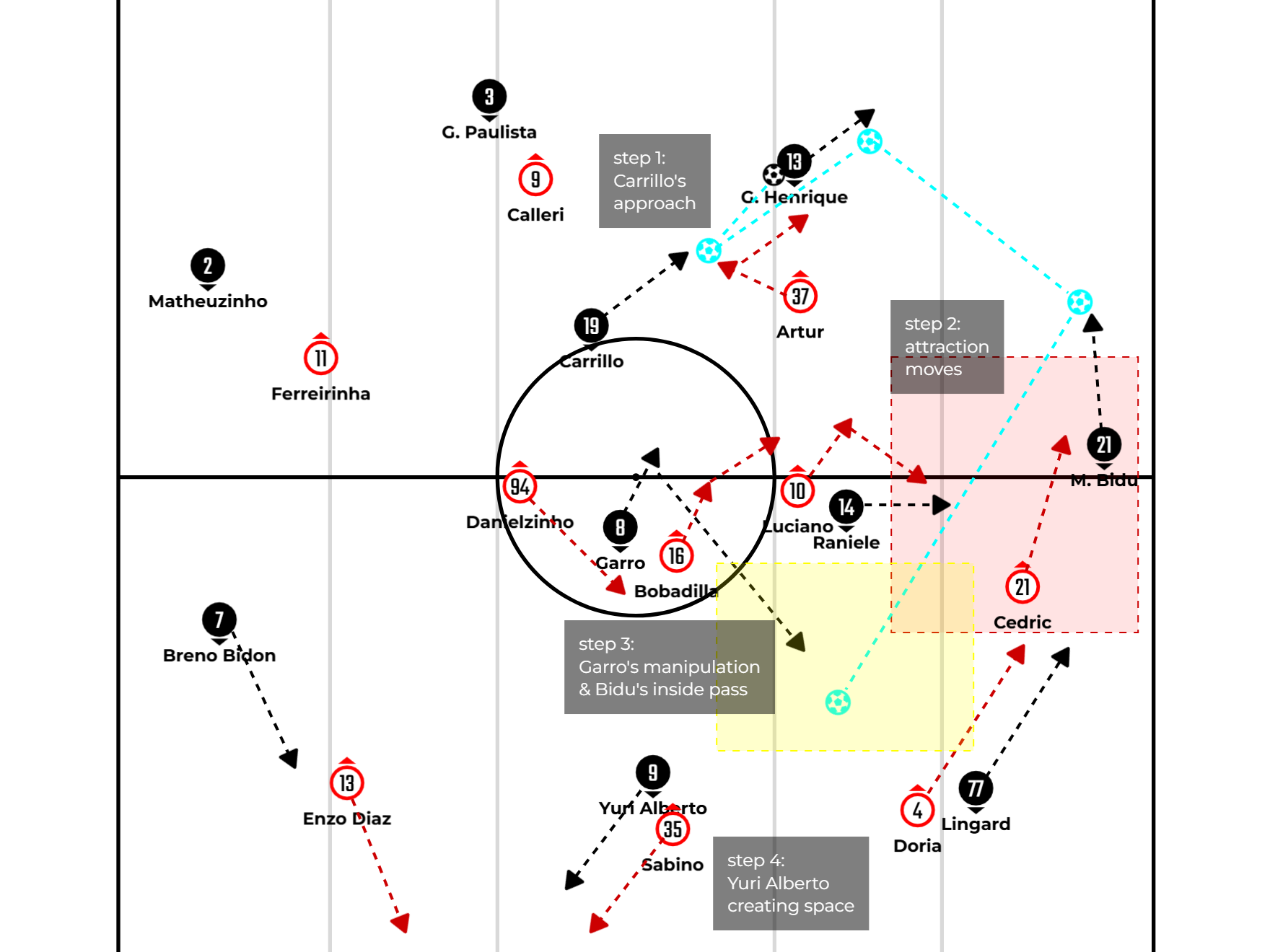
Corinthians’ third goal in four steps, built from the logic of attracting opponents and exploiting space through deception.
Minutes later, Corinthians effectively sealed the game with a beautiful collective goal. To explain it better, the play can be divided into four stages that detail how they manipulated São Paulo’s defensive structure. Watching the video of the goal is highly recommended for a clearer understanding.
Step 1: Artur jumps to press Gustavo Henrique; the Corinthians center back passes to Carrillo, who moves closer and leaves Artur uncertain about whether to press the pivot. Carrillo immediately returns the ball to Gustavo Henrique, who had dropped slightly deeper to receive with an open angle. Corinthians trigger the pressing trap by retreating and attracting São Paulo into their own half.
Step 2: Matheus Bidu drops to receive and attracts Cedric, while Lingard also drops, pulling center back Dória with him. Centrally, São Paulo’s disorganized defense, with three players clustered together, falls into the trap of stepping higher with the retreating movement, while Corinthians’ midfielders collectively drop deeper. Raniele then drifts laterally, attracting Luciano as if offering a passing lane for Matheus Bidu.
Step 3: Bobadilla falls into Garro’s trap while stepping forward focused on the ball. The Argentine midfielder attacks the blindside space behind him, far enough away to avoid being reached by Danielzinho. Matheus Bidu then delivers an excellent outside to inside pass, taking advantage of all the manipulated movement to find Garro.
Step 4: Yuri Alberto halts his support movement and changes direction, dragging Sabino away and creating space for Garro to carry forward. On the opposite side, Breno Bidon moves from outside to inside to receive the assist and finish from distance.
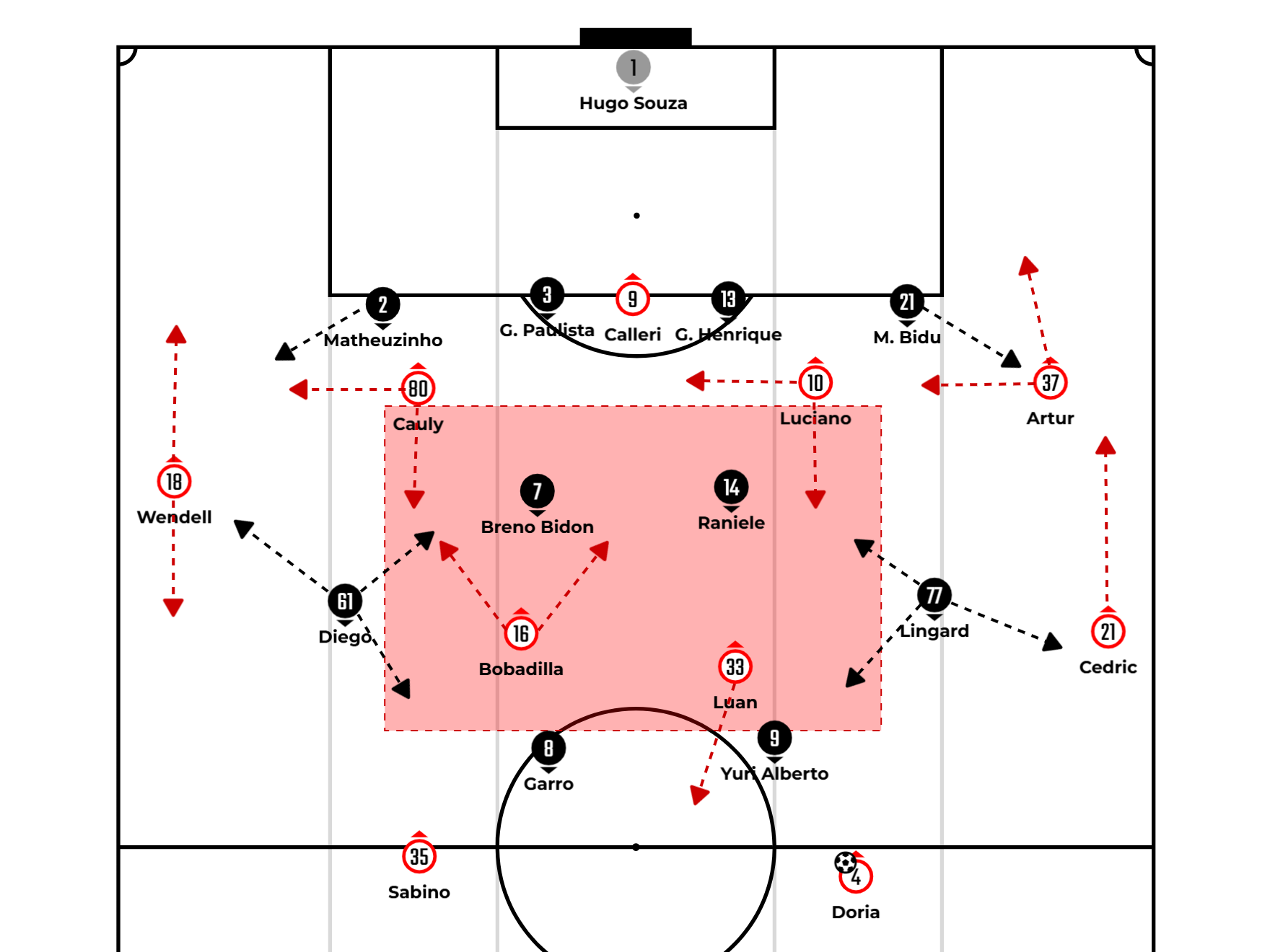
Final game scenario after substitutions, with São Paulo attacking in a 4-2-4/2-3-5 shape without being able to exploit the central block.
After conceding, São Paulo still managed to threaten a few times and Roger Machado made changes to try to alter the game. Cauly replaced Ferreirinha to improve central play and Luan came on for Danielzinho to retain possession better in duels. Later, Wendell (former Porto) replaced Enzo Díaz at left fullback to attack that corridor.
However, São Paulo’s attempt to build a stronger central block was effectively neutralized by Corinthians. The home side defended in a 4-4-2 formation with varying heights, almost forming a hexagonal defensive block that closed central spaces extremely well. Whenever São Paulo tried to move play wide, Corinthians’ wide defenders protected the flanks to prevent crosses.
Takeaways
With the derby victory, Corinthians improved their Brasileirão form and finally turned their good performances into points, climbing out of the relegation zone. After qualifying in the Copa do Brasil, the team now faces Botafogo on the final weekend before Brazil’s national team call up, which goalkeeper Hugo Souza is eagerly awaiting.
At São Paulo, what was already a crisis became even more exposed. The team lost again and reached four matches without a win in their last five Brasileirão fixtures, despite remaining in the G4. After the game, leaked audio from a club executive revealed the coach was only being kept because the club could not afford to dismiss him. Then, after São Paulo were eliminated by Juventude midweek, Roger Machado was officially sacked. Dorival Júnior returns as the new manager and will face Fluminense in a direct clash next weekend.


Comments