
Flamengo – Palmeiras: Palmeiras gain an advantage in the title race with a dominant win at the Maracanã (0-3)
Flamengo and Palmeiras have built one of the biggest rivalries in Brazilian and continental football, with titles, electrifying finals and even financial competition. This year, they are the two teams at the top of the Brasileirão table. With several players from both sides called up for the World Cup, the teams faced each other on Matchday 17 and the visitors won 3-0, opening a gap after Carrascal’s red card.
Tactical analysis and match report by Marcus Arboés.
Leonardo Jardim’s (former Monaco) Flamengo have been finding a clear playing identity. The team has four players called up for the World Cup and finished with the best campaign in the Libertadores Cup group stage. For this clash, Arrascaeta (Uruguay National Team) was out injured and Danilo (former Juventus) was suspended. Therefore, Flamengo lined up in a 4-2-3-1 formation with: Rossi in goal; Varela (Uruguay), Léo Ortiz, Léo Pereira (Brazil) and Alex Sandro (Brazil, former Juve) in the defensive line; Evertton Araújo and Jorginho (former Arsenal) as the double pivot and Paquetá (Brazil, former West Ham) as the attacking midfielder; up front, Carrascal (Colombia) played on the right and Samuel Lino (former Atleti) on the left wing, with Pedro as the number nine.
Palmeiras had been at risk of not qualifying in the Libertadores and, even with a recent negative fluctuation in results and performances, the team still lead the Brasileirão table. An away win at the Maracanã would be essential for the title race. With at least three major absences (Vitor Roque, Sosa and Piquerez), Portuguese coach Abel Ferreira sent out: Carlos Miguel (former Nott Forest) as goalkeeper; Giay, Gustavo Gómez (Paraguay National Team), Murilo and Arthur Gabriel in defense; Martínez, Marlon Freitas and Andreas Pereira (former Fulham) in midfield; Allan on the right wing, Arias (Colombia, former Wolves) on the left and Flaco López (Argentina National Team) as the target man.
Flamengo’s superiority until the red card
As you can see from the lineups, Palmeiras and Flamengo possess squads equivalent to continental National Teams, in addition to the stars available on the bench. Every year, they produce elite-level clashes. This time, Flamengo started better, but Carrascal’s sending off and Palmeiras’ technical growth changed the direction of the match that had been established during the opening 20 minutes.
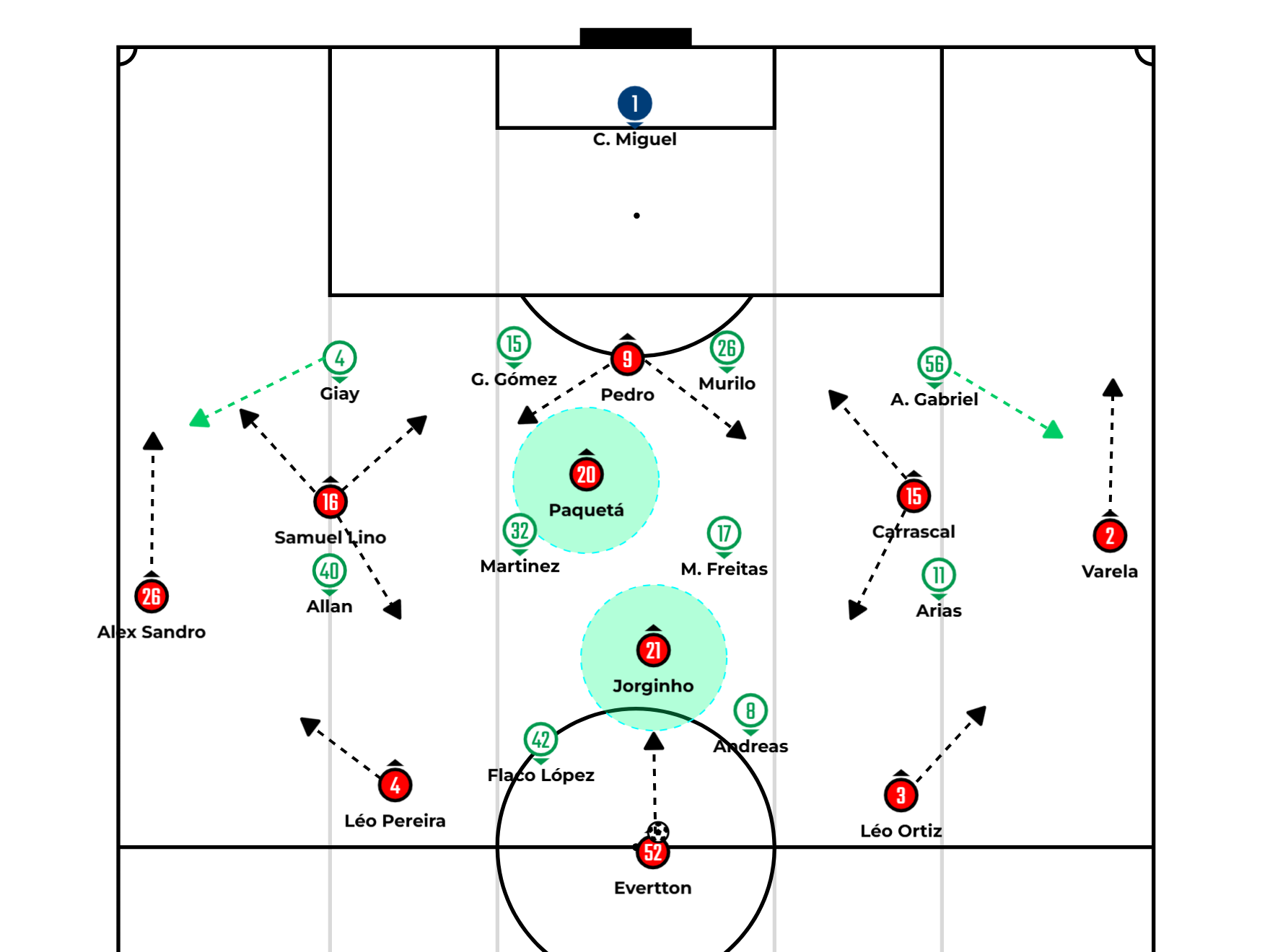
Flamengo’s relational/functional attack in a 4-2-3-1/3-1-5-1 shape, seeking central superiority.
Leonardo Jardim does not necessarily have a brilliant project, as the team still has weaknesses and fluctuations, but it’s undeniable that some players, such as Pedro, Samuel Lino and Paquetá, have been tactically elevated through the dynamics inside the team’s relational/functional style based on short connections on the flanks and central progressions, demanding a high level of mobility. The team starts from a 4-2-3-1 outline, where the midfielders vary their height and functions, while the trio behind the striker shorten distances with freedom, with the fullbacks staying wide to provide width, thus generating a 3-1-5-1 formation in possession.
During the build-up phase, Evertton Araújo dropped between the center backs to create numerical superiority against Palmeiras’ first pressing line, which defended with zonal references in a 4-4-2 shape, but the young midfielder could also advance in certain situations, giving Jorginho more freedom, as he acted as an anchor to organize the team’s construction. Close to that trio and the Italian-Brazilian midfielder, the wide wingers/attacking midfielders (Lino and Carrascal) alternated between dropping deeper to provide support and combinations or attacking spaces inside or outside behind the second or final defensive line, while Paquetá played with positional freedom inside, supporting attacks on both sides of the pitch.
To create space inside, both fullbacks, Alex Sandro and Varela, held the width out wide, while striker Pedro stayed centrally as a target to receive with his back to goal and retain possession, though he was rarely involved during the match. Any slight spacing between Palmeiras’ defensive lines allowed the center backs or Jorginho to find progressive central passes, long balls or combination plays with the wingers or Paquetá.
Until the 20th minute, the Rio de Janeiro side were dominant and dangerous at home, until Colombian winger Carrascal displayed aggressive conduct. His red card changed the flow of the game and introduced a new protagonist.
Marlon Freitas, the soul of Palmeiras
Among so many stars, players representing their countries in National Teams and athletes who have worn the shirts of major European clubs, the standout performer of the match, in my opinion, will not play in the World Cup. He dictated and conditioned the rest of the game. Unlike those other players, midfielder Marlon Freitas is not what I would call the star or the genius, but rather the soul of Palmeiras, because he represents the coach’s football philosophy on the pitch.
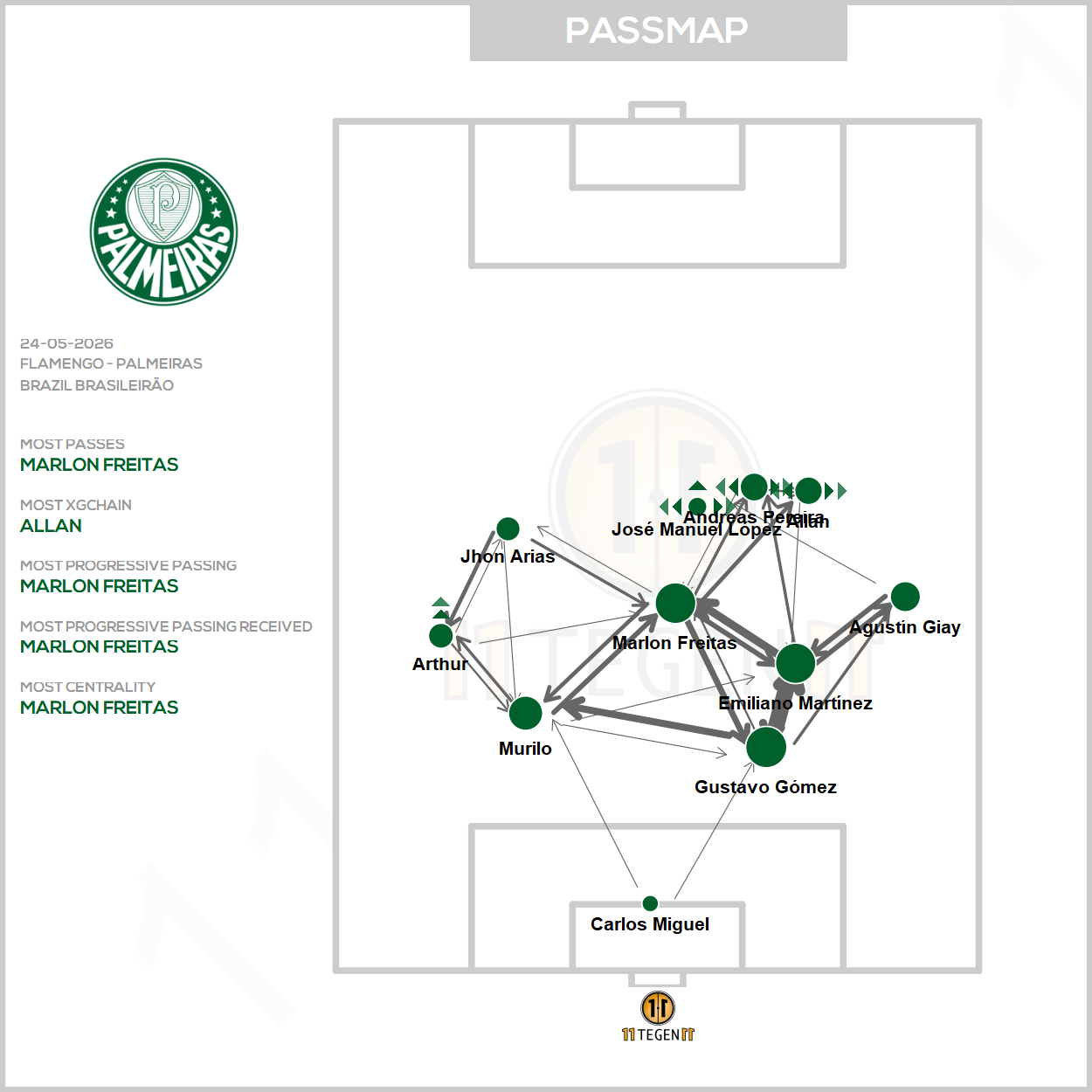
Palmeiras pass map, with Marlon Freitas as the team’s most influential player in build-up.
With the numerical advantage, Palmeiras managed to dominate Flamengo and open the scoring before halftime, but before getting there, it’s important to understand why Marlon Freitas is so crucial to the team’s style of play. This is based on two key characteristics: his positional awareness as a midfielder during build-up and his ability to progress plays through his passing repertoire.
Abel Ferreira is a typical coach from the Portuguese tactical school of football. He likes stretched, vertical and fast positional football, with switches of play and direct long balls, using dynamics that favor this type of superiority. To achieve this, he sought a title-winning midfielder with leadership qualities from Botafogo. Marlon Freitas, without glamour and having never played in Europe, perfectly fits the role: excellent passing accuracy through switches, long diagonals, progressive passes inside and frontal long balls over the top, all combined with a superb ability to position himself to generate tactical advantages.
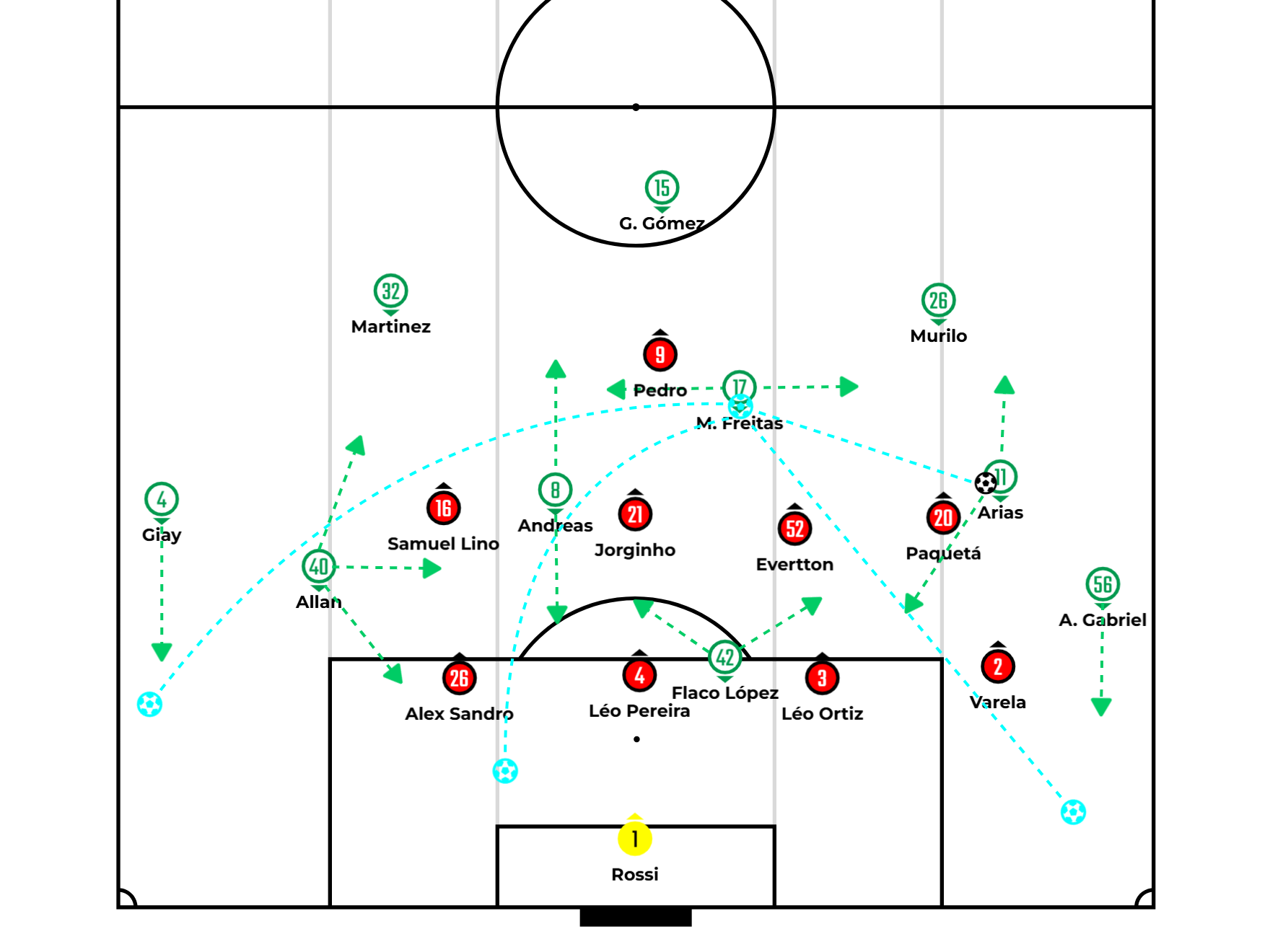
Palmeiras’ positional attack in a 3-1-6 formation, with Marlon Freitas as the center of the game.
Palmeiras’ opening goal, which unlocked the match, came from his vision to find a long ball over the top toward Allan, who attacked the space behind the final line before assisting Flaco López. There’s huge merit in the midfielder and his ability to change the game, but it’s interesting to observe the dynamic that allows him to find space for those passes.
Abel Ferreira deployed his fullbacks very wide and brought midfielder Emi Martínez into the first line alongside the center backs during the build-up phase. This triangle creates superiority so Martínez or Murilo can find passes toward the wingbacks out wide or Marlon through the center. When the marking becomes tight, the third midfielder, in this case Andreas Pereira (former Flamengo, incidentally), drops deeper to help unlock the construction and generate central superiority.
But he is not the only one doing this. Wingers Allan and Arias manage their heights by dropping deeper to support the build-up, attacking the box on the last line or serving as outlets to receive wide before driving inside. In this case, Colombian winger Arias dropped deeper to attract Flamengo’s defensive references, as Flamengo were already down to ten men with a deeper block. Escaping Pedro’s marking, Marlon received facing forward with good distance from the midfielders. Allan, moving inside, took advantage of the defensive shifting in the final line to attack the space and assist Flaco López.
The consolidation of Palmeiras’ victory
By the end of the match, Palmeiras had secured a 3-0 away victory. Because of the red card, the tendency is to assume it was complete domination, but Flamengo fought hard despite being down a man. For at least ten minutes in the second half, the team pushed forward and created good scoring opportunities, forcing Carlos Miguel into important saves. Showing courage, Leonardo Jardim removed midfielder Evertton Araújo to introduce Bruno Henrique on the left wing. With that same courage, Flamengo also decided to press high despite the disadvantage, and that proved costly.
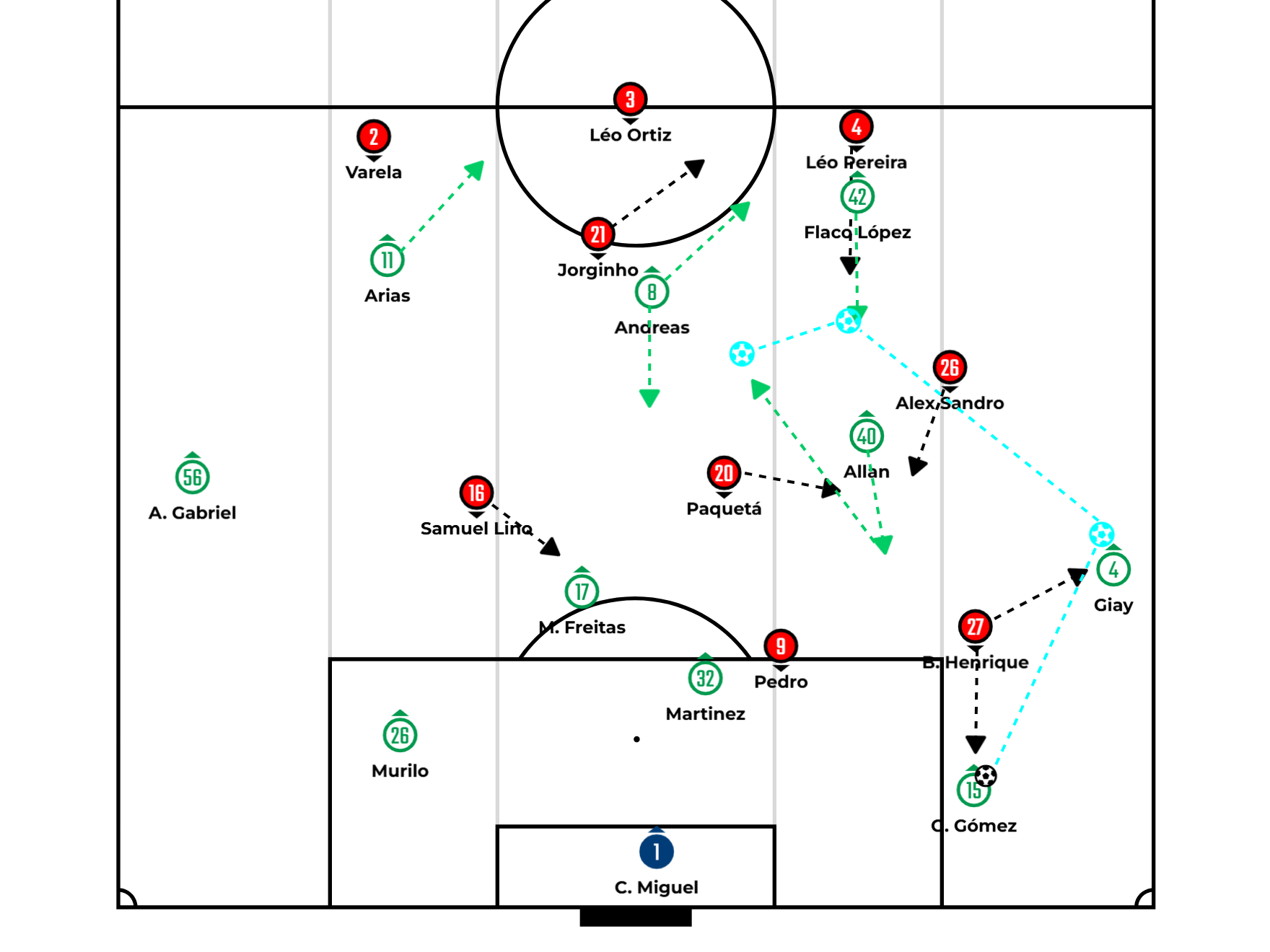
Palmeiras’ low build-up for the second goal, manipulating Flamengo’s defensive references while holding a numerical advantage.
At that stage of the game, energized by their chances and after sacrificing a midfielder for an extra winger, Flamengo began pressing high with man-oriented marking using two blocks of players: the defensive line and the front four, with Jorginho acting as an inside marker mainly focused on Andreas Pereira. The references were therefore established, but with one player fewer, the team had to press while inevitably leaving someone free on the opposite side, always operating in overall numerical inferiority.
In the move that produced the goal, Bruno Henrique was caught between Gustavo Gómez and Giay. The center back passed to the fullback. However, the key to the move was Allan: despite being the right winger, he dropped inside, attracting Alex Sandro, his direct marker, with Paquetá also helping defensively. Giay’s pass then went to Flaco López, who dropped deeper and resisted the pressure from Brazil National Team defender Léo Pereira, acting as the second man in a triangular dynamic before finding Allan, now free, escaping from two markers.
To create space for his inside carry, Andreas Pereira dragged Jorginho’s marking away, and the move ended with Allan scoring after support from Arias and a bit of luck. Flamengo did not give up, made further substitutions and introduced Plata (Ecuador National Team), De La Cruz (former Uruguay) and Sául (former Atleti) to change the game. They managed to gain territory, but without truly threatening Palmeiras.
Meanwhile, the visitors, already leading 2-0, orchestrated their counterattacks through the carries of silent protagonist Marlon Freitas and could even have extended the scoreline further. It was during an offensive transition near the end of the match, initiated by Lucas Evangelista and finished by left fullback Jefté, whose assist allowed Paulinho (former Bayer Leverkusen) to score the final goal, his first after returning from injury. A goal involving three players who had entered in the second half.
Takeaways
The result was extremely important for Palmeiras to practically secure first place in the Brasileirão heading into the second half of the season. Winning the direct clash for the lead at the Maracanã, the historic stadium and home of rivals Flamengo, by 3-0, was such a boost for morale that they also recorded another big win midweek to qualify in the Libertadores. With a seven-point lead, they will face bottom-placed Chapecoense this weekend.
The impact of the home defeat is already evident for Flamengo. Even so, they still possess a very strong squad filled with players who will be at the World Cup. Furthermore, they achieved the best Libertadores group-stage campaign, but they will need to recover this gap in the Brasileirão. To do so, before the World Cup break, they face Coritiba.
Use the arrows to scroll through all available match plots. Click to enlarge. Check the match plots page for plots of other matches.


Comments