
France – Senegal: Deschamps Rediscovers Balance For Winning Start (3-1)
It was to be a repeat of the opener to the 2002 World Cup as France faced Senegal. Back then, Senegal humbled Les Bleus with a 1-0 win, but there would be no repeat of that outcome this time round. Kylian Mbappé would take the headlines as he fired France to a 3-1 win and surpassed Olivier Giroud’s record to become the nation’s all-time top scorer.
Tactical analysis and match report by Nick Hartland.
We decided to make this article free to read. If you want to support our work, consider taking a subscription.
The end of an era approaches France. Each match at this World Cup brings manager Didier Deschamps closer to his grand farewell, with the ‘water carrier’ set to leave his position and for the federation to finally address the Zinedine Zidane-shaped elephant that has been cluttering up the room for years. The only living person who has won the World Cup as a player (1998) and a manager (2018) has not always had a fond reception in France due to his cautious selections and tactics, but his pragmatism has led Les Bleus to the final of two consecutive World Cups, and it’ll be his hope that his tenure ends with a third.
An asterisk hangs over Senegal. The AFCON they won on the pitch this year was stripped from them in March, months after the final was played. The decision of Senegal’s manager, Pape Thiaw, to gather his players and exit the pitch in protest at a series of contentious refereeing decisions culminating in Morocco being awarded a late penalty was punished belatedly by the CAF appeal board. Senegal have appealed the appeal in a perfect encapsulation of what modern football has become and will certainly have a sense of injustice fueling them as they look to become the first African team to win the World Cup.
Deschamps went with a 4-2-3-1 formation. Mike Maignan was in goal with a defense consisting of Théo Hernandez, William Saliba, Dayot Upamecano, and Jules Koundé. In midfield, a double pivot of Adrien Rabiot and Aurélien Tchouaméni. On the wings, Désiré Doué and Michael Olise with Ousmane Dembélé in midfield. Up top, Kylian Mbappé as the number nine.
Thiaw picked a 4-3-3 shape. Édouard Mendy started in goal and was defended by El Hadji Malick Diouf, Moussa Niakhaté, Kalidou Koulibaly, and Krépin Diatta. Pape Gueye, Idrissa Gueye, and Lamine Camara made up the midfield. In attack, Nicolas Jackson was flanked on either side by Sadio Mané and Ismaïla Sarr.
Issues for France
Coming into this tournament, question marks were hanging over the France squad. Player for player, there are no teams that can rival the sheer talent at Deschamps’ disposal. And it’s been joked that his second team could probably win the World Cup. However, with so many stars in attack, it wasn’t clear how Deschamps would find the balance to make the team function as a cohesive whole. The final preparatory friendlies didn’t particularly shed much light on the matter, and in the first half against Senegal these question marks swiftly became issues.
This was most apparent in France’s build-up phase, where they settled into a fluid 3-1-3-3/3-1-2-4 shape. The fullbacks moved up and held the width, while Tchouaméni dropped in between the center-backs to create a back three. Rabiot kept a more advanced position, meaning that one of the forward players were tasked with dropping into the pivot to collect the ball out of the defense. This task fell to Olise at first and then was taken over more by Dembélé.
Out of possession, Senegal were set up in an active 4-4-2/4-2-3-1 shape with Camara moving up alongside Jackson or, less occasionally, just behind him, and the two Gueyes forming the deeper partnership in the center. Senegal’s structure worked by protecting the middle of the pitch and putting pressure on the ball carrier with pressing runs. France’s central access was often blocked or could be quickly jumped on. And instead of playing through the lines, France were forced to shift from side to side, unable to penetrate the block.
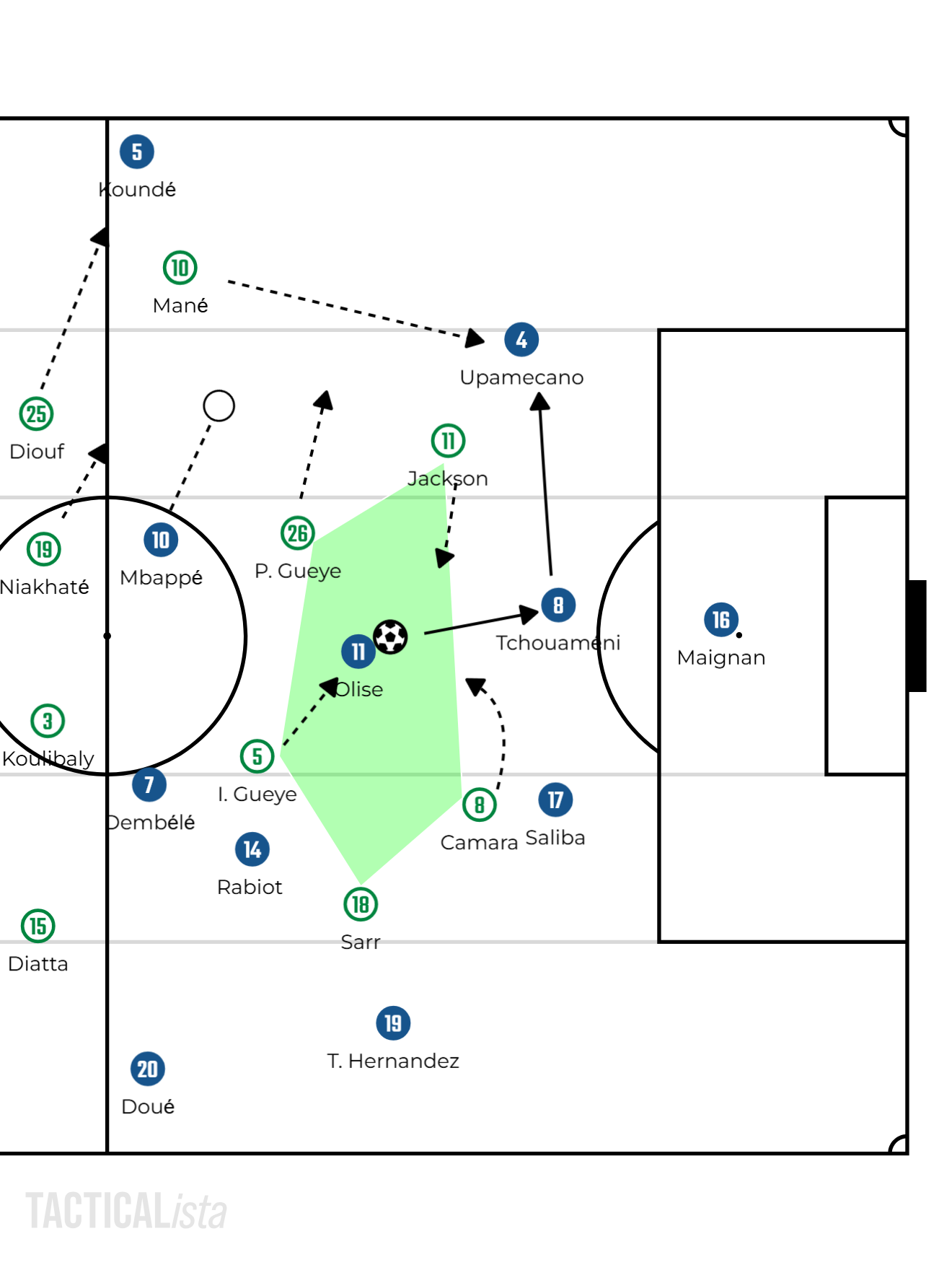
9th minute: Senegal’s active out-of-possession shape nulifies France’s build. Olise drops into the pivot but is met with a central overload and is rapidly harried. He plays the ball back to Tchouaméni, who spreads it wide. A shift wide from Gueye puts Mbappé in the covershadow and maintains the central block, while Mané leaps up to press Upamecano.
Senegal threaten without result
France dominated the ball in the first half, but Senegal carried the greater threat. Transitions, in particular, looked like Les Lions de la Teranga’s most potent weapon as they took advantage of France’s vulnerable rest defense. With so many players taking up advanced positions, France often only left three players to defend the counter-attack, and with Tchouaméni in the backline, no player was acting as a shield in front of the defense.
Just before the hydration break (read advertising break), Senegal came close to opening the scoring on the counter. Diouf leapt on a poor touch from Mbappé, picking his pocket and then releasing Jackson down the left channel. A little turn of pace from the striker allowed him to breeze past Upamecano in the box and release his shot from a tight angle. It beat Maignan, but hit the post; the deflection then bounced off the keeper’s trailing leg and wide for a corner.
As so often in this World Cup, the return to play saw a shift in the dynamic of the game and with it, Senegal saw some better spells of possession. Mbappé’s historic struggles to press from the front came to the fore, and even with Dembélé alongside him, France couldn’t put enough pressure on Senegal’s build-up play to maintain an effective press. So they instead slipped more regularly into a fairly passive 4-4-2 medium block.
It was when France committed to the press that they looked vulnerable, as the back four didn’t seem comfortable jumping and covering the midfield when it moved up, creating a lack of co-ordination and synergy between the lines. In injury time, this saw Senegal come close to finding the back of the net, as they slipped past France’s laissez-faire press and forged a crossing opportunity for Sarr, who really should have put his shot on target for the opener.
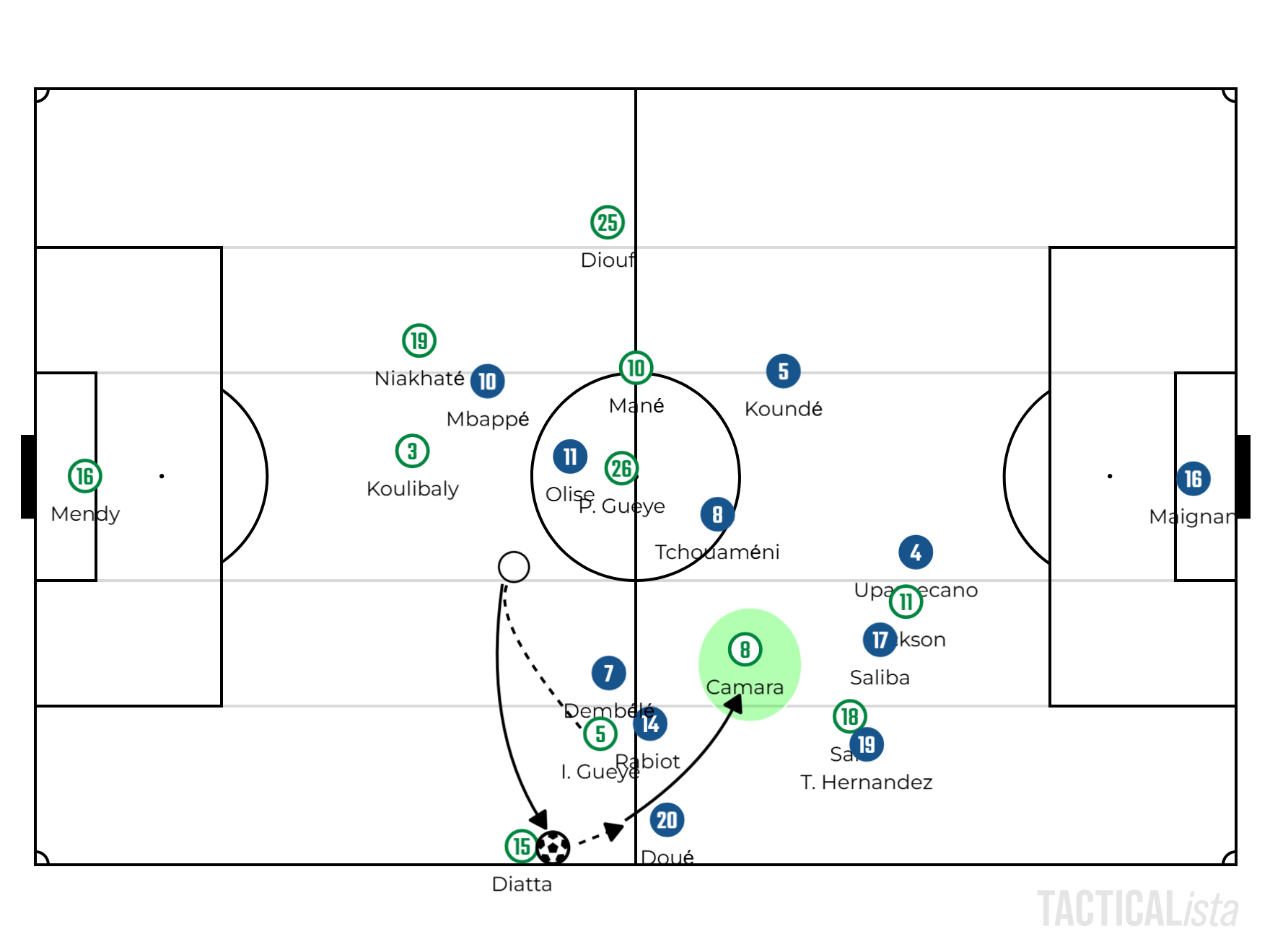
45+6th minute: France’s press falls apart. Lack of co-ordination sees large gaps between the players and spaces for Senegal to exploit. France create a wide defensive overload, but leave Camara free. The center-backs are pinned and unwilling to make the jump to cover the midfield’s movement. Camara receives the ball in space.
A change in the winds
France had created next to nothing in the first half. Something had to change for them, as too often their attackers were trying to occupy the same spaces and limiting their own potential. A substitution would have been the obvious choice, but Deschamps went for something more subtle. Dembélé was moved to the right wing, while Olise was given the keys to the kingdom and provided the role in the pocket.
France’s positional switches following the halftime break felt far more organized and purposeful. In the first half, it felt as if players were swapping positions for the sake of it, and there were no clearly demarcated roles. An aspect that was not helped by the fullbacks providing the width and forcing the wingers to find other spaces to occupy. Koundé and Hernandez were a bit more reserved in the build-up phase in the second half, only providing an overlapping run if the wide space was unoccupied; otherwise, they would attack the halfspace from deep (providing a bit more rest defense as well).
Deschamps further tweaked the side’s build-up play with the team no longer looking to immediately move into a back three. Tchouaméni still stuck close to the center-backs and would drop in between them when needed, but he could also move into the pivot, freeing Olise and Dembélé to remain high and causing Senegal to focus more on protecting their deeper areas, which created some tension and risk when they had to press.
France’s threat was now spread across the pitch. If Senegal protected the center, the width was given to the attackers. If they focused their efforts too wide, Olise would have the space to pick out a pass or make a run. With this structure in place, France’s front four could now rotate among one another and provide fresh threats to the defender rather than what happened in the first half, when they were simply getting under one another’s feet.
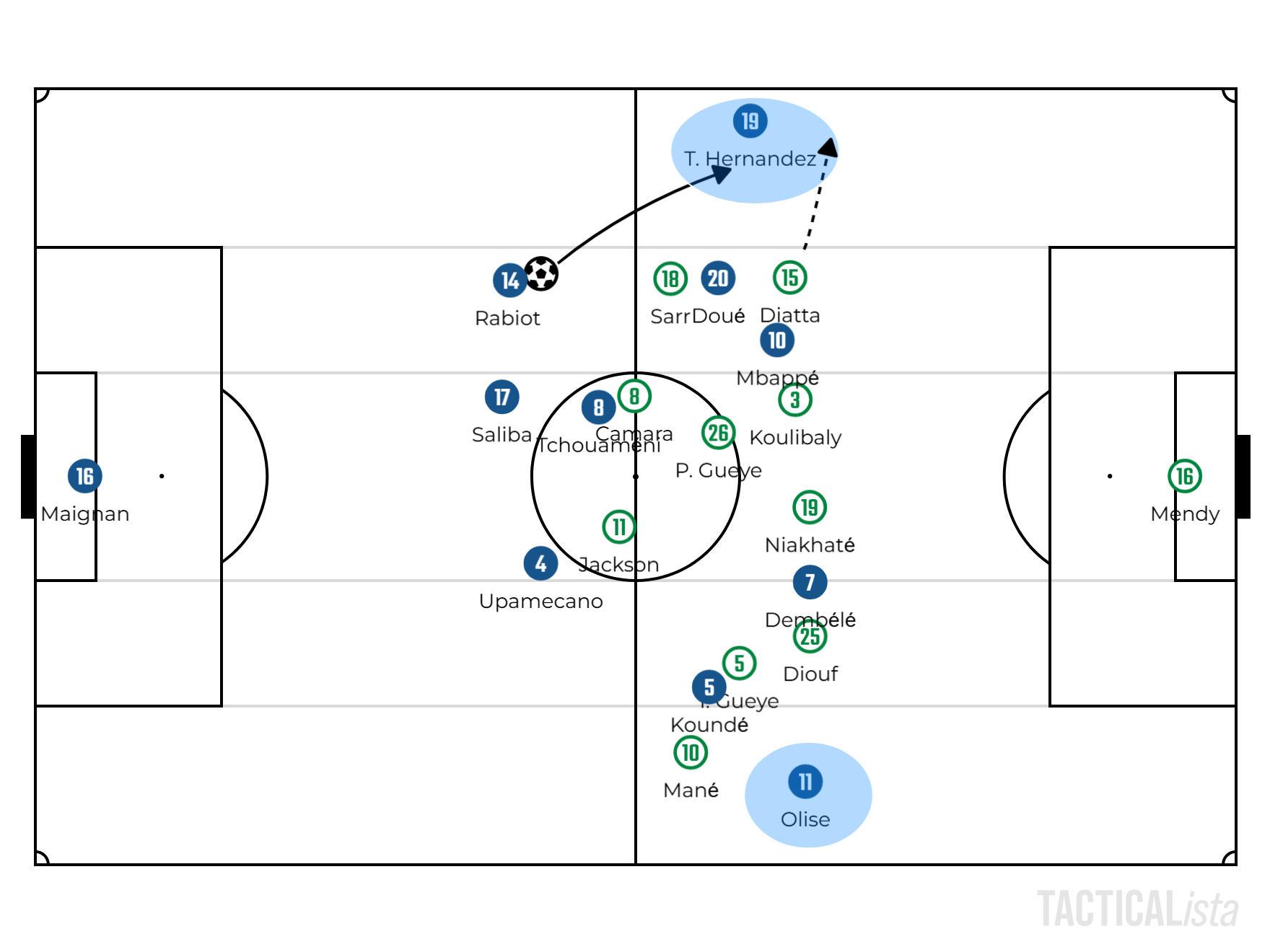
65th minute: France’s renewed build. Tchouaméni moves into the pivot, meaning Olise and Dembélé remain high. Rabiot drops into the backline. Koundé occupies the right halfspace because Olise has rotated wide. Hernandez takes the width on the left because Doué has moved into the halfspace. Threats are now spaced out and tension is created in Senegal’s 4-4-2 mid-block. They block the center double marking Dembélé and Mbappé, but once the ball moves wide they have to weaken that superiority. There are now problems across the pitch for Senegal to think about.
The goals pile in
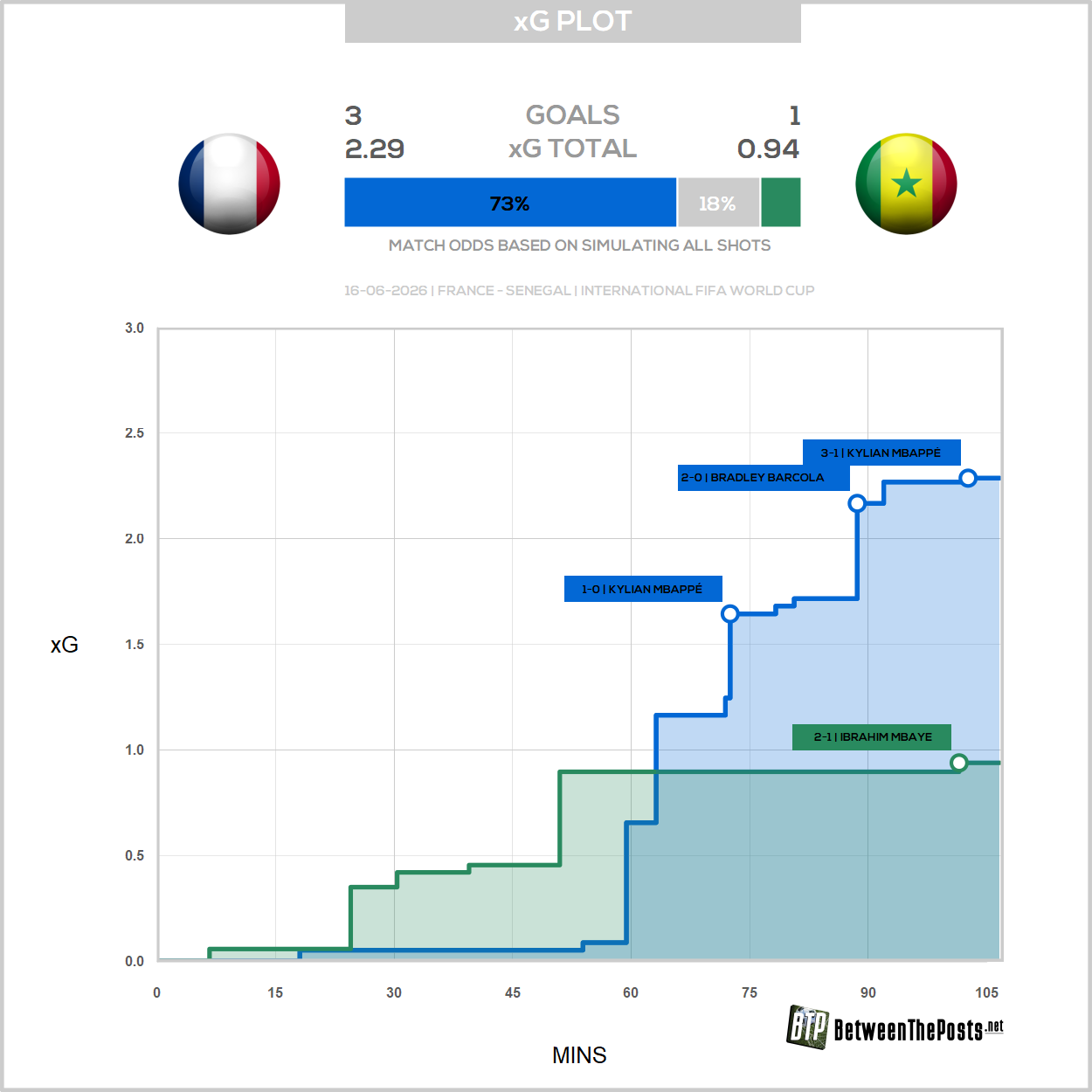
The overall result was that it looked as if France awoke from a deep sleep as they began to rack up chances in the second half. They should have been awarded a penalty in the 58th minute when Mbappé attacked down the right wing and was brought down in the box by Mané. It looked like a clear-cut penalty, but the referee disagreed, even after taking a closer look at the pitchside monitor. It wouldn’t take long for justice to be served when Olise fed Mbappé with a breathtaking curled pass into the box. Senegal had an instant response from Jackson, but the striker was ruled out for offside.
France would make it two in the 82nd minute from Bradley Barcola. The Paris Saint-Germain winger was only on the pitch for a few minutes after replacing Dembélé before he added to France’s tally. Brought on against tiring legs, he was the outlet in transition to give France a comfortable lead.
The lead would be halved by his club teammate Ibrahim Mbaye with a powerful effort in the fifth minute of injury time. It would prove to be only a consolation. A minute later, the two-goal lead would be restored courtesy of a goalazo from outside the box from Mbappé, earning him the title as France’s all-time top scorer with 58 strikes, surpassing Olivier Giroud.
Takeaways
Deschamps’ management has been defined by the obsessive pursuit of balance. And in the first half, France looked anything but. The fear was that it would take him a few games of tinkering to find the right solution. In the end, it would take him only fifteen minutes. The France that will line up against Iraq on Monday may look very different with rotations likely, but in the final group game against Norway, we perhaps have an insight into how Les Bleus will approach the fixture.
Senegal will look at the first half as a missed opportunity. They had the chance to put the pressure on France and take control of the group with a statement win, but they lacked the killer instinct. The next match against Norway has become far more crucial, even if the forgiving nature of the group stages means that it’s not necessarily a do-or-die game for the asterisked AFCON runner-ups.
Use the arrows to scroll through all available match plots. Click to enlarge. Check the match plots page for plots of other matches.there


Comments