
France – Spain: Spain’s System Strongarms French Firepower (0-2)
Though this World Cup concludes with its top teams in contention for the crown, football frequently has a way of deviating from the script. On a day destined for French celebration, a well-drilled opposing outfit orchestrated a disappointing denouement for the head coach.
Tactical analysis and match report by Emmanuel Adeyemi-Abere.
We decided to make this article free to read. If you want to support our work, consider taking a subscription.
Familiar battle lines were drawn in this duel. For the third time in just over two years, two of the top countries on the European continent clashed to advance to the final of an international tournament.
France are the team to beat, boasting a flawless record across six showdowns to reach the semi-final. The attackers are the highlight of their troupe, but the quality across the squad bears no rival. Topped off with a functional midfield and an unflappable central defense, Les Bleus have handled Morocco with relative ease, put Paraguay’s antics to shame and swept away Scandinavian opposition. To many, a third World Cup title was pending— with no better time than Bastille Day to close in on the trophy.
Spain shall not be fearful of their opposition, having defeated the French in the semi-finals of EURO 2024 on the way to the trophy as well as at the same stage of the Nations League in 2025. Lacking the dual threat on the flanks of recent years, La Roja have not turned ball dominance into devastation with the frequency that has typified Luis de la Fuente’s reign. However, the best of their performances has still put them a class above the chasing pack, platforming the best defensive record in the tournament.
Spanish manager de la Fuente fielded the same starting eleven he used against Belgium. Pedro Porro has ousted Marcos Llorente in the fight for the right back position as part of a rearguard that includes Pau Cubarsí, Aymeric Laporte and Marc Cucurella. Fabián Ruiz remained in the midfield unit with Rodri and Dani Olmo while Pedri watched from the bench. Álex Baena was entrusted to play as the left winger instead of Nico Williams in a frontline featuring Mikel Oyarzabal and Lamine Yamal.
France’s Didier Deschamps decided to rotate two members of the lineup from the quarter-final. Manu Koné came out of the pivot as Aurélien Tchouaméni took the place of Adrien Rabiot, having returned to fitness. Behind them, Mike Maignan, William Saliba and Dayot Upamecano would be relied upon to secure the spine of the side. The head coach chose to back his attacking talent: Bradley Barcola displaced Désiré Doué in a quartet with Michael Olise, Ousmane Dembélé and Kylian Mbappé.
France foil their early momentum
Morocco might have been stiffer competition for France if Ismael Saibari had been available, but they were relatively powerless to prevent the favorites from dominating the game. Against a Spanish side so set and stable in their ways, Deschamps’ men would have the ability to be protagonists truly tested.
Les Bleus were not immediately concerned with controlling possession. They knew that the Spaniards would try to control the center with their typical blueprint: Rodri dropping deep with the center backs, patient ball circulation from side to side and attempts to wear down the defensive unit from the flanks.
Without Williams’ electric 1 v 1 ability and dynamic edge on the left, it has been a bigger challenge for the Spaniards to sustain effective width on that side of the field. Cucurella continued to support attacks on the underlap, and Fabián can offer more flexibility in that channel, but Baena struggled as a wide outlet, and the imperious Upamecano was mostly untroubled in the early stages of the game.
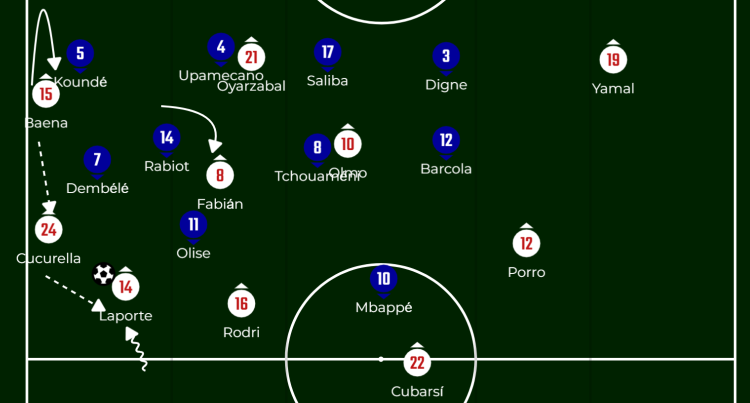
5th minute: offensive sequence from Spain. Laporte pushed the ball forwards, requesting movement from his teammates. Baena burst down the line, but Koundé could track him while Rabiot and Olise closed the inside gap for Fabián. The ball returned to Laporte with no following movement from Baena. Upamecano followed Oyarzabal into the channel, and Koundé shut down Baena before he could connect with Cucurella. Dembélé then received possession and the counterattack began.
The French also knew that they could lean into their transition threat when their opponents lost the ball. Twice, Dembélé sprung dangerous counterattacks with his downfield passing, Cubarsí could not keep pace with Mbappé, and Barcola brought additional threat in these moments on the left wing.
Another attack took a seemingly standard pattern for Spain in the 20th minute. Cucurella advanced on the left flank and fired the ball into the box with only one white shirt present to attack the delivery. The ball bounced kindly for Lucas Digne at the far post, and the defender did not sense any danger.
It was a grave mistake: the fullback whacked Yamal as he angled to volley away the ball, and the referee pointed to the penalty spot. Oyarzabal outwitted Mike Maignan: the Spaniards had the lead. If that was not enough, Saliba soon crumpled under no contact, conceding the battle with a niggling back injury. Deschamps was forced to withdraw the defender and Maxence Lacroix replaced him.
Spain master the midfield management
The French had fallen behind for the first time in the competition, and their troubles were far from over. Yamal continued to unsettle Digne, and the winger would combine neatly with Olmo to almost assist Fabián in a phase with a flurry of chances for La Roja. However, the strength of the Spaniards has leaned into an ability to avoid conceding chances, and the midfield managed that responsibility.
Les Bleus would not commit the mistake from the EUROs of letting their opponents calmly circulate the ball free from pressure, but the Spaniards back themselves to keep the game ticking. Fabián is a reliable option deeper in the midfield, and his composure was an asset in this phase of the match.
Rodri has also raised the standards of his performances as the tournament has gone along. His heading, physical presence as a screen and tactical fouling helped to stop the French from finding rhythm in the engine room. With only a single goal lead, the Spaniards were sure of themselves.
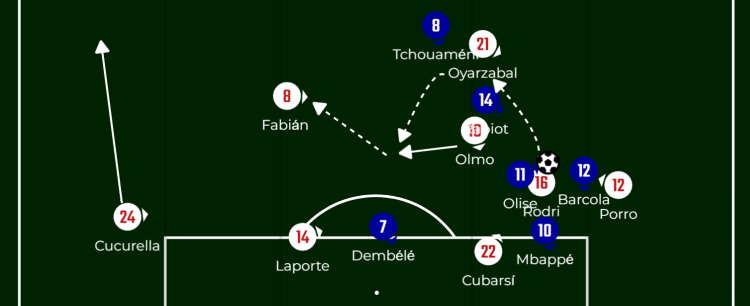
37th minute: offensive transition from Spain. Rabiot had outdone Olmo in an aerial duel, and Olise attempted to retain the ball. However, Rodri timed his leap to knock Olise off balance, and Oyarzabal snuck onto the shoulder of Tchouaméni to flick the ball around the corner into the path of Olmo. Fabián was free to his left, and Spain were able to engineer a classic 2 v 2 situation on the outside.
For the start of the second half, Les Bleus reemerged with another alteration in the spine of the side. Since Rabiot received a yellow card, he was hooked off and Koné came on for him in the midfield. The substitution yielded little impact: Spain suffered little, continuing to pass with confidence.
As the hour mark neared, Spain seamlessly popped the ball through French pressure again, allowing Olmo to advance into the final third. A blocked Baena effort dropped for Rodri, and the ball was worked. Porro flowed back inside the pressure, punching a pass towards Olmo. Upamecano tracked him and Lacroix latched onto Oyarzabal while Digne was wide with Yamal. So, no one pursued the fullback who had followed his pass, and Porro put the ball beyond Maignan to double the buffer.
La Roja remain watertight
Problems compounded for Les Bleus, whose fullbacks remain a weaker point in their roster. Yamal kept gunning for Digne, and he was marginally offside as he dispatched a through ball into the net.
Deschamps had brought on Doué as a replacement for Barcola just before Porro’s breakthrough, and he subsequently sent Theo Hernández into action with Rayan Cherki while Olise and Digne departed. France produced their most sustained phase of pressure, but they never really looked like recovering. De la Fuente’s men settled into a deeper block, refusing to give their opponents clean strikes at goal.
The Spanish have still conceded just one goal all tournament, deservedly earning a spot in the final.
Takeaways
There will be no dream departure for Deschamps, whose time in the post will finish in the third-place playoff after a 14-year stint. It was hard to find fault with a group that had reached three consecutive World Cup semi-finals for the first time in France’s history (and achieved the feat it in impressive style) so the head coach comes away with plenty of pride in his work. But on this evening, his ensemble of stars struggled to hit their level, and they were ultimately outdone by the better team.
Spain shoved it to the critics who thought that the individual quality and athletic prowess of their opposition would decide the semi-final in favor of the French. It is true that La Roja required some gamesmanship to get the better of their rivals, and their deficiencies in the final third had not disappeared. But what de la Fuente cherishes is the strength of the system that the Spaniards have nurtured, and they have booked themselves a place in the final just as one could have imagined.
Use the arrows to scroll through all available match plots. Click to enlarge.
Check the match plots page for plots of other matches.


Comments