

Netherlands – Sweden: Brobbey’s Presence Transforms Dutch Offensive Line (5-1)
The Netherlands secured their place in the knockout stages with a convincing 5-1 victory over Sweden, producing the kind of attacking display that had been largely absent in their opening draw against Japan. Ronald Koeman’s side played with far greater intensity, verticality and conviction. Sweden briefly threatened to turn the match into a genuine contest with first half adjustments, but the Dutch gradually imposed themselves before pulling away once more. By full-time, the scoreline reflected not only the difference in quality between the two teams, but also the growing gap in collective organisation as the game progressed.
Tactical analysis and match report by Sander IJtsma.
We decided to make this article free to read. If you want to support our work, consider taking a subscription.
After the opening round of Group F, the situation appeared relatively straightforward. The Netherlands and Japan had shared the points in a cautious but evenly matched encounter, while Sweden dismantled a Tunisia side that looked alarmingly unprepared for the tournament and promptly dismissed manager Sabri Lamouchi after the final whistle. That left Koeman’s team knowing that victory would virtually guarantee qualification for the knock-out rounds, while Sweden needed a positive result to prove that their opening win said more about their own strengths than Tunisia’s weaknesses. For Graham Potter, this represented a significant step up in opposition quality and a far more demanding test of his team’s defensive structure.
Koeman largely retained the framework used against Japan. Bart Verbruggen started behind a back four of Denzel Dumfries, Jan Paul van Hecke, Virgil van Dijk and Micky van de Ven. Frenkie de Jong once again operated as the deepest midfielder, with Ryan Gravenberch and Tijjani Reijnders positioned ahead of him. Further forward, Cody Gakpo and Donyell Malen flanked Brian Brobbey, whose inclusion from the start offered a more physical reference point through the middle than the Dutch had possessed in their opening fixture. On paper, the shape resembled the same 4-3-3 used against Japan, though several of the attacking relationships would prove noticeably different once the game settled.
Sweden lined up in what was nominally a 3-1-4-2 system. Viktor Nordfeldt started in goal behind Victor Lindelöf, Hien and Gustaf Lagerbielke. Ayari operated as the single pivot, supporting a midfield line that featured Bernhardsson, Nygren, Gudmundsson and Karlström. Up front, the highly anticipated partnership of Viktor Gyökeres and Alexander Isak offered Sweden two forwards capable of threatening both in transition and in possession. Potter’s selection suggested an intention to remain compact through central areas before using the movement of his front two to attack the spaces left behind the Dutch full-backs.
A more vertical Netherlands
The contrast with the Japan match became visible almost immediately.
Within the opening minutes, Reijnders attacked the space behind Sweden’s midfield with a deep run that ultimately went unrewarded because of an underhit pass. Shortly afterwards, Van Dijk attempted to release Gravenberch with a direct ball into depth. These moments may have appeared insignificant in isolation, but they represented a fundamental shift in attacking intention. Against Japan, the Netherlands often circulated possession around the block without enough movement beyond the ball. Here, the midfielders were actively looking to penetrate.
The Dutch press also carried a different intensity. Brobbey led the first line aggressively, often pressing alongside the wide forwards to create a three-versus-three against Sweden’s back line. The objective was simple: force long balls towards Gyökeres and Isak, then allow Van Dijk and Van Hecke to dominate the resulting duels.
The opening goal encapsulated the entire approach. Sweden were initially drawn forward before a direct pass found Brobbey. The Sunderland striker secured possession and laid the ball off, allowing the supporting runners to attack the retreating Swedish defense. Gakpo eventually delivered a low cross that Brobbey himself converted from close range.
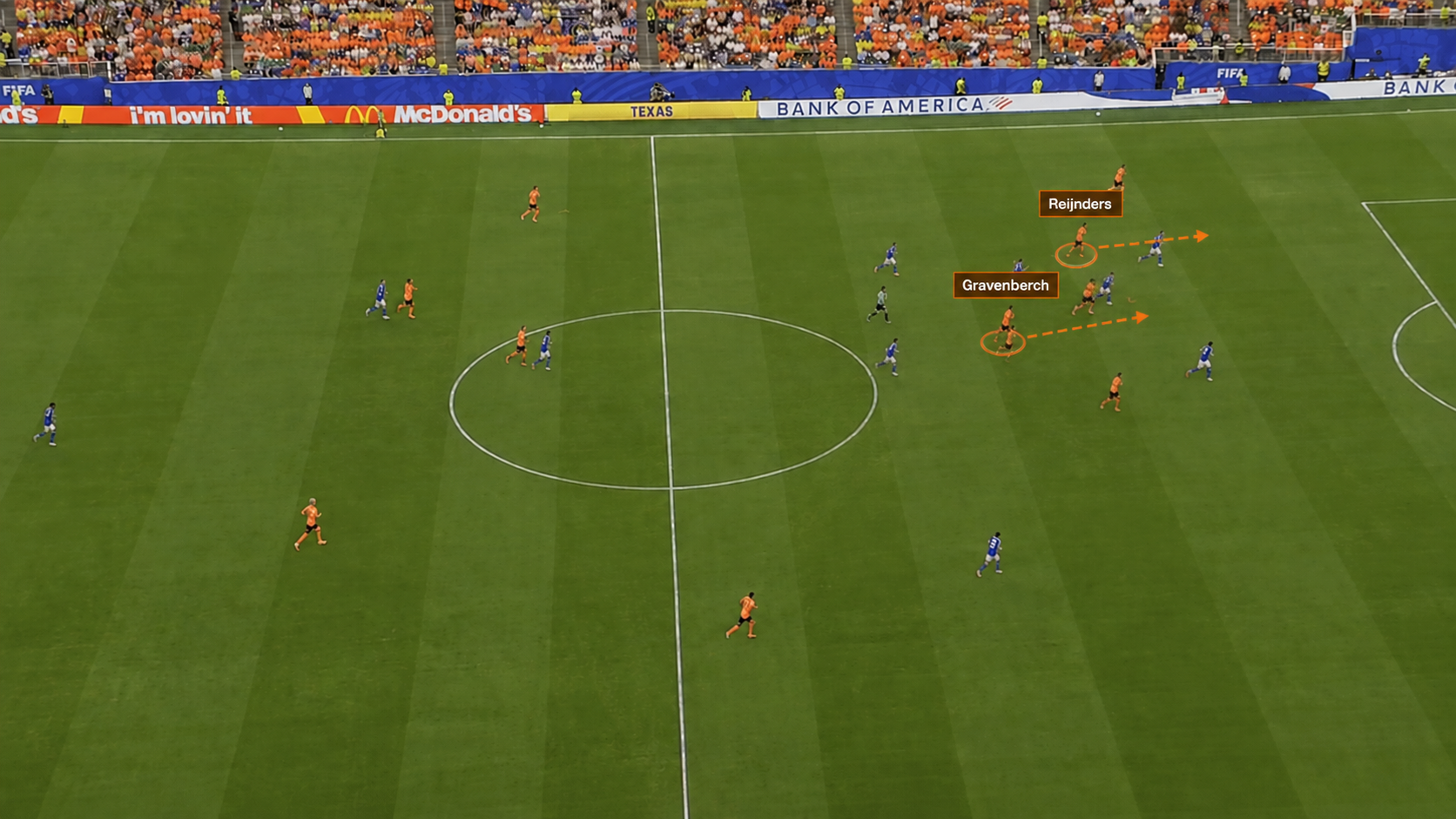
Both Dutch central midfielders as vertical runners on the break leading to Brobbey’s opening goal.
The move contained several elements that had largely been absent against Japan: a focal point capable of securing direct passes, midfield runners attacking beyond him, and four Dutch players arriving inside the penalty area.
Brobbey’s influence extended far beyond his finishing. His presence occupied Sweden’s back three and created reference points for the surrounding attackers. Reijnders and Gravenberch repeatedly attacked the spaces around him, while Dumfries operated from a noticeably higher starting position than in the previous match.
The second goal emerged from similar dynamics. By then, the Netherlands had established heavy territorial dominance and repeatedly forced Sweden backwards. A right-sided combination eventually released Dumfries, whose low delivery was once again turned in by Brobbey. At 2-0, the Netherlands appeared to be in complete control.
The hydration tactical break
Until the first stoppage midway through the half, Sweden had struggled to escape Dutch pressure. Their initial 5-3-2 defensive structure offered little resistance against the movement generated by Brobbey and the Dutch midfield. Potter used the interruption to alter both his defensive organization and his buildup structure.
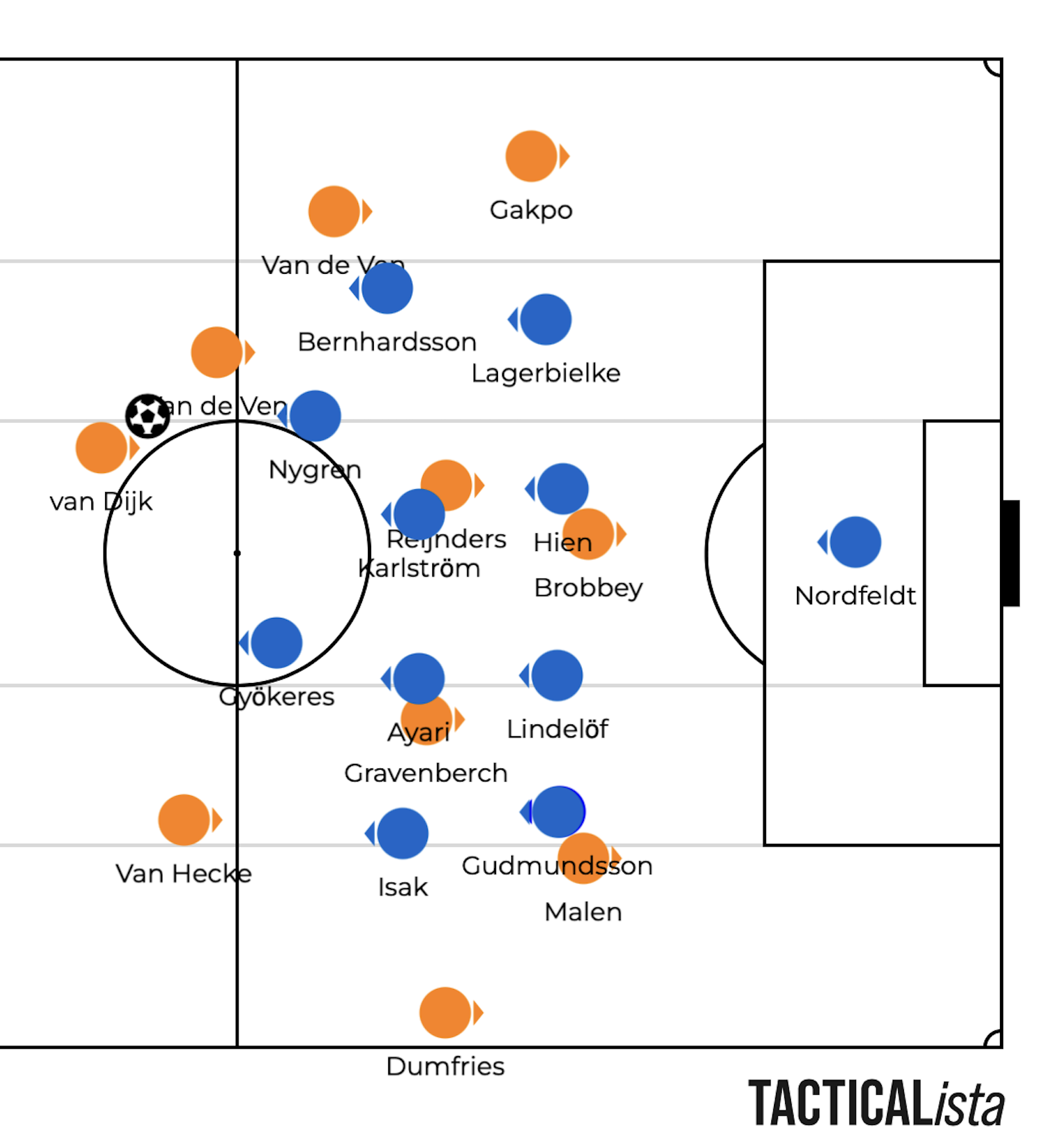
Shortly after the tactical break, Sweden very clearly operating in a 4-4-2 setup in medium block defending.
Defensively, Bernhardsson began operating much higher up the pitch, creating a more active 4-4-2 setup whenever Sweden sought to engage the Dutch buildup. When forced deeper, Sweden could still retreat into a back five, but the overall picture became far more flexible.
The more significant change occurred in possession. Sweden started using Gudmundsson in deeper positions during buildup, creating uncertainty in Dutch pressing references. The previously clean three-versus-three pressing scheme became increasingly difficult to execute. Malen, Dumfries and the midfielders were no longer always sure who should step out and who should hold position.
As a consequence, Sweden began finding players between the Dutch lines.
One transition attack shortly before the half-hour mark illustrated the change. A single Dutch turnover allowed Sweden to combine through midfield with one- and two-touch passing before the move eventually fizzled out. Similar situations followed. The Dutch front line still attempted to press, but the distances behind them gradually increased, allowing Sweden to progress through midfield more comfortably.
The momentum of the match shifted.
While the Netherlands still looked dangerous whenever they established longer spells of possession against Sweden’s deeper block, they no longer controlled the overall flow of the game. Sweden repeatedly reached advanced areas, generated several dangerous situations and even had an indirect free-kick goal ruled out for offside shortly before half-time. Verbruggen was increasingly called into action.
The scoreline remained favourable for the Netherlands, but the tactical picture looked considerably less comfortable than it had twenty minutes earlier.
Koeman restores control
Koeman’s response arrived immediately after the interval. Malen, whose role had become increasingly problematic once Sweden altered their structure, was replaced by Crysencio Summerville. The substitution proved decisive almost instantly. Within two minutes of the restart, Summerville isolated his defender, produced a clever piece of skill and released Dumfries on the overlap. The resulting low cross reached Gakpo at the far post, who converted for 3-0.
The goal highlighted something that had been missing from large parts of the first half: genuine one-versus-one threat from the wing.
The Netherlands also appeared to defend differently after the break. Reijnders increasingly joined Brobbey in the first line, creating a more obvious 4-2-4 pressing shape. The pressing references became clearer and Sweden found it more difficult to access midfield through the same routes that had caused problems before halftime.
Any hopes of a Swedish comeback were further damaged by the fourth goal. After Isak miscontrolled possession, De Jong regained the ball inside his own box and released Gravenberch. The Liverpool midfielder then demonstrated his outstanding ability to resist pressure before finding Summerville. The substitute accelerated the attack and supplied Gakpo, who drove inside and finished into the near corner.
The sequence combined individual quality with structural superiority. Sweden’s defensive organisation was beginning to stretch, while the Netherlands possessed too much technical quality in decisive moments.
Quality finishes the job
Potter attempted another response through a triple substitution, introducing Anthony Elanga, Lucas Bergvall and Zeneli. Sweden immediately found a reward.
A slightly misplaced pass from De Jong under pressure triggered a rapid transition. Isak released Elanga with a perfectly weighted through ball and the substitute calmly reduced the deficit to 4-1. A goal that served as a reminder that Sweden still carried genuine attacking threat whenever they could attack space quickly.
Koeman withdrew both De Jong and Reijnders, in a double substitution that had already been prepared before Sweden scored, with De Jong managing a minor knee issue. Guus Til and Teun Koopmeiners entered the game, providing fresh energy and improved control through renewed pressing energy.
As intensity naturally faded, the Dutch pressing shape gradually settled into something closer to a 4-4-2 shape. Whether through game management, fatigue or simple scoreline logic, the final thirty minutes were played at a considerably slower tempo. Memphis Depay later replaced Brobbey, while the Netherlands increasingly controlled possession through longer circulation phases. Gravenberch continued carrying the ball through pressure and Koopmeiners added variation with his passing range. Sweden’s earlier momentum had disappeared.
Summerville eventually provided the final flourish.
Dropping into midfield to participate in a combination, he continued his run through the centre as Memphis combined with teammates around him. The resulting third-man sequence released the substitute beyond Sweden’s midfield and defence, allowing him to finish low into the corner and complete the scoring. Fittingly, the final goal echoed one of the game’s central themes: forward runs from midfield and advanced areas attacking beyond the striker line.
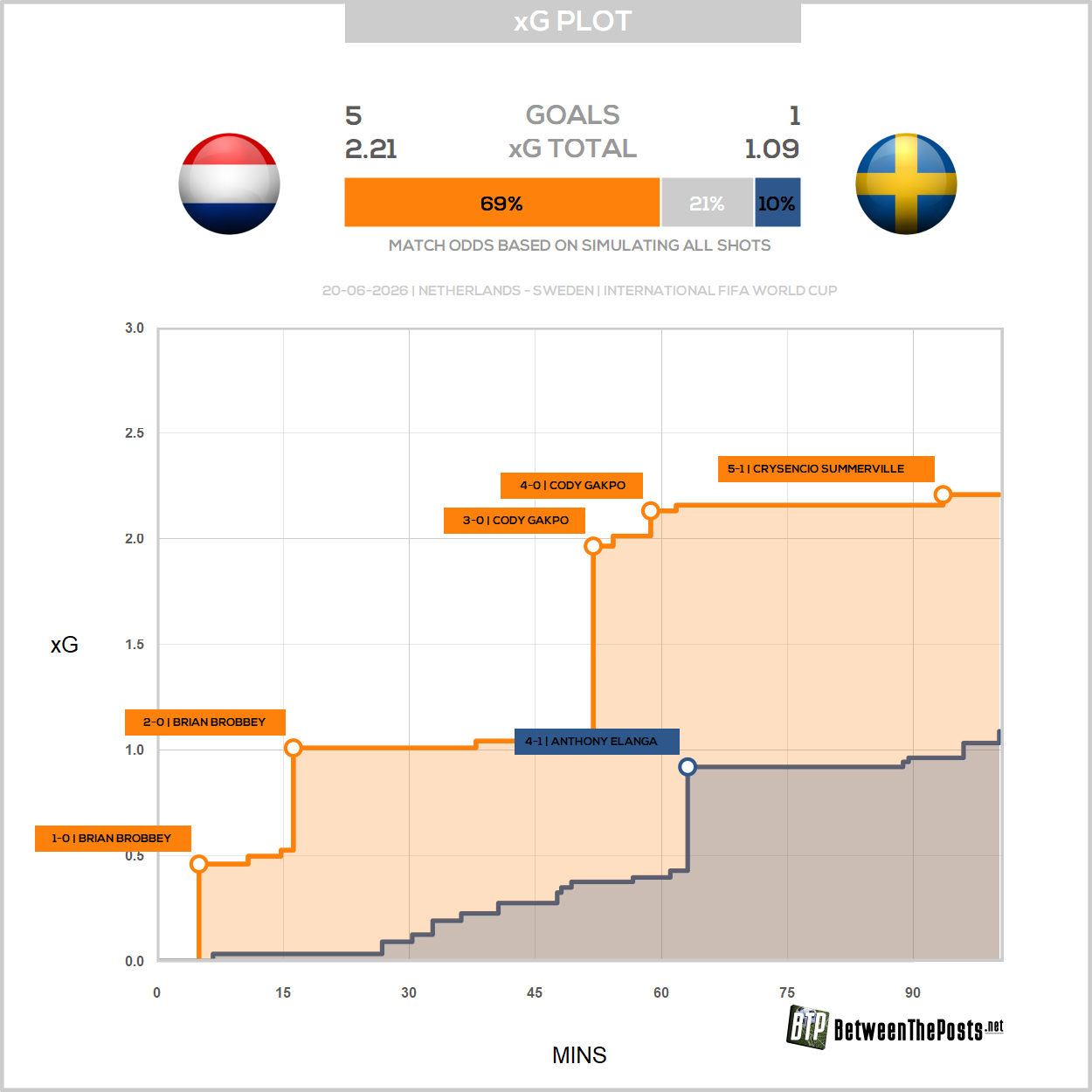
Takeaways
The Netherlands solved several of the attacking problems that had limited them against Japan. The inclusion of Brobbey provided a genuine focal point, the midfield offered far more penetration through aggressive runs, and the overall attacking approach carried considerably more vertical intent.
At the same time, Sweden’s adjustment around the cooling break exposed vulnerabilities that stronger opponents may punish more effectively. Once the Dutch pressing references became unclear, the distances between lines increased and Sweden repeatedly found ways into midfield.
The most encouraging aspect for Koeman was therefore not the scoreline itself. It was the fact that, unlike against Japan, his team found solutions during the match. Potter changed the game. The Netherlands responded. Then they responded again.
That ability to adapt may ultimately prove more valuable than the five goals.
We decided to make this article free to read. If you want to support our work, consider taking a subscription.
Use the arrows to scroll through all available match plots. Click to enlarge.
Check the match plots page for plots of other matches.


Comments