

Olympique de Marseille – Liverpool: All Too Comfortable At The Stade Vélodrome (0-3)
Olympique de Marseille had already claimed one scalp from the Premier League when they defeated Newcastle United in November, but Liverpool would prove to be tougher opposition on a bruising night for the French side. Dominik Szoboszlai would give Liverpool the lead on the stroke of half-time, and while Marseille came out with more purpose in the second half, Arne Slot’s men made easy work of light resistance.
Tactical analysis and match report by Nick Hartland.
We decided to make this article free to read. If you want to support our work, consider taking a subscription.
The focus in the build-up for Olympique de Marseille was on their attacking threat. Roberto De Zerbi’s side, despite sitting only third in Ligue 1, have scored the most goals in the league. It was a rout on the weekend as they beat a usually stubborn Angers SCO 5-2 away from home. In fact, a fifth of the goals Angers have conceded in the league came in that match.
For Liverpool, the focus was less flattering. The reigning Premier League champions slipped up again on the weekend as they drew 1-1 to relegation candidates Burnley. Liverpool are well off the pace in the league, with their dreams of retaining their title long faded. However, in the UEFA Champions League, results and performances have been far more consistent.
De Zerbi would line his side up in a 4-4-2 formation. Gerónimo Rulli started in goal behind a backline of Michael Amir Murillo, Facundo Medina, Leonardo Balerdi, and Benjamin Pavard. In midfield, Pierre-Emile Højbjerg and Geoffrey Kondobia, with Hamed Traorè and Timothy Weah as wingers. Up front, Mason Greenwood joined Amine Gouiri.
Arne Slot would stick to a 4-3-3 formation. Alisson Becker in goal with Milos Kerkez, Virgil van Dijk, Joe Gomez, and Jeremie Frimpong as his back four. Alexis Mac Allister, Ryan Gravenberch, and Dominik Szoboszlai would make up the midfield. In attack, Florian Wirtz started on the left with Hugo Ekitike as the number nine, on the right, Mohamed Salah returned from AFCON.
More risk than reward for Marseille
Marseille wanted to do as they usually do under De Zerbi when given the opportunity to play against a team that doesn’t set out to defend in a passive low block. They looked to bait Liverpool into pressing high up the pitch, with the objective being that as the red shirts rushed forward to close down the ball, space would open up behind them for Marseille to theoretically exploit.
On paper, Marseille are at their most dangerous in that moment when they switch tempo and exploit the press. This has been the high risk high reward tactic that has often underpinned De Zerbi’s success, both in Brighton and in the south of France. But in practice, it was more risk than reward on the night, with Marseille struggling to execute their plans.
Marseille recycled possession between the center-backs and the double pivot with quick interchanges of lateral and backwards passes. Liverpool would take the bait, with Szoboszlai often leading the press as the first line of engagement. As this was happening, Marseille looked to create a bit of chaos within Liverpool’s defensive ranks further up the pitch with lots of positional rotation, putting attackers in unexpected positions to open up new avenues to attack.
Greenwood would drop deep, looking for pockets of space, like in the victory over Newcastle, with the aim being that he could either turn and release the other forwards or he could carry the ball and drive at the defense. With one of Højbjerg or Kondogbia dropping into the backline, Pavard was freed up to roam forward and attack the halfspace deserted by Greenwood.
Greenwood’s threat meant that Mac Allister was always tracking him, while Gouiri could drag Van Dijk wide, creating a gap for Pavard to attack. However, the fullback’s unexpected movement appeared to confuse not only Liverpool but also his own teammates, and they rarely pulled the trigger at the right time when he entered these promising areas.
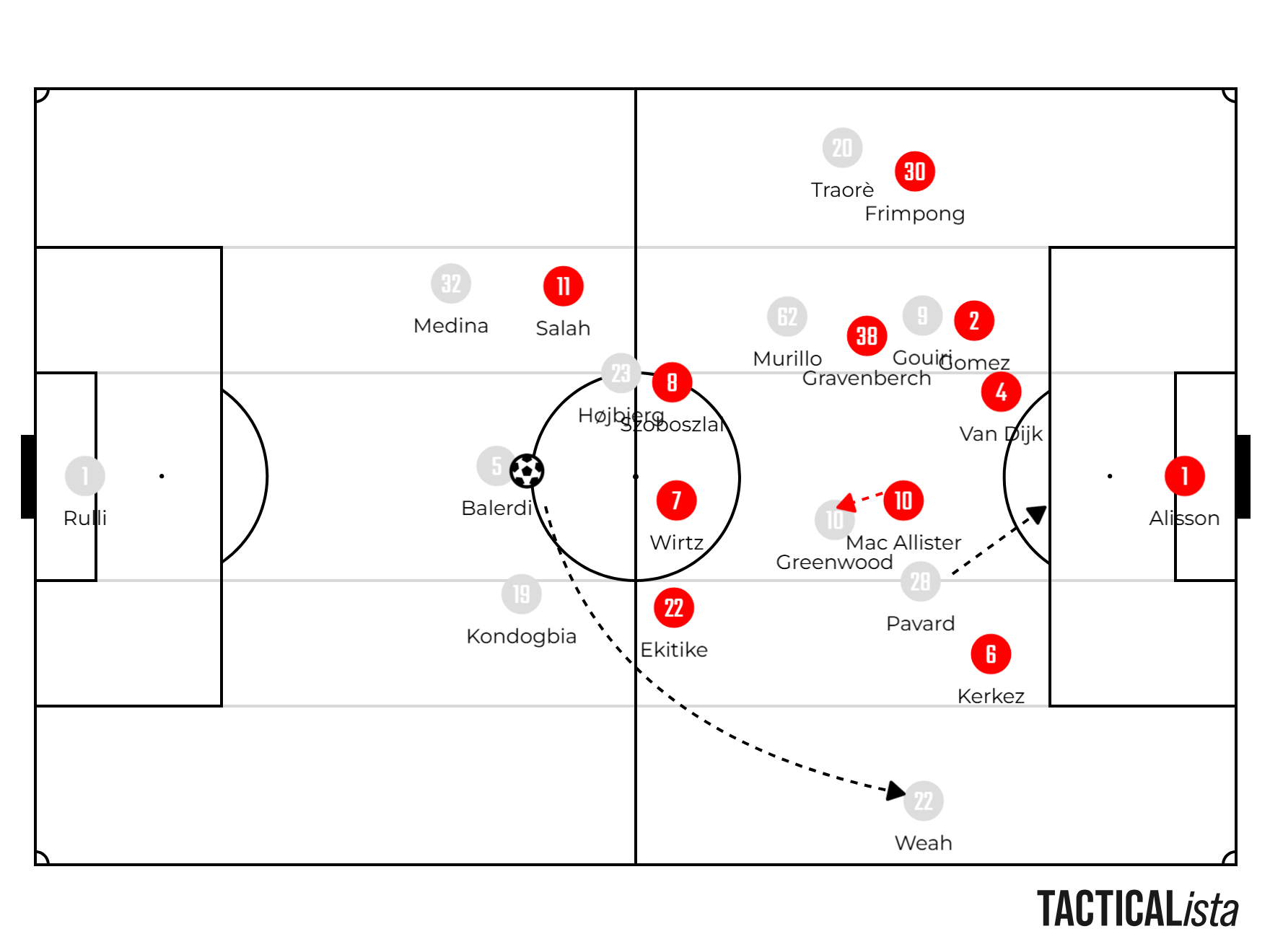
8th minute: Marseille’s build-up with positional rotation. Greenwood looks for deep pockets of space, drawing Mac Alister. Gouiri goes wide, attracting Van Dijk. Kondogbia drops into the backline, freeing Pavard to attack the halfspace left by Greenwood’s movement. Balerdi could pull the trigger and find Pavard, but he goes wide to Weah.
No possession? No problem!
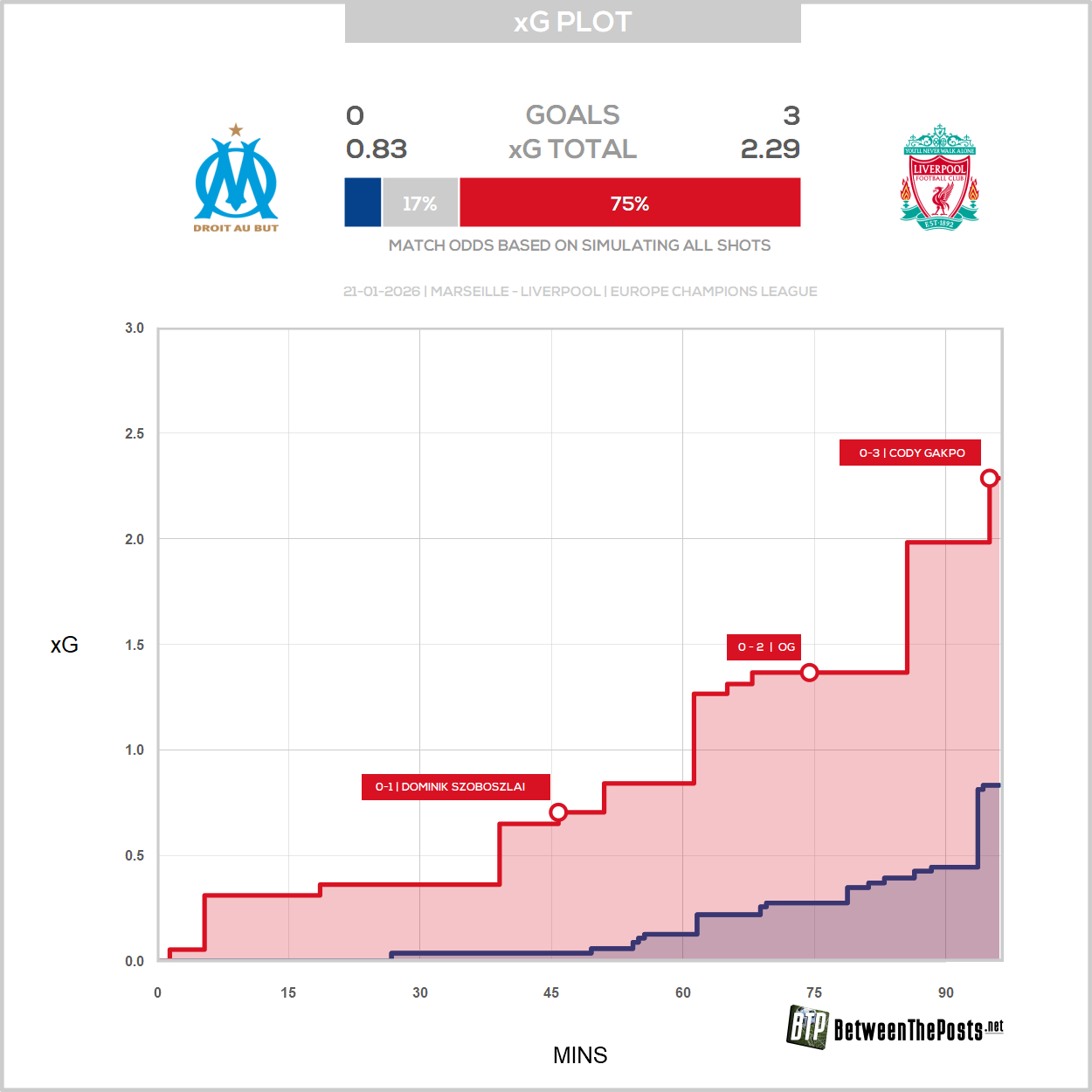
Liverpool had far less of the ball than might have been expected. In the Premier League, they’ve averaged around 61% possession, but against Marseille, they registered their second-lowest season total across all competitions, recording only 42% possession. However, when they took control of the ball, they looked the far more convincing side.
When building from deep, Slot wanted his side to focus their attacks through the center of the pitch in a 3-5-2/2-1-5-2 formation. They kept a narrow shape with the fullbacks, Kerkez and Frimpong, providing most of the width. Gravenbech, or more commonly, Mac Allister, would sit beside Van Dijk and Gomez to help bring the ball out from the back, before taking up a slightly more advanced anchoring role just ahead of the center-backs. The aim was to overload Marseille’s midfield with Wirtz also coming in from the left to help establish a diamond shape.
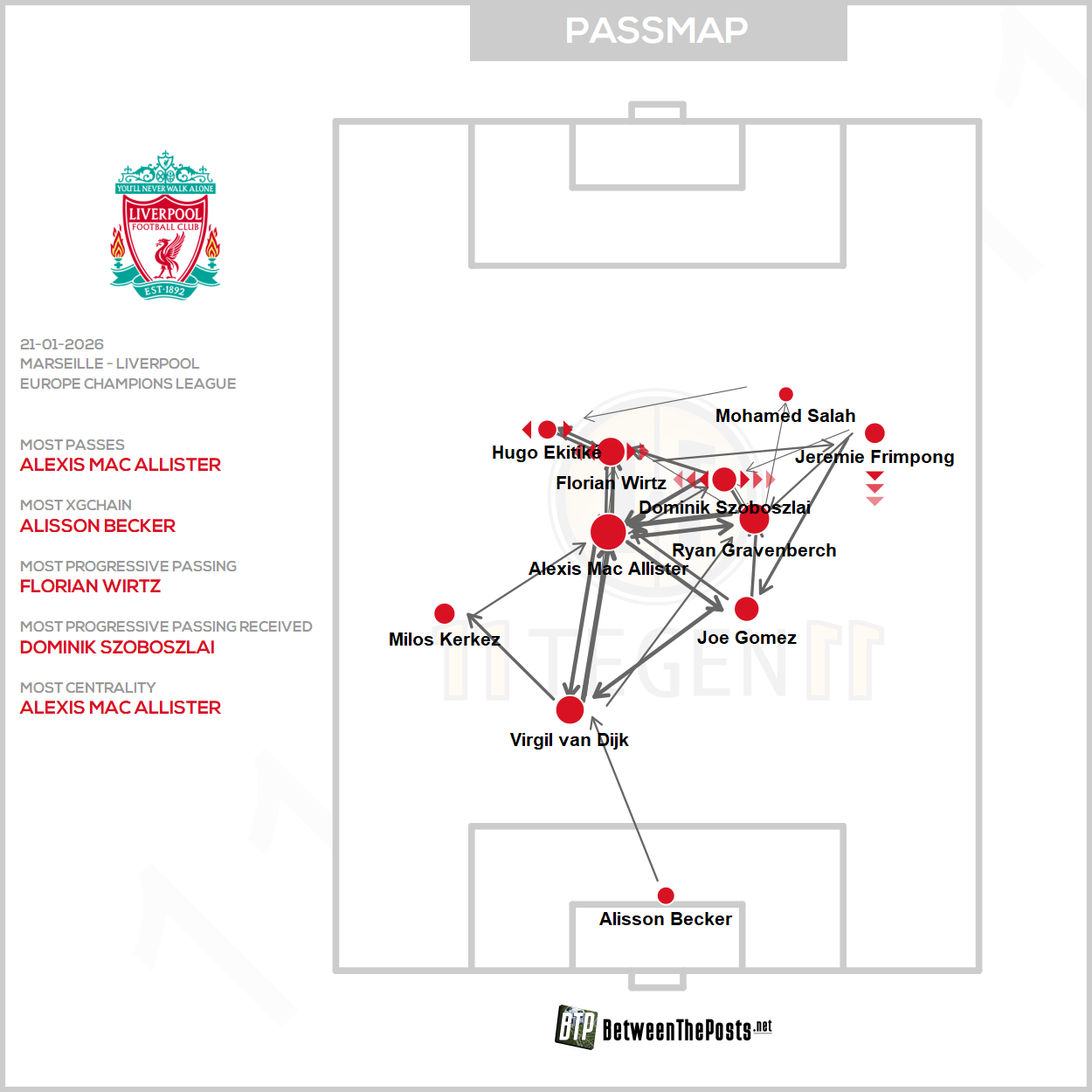
Marseille defended from a 4-4-2 formation, which could drop into a 5-4-1 when they were forced to defend closer to their box. In either of these shapes, Marseille had problems preventing Liverpool from playing line-breaking passes that bypassed their midfield. Liverpool found it a simple enough task to outnumber and manipulate Kondogbia and Højbjerg and then deliver a ball into advanced areas.
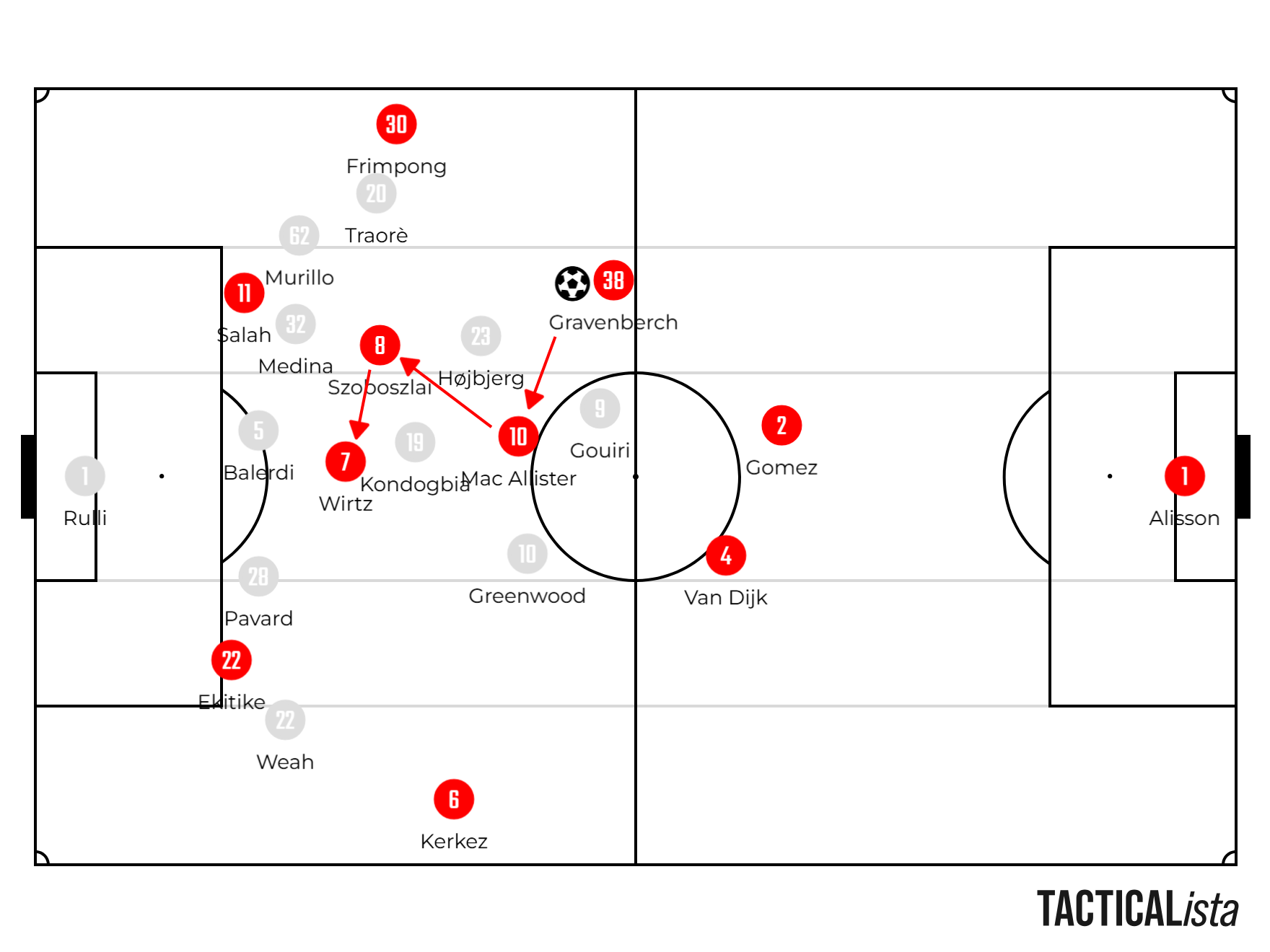
12th minute: Liverpool’s narrow attacking shape. Wirtz cuts in from the left to create a midfield diamond. Marseille are overrun in the center, with Liverpool able to work the ball through the lines of Marseille’s midfield two.
However, their greatest threat in the first half was in transition, where they instead embraced their width. They would look to force a mistake in Marseille’s build-up through consistent pressure. When Liverpool won the ball, they would look to break at pace down the wings and then hook a cross for Ekitke to attack. In the 23rd minute, this would result in the Frenchman putting the ball in the back of the net. However, it would be correctly ruled out as offside.
No matter, Liverpool’s superiority was on the scoresheet before the first half was over. Balerdi brought down Gravenberch outside the box, and after a lengthy wait for VAR to check a handball in the box, Liverpool lined up to take the free kick. Szoboszlai guessed correctly that the wall would jump up, and he shot low and underneath them. His freekick giving Liverpool the deserved advantage as they went into the break.
Liverpool turn the screw
Marseille had acted like obliging hosts for the first 45 minutes, and they came out in the second half with far more aggression and purpose, albeit with no better result. Greenwood and Højbjerg showed intention when they fired potshots from distance, but neither of their efforts truly threatened Alisson, who had a largely quiet evening. In general, the themes of the first half continued into the second.
Marseille struggled to protect the center of the pitch from Liverpool’s ability to find passes through the lines. And in the 59th minute, this almost resulted in the visitors doubling their lead when Liverpool scythed through the middle of the pitch, in a move that was ended with Ekitike hitting the woodwork. Less than twenty seconds later, Marseille would fail to score from their best chance of the evening when space opened up on the counter, with Greenwood setting up Traorè, who forced a save from Alisson.
It was somewhat telling that Marseille’s best moment of the night was the antithesis of the possession-oriented game that they had been playing. De Zerbi rolled the dice, making a proactive triple substitution with Pierre-Emerick Aubameyang, Igor Paixão, and Bilal Nadir replacing Gouiri, Traorè, and Kondogbia. However, minutes later, Liverpool would make it two with mistakes coming from Nadir and Paixão as Frimpong forced an own goal from Rulli.
It would be three before the end of the evening, as the substitute Cody Gakpo finished a passing move down the center of the pitch in the third minute of injury time. Liverpool had been dominant throughout, and they finally had a score that reflected that dominance.
Takeaways
It’s hard not to be disappointed with what was such a limp performance from Marseille, and the blame should be pointed towards De Zerbi, who didn’t really respond to Slot’s plans. De Zerbi can at times come across as a very inflexible figure who is loath to deviate from his initial gameplan even when it isn’t going well, and that was on display as Marseille were overrun in midfield from the first minute until the last.
Slot has come under pressure this season due to results, a situation made worse by Real Madrid’s decision to sack Xabi Alonso, leaving a manager whom the fans had wanted and had a connection to as a player as a free agent. If results allude Slot in the Premier League, he has at least been excellent in the Champions League. He surgically tore apart De Zerbi’s gameplan and left a rowdy Vélodrome deflated.
Use the arrows to scroll through all available match plots. Click to enlarge.
Check the match plots page for plots of other matches.


Comments