

Palmeiras – Botafogo: Palmeiras Prevail In The Battle Of The Brazilians (1-0)
Two of the teams that have turned heads away from Europe in the Club World Cup clashed in the first fixture of the knockout stages. But perhaps familiarity bred contempt: the two camps cancelled each other out for most of a match that was tight and tense but seldom a spectacle.
Tactical analysis and match report by Emmanuel Adeyemi-Abere.
We decided to make this article free to read. If you want to support our work, consider taking a subscription.
The Club World Cup has been an exercise cutting down European clubs to size on a global stage. South America has excelled and two of its best exports would clash in the knockout stages.
After winning against Al Ahly and peppering Porto everywhere but on the scoreline, Palmeiras pipped Inter Miami to the top spot in Group A. The Brazilian outfit scored twice in the last ten minutes of a 2-2 draw in the meeting between the two teams, taking pole position thanks to their better goal difference. Having gone to the final of this cup in 2021, they seek to try and repeat the feat.
In their way were another club from their country. Botafogo, who knocked Palmeiras off their throne in the Brazilian Série A, are the champions of South America and stunned their counterparts from Europe with a shock one-goal victory over PSG. Out of the blue, they were on the cusp of reaching the Round of 16— and they moved on from their group despite a 1-0 defeat to Atlético Madrid.
Renato Paiva put his faith in ten of the eleven players who started that loss. Gregore gave way to Danilo Barbosa as he operated with Marlon Freitas and Allan Marques Loureiro in the middle of the park. Alex Telles, formerly at Manchester United, was in the lineup as the left back. Vitinho bounced back from a thigh issue to be their right back. Recent signings Arthur Cabral and Joaquín Correa had to be content with places on the bench instead of as part of the front three that included Igor Jesus.
For Abel Ferreira, only four outfield players held onto their starting spots for Palmeiras. One of them was club captain Gustavo Gómez, whom Bruno Fuchs partnered to make up for the absence of Murilo, injured with a thigh strain. Emiliano Martínez and Allan Andrade Elias joined Richard Ríos in the midfield. All eyes were on Estêvão Willian, who has not scored in the tournament and is about to become part of the plans at Chelsea. Vitor Roque, a returnee from Europe, started as the striker.
Estêvão enters the imagination
As the Round of 16 kicked off, neutrals would have hoped for a carnival. What they would receive was something much more gritty. In the first three minutes, Alexander Barboza slid into a scissor tackle on Richard Ríos and earned a caution. Most of the first half would break up with fouls that interrupted the flow of the game and there was little goalmouth action to record in either box.
These two teams know each other well from their battles in Brazilian football. Paiva was content to contain the opposition and gain more momentum as time ticked away. Already against PSG, he found a successful strategy in sitting off with a 4-1-4-1 block to give up the ball and thrive on offensive transitions. The first half hour of the contest saw Palmeiras play with more intent to go forward.
Estêvão has established himself as an explosive threat with strong finishes from the right wing, but he switched sides for the start of this clash. With his willingness to make movements behind the defense and off of Vitinho, his side were able to stretch their opponents and push forward into the final third.
After ten minutes, he set away Joaquín Piquerez on the outside to pick out a delivery that flashed across the face of the goal, but Vitor Roque turned the ball wide of the post. The winger would then test the penalty area with a few crosses from set-pieces before the first cooling break of the match.
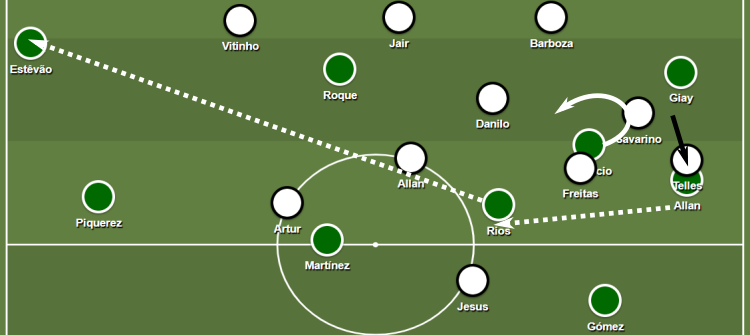
9th minute: offensive sequence from Palmeiras. Palmeiras mostly maneuvered the ball on the edges of Botafogo’s block. Here, Augustín Giay broke forward on the underlap and Maurício, who had rolled outside of the space between the lines, disappeared in the room behind Savarino and Freitas. Allan has to hold off Telles without any immediate support underneath him but once he passes to Rios, Maurício comes alive again and the midfielder manages to find the space to switch to Estêvão.
Botafogo break down repeatedly
Paiva’s players rotated out of their 4-1-4-1 formation on the ball. Both fullbacks detached from the buildup quite early and gave room for the midfielders to show for the ball. That meant Telles and Jesus, who stood on the left of the attack, were anonymous figures for most of the match.
In addition to the three midfielders, Jefferson Savarino slid centrally from the left. Most of the best ball sequences for Botafogo saw Freitas or Allan allow the ball to filter forward into the gap on the outside of Gómez. But more attempts broke down as the shot count clocked up for their opponents.
Estêvão ferociously fired two strikes at the target in the first five minutes after the restart. Palmeiras pulled back their line of engagement and continued to frustrate Botafogo. But the stalemate remained.
An explosive extra time period
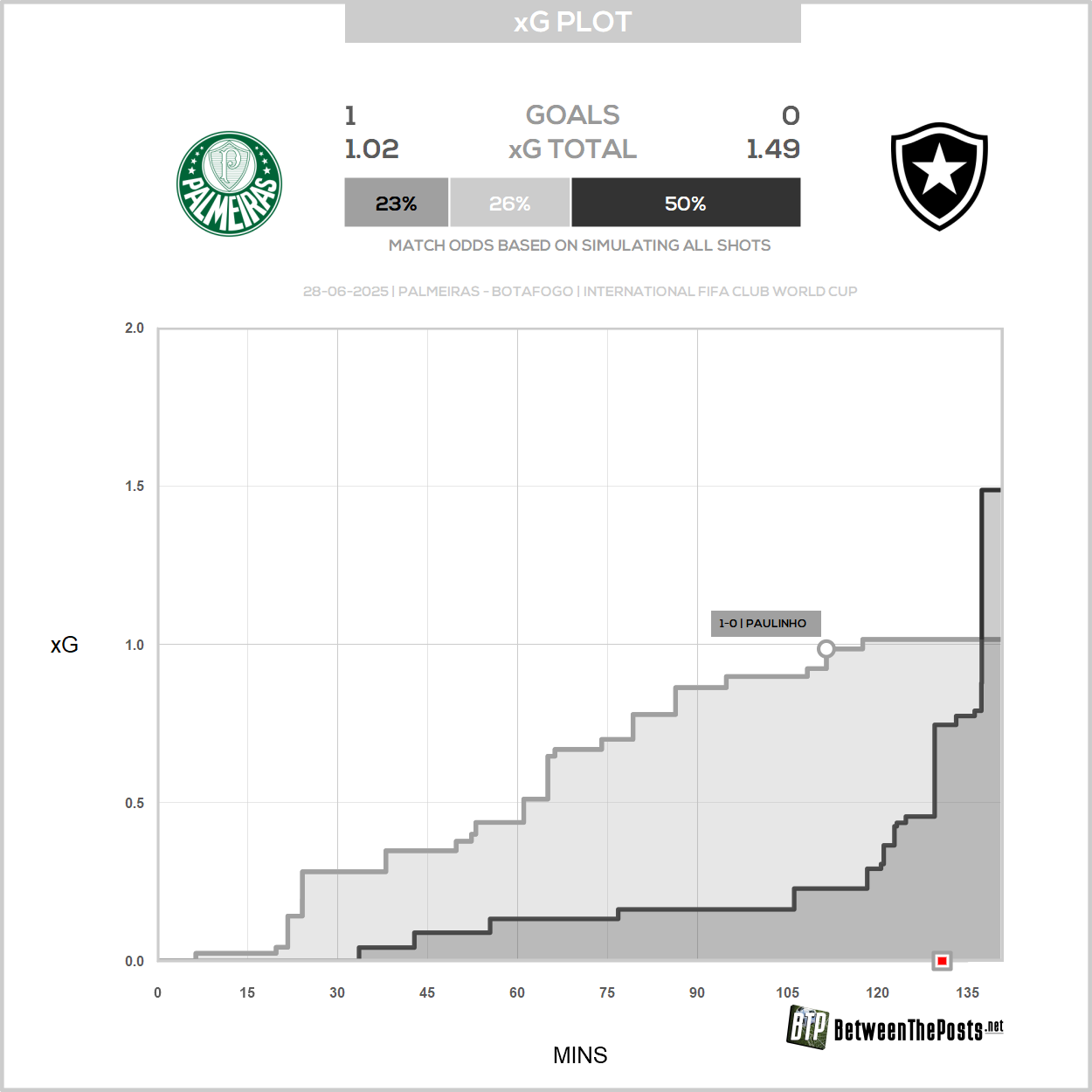
It would take a moment of individual quality to carve an opening. Paulinho was the man to pull the trigger. He shifted to cut away from Freitas, drove into the penalty area, and fired beyond John.
The breakthrough.@Palmeiras | #FIFACWC pic.twitter.com/VWDbgmCaud
— FIFA Club World Cup (@FIFACWC) June 29, 2025
At long last, Botafogo brought a phase of sustained pressure to the goal. Arthur Cabral came on for Freitas as an additional point of reference in the penalty area. Passes would be fizzed into the feet of the strikers, but the ball stuck most in the final third through two means: Correa carried from deep and tried to stimulate something for his side or it was a case of old-school slingshots from the flanks.
The best chance of extra time fell at the far post for Vitinho, who connected with a deep cross from Álvaro Montoro but could not hit the target. Palmeiras would survive, but not without any scars.
Gómez, who was already facing a suspension for the next round, grappled the shirt of Barboza. Their tussle took the attention of the referee, who paused the play, awarded a second yellow card to the captain, and gave him his marching orders. But bragging rights would still belong to the Verdão.
Takeaways
The Club World Cup has been a brilliantly unique stage to show how clubs from continents around the world are at a closer level than one might first think. However, in cases where clubs have already encountered each other, the action has typically been a little less exciting and this was no exception.
Botafogo are caught in the maelstrom of the John Textor saga and Paiva has paid the price for this exit with his job, parting ways with the club only days after the final whistle. He tried to gently ease his men into the match, and it would not have been the first time that he deployed a defensive strategy in this tournament. But when it came to cranking up the pressure, the onslaught arrived all too late.
Palmeiras play for more pride in the quarter final as they have the chance to avenge their 2-1 defeat in the final of the 2021 edition against Chelsea. In contrast to his counterpart, Ferreira has been at the club for over four years, enjoying calmness conveyed through his players on the pitch. The small switches in his plans put the brakes on Botafogo and they rightfully earned a spot in the next stage.
Use the arrows to scroll through all available match plots. Click to enlarge.
Check the match plots page for plots of other matches.


Comments