

Palmeiras – Cruzeiro: Title contenders disappoint those who expected a good match (0-0)
Cruzeiro had already fallen slightly behind, while Palmeiras managed to stay at the top of the table even after losing to Flamengo. Considering their league positions, a higher tactical and technical quality was expected, but the refereeing ended up standing out negatively on matchday 30, in a goalless draw.
Tactical analysis and match report by Marcus Arboés.
In the middle of last week, Palmeiras suffered a blow: they lost 3–0 to LDU, from Ecuador, in the first leg of the Libertadores semifinal. That result directly influenced some of the coach’s decisions during this match, as he made no concessions and fielded almost his entire starting lineup against Cruzeiro: Carlos Miguel in goal; Khellven and Jefté (former Rangers) as fullbacks; Gustavo Gómez (Paraguay National Team) and Murilo as center-backs; Bruno Fuchs playing as a defensive midfielder, Andreas Pereira (former Fulham) as central midfielder, Maurício and Felipe Anderson (former Lazio) on the wings; the attacking duo, once again, formed by Flaco López (Argentina National Team) and Vitor Roque (former Barcelona).
They faced Cruzeiro, coached by Léo Jardim, who came from a win over Fortaleza, trying to build a positive run after a stretch of poor results. The Minas Gerais side lined up, as usual, in a 4-2-3-1 outline, with the experienced Cássio in goal; William, Fabrício Bruno (Brazil National Team), Villalba and Kaiki forming the defensive line; Lucas Romero and Lucas Silva (former Real Madrid) as holding midfielders, Christian as right midfielder, and Matheus Pereira, the team’s key player, acting as the central playmaker; up front, Kaio Jorge (former Juventus) played as striker and Wanderson as left winger, soon replaced by Arroyo (Ecuador National Team).
No playmakers, no fun
The match between Palmeiras and Cruzeiro could have been much more interesting than it was. Abel Ferreira’s side had been performing well playing with a front two, but the recent heavy loss to LDU clearly had a mental impact. It’s even possible that their focus was more on the upcoming Libertadores match than on this Brasileirão fixture itself. On the other hand, it’s been a while since Leonardo Jardim’s Cruzeiro have shown attractive football. They had a run of disappointing draws, but after beating Fortaleza they managed to climb slightly up the table again.
Cruzeiro adopted a more reactive approach, waiting for Palmeiras, using open space and verticalizing their attacks. Palmeiras, in turn, tried more direct approaches, circulating the ball and switching sides to look for crossing opportunities. In the end, the main highlight was how both teams effectively protected themselves from the opponent’s playmakers. The individual matchups essentially neutralized Andreas Pereira and Matheus Pereira.
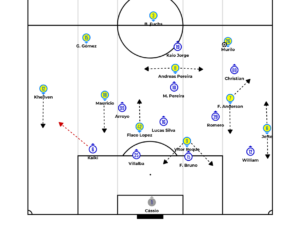
Palmeiras in possession in a 3-1-6 shape, with Bruno Fuchs dropping between the center-backs, Andreas Pereira as the only free man in the second line, marked individually by Matheus Pereira. Cruzeiro defended with compact horizontal spacing in a 4-4-1-1 shape.
When Palmeiras had the ball, they tried to attack through overlapping movements on the flanks, using fullback–winger pairs: Jefté with Felipe Anderson or Khellven with Maurício. The idea was to have an inverted-foot winger to cross or a fullback to make frontal deliveries or drag the marker to the byline. Andreas Pereira was responsible for circulation but was efficiently hunted by Matheus Pereira.
Cruzeiro’s double pivot alternated roles. While one stepped out to press the winger dropping inside, the other protected the half-spaces. Fabrício Bruno and Villalba covered the advancing fullbacks, stepping out to press when necessary. Those fullbacks, when Palmeiras quickly switched sides, detached from the defensive line to delay and mark the receiver, avoiding crosses, while the opposite winger (Christian or Arroyo/Wanderson) tucked inside to support.
The tight marking against Palmeiras’ positional attacks generated several fouls. As the home side pressed aggressively after losing possession, the match was constantly stopped, and the refereeing only made it worse. Overall, the key reason Palmeiras couldn’t create much was that Andreas Pereira was overloaded and lacked space, since there was no other interior midfielder. The coach opted for more players attacking the last line, supplied either by the former Fulham man or the center-backs.
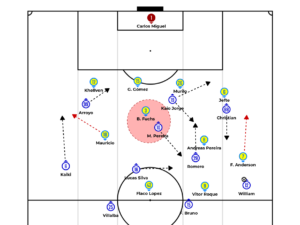
Cruzeiro attacking in a functional 4-2-3-1 formation, using midfielders at different heights and asymmetries between wingers and fullbacks. Palmeiras defending with individual matchups, with Bruno Fuchs marking Matheus Pereira individually.
Cruzeiro, on the other hand, sought quicker, vertical and counterattacking plays, starting from more relational attacks. Their buildup began wide, with the center-backs looking for fullbacks or holding midfielders. From a relational 4-2-3-1 shape, the team broke its structure to create connections near the ball. However, Palmeiras’ individual-oriented defending neutralized this very well.
Bruno Fuchs, improvised as a holding midfielder, followed Matheus Pereira even in longer chases, taking him out of the game at times. As a result, Cruzeiro’s number ten had to drop deeper alongside the holding midfielders or drift wide during positional rotations, losing much of his influence in buildup, which became heavily dependent on fullbacks and pivots.
Despite both defenses being effective at neutralizing danger, each side still created one or two finishing chances, mostly in the second half, even as the match turned more physical and direct.
Direct game and red card
For the second half, Abel Ferreira replaced Felipe Anderson with Ramon Sosa, looking for more inverted-foot crosses. Crosses and wide plays became the main theme of a half lacking inspiration. Palmeiras circulated the ball until they found a crossing angle, while Cruzeiro looked to transition or win second balls to attack quickly down the flanks. Both teams had good chances from wide play.
And that wasn’t the only common point between them in the second half. Neither Cruzeiro nor Palmeiras tried to build short from the back anymore. Goalkeepers opted for long kicks straight to the attacking half, forcing aerial duels, which slightly favored Palmeiras.
As time passed, Abel Ferreira had to rest some players. Of course, Palmeiras have a deep squad to replace quality with quality, but after deciding to take off Flaco and Vitor Roque, he brought on Bruno Rodrigues and Allan. It was Allan, in fact, who completely changed the match scenario. During a moment when Cruzeiro had two good chances, the youngster made an individual run full of dribbles and pace, forcing Fabrício Bruno to commit a foul and receive a second yellow card.
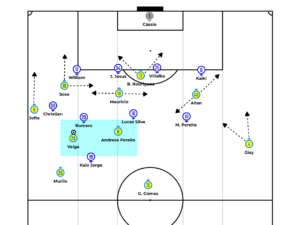
Final game scenario, with Palmeiras attacking in a 2-2-6 shape, having Veiga and Andreas as playmakers, against a Cruzeiro defending in a 4-4-1 formation.
If the match had been ugly but balanced before, the red card created a much more comfortable setting for Abel Ferreira to chase three points while resting key players for the Libertadores semifinal second leg. Both sides began making substitutions and tactical adjustments. Palmeiras’ coach replaced Khellven with Giay and reshaped the team by taking off Bruno Fuchs for Veiga, now having two playmakers.
In theory, that would solve the issue of Andreas Pereira being overloaded in buildup. However, with the red card, Cruzeiro switched to a 4-4-1 formation, with Matheus Pereira dropping into the second line. Defending in a compact, zonal, pressing structure, closing gaps and protecting width with excellent defensive balance, Cruzeiro managed to survive Palmeiras’ attempts, whose circulation became much more dynamic with two midfield creators.
Even with ten men, Cruzeiro almost scored in the final minutes through Kaio Jorge, but Carlos Miguel — perhaps the only true standout of the draw — made a miraculous save through superb positioning. Despite that, the feeling remains that Palmeiras dropped crucial points.
Takeaways
But there’s no time to dwell on it. Abel Ferreira’s side stumbled for the second straight time in the Brasileirão title race but have a final to play on Wednesday, facing a three-goal deficit on aggregate. A win in that clash could give them a significant confidence boost to aim for both trophies. If they advance, they would face Flamengo in the final — their direct rival in the domestic title race as well.
With yet another draw — their fourth in the last five matches — Cruzeiro drifted away from the title fight. Of course, there are still eight rounds left, but the five-point gap to the leader, with one extra game played, makes the coveted trophy look farther than it seems. Nonetheless, they’ll try to collect three points at home against Vitória next Saturday.
Use the arrows to scroll through all available match plots. Click to enlarge. Check the match plots page for plots of other matches.


Comments