
Palmeiras – Santos: Brasileirão leaders held in another derby, this time against Neymar-less Santos (1-1)
Palmeiras stumbled after drawing at home against Santos, one of their biggest rivals, on Matchday 14 of the Brasileirão. In the derby, Neymar was rested after refusing to play on the mixed synthetic pitch due to injury risk concerns. Without their star, Santos started Rollheiser as the playmaker and saw him deliver a footballing masterclass with a brilliant goal. In the second half, Palmeiras found the equalizer through top scorer Flaco López.
Tactical analysis and match report by Marcus Arboés.
With Abel Ferreira suspended, his assistant João Martins took charge from the touchline. However, the starting lineup had few surprises, with the usual core starters remaining, except for Allan’s absence. Carlos Miguel (former Nottingham) in goal; Khellven, Gustavo Gómez (Paraguay National Team), Murilo and the young Arthur Gabriel in the defensive line; Marlon Freitas and Lucas Evangelista as pivots, with Andreas Pereira (former Fulham) completing midfield; Jhon Arias (former Wolverhampton), Flaco López (Argentina) and Maurício (Paraguay) in attack.
Neymar has positioned himself strongly against the use of mixed synthetic pitches, believing they increase injury risk. In his race for a place at the World Cup, the Santos number ten was rested for the derby. Alongside other absences, Cuca made several changes: Brazão (former Internazionale) as goalkeeper; Igor Vinícius at right fullback and Escobar on the left; Lucas Veríssimo and Luan Peres as the center back pairing; João Schmidt and Oliva as pivots; Barreal on the left wing, Bontempo as right midfielder and Rollheiser (former Benfica) as the number ten replacing Neymar; Gabi (former Benfica and Inter) played as the number nine.
Proximity and verticality, Santos’ style
Santos have improved considerably regardless of results. That improvement is linked to the coaching change, which has maximized several players. Even without Neymar and Gustavo Henrique, the team managed to impose itself through a football based on proximity, using three technically gifted players, Barreal, Rollheiser and Bontempo, close together to create superiority, attract marking and verticalize attacks from a 4-2-3-1 relational/functional outline.
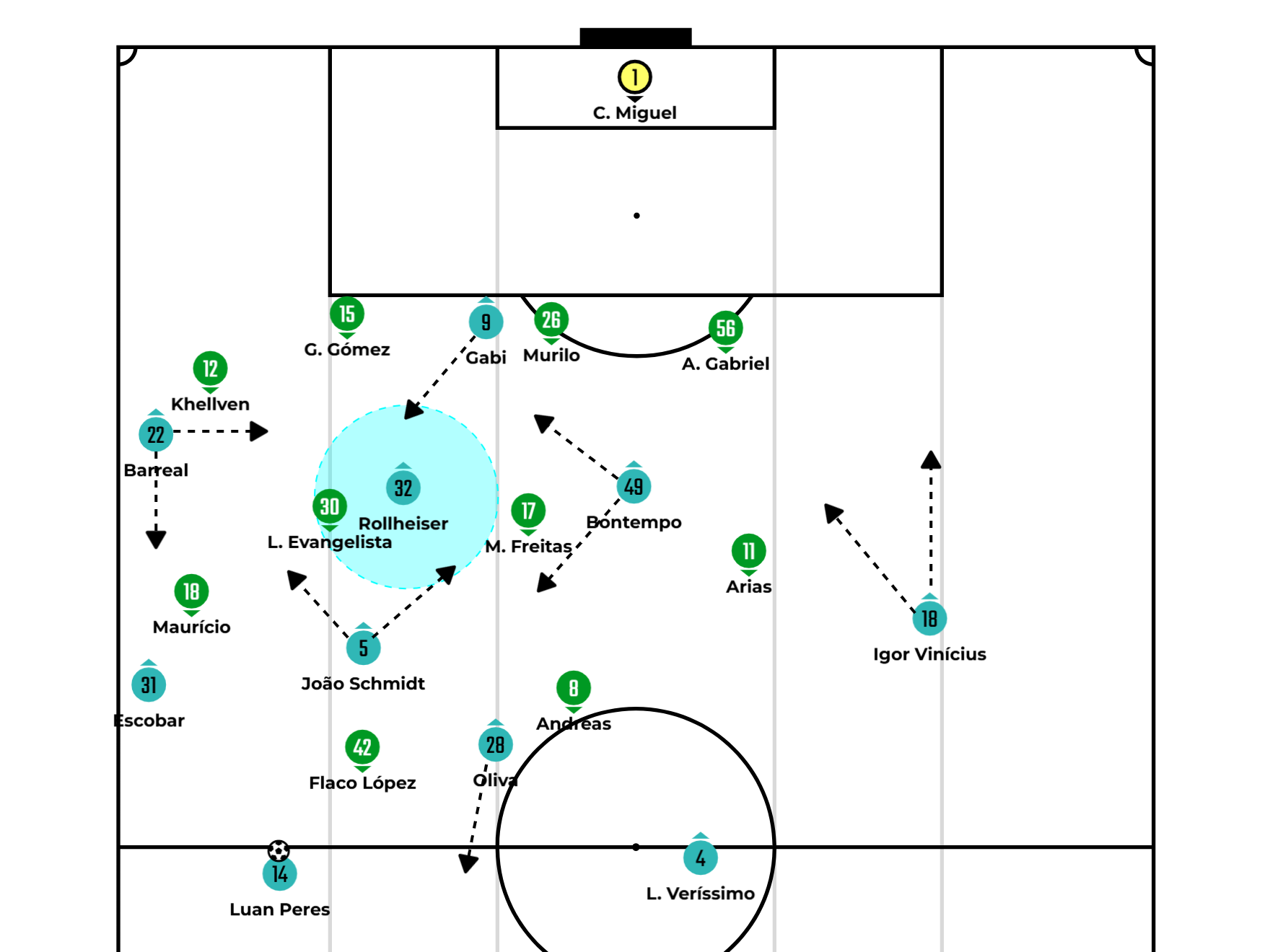
Santos relational/functional attack in a 4-2-3-1 shape, with Bontempo creating superiority on the opposite side.
During parts of the first half, Santos controlled possession very well, making excellent use of the double pivot at the base of build up, but especially through the support movements of Rollheiser and Gabi, dropping deeper to create superiority. Advantages were generated through proximity on the flanks, mainly with Bontempo, the right midfielder, drifting across the pitch to offer passing options on the opposite side, leaving the right side available for Igor Vinícius, who did not always provide width.
Palmeiras defended in a 4-4-2 formation and struggled at times with defensive references because of Santos’ fluid movements. Using support play to progress, the idea was to find Rollheiser, Bontempo, Barreal or Igor Vinícius arriving facing goal to shoot. This happened at least twice, but Santos’ best early moments came from build up in their own half following similar principles.
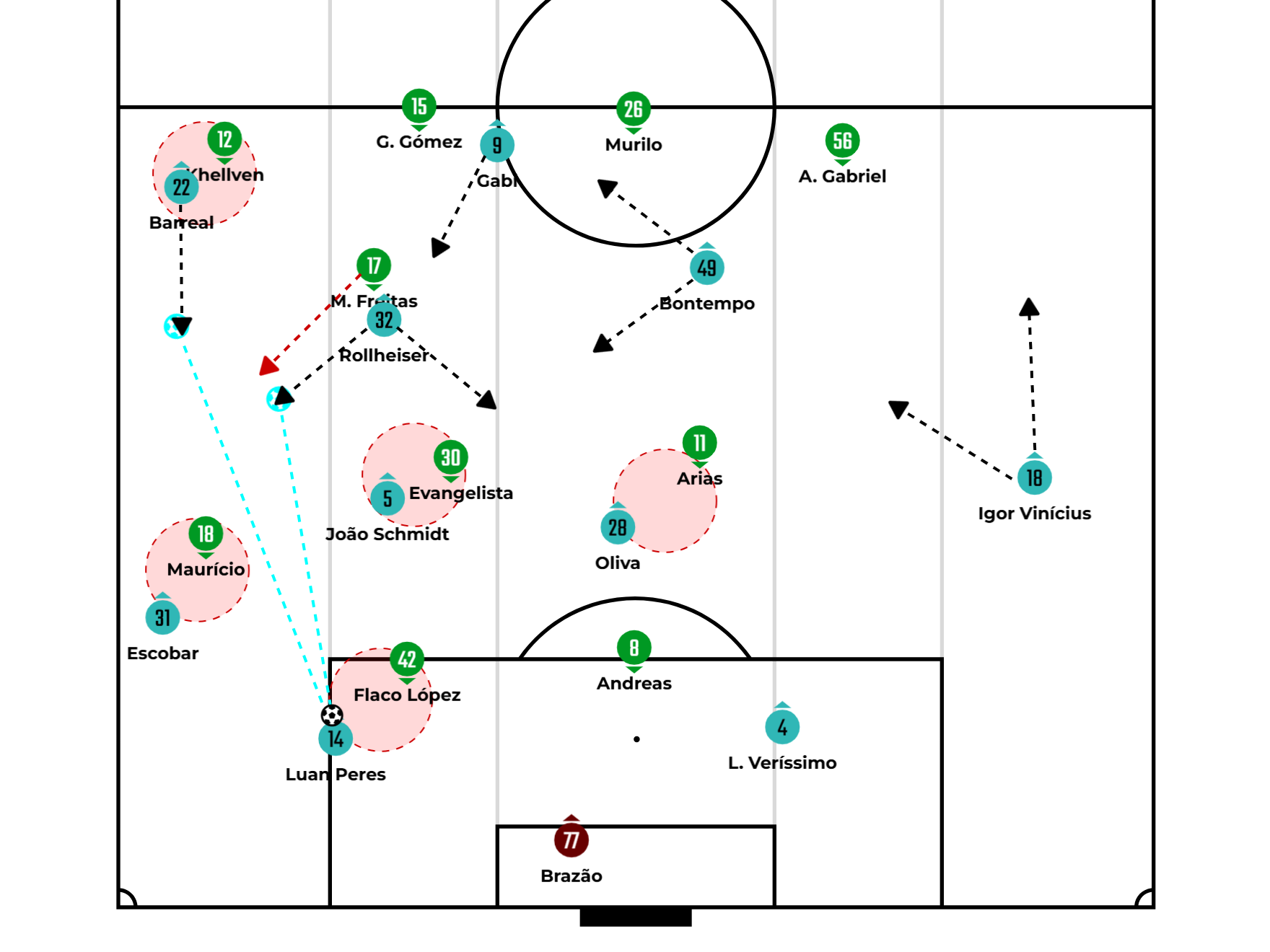
Santos build up in an asymmetric 4-2-3-1 shape against Palmeiras’ man oriented high press in a 4-1-3-2 formation.
The same principle of using frontal support and overloading one side asymmetrically to attack quickly and vertically also appeared when Santos built from deep under Palmeiras’ high press. The reason it worked was due to a gap in Palmeiras’ pressing structure.
The team pressed in a 4-1-3-2 shape, a global tactical trend. Andreas Pereira pressed alongside Flaco López in the first line, with Lucas Evangelista between the wingers. Marlon Freitas was responsible for protecting the space behind the second line, even drifting wide to defend the flanks, keeping the fullbacks in the last line. However, this approach leaves an inside gap.
If Marlon Freitas and the fullback protect the wide corridor, a central space opens up, which Bontempo exploited by drifting from the right into the opposite side behind the second line. This allowed the pivots and fullbacks to fix their man oriented references while the center backs attempted line breaking passes toward the support movements of Rollheiser, Bontempo, Barreal or even Gabi.
Gradually, Palmeiras adapted. In the second half, for example, the equalizer came from a turnover during Santos’ build up after an adjustment where Allan, replacing Khellven, pressed higher while Marlon Freitas protected the inside space more consistently. Before that, Santos had already scored a brilliant goal through Rollheiser following a counterattack from another counterattack situation.
Palmeiras’ offensive tactics
After conceding, Palmeiras created more offensive volume toward the end of the first half, concentrating almost all of their attacking organization around the technical quality of Marlon Freitas, operating from a 4-3-3 outline that in practice repeated positional structures seen in several previous matches.
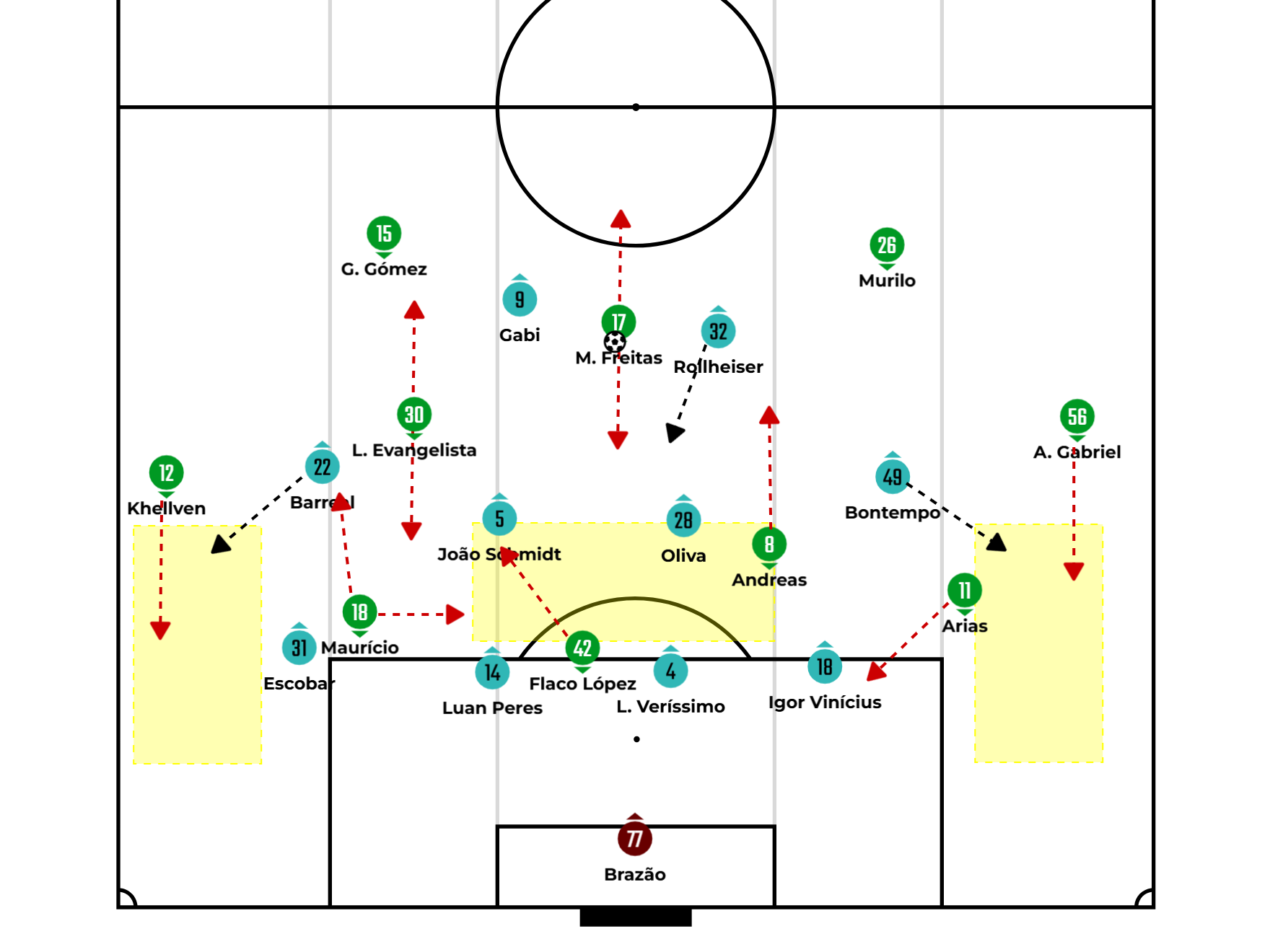
Palmeiras offensive organization in a 4-3-3 shape, looking for free spaces out wide or between Santos’ defensive lines.
Against Santos defending in a low block, build up started with the center backs, usually with a pivot positioned between them, varying heights to receive, mainly Marlon Freitas, who was responsible for orchestrating the attacking organization. He controlled switches of play and circulation while also arriving as a shooting option at the edge of the box.
When Palmeiras could not find space, they circulated the ball from side to side using the pivots, especially Marlon Freitas, to find the opposite fullback. Since Arias, the left winger, dragged defenders inside, Santos’ compact 4-4-2 block often left the far side open. This allowed the fullback to receive wide for crosses or even move inside to shoot.
However, Palmeiras’ main attacking patterns came when Andreas Pereira and Lucas Evangelista dropped or advanced within their channels following positional logic, while the three forwards dropped into central corridors and rotated among themselves to manipulate Santos’ defensive lines. This allowed Palmeiras to use players in the half spaces or wide corridors as support for Marlon Freitas arriving behind Santos’ pivots to shoot.
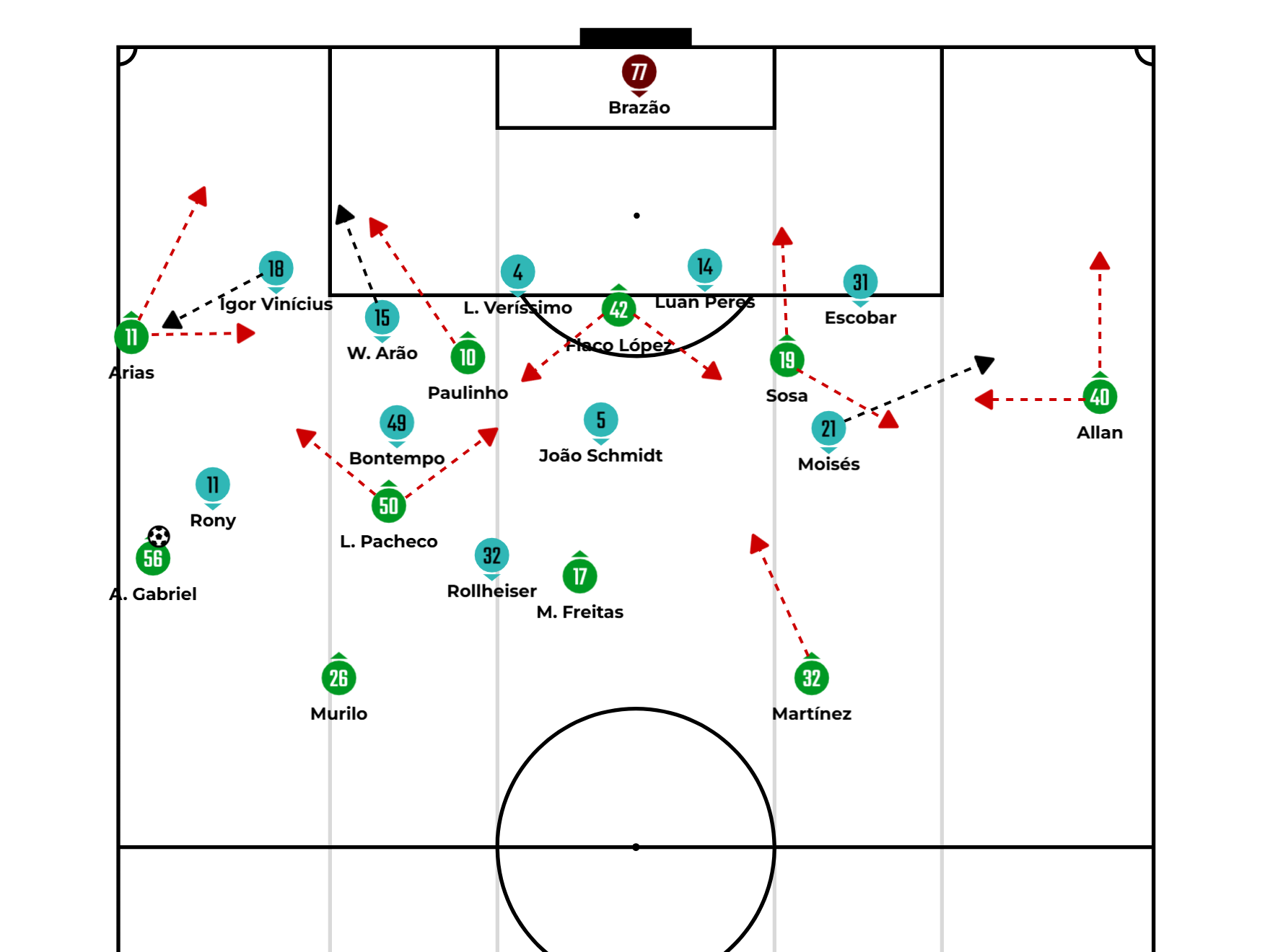
Second half scenario after key substitutions, with Palmeiras attacking in a 2-3-5 shape and Santos defending in a 5-4-1 formation.
Despite their attacking volume late in the first half, Palmeiras missed three major chances. In the second half, the decision was to remove Khellven and bring on Allan, replacing a right fullback with a natural right winger, making the team even more offensive. Although Allan directly contributed to the equalizer, Santos still created clearer chances beforehand, mostly from transitions, and failing to extend the lead proved costly.
After that, Palmeiras removed one pivot, Lucas Evangelista, for attacker Sosa. Andreas Pereira dropped deeper into midfield and the team concentrated more players on the left, pushing the last line higher. In response, Cuca introduced Willian Arão, who can also play as a center back. Beyond improving counterpressing recoveries, he started dropping into the last line to track attackers moving centrally, covering the right fullback’s pressing movements and almost forming a low block 5-3-2 formation.
Later, Palmeiras replaced Maurício with Paulinho (former Leverkusen), returning from injury, and improved their duel winning capacity by replacing Andreas Pereira with the young Luís Pacheco. Minutes later, they took even more risks by removing center back Gustavo Gómez for pivot Martínez. Against an even more attacking Palmeiras, Cuca had to react, as Rollheiser and Gabi were no longer contributing enough defensively.
Rollheiser stayed more protected, while Barreal was replaced by Moisés on the left wing and Rony entered on the right, moving Bontempo inside. Later, this changed again when Zé Rafael replaced Bontempo to strengthen defensive power even further. The match became very scrappy, with Palmeiras trying to overload the left side to finish attacks through crosses or circulate until someone could shoot facing goal. They even scored late on, but the goal was disallowed for handball.
Takeaways
Despite the draw, Palmeiras maintained a six point lead over second place because none of the top six teams managed to win during the round, making it a weekend dominated by teams near the bottom of the table. Still leading the Brasileirão, Palmeiras will next face Remo, who are currently in the relegation zone.
Santos will count on Neymar’s return next round against Red Bull Bragantino. After drawing with the league leaders, which is an excellent result, the team managed to stay 16th, outside the relegation zone. But while Neymar continues his individual race to prove his physical and technical condition for the World Cup, the team still needs to transform technical improvement into positive results.
Use the arrows to scroll through all available match plots. Click to enlarge. Check the match plots page for plots of other matches.


Comments